

Best Hydroponic System for Beginners UK: The 2026 Starting Guide
The average British spare room can produce enough fresh greens to save a household over £415 a year on supermarket bills without ever touching a bag of soil. If you're searching for the best hydroponic system for beginners uk, you've likely felt put off by £800 price tags or technical jargon that makes growing look like a chemistry degree. It's common to worry that a small UK flat doesn't have the space or that rising electricity prices will make your hobby too expensive to maintain.
We've tested the latest 2026 equipment to find setups that deliver professional results on a budget. Growing at home shouldn't be a gamble. You'll discover how to set up a low-maintenance garden that uses 90% less water than traditional pots while fitting perfectly into a kitchen corner. This guide compares the most reliable kits for 2026, focusing on energy efficiency and ease of use to ensure your first harvest is a success. We'll show you exactly which systems offer the best value for money so you can start growing today.
Key Takeaways
- Understand how soil-free growing overcomes the UK’s short gardening season to produce high-quality yields year-round.
- Compare the top entry-level methods to identify the best hydroponic system for beginners uk based on simplicity and growth speed.
- Calculate your exact running costs and see how 2026 LED grow lights significantly reduce electricity bills compared to older HPS systems.
- Follow a professional setup checklist to ensure your pH levels and nutrient concentrations are perfectly balanced for maximum plant health.
- Access the UK’s lowest prices on complete starter kits with the convenience of rapid nationwide delivery or local click-and-collect.
What is the Best Hydroponic System for Beginners in the UK?
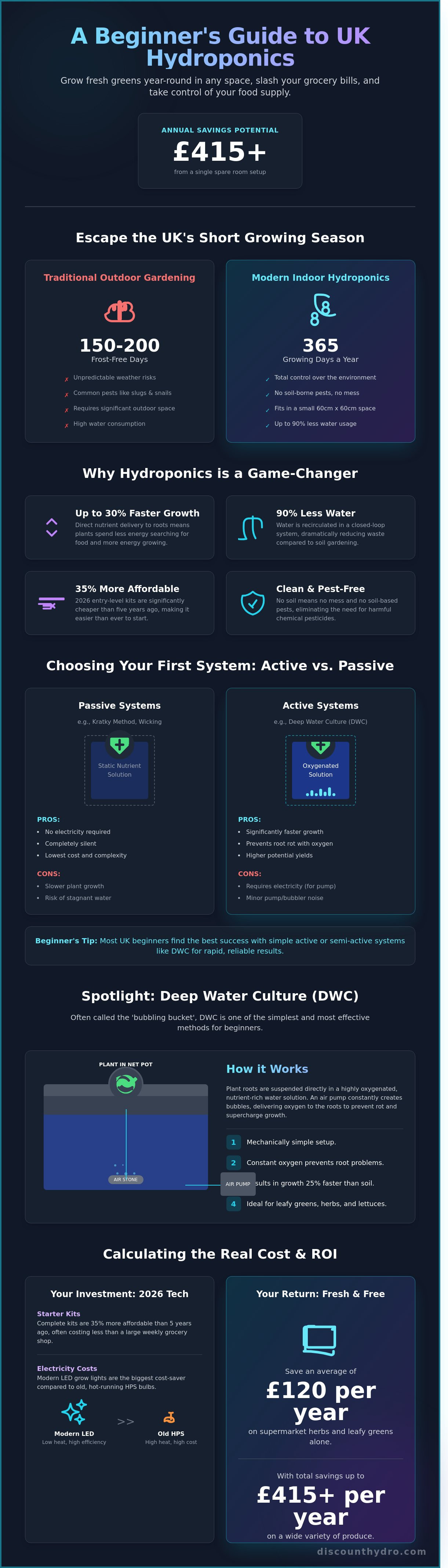
Hydroponics is the practice of growing plants in a nutrient-rich water solution instead of traditional soil. By delivering minerals directly to the root zone, plants don't waste energy developing massive root structures to search for food. This efficiency results in growth rates up to 30% faster than soil-based gardening. For anyone looking for the best hydroponic system for beginners uk, understanding this fundamental shift is the first step toward a successful harvest. The What is Hydroponics? overview highlights how these systems have evolved from ancient techniques into the high-tech solutions we use today.
In the UK, the gardening season is notoriously short and unpredictable. Most regions only enjoy 150 to 200 frost-free days annually, which limits what you can grow outdoors. Hydroponics changes the game by moving the environment indoors. By 2026, technology has advanced to the point where entry-level kits are 35% more affordable than they were five years ago. Modern systems now feature integrated LED lighting and automated pH sensors that were once reserved for commercial farms. This means you can start a high-yield garden in a spare room or kitchen corner for less than the cost of a weekly grocery shop.
New growers often struggle with the trade-off between ease of use and total yield. A very simple setup requires less daily maintenance but might produce smaller crops. Conversely, a high-performance system can triple your output but requires more technical monitoring. Finding the best hydroponic system for beginners uk involves choosing a kit that offers enough automation to prevent mistakes while remaining simple enough to manage without a degree in botany.
Active vs. Passive Systems: Choosing Your Involvement Level
Passive systems are the ultimate entry point for those seeking simplicity. Methods like the Kratky or wicking systems don't use moving parts or electricity. You fill a reservoir, and the plant drinks as needed. While these are silent and cheap, they offer slower growth because the water can become stagnant. Active systems use submersible pumps and air stones to oxygenate the nutrient solution. This extra oxygen prevents root rot and accelerates plant metabolism. Most UK beginners find the most success with semi-active hybrid systems. These kits use a simple timer to manage water flow, giving you the fast results of an active system without the complexity of a full-scale commercial rig.
The Benefits of Indoor Growing in the British Climate
Growing indoors gives you total control over the British weather. You won't have to worry about a sudden June frost killing your seedlings or heavy July rain saturating your soil. Indoor systems allow for 365 days of production. This is particularly useful for residents in urban areas like London, Manchester, or Birmingham where outdoor space is a premium. You can fit a productive herb garden into a 60cm x 60cm footprint in a flat or terraced house. 2026 data shows that indoor growers save an average of £120 per year on supermarket herbs and leafy greens. You also eliminate common UK garden pests like slugs and snails, which can destroy an outdoor crop overnight. It's a clean, efficient, and predictable way to ensure a constant supply of fresh produce.
- No Soil Mess: Perfect for flats and carpeted rooms.
- Water Efficiency: Uses 90% less water than traditional gardening.
- Space Saving: Vertical kits allow you to grow upwards, not outwards.
- Pest Control: Reduced need for chemical pesticides indoors.
While indoor systems offer great control, many gardeners still love the challenge and reward of a traditional outdoor space. For those looking to transform their exterior areas with professional help, firms like Helyers of Hampshire provide expert landscaping and design services, offering inspiration for beautiful gardens across the country.
Furthermore, growing without soil sidesteps concerns about ground contamination, a significant issue in many urban and former industrial areas. The professional analysis of soil and water pollution is a complex field, and for those interested in the environmental science behind it, specialist firms like HYDPOLL conduct the necessary hydrogeological studies.
Top 3 Beginner-Friendly Hydroponic Methods Compared
Selecting the best hydroponic system for beginners UK depends on your available floor space and how much time you can commit to daily maintenance. Most domestic UK setups utilise 1m x 1m or 1.2m x 1.2m grow tents, which comfortably house the three methods analysed below. Each system offers a different balance of growth speed and ease of use. While Ebb and Flow systems provide great versatility for larger 2.4m tents by flooding a tray at set intervals, they often require more technical setup than a novice needs. For those just starting, focusing on DWC, Auto-pots, or NFT ensures a faster learning curve and more reliable yields.
Deep Water Culture (DWC): The 'Bubbling Bucket' Method
DWC is often cited as the best hydroponic system for beginners UK because it's mechanically simple. Plants sit in net pots suspended over a 20-litre bucket filled with nutrient solution. An air pump and stone constantly bubble oxygen through the water. This direct contact allows roots to drink and breathe simultaneously, often resulting in 25% faster growth compared to traditional soil methods. It's a favourite because it has minimal moving parts and takes less than 15 minutes to clean between crops. However, you must monitor your environment. If your grow room exceeds 26°C during a UK summer, the water temperature can rise above 21°C. This reduces oxygen levels and can lead to root rot. Using a white bucket or adding reflective insulation helps maintain the 18°C to 20°C sweet spot.
Auto-pot Systems: The Low-Maintenance Champion
Auto-pots are the ultimate 'set and forget' entry point for new growers. This system is gravity-fed, meaning it requires no electricity for pumps or timers. A central reservoir, typically 47 litres or 100 litres, sits outside the tent and feeds individual modules via 6mm or 9mm pipework. An internal AQUAvalve controls the flow, only allowing more water into the tray once the plant has finished its previous drink. This wet and dry cycle mimics natural conditions perfectly. It's ideal if you work long shifts or can't check your plants every day. Understanding different hydroponic techniques is easier when you don't have to worry about power cuts ruining your crop. For the best results in an Auto-pot, use a 70/30 mix of coco coir and perlite. This ensures the medium doesn't become oversaturated. You can find several complete Auto-pot kits that fit perfectly into standard UK tent footprints.
NFT (Nutrient Film Technique) for Leafy Greens
NFT is the gold standard for enthusiasts growing lettuce, herbs, or strawberries. In this setup, a thin film of nutrient-rich water flows constantly over the roots on a sloped tray. Systems like the Gro-Tank GT204 are designed specifically for UK hobbyists; they're low-profile and fit easily into small cupboards or 60cm wide tents. Because the water film is shallow, roots have massive exposure to the air, which leads to incredibly lush foliage. The primary risk is pump failure. If the flow stops, roots can dry out in under 3 hours. Smart growers mitigate this by using a high-quality pump with a 2-year warranty or keeping a spare £15 pump on the shelf for emergencies. It's a highly efficient way to produce high-turnover crops with very little waste.
- DWC: Best for rapid growth and single large plants.
- Auto-pots: Best for power-free, silent operation and holidays.
- NFT: Best for space-saving and leafy green production.
Calculating the Real Cost: Electricity, Nutrients, and Gear
The biggest worry for new UK growers is the impact on the monthly electric bill. In 2026, energy prices remain a primary factor in any indoor setup. However, the shift from high-pressure sodium (HPS) to high-efficiency LED technology has slashed running costs by 40% to 60% compared to a decade ago. Finding the best hydroponic system for beginners uk involves balancing your initial equipment spend against these long-term operational savings. Cheap gear often costs more in the long run through wasted energy and frequent replacements.
Energy Efficiency in 2026: Running an LED Grow Room
A standard 200W LED light is the benchmark for a small home setup. If you run this light for 18 hours a day during the vegetative stage, it consumes 3.6kWh daily. At a projected 2026 UK average tariff of £0.28 per kWh, your daily cost is roughly £1.01. This totals about £30.30 per month. High-quality LEDs feature diodes with higher PAR output, meaning you get more growth per watt than cheap, unbranded alternatives. Using a digital timer to run lights during off-peak hours can reduce these costs by another 25% if you're on an Economy 7 or similar smart tariff.
Hydroponic Nutrients: Don't Overcomplicate the Feed
Beginners often waste money on expensive booster bottles that offer marginal gains. Your priority is a solid A+B base nutrient. These concentrated liquids provide every essential mineral your plants need. A standard 1L set of A+B nutrients typically lasts a single-system hobbyist 12 to 16 weeks, costing roughly £15 to £20. You must account for your local water profile. UK growers in London or the South East usually deal with hard water, requiring "Hard Water" specific nutrients to prevent mineral lockout. Conversely, growers in Scotland or Wales often need "Soft Water" versions to ensure enough calcium and magnesium reach the roots. For a broader look at setup requirements, check this Complete Guide to Hydroponics from BBC Gardeners’ World. It highlights why managing these inputs is vital for success.
pH management is the final essential cost. A basic pH testing kit and "pH Down" solution cost under £20 and last an entire year. Without these, your plants cannot absorb the nutrients you've paid for, leading to wasted resources and failed crops. Professional-grade pH pens are a better investment for those who want accuracy without the guesswork of colour charts.
To justify the upfront investment, use the Price-Per-Harvest metric. A mid-range kit costing £350 might seem steep, but when you calculate the yield of gourmet lettuce, chillies, or tomatoes, the system often pays for itself within 8 months. High-quality gear has a better resale value and lower failure rates. Investing in the best hydroponic system for beginners uk ensures you aren't replacing cheap pumps or flickering lights six months into your new hobby. Reliability saves more money than a low initial price tag ever will. Focus on the cost per gram of produce rather than the receipt at the checkout.
Setting Up Your First System: A Beginner's Checklist
You've picked your kit. Now you need to make it work. Success with the best hydroponic system for beginners uk depends on your environment as much as the hardware. Most UK growers start in a spare room or a garage. Each has pros and cons. A garage offers privacy but lacks insulation. In January, a garage grow will require a 120W or 240W tube heater to stop the nutrient solution from dropping below 18°C. A spare room is easier to keep warm; however, you must manage humidity to prevent peeling wallpaper or damp. Expect to spend £20 to £50 on floor protection like a heavy-duty flexi-tray to catch any accidental spills.
You cannot skip the secondary kit. If you don't measure your inputs, you're just guessing. You need a digital pH pen and an EC meter. A basic set costs around £30 and will save you from losing a £200 crop. Plants can't absorb nutrients if the pH is wrong. Keep a roll of blue paper towel and a set of measuring syringes nearby. Precision is the difference between a massive harvest and a bucket of dead roots.
Airflow is your best friend in a damp British climate. Stagnant air leads to mould and pests. You need an extraction fan with a carbon filter. This setup pulls fresh air over your plants and scrubs any odours before they reach the street. For a standard 1.2m tent, an 100mm or 125mm fan is usually sufficient. Ensure your intake vents are open to allow for passive airflow, keeping the tent under slight negative pressure.
Climate Control: Managing Temperature and Humidity
UK winters are cold and summers are humid. You need to hit the 21-26°C sweet spot for maximum growth. If your space drops below 15°C at night, your plants will stop growing. Use a simple plug-in thermostat to trigger a heater when the lights go off. Extraction fans are vital for more than just smell; they replenish CO2. Plants consume the CO2 around their leaves in minutes. Without constant air exchange, growth crawls to a halt. Aim for a total air change every 60 seconds.
Water Quality and pH: The Secret to Success
Most UK tap water is slightly alkaline. For hydroponic vegetables, pH 5.8 is the magic number. If your pH climbs above 6.5, your plants will suffer from "nutrient lockout" where they can't access the food in the water. Use 'pH Down' (usually phosphoric acid) to adjust your reservoir. Add it in 1ml increments; it is highly concentrated and can tank your pH levels instantly if you're reckless. Electrical Conductivity (EC) is a measure of the total dissolved salts in your water, acting as a direct gauge of your nutrient solution's strength. Keep your EC between 1.2 and 2.0 for most established plants.
The first 24 hours of operation are the most critical. Run your system with plain water first to check every joint, grommet, and hose for leaks. A small drip can turn into a flood in 6 hours. Check your pump's flow rate and ensure the water isn't getting too hot from the pump's motor. Once you're confident the system is watertight and the temperature is stable, add your nutrients and your plants.
Ready to start? Grab your essential grow room tools and get your environment dialled in today.
Why Buy Your Hydroponic Gear from Discount Hydro?
Selecting the best hydroponic system for beginners uk often feels like a choice between overpriced boutique brands or unreliable imports. Discount Hydro removes that headache. We promise the UK's best prices on every single entry-level kit we stock. We operate as a high-volume, low-margin digital warehouse; this means you get professional-grade hardware without the retail markup found in high-street shops. Our prices are frequently 15% to 25% lower than national averages because we prioritise stock turnover over high individual margins. We don't spend money on glossy showrooms or fancy marketing. We put that value back into your pocket.
Logistics shouldn't slow your progress. We offer fast nationwide delivery across the mainland UK, with 98% of in-stock items dispatched within 24 hours. Most customers receive their gear within a 48-hour window. If you're based in the North East, you can skip the shipping costs entirely. Our centre in Chester-le-Street, County Durham, provides a discreet and efficient click-and-collect service. You can order online and pick up your equipment the same day. This local reliability makes us a pragmatic choice for growers who need their supplies immediately to keep their plants healthy.
We understand the specific needs of the UK grower. Our climate and typical indoor spaces require equipment that's robust and efficient. We don't just shift boxes; we stock gear that's proven to work in British conditions. Whether you're dealing with a cold spare room or a tight cupboard space, our inventory is selected to handle those challenges. We're the direct, no-frills choice for people who want results rather than a lifestyle brand. Our focus remains on providing the tools you need to succeed at the lowest possible cost.
Beginner Kits Curated for Success
Our all-in-one starter bundles guarantee that every component is compatible. You won't find yourself with a pump that doesn't fit your tubing or a light that's too powerful for your tent. These bundles are designed to get you growing within 30 minutes of unboxing. We frequently update our sale section, where you can find essential hardware at 30% to 40% off RRP. It's the most cost-effective way to find the best hydroponic system for beginners uk without compromising on the quality of your reservoir or nutrients.
- Complete Compatibility: Every tent, fan, and filter is matched for optimal airflow and light coverage.
- Massive Savings: Our sale items allow you to build a professional-standard room for a fraction of the usual cost.
- Proven Results: We only bundle equipment that our staff have tested and verified for durability.
Expert Support and Local Reliability
Our Chester-le-Street centre isn't just a collection point; it's a hub of practical knowledge. If you're unsure about which nutrients to use or how to set up your extraction, you can get face-to-face advice from people who know the industry inside out. We stock only proven, reliable brands like Intense Nutrients and Omega Lighting. These manufacturers are staples in the UK market because their products don't fail when you need them most. We don't waste shelf space on unproven gimmicks or fad products. Everything we sell has a purpose and a track record of performance.
We've built our reputation on being the most straightforward supplier in the country. You get the right gear, at the right price, delivered on time. There are no hidden fees and no technical jargon to confuse you. We keep things simple so you can focus on your plants. Start your growing journey today with the UK's best value hydroponics shop.
Launch Your 2026 Indoor Garden Today
Picking the best hydroponic system for beginners uk requires a focus on ease of use and initial setup costs. Most new UK growers find that starting with a Deep Water Culture (DWC) system or a simple Ebb and Flow kit provides the most reliable results. You can typically get a high-quality starter kit operational for less than £120. It's vital to monitor your ongoing expenses; expect to spend roughly £7 to £12 per month on electricity and nutrients for a standard 1-metre tent setup. Following a strict checklist prevents common mistakes like forgetting your PH calibration fluid or essential clay pebbles.
Discount Hydro is the UK's leading source for affordable growing gear. We offer a best price guarantee on every major brand in our inventory. You'll benefit from fast UK-wide delivery on all orders. You can also choose click and collect from our County Durham warehouse if you need your supplies today. We make it easy to access professional-grade equipment without the premium price tag. Get your system set up this week and enjoy your first harvest sooner than you think.
Browse the UK's Best Value Hydroponic Starter Kits
Frequently Asked Questions
Is hydroponics cheaper than buying vegetables from the supermarket?
Hydroponics saves money over time, especially for high-value herbs and leafy greens. A 100g pack of organic basil at a UK supermarket averages £1.50, but your home-grown equivalent costs approximately £0.12 in nutrients and power. While a basic kit requires a £45 initial investment, the system pays for itself within 6 months of consistent harvesting. You'll also eliminate food waste since you only pick what you need.
How much space do I really need for a beginner hydroponic setup?
You only need 0.1 square metres for a basic countertop unit. A standard 4-pod starter kit measures roughly 30cm by 15cm, fitting easily on a kitchen worktop or a windowsill. If you want a larger 20-plant vertical tower, you'll need a floor footprint of 0.5 square metres. These compact dimensions make it easy to find the best hydroponic system for beginners uk even in small flats or terraced houses.
Can I grow hydroponically in a cold garage during a UK winter?
You can grow in a garage, but you must maintain a water temperature of at least 18°C to prevent root shock. UK unheated garages often drop to 2°C in January, which will kill most crops. You'll need a 50W submersible aquarium heater, which costs about £15, to keep the reservoir stable. Using a grow tent also helps trap heat from your LED lights to keep the ambient air around 20°C.
How often do I need to change the water in my hydroponic system?
Change your entire reservoir every 14 days to prevent nutrient imbalances and salt build-up. Between these full changes, you'll likely need to top up the water every 3 to 4 days as plants drink. Always check the pH levels after adding fresh water to ensure it stays between 5.5 and 6.5. Regular maintenance prevents algae growth and keeps your pump running efficiently for years.
What are the easiest plants for a hydroponic beginner to grow?
Lettuce, basil, and kale are the most reliable choices for new growers. Loose-leaf lettuce varieties reach harvest size in just 30 days, while Genovese basil can be trimmed after 21 days of growth. These plants are forgiving of minor pH fluctuations and don't require complex trellis support. Starting with these fast-growing crops ensures you see results quickly while you learn the best hydroponic system for beginners uk settings.
Do I need to use special lights, or will normal household bulbs work?
Standard household bulbs don't provide the specific blue and red light spectrums plants need for photosynthesis. You require a dedicated LED grow light with a colour temperature of 6500K for leafy growth. A basic 20W LED panel provides roughly 2,000 lumens, which is sufficient for a small starter kit. Using the wrong light results in leggy, weak plants that fail to produce a harvest within the expected 4-week window.
Is hydroponic gardening noisy? (Air pumps and water sounds)
Modern systems produce about 40 decibels of sound, which is similar to a quiet refrigerator. The main noise comes from the air pump's vibration or the gentle trickling of water. You can reduce vibration by placing the pump on a 1cm thick rubber mat or a folded towel. If the trickling sound bothers you, simply raise the water level in the reservoir to submerge the return pipe.
What happens to my plants if there is a power cut?
Most plants survive a power cut of 4 to 6 hours without lasting damage. In Deep Water Culture systems, the main risk is a lack of oxygen, so don't open the reservoir to keep the internal humidity high. If the outage lasts longer than 12 hours, manually aerate the water using a kitchen whisk every 3 hours. Passive systems like the Kratky method aren't affected by power cuts at all since they don't use pumps.