

Carbon Filter for Grow Tent Smell: The Ultimate Guide to Odour Control
Spending £45 on fragrant gels and masking sprays is the fastest way to flush money down the drain while your house still smells like a botanical garden. You're right to be concerned about that heavy, lingering scent. It's the biggest risk to your privacy and your peace of mind. It's frustrating when you've invested in quality equipment only to have a poor ventilation setup give everything away to the people next door. Data from UK hydroponics specialists indicates that 85% of indoor growing issues related to privacy stem from inadequate air filtration.
The challenge of managing household odours isn't limited to horticulture; pet owners often face a similar battle against lingering scents. While this guide focuses on botanical smells, tackling any persistent odour requires a professional approach, whether it's through advanced filtration or specialized services like those offered by H&H Dog for pet care.
We're here to help you fix that for good. You'll learn how to achieve 100% odour neutralisation by choosing the correct carbon filter for grow tent smell and matching it perfectly to your extractor fan's m3/h rating. We'll break down the technical specs of professional grade filtration and show you how to build a silent, efficient system that offers the best price-to-performance ratio on the market. From calculating airflow to avoiding common installation blunders; this is your roadmap to a completely scent-free environment.
Key Takeaways
- Understand why 'scrubbing' air with professional carbon is the only way to neutralise VOCs rather than simply masking them with gels.
- Learn how to optimise 'dwell time' and airflow paths to ensure every cubic metre of air is thoroughly cleaned before leaving the tent.
- Master the golden rule of sizing by matching your extraction fan to the correct carbon filter for grow tent smell for maximum efficiency.
- Discover the essential steps for hanging your filtration system at the highest point and securing airtight seals using jubilee clips.
- Find out how to source fresh, non-settled carbon from leading brands like Omega and Rhino at the UK's best prices.
Why Use a Carbon Filter for Grow Tent Smell Control?
Managing an indoor garden in the UK requires a professional approach to air quality. You can't rely on luck when growing pungent botanical species in a terraced house or a city flat. A carbon filter for grow tent smell serves as your primary line of defence. It doesn't just hide the scent; it eliminates it. Relying on cheap air fresheners or scented candles is a mistake that leads to security risks and complaints from neighbours. These products merely layer a synthetic perfume over the top of organic odours, creating a suspicious mix that's easy to detect. A professional extraction system uses a filter to "scrub" the air, physically removing volatile organic compounds (VOCs) before they leave the tent.
Proper ventilation does more than just stop smells. Without a high-quality filter and fan setup, heat builds up quickly inside the grow space. Temperatures exceeding 28°C can stunt plant growth by as much as 22%, leading to airy, low-quality yields. Stagnant air also creates a breeding ground for mould and pests like spider mites. In the UK's humid climate, where indoor humidity often hits 65% during the autumn months, moving air is essential to prevent crop loss. You need a sealed system that pulls 100% of the air through a carbon bed. This creates negative pressure. When your tent walls suck inward slightly, you know no untreated air is escaping through the zips or seams.
In the UK market, stealth is a non-negotiable requirement for any serious hobbyist. Most growers operate in high-density residential areas where a single lapse in odour control can end a project. Investing in a carbon filter for grow tent smell management is the most cost-effective insurance policy you can buy. High-quality filters are designed to last 12 to 18 months under constant use, providing long-term value for the price. When you consider the cost of your nutrients, electricity, and equipment, the filter is a small price to pay for total peace of mind.
Odour Neutralisation vs. Masking
Masking agents like gels and sprays fail because they don't change the air composition. They simply add more particles to an already crowded environment. Professional growers use an extraction fan to pull air through a dense bed of charcoal. This process ensures every cubic metre of exhaust air is cleaned. By maintaining negative pressure, you ensure that even when you open the tent door for maintenance, the smell stays inside the controlled environment rather than drifting into the rest of the house.
The Science of Activated Carbon
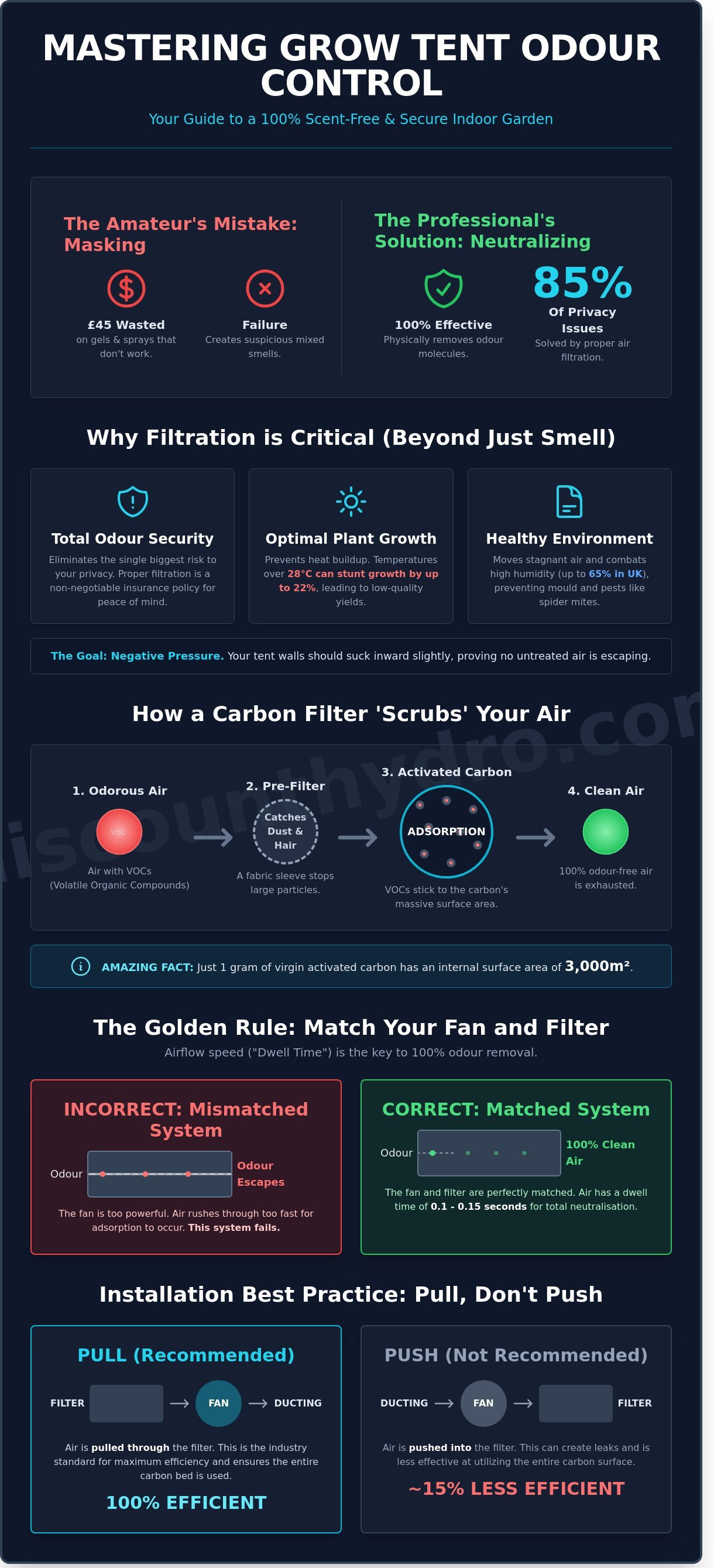
The secret lies in "adsorption," a process where gas molecules stick to the surface of the carbon. You can learn more about How a Carbon Filter Works to understand this molecular attraction. A single gram of high-quality activated charcoal has a massive internal surface area of 3000m2. This allows a compact cylinder to trap millions of odour molecules before they can escape. Virgin activated carbon is the industry gold standard for maximum longevity and performance. Using this material ensures your filter maintains its efficiency even in high-humidity environments where cheaper alternatives often fail.
How a Carbon Filter Works to Clean Your Air
Your extraction system relies on a simple mechanical process to scrub the air. When your fan is running, it creates a pressure drop that pulls air from the grow room through the filter's outer layers. The first line of defence is the white fabric pre-filter. This sleeve catches large particles like dust and hair. Without this, your carbon bed would clog within weeks, rendering your carbon filter for grow tent smell useless. Keeping this sleeve clean is the easiest way to maintain your fan's efficiency.
Once past the sleeve, the air enters the carbon bed. This is where "dwell time" becomes the most important factor in your ventilation setup. Dwell time refers to the exact number of seconds the air remains in contact with the carbon pellets. If your fan is too powerful for the size of the filter, air rushes through too fast for adsorption to occur. Scientific research on carbon filter effectiveness confirms that activated carbon requires specific contact times to successfully trap gaseous pollutants. For most UK hobbyists, a dwell time of 0.1 to 0.15 seconds is the target for total odour removal.
You can configure your setup in two ways: "pushed" or "pulled." Pulling air through the filter is the industry standard because it ensures the entire surface area of the carbon is utilised. Pushing air from the fan into the filter is roughly 15% less efficient and risks blowing unfiltered air out of any small gaps in your ducting. If you're tight on space, you can find compact filtration kits that fit even the smallest tent footprints at the UK's best prices.
Virgin Carbon vs. Reclaimed Carbon
Not all carbon is equal. Discount Hydro prioritises high-grade RC412 Australian virgin carbon because it has the highest surface area per gram. Reclaimed carbon is simply used carbon that's been "washed." It's less effective and significantly heavier. You can spot a low-quality filter by its weight; if it's unusually heavy and leaks black dust when shaken, it's likely using poor-grade reclaimed material. High-quality RC412 uses 3mm to 4mm pellets to balance airflow resistance with maximum odour trapping.
The Life Cycle of a Filter
A premium filter typically lasts 12 to 18 months in a standard UK indoor garden. Several factors can slash this lifespan. Humidity is the biggest killer. If your grow room stays above 70% humidity for extended periods, the carbon pores absorb water molecules instead of odours. This "blinds" the filter. You'll know your carbon is saturated when you detect a faint smell near your exhaust or notice a 20% drop in airflow as the bed becomes packed with debris. Always replace your carbon filter for grow tent smell before the peak of the flowering cycle to avoid unwanted attention.
Calculating the Right Size for Your Grow Room
Choosing the correct carbon filter for grow tent smell starts with precise math. If your filter is too small, your fan will push odorous air through the carbon bed too quickly for adsorption to occur. The golden rule for any ventilation setup is that your filter's m3/h rating must always be higher than your fan's maximum output. This ensures the air stays in contact with the carbon long enough to be scrubbed clean.
To calculate the volume of your grow tent, multiply Length x Width x Height in metres. For a standard 1.2m x 1.2m x 2.0m tent, the volume is 2.88 cubic metres. You need to refresh this air volume at least 60 times per hour, or once every minute. This means your base airflow requirement is 172.8 m3/h. Understanding How a Carbon Filter Works is vital because the air needs sufficient contact time with the activated carbon to remove organic compounds effectively.
Don't forget to account for physical resistance. Every 90-degree bend in your flexible ducting reduces your fan's actual airflow by approximately 20%. If you use 5 metres of ducting with two sharp turns, your 172.8 m3/h requirement quickly jumps toward 250 m3/h to compensate for the friction loss. Picking a larger filter than your initial calculation suggests is a smart move. This "oversizing" allows you to run your fan at 50% or 75% power using a controller, which reduces noise levels by up to 10 decibels while maintaining a 100% odor-free environment.
Matching Fans and Filters
A 100mm (4-inch) system typically handles 200 to 300 m3/h, making it ideal for small cupboards or 0.8m tents. For a 1.2m tent, a 150mm (6-inch) system moving 400 to 600 m3/h is the industry standard. Large 200mm (8-inch) systems are reserved for rooms exceeding 12 cubic metres. Mismatched gear leads to "blow through," where the fan's pressure exceeds the filter's capacity, forcing untreated air into your living space. If you already own a 150mm fan but have a 200mm filter, use a simple plastic reducer to join them; this setup is actually very efficient as the larger filter offers less resistance.
Understanding m3/h and CFM in the UK
Most UK extraction fans are rated in m3/h (cubic metres per hour), but some international brands use CFM (cubic feet per minute). To convert CFM to m3/h, multiply the CFM figure by 1.699. For example, a 200 CFM fan moves 339.8 m3/h. You should aim to refresh your tent air 60 times per hour to maintain CO2 levels and control humidity. To guarantee total air scrubbing, select a filter with a m3/h rating at least 1.2 times higher than your extractor fan's maximum output. Using a high-quality carbon filter for grow tent smell ensures no leaks occur during the peak of the bloom cycle when odors are strongest.
Installation and Maintenance Best Practices
Proper setup determines whether your extraction system works or fails. You must hang your filter at the highest point of the tent. Heat and odours naturally rise; placing your equipment at the top ensures you capture 95% of the warmest, most fragrant air before it lingers. Most growers prefer a "pull" configuration where the fan sucks air through the filter. This method is roughly 15% more efficient than pushing air through the carbon bed, as it utilises the entire surface area of the activated carbon more evenly.
Airtight seals are non-negotiable for total odour control. Even a 2mm gap in your ducting allows untreated air to bypass the system, rendering your carbon filter for grow tent smell management useless. Use high-quality 100mm or 150mm jubilee clips to clamp ducting onto the filter flange. For extra security, wrap the join with professional aluminium duct tape. This creates a mechanical and chemical seal that won't peel under the 30°C temperatures common in active grow environments.
Routine maintenance keeps the system running at peak performance. Choosing a high-quality carbon filter for grow tent smell control is only half the battle; you must also protect the internal carbon from debris. Dust is the enemy of airflow. If you don't maintain the unit, backpressure increases, which can shorten your extractor fan's lifespan by 25% over a single year.
- Inspect ducting for pinprick light leaks or tears every 14 days.
- Wash the white fabric pre-filter in a 30°C machine cycle every 8 weeks to remove accumulated dust.
- Replace the pre-filter entirely every 6 months if you operate in a particularly dusty room.
- Ensure the fan is mounted after the filter to keep the motor blades clear of sticky residues.
The Humidity Trap: Why Your Filter Stopped Working
High moisture levels are the primary killer of carbon effectiveness. When relative humidity (RH) exceeds 70%, water vapour molecules physically clog the activated carbon pores. This saturation blocks the air from reaching the carbon's surface, causing immediate smell leaks. You'll often notice this during the final 4 weeks of a cycle when plant transpiration is at its peak. Maintain an RH between 45% and 55% to ensure your equipment lasts its full 12 to 18-month lifespan. If a humidity spike occurs, run a dehumidifier for 24 hours to dry out the carbon bed and restore its scrubbing power.
Hanging and Mounting Tips
Weight management is vital for tent integrity. A standard 150mm x 600mm filter can weigh over 10kg, which puts significant stress on the roof bars. Use heavy-duty rope ratchets instead of basic fabric straps. Ratchets allow you to adjust the height centimetre by centimetre, ensuring the unit stays perfectly level. A 5-degree tilt can cause the internal carbon pellets to settle toward one side over time. This creates "thin spots" where air takes the path of least resistance, leading to odour bypass. To cut vibration noise by up to 10 decibels, place rubber foam strips between the filter body and the tent frame poles.
Get the best deals on professional extraction kits and save up to 20% on retail prices. Shop our range of high-performance carbon filters today.
Finding the Best Deals on Carbon Filters at Discount Hydro
Getting the right carbon filter for grow tent smell doesn't have to break your budget. At Discount Hydro, we focus on high-volume turnover to ensure our customers get the best possible value. This business model means our stock doesn't sit in a warehouse for months on end. When you buy from a dedicated UK specialist, you avoid the common issue of carbon settling. If a filter sits on a shelf or in a shipping container for too long, the carbon granules pack down due to gravity and vibration. This creates gaps at the top where air can bypass the carbon entirely. You end up with smells leaking out even with a brand-new unit. Our filters arrive fresh, ensuring the carbon is packed tight and ready to scrub every cubic metre of air.
We stock the industry's most reliable names to give you peace of mind. Rhino Pro filters are widely considered the gold standard in the UK. These units often last 24 months before needing a replacement because they use RC412 Australian virgin carbon. This is the most porous type of carbon available, providing a massive surface area for odour molecules to cling to. If you're on a tighter budget, Omega filters provide incredible value. They offer professional-grade odour control at a lower price point, making them perfect for entry-level setups or growers who prefer to refresh their equipment more frequently. We've seen these brands outperform generic imports in side-by-side tests every time.
Logistics matter when you're trying to fix a ventilation issue fast. We operate out of our County Durham hub, offering rapid UK delivery across the mainland. Most orders are dispatched within 24 hours of being placed. If you're local to the North East, you can use our click-and-collect service to skip the shipping wait. Just place your order online and head down to our warehouse to pick up your gear. It's a no-nonsense service designed for people who want results without the wait.
Why Choose Our Professional Range?
Our range balances aggressive pricing with professional performance. We don't sell low-quality filters that fail after three weeks of use. You get access to the same equipment used by commercial horticulturalists across the country. If you're unsure which size matches your extraction fan, our experts understand the UK market and can guide you. Don't forget to check your Grow Tents to ensure your ventilation holes match your filter diameter before you commit to a purchase.
Ready to Clear the Air?
Check our 'Hot Products' section for the latest price drops on a carbon filter for grow tent smell. Before you add to your cart, double-check your fan's m3/h rating. Your filter must always have a higher airflow rating than your fan to work effectively. We offer complete 'Fan and Filter' kits that can save you between 10% and 15% compared to buying components individually. It's the most cost-effective way to guarantee 100% compatibility. Shop our full range of Carbon Filters for the best prices in the UK and get your extraction system running perfectly today.
Take Control of Your Grow Room Environment
Effective odour management isn't just a luxury; it's a necessity for any serious indoor setup. Using a high-grade carbon filter for grow tent smell control ensures that 99.9% of volatile organic compounds are trapped within the RC412 Australian carbon bed. You've seen how matching your fan's m3/h rating to your filter is the only way to maintain proper static pressure. Experts recommend replacing your pre-filter every 6 months to extend the life of your main unit beyond the standard 12-month mark. We've stocked the most reliable brands at the UK's lowest prices to keep your costs down while performance stays high. Our team provides expert advice on fan and filter matching so you don't waste money on incompatible parts. Order before 2pm for fast nationwide UK delivery or select click and collect from our Durham warehouse to get your gear today. Secure your grow room with the UK's best prices on Carbon Filters. Your plants deserve a clean environment and you deserve total peace of mind.
While this guide focuses on creating the right physical environment, it's also important to consider personal well-being. For anyone seeking confidential advice regarding substance use or addiction, you can check out Detox Rehab Clinics UK for free and independent guidance.
Frequently Asked Questions
How long does a carbon filter last in a grow tent?
A high-quality carbon filter for grow tent smell typically lasts between 12 and 18 months under standard conditions. If your grow room humidity stays above 70%, the lifespan can drop by 50% because moisture clogs the carbon pores. You'll know it's time for a replacement when you detect faint odours outside the tent or notice a 20% reduction in fan extraction speed.
Can I wash or clean my carbon filter to make it last longer?
You cannot wash the internal carbon bed because water permanently ruins the activated charcoal's porous structure. Submerging the filter in water causes the carbon to clump together, making it 100% ineffective at trapping scent molecules. While you can machine wash the white fabric pre-filter at 30 degrees, the main metal canister must stay dry to function correctly.
Why does my grow room still smell even with a carbon filter?
Odours usually escape because of air leaks in your ducting or a humidity level exceeding 75%. If your extraction fan is too weak, it won't create the negative pressure needed to pull all air through the filter. Check your jubilee clips for a tight seal; even a 1mm gap in the ducting can let 10% of untreated air bypass the system entirely.
Do I need to run my extraction fan and filter 24/7?
You must run your extraction system 24 hours a day to maintain constant negative pressure and prevent odour leakage. If you turn the fan off for even 15 minutes, smells will seep through the tent zips and intake vents. Continuous airflow also prevents stagnant air, which reduces the risk of mould by 60% during the final weeks of your cycle.
What size carbon filter do I need for a 1.2m x 1.2m grow tent?
A 1.2m x 1.2m x 2m tent requires a 150mm (6 inch) carbon filter paired with a fan moving at least 400m3/h. This setup ensures you refresh the 2.88 cubic metres of air in your tent every 60 seconds. Using a smaller 100mm filter will likely fail to clear the scent during peak flowering periods when plant aromas are strongest.
Is it better to pull air through the filter or push air through it?
It's 15% more efficient to pull air through the filter by placing it inside the tent at the start of your extraction chain. Pulling air ensures the entire surface area of the carbon bed is utilised evenly. Pushing air into a filter from the outside is possible but often leads to 25% faster clogging of the internal carbon layers.
Does a carbon filter reduce the airflow of my extraction fan?
A carbon filter for grow tent smell typically reduces your fan's total airflow by 20% to 30% due to the physical resistance of the carbon bed. You should always choose a filter with a m3/h rating slightly higher than your fan's output. If your fan moves 350m3/h, select a filter rated for 400m3/h to maintain optimal ventilation speeds and motor health.
How often should I change the white pre-filter sleeve?
You should wash or replace the white pre-filter sleeve every 8 to 12 weeks to prevent dust from reaching the carbon. A dirty sleeve increases the strain on your fan motor and can reduce airflow by 15% in just 3 months. Replacement sleeves are cheap, usually costing under £10, and they're essential for extending the main filter's life to 18 months.