

Deep Water Culture (DWC) Kit UK: The Ultimate 2026 Buyer’s Guide
Most UK growers are still losing up to 30% of their potential harvest weight by sticking to traditional pots and soil. The fastest way to hit a consistent 2.0 gram-per-watt yield in 2026 isn't found in a bag of dirt; it's achieved through the high-octane oxygenation of a professional deep water culture (dwc) kit uk. You've probably felt the sting of root rot when your reservoir hits 24°C or worried that a loud air pump will alert the neighbours to your hobby. It's frustrating when you're chasing explosive growth but end up fighting pH swings and noisy equipment instead.
We'll help you master this method so you can stop guessing and start growing. You're going to learn how to select a system that stays below 35 decibels and keeps your nutrient costs under £0.12 per litre. This guide covers everything from setting up your first 20-litre bucket to managing a complex multi-pot system without a single leak. We're breaking down the exact hardware and maintenance routines you need for massive yields and white, healthy roots every single time.
Key Takeaways
- Understand why DWC is considered the "Formula 1" of hydroponics, delivering significantly faster growth rates than traditional soil or coco-based setups.
- Identify the essential components of a high-performance system, including the best light-proof reservoirs and quiet air pumps for a discreet home grow.
- Compare single pot, multi-pot, and RDWC systems to choose the perfect deep water culture (dwc) kit uk for your available space and budget.
- Learn the vital maintenance steps for the UK climate, including how to keep your nutrient solution in the 18°C to 21°C sweet spot year-round.
- Discover how to access unbeatable UK prices on professional-grade equipment curated specifically for reliable and efficient indoor gardening results.
What is Deep Water Culture (DWC) and Why is it the Choice for UK Growers?
Deep Water Culture (DWC) is a high-performance hydroponic method where plant roots stay submerged in a highly oxygenated nutrient solution 24 hours a day. Unlike soil or coco coir, there is no solid medium for the roots to fight through. Instead, they hang directly into a reservoir filled with water and liquid fertilisers. To understand the fundamentals, many beginners ask What is Deep Water Culture (DWC)? as it represents the purest form of hydroponics. By using an air pump and porous stones, the system creates a constant stream of bubbles that ensures the water remains saturated with oxygen. This environment allows the plant to focus 100% of its energy on upward growth and flower production rather than root expansion.
The UK market has seen a massive shift toward the deep water culture (dwc) kit uk in 2026 because of a renewed focus on resource efficiency. As energy costs remain a priority for indoor gardeners, the ability to shave 10 to 14 days off a standard vegetative cycle is a significant financial advantage. DWC is often called the "Formula 1" of growing. It delivers nutrients at a speed that traditional methods simply cannot match. When roots don't have to search for moisture, they explode in size. It's common for a DWC-grown plant to produce 25% more biomass than a soil-grown counterpart in the same timeframe. This makes it the primary choice for growers who want the highest possible return on their equipment investment.
DWC vs. Traditional Growing Methods
DWC outperforms soil primarily through nutrient delivery speed. In soil, nutrients must be broken down by microbes or dissolved in the substrate before the plant can use them. In a bubbler system, the minerals are already in ionic form, ready for immediate uptake. While coco coir is faster than soil, it still requires manual or automated runoff management. A deep water culture (dwc) kit uk simplifies this by keeping the root zone in a self-contained reservoir. Maintenance levels are different rather than "more." You won't be lugging heavy bags of dirt, but you must check pH and EC levels daily. The cost-benefit analysis is clear; a £150 investment in a professional DWC setup typically pays for itself within a single harvest through a 15% to 20% increase in final dry weight.
The Science of the 'Bubbler' System
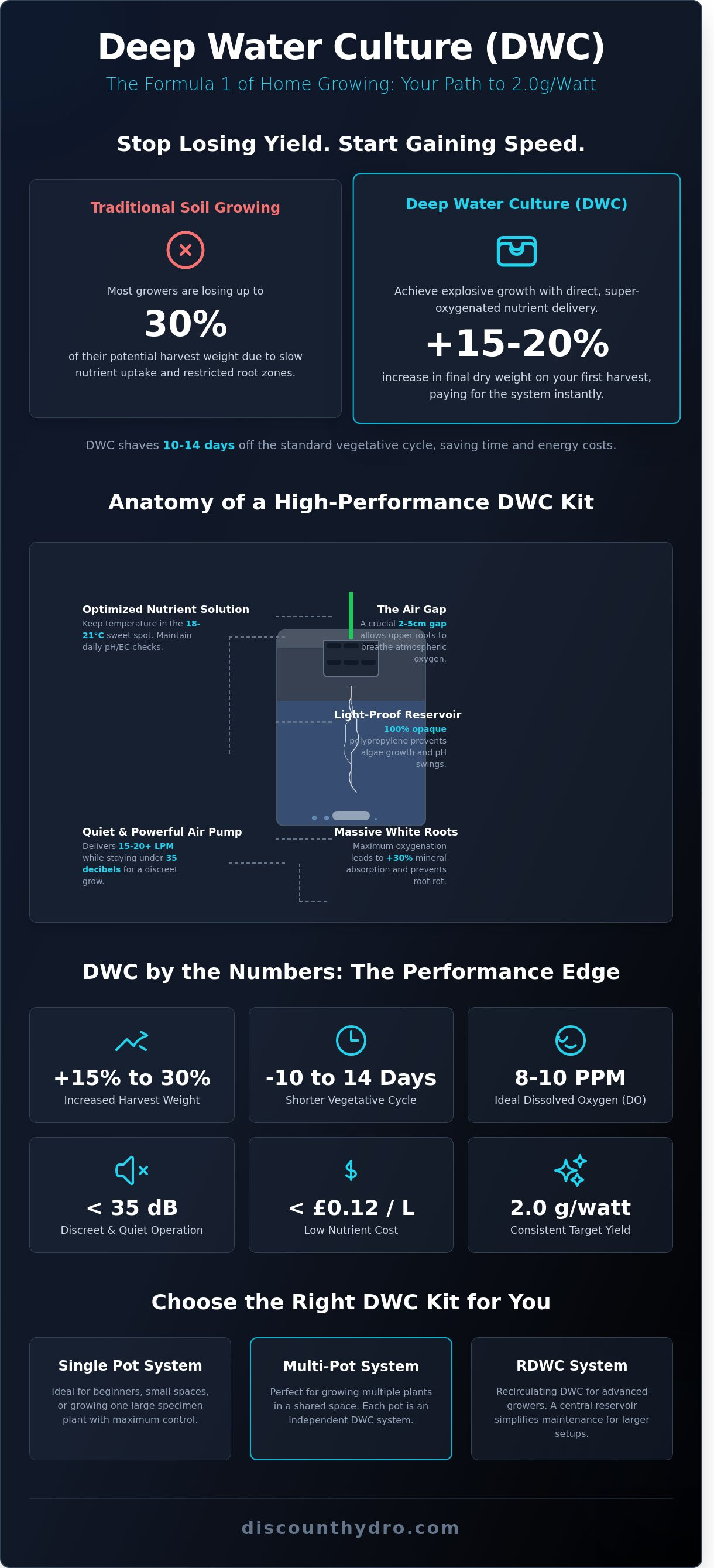
The "bubbler" name comes from the air stones that sit at the bottom of the bucket. These stones create dissolved oxygen (DO), which is the most critical factor in DWC success. High DO levels, ideally between 8 and 10 ppm, act as a shield against root pathogens like Pythium. These "root rot" organisms thrive in stagnant, low-oxygen water but cannot survive in the highly aerated environment of an active DWC system. This makes DWC more resilient than "passive" systems like Autopots or Kratky jars which rely on natural diffusion.
- The Air Gap: A 2cm to 5cm gap between the bottom of the net pot and the water line is essential. This "moist air zone" allows the upper roots to breathe atmospheric oxygen directly while the lower roots drink from the reservoir.
- Oxygen Uptake: Maximum oxygenation leads to "fuzzy" white roots with massive surface areas, increasing mineral absorption by up to 30%.
- Active vs. Passive: Active systems use electricity to move air or water, providing a level of control that passive wicking systems can't offer for intensive indoor plants.
By 2026, the precision offered by these kits has made them the standard for UK hobbyists who demand professional results. The combination of direct nutrient access and unlimited oxygen creates a growth rate that feels almost artificial. If your goal is to maximise yield within a limited space, the bubbler system is the most pragmatic tool available today.
The Anatomy of a High-Performance DWC Kit
A professional deep water culture (dwc) kit uk must withstand constant exposure to high-intensity lighting and corrosive nutrient salts. The foundation of any setup is the reservoir. You must use heavy-duty, UV-stabilised polypropylene. This material is non-reactive and 100% light-proof. If even 1% of external light penetrates the bucket, algae will colonise the root zone within 48 hours, competing for oxygen and crashing your pH levels. Most commercial-grade buckets in the UK market feature a 2mm wall thickness to prevent bowing when filled with 20 or 30 litres of water.
The air pump acts as the lungs of the system. For a single-plant setup, a pump delivering at least 15 to 20 litres per minute (LPM) is the baseline. High-performance kits often utilise acoustic housing to keep noise levels below 45 decibels, which is essential for home grows. You want a pump that provides consistent pressure without overheating. When Setting Up and Maintaining Your DWC System, the reliability of the oxygen source determines whether your plants thrive or succumb to root rot. Reliable oxygenation leads to a 25% faster growth rate compared to traditional soil methods.
Air stones and diffusers translate that pump power into usable oxygen. Cheap, small stones create large bubbles that rise too quickly to the surface. High-quality kits include large, 100mm ceramic air discs or flexible bubble curtains. These components produce a "fizz" of micro-bubbles. Smaller bubbles have a larger total surface area, which maximises the dissolved oxygen (DO) levels in the water. Aim for DO levels between 8 and 12 parts per million (ppm) for peak nutrient uptake.
Support structures like net pots and clay pebbles provide the physical anchor. A 150mm (6-inch) heavy-duty net pot is the UK standard for most 20L buckets. These pots feature wide-mesh sides that allow roots to explode into the reservoir without restriction. We recommend using pre-washed expanded clay pebbles to fill these pots, as they offer excellent drainage and won't affect your EC levels. You can find these essential hydroponic supplies at competitive prices to complete your build.
Choosing the Right Bucket Size
Most growers choose between a 20L (5-gallon) and a 30L (7-gallon) setup. A 20L bucket is ideal for 1.2m x 1.2m tents where vertical space is limited. However, a 30L reservoir provides a much larger buffer. In a larger volume of water, pH and EC levels fluctuate 40% slower than in smaller containers. This stability is vital during the peak of summer when temperatures rise. Larger reservoirs also require less frequent topping up, saving you time during the flowering stage.
Air Pumps and Oxygenation Standards
Calculate your air requirements by matching 1 LPM of air to every 1 litre of nutrient solution. If you run a 20L system, a 20 LPM pump is your minimum target. Diaphragm pumps are affordable but can be noisy; acoustic piston pumps are the professional choice for larger multi-pot systems. Always install one-way check valves on your air lines. This simple 50p component prevents water from back-siphoning into your electric pump if a power cut occurs, protecting your equipment from permanent damage.
Choosing Your Setup: Single Pot vs. Multi-Pot vs. RDWC
Selecting the right configuration for your grow room is a choice between manual control and automated efficiency. Your decision depends on your available floor space and how many hours you can commit to maintenance each week. A single deep water culture (dwc) kit uk is often the starting point for most hobbyists; however, scaling up requires a shift in how you manage your nutrient solution.
Standard DWC setups involve independent buckets. Each plant lives in its own 20-litre or 33-litre reservoir with a dedicated air stone. This is the most cost-effective entry point. You can pick up a single-pot system for under £40, making it accessible for those testing the waters. If you only grow one to four plants in a 1.2m x 1.2m tent, independent pots offer maximum flexibility. You can move plants around or treat an individual plant for deficiencies without affecting the rest of the crop.
Standard DWC: Simple and Effective
Individual bubblers are the backbone of small-scale UK home grows. They're reliable because they have no moving water parts that can leak or clog. You simply fill the bucket, add your nutrients, and let the air pump do the work. If one plant develops a root issue, it stays isolated in that bucket.
- Pros: Low initial investment; plants can be moved or rotated; easy to clean between cycles.
- Cons: Every pot requires its own pH and EC testing; water temperatures can vary between buckets.
- Best for: Growers managing 1 to 4 plants in standard grow tents who want total control over each plant.
RDWC: The Professional Choice for 2026
Recirculating Deep Water Culture (RDWC) is the logical upgrade for anyone running more than four plants. These systems link all buckets to a central "Control Bucket" or header tank using 19mm or 32mm pipework. A water pump constantly moves the solution through the entire circuit. This ensures that every plant receives the exact same pH, EC, and temperature levels. You only need to test and adjust the solution in one location rather than checking eight different buckets.
The control bucket acts as the brain of your deep water culture (dwc) kit uk. It's usually located outside the grow tent. This placement is strategic; it allows you to manage nutrients without disturbing the plants or opening the tent and losing CO2 or heat. Professional RDWC kits for 2026 often include 50mm return pipes to prevent root blockages, which was a common failure point in older designs. Expect to pay between £300 and £800 for a high-quality 4-pot or 6-pot RDWC system depending on the pump specifications and pipe diameters.
Scalability is the biggest draw for linked systems. While a single pot is great for learning, checking four individual buckets takes about 20 minutes a day. An RDWC system reduces that task to two minutes. You trade a higher upfront cost for massive time savings and superior nutrient stability. Most commercial-grade UK kits now use 1000L/hr to 3000L/hr pumps to ensure the solution stays highly oxygenated as it moves through the circuit. This constant motion prevents stagnant zones where bacteria can thrive.
Setting Up and Maintaining Your DWC System in the UK
Operating a deep water culture (dwc) kit uk successfully depends on one non-negotiable rule: the air pump stays on 24/7. Oxygen is the lifeblood of this method. If your pump fails or you switch it off to save electricity, your plants will begin to suffocate within two hours. Without constant aeration, dissolved oxygen levels in the water drop rapidly, leading to root rot and total crop failure. Always keep a spare air pump in your kit bag; a £20 backup is cheaper than losing a full harvest.
Temperature control is your next priority. In the UK, indoor temperatures vary wildly between seasons. You must keep your nutrient solution in the 18°C to 21°C sweet spot. If the water drops below 16°C, metabolic processes stall and growth stops. If it climbs above 22°C, the water's ability to hold oxygen decreases, creating a breeding ground for Pythium. Daily monitoring is essential for success. You aren't just growing plants; you're managing an aquatic ecosystem.
Environmental Control in British Grow Rooms
Winter brings the risk of root shock. If you're growing in a loft or garage, temperatures can plummet to 5°C overnight. Use a 50W or 100W aquarium heater to maintain your reservoir at a steady 19°C. During summer heatwaves, reservoirs can easily hit 26°C. You don't always need a £400 chiller; try insulating your buckets with reflective foil or dropping frozen 500ml water bottles into the reservoir twice daily to keep things cool.
Nutrient and pH Management
DWC systems require clean, mineral-based nutrients. Organic formulas often contain thick particles that clog air stones and cause bacterial blooms. The pH will naturally drift, which is known as the "pH swing." This isn't a problem as long as it stays between 5.5 and 6.5, as different minerals are absorbed at different pH levels. Check your levels every single morning. In many soft water areas of the UK, adding a Cal-Mag supplement is vital to prevent deficiencies, while silicon helps plants handle the high-intensity growth your deep water culture (dwc) kit uk provides.
The "Change-out" process is the final pillar of maintenance. Every 7 to 10 days, you must completely refresh your reservoir. Don't just top it up with fresh water. Over time, plants consume specific elements while leaving others behind, leading to a toxic salt imbalance. Follow these steps for a stress-free refresh:
- Prepare a secondary bucket with pH-balanced, room-temperature water.
- Carefully lift the lid with the plant and roots attached.
- Place the plant into the temporary bucket to keep the roots hydrated.
- Drain and scrub your main reservoir to remove any biofilm.
- Refill with fresh nutrients and return the plant immediately.
This process takes less than 15 minutes per bucket but prevents 90% of common DWC issues. Consistency is the difference between a mediocre harvest and a record-breaking one. If you monitor your EC (electrical conductivity) and keep it between 1.2 and 1.8 mS/cm, your plants will thrive in this high-oxygen environment.
Why Buy Your DWC Kit from Discount Hydro?
Discount Hydro remains the primary destination for high-performance hydroponics at warehouse prices across the United Kingdom. We've spent years refining our inventory to ensure every deep water culture (dwc) kit uk customers buy from us meets a strict standard of durability and efficiency. Our business model is built on high volume and low margins. This allows us to offer the best prices on leading brands like Omega and IWS. We don't believe in over-complicating things. You need equipment that works, delivered fast, at a price that leaves more money in your pocket for nutrients and electricity.
Our County Durham warehouse serves as a central hub for the northern gardening community. Local growers often use our click-and-collect service to save on shipping and get their systems running the same day. For customers further afield, we've partnered with reliable couriers to ensure 98% of in-stock items arrive within 24 to 48 hours. We stock everything required for a complete setup under one roof. This includes full-spectrum LED arrays, silent air pumps, and pH-buffered nutrients designed specifically for water-based systems. Buying a complete kit from one supplier ensures that every pipe, fitting, and pump works together perfectly without compatibility issues.
We only stock kits that we know deliver results. Our team regularly tests new equipment to verify manufacturer claims. If a pump is too loud for a residential setting or a bucket is made from thin, light-leaking plastic, it doesn't make it onto our shelves. This curated approach means you don't have to sift through hundreds of sub-par products to find a reliable setup. We've done the hard work for you, selecting only the most robust deep water culture (dwc) kit uk options available today.
Our Top-Rated DWC Kits for 2026
Our single 20-litre bubbler systems remain the most popular choice for those new to the method. These kits are priced competitively, often starting under £35, making them the most affordable entry point on the market. For those seeking professional-grade automation, the Omega and IWS RDWC systems provide unparalleled control. These systems use a central reservoir to manage nutrient levels across multiple sites simultaneously, reducing the time you spend on maintenance. We also offer individual components for those building bespoke setups. You can select specific air stones, heavy-duty buckets, and high-output pumps to create a tailored solution for any tent size or configuration.
The Discount Hydro Promise
We understand the importance of reliability and discretion. All orders are shipped in plain, unbranded boxes to maintain your privacy throughout the delivery process. Since 2015, we've focused on providing pragmatic equipment that avoids unnecessary gimmicks. Our goal is to help you achieve the highest yields for the lowest possible investment. Every product we stock has been vetted for its performance in real-world UK growing conditions. If you're ready to upgrade your indoor garden and experience the growth rates of hydroponics, Browse our full range of DWC Kits and Bubbler Systems here and see why we are the UK's favourite discount store for serious growers.
Scale Your Grow with the Best DWC Technology for 2026
Success in 2026 depends on using the most efficient technology available. Switching to a high-performance deep water culture (dwc) kit uk can boost your growth rates by up to 25% compared to soil-based methods. You've learned that maintaining a precise nutrient solution between 18 and 21 degrees Celsius is the secret to explosive root health. Whether you choose a standalone 20-litre pot or a sophisticated multi-pot RDWC system, the focus remains on maximum oxygenation and rapid nutrient uptake.
Discount Hydro provides the essential hardware you need at the UK's most competitive prices. Our County Durham warehouse is fully stocked with the latest gear, ready for fast nationwide delivery. If you're nearby, use our click and collect service to get your equipment today. We don't believe in overcharging for professional quality; we focus on getting you the best deals so you can focus on your harvest.
Shop the UK's Best Prices on DWC Kits and Systems
Grab your kit today and watch your garden reach its full potential faster than ever before.
Frequently Asked Questions
Is DWC better than soil for beginners in the UK?
DWC offers 20% to 30% faster growth rates than soil, though it requires more frequent monitoring. While soil is more forgiving of pH fluctuations, a deep water culture (dwc) kit uk allows you to control every aspect of plant nutrition. Most beginners succeed by checking their pH and EC levels once every 24 hours to ensure the system stays within the correct range.
How often should I change the water in my DWC reservoir?
You should perform a full reservoir change every 7 to 14 days to prevent nutrient imbalances and salt buildup. While you'll need to top up the water daily as plants drink, a complete refresh every 10 days keeps the solution chemistry stable. This routine prevents the Electrical Conductivity (EC) from rising to toxic levels that could stunt your crop.
What is the ideal water temperature for a DWC system?
The ideal water temperature for a DWC system is between 18°C and 20°C. If your nutrient solution exceeds 22°C, the water's capacity to hold dissolved oxygen drops by over 15%, which creates a breeding ground for pathogens. Maintaining a steady 19°C ensures your roots stay healthy and can absorb nutrients at the maximum possible rate.
Can I use organic nutrients in a Deep Water Culture kit?
You shouldn't use standard thick organic nutrients in a deep water culture (dwc) kit uk because they often clog the air stones and pumps. Organic matter can also lead to rapid bacterial growth and unpleasant odours in a water-based system. It's better to use mineral-based nutrients or specific "clean" hydroponic organics that won't create a sludge in your buckets.
How noisy are the air pumps in a DWC setup?
Most high-quality air pumps operate at a noise level between 40 and 45 decibels, which is roughly the same as a quiet hum in a library. You can reduce this vibration by 50% by placing the pump on a thick rubber mat or hanging it from a bungee cord. It's essential to keep the pump running 24 hours a day to maintain oxygen levels.
What happens to my DWC system during a power cut?
Your plants can typically survive for 3 to 6 hours without power before oxygen depletion becomes a serious threat to the roots. If a power cut lasts longer than 4 hours, you should manually aerate the water using a jug or a battery-powered air pump. Investing £15 in a backup battery air pump provides cheap insurance against unexpected UK power outages.
Do I need a water chiller for my DWC kit in the UK?
You only need a water chiller if your grow room temperatures consistently push your reservoir water above 22°C. Many UK growers avoid this £300 expense by keeping their reservoirs on cold concrete floors or using insulated jackets. If your water stays at 24°C for more than 48 hours, a chiller becomes necessary to prevent crop failure.
How do I prevent root rot in my bubbler system?
Preventing root rot requires keeping your water temperature below 21°C and maintaining high dissolved oxygen levels. Adding a 35% food-grade hydrogen peroxide solution at a rate of 2ml per 4 litres of water helps keep the reservoir sterile and oxygenated. Healthy roots should always appear bright white; any brown slime indicates that your oxygen levels have dropped below 5ppm.