

Discreet Plant Lights for Apartments: Your 2026 Buyer's Guide
Your plants need light, but your living room doesn't need a bulky fixture and that infamous purple glow. If you're tired of grow lights that look like a science experiment, you're in the right place. The good news is that you no longer have to choose between healthy plants and a stylish home. The solution is finding the perfect discreet plant lights for apartment living-lights designed to blend in, not stand out. They are powerful, effective, and won't make you cringe every time you turn them on.
But are these 'pretty' lights powerful enough? How do you know what to look for? This 2026 buyer's guide cuts straight to the facts. We'll show you exactly how to choose stylish, low-profile grow lights that deliver the right spectrum for lush growth. You'll learn the key features to demand, see practical ideas for any layout, and gain the confidence to buy a light that fits your space, your style, and your budget. Get ready to upgrade your indoor garden without downgrading your decor.
Key Takeaways
- Instantly upgrade any existing lamp into a plant-supporting light with a simple grow bulb - the most cost-effective solution for renters.
- Discover the key differences between integrated fixtures and hidden LED strips to find the perfect discreet plant lights for your apartment.
- Understand the essential features of a stylish grow light so you can avoid the harsh purple "blurple" glow in your living space.
- Get a quick-reference guide to match the right light intensity to your specific houseplants, ensuring they get exactly what they need to thrive.
What Makes a Plant Light 'Discreet' Anyway?
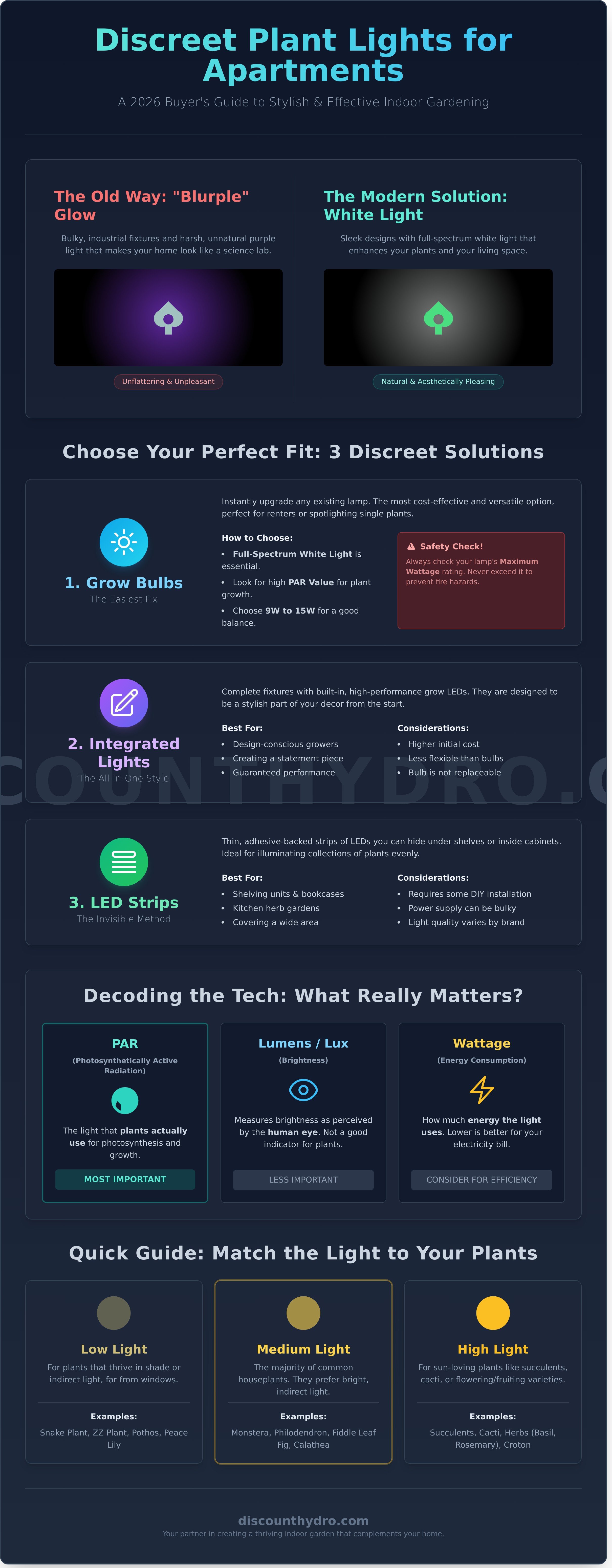
When you think of a grow light, you probably picture a bulky, industrial fixture blasting an alien-purple glow. That's fine for a commercial setup, but it's the last thing you want in your living room. The search for discreet plant lights for apartment living is about moving beyond that outdated image. It’s about integrating plant care into your home's aesthetic, not letting it take over. This means focusing on form factors that blend in-like standard screw-in bulbs, sleek LED strips under a shelf, or fully integrated, stylish lamps.
A truly discreet light gets two things right: the quality of the light it produces and its physical design. It should blend seamlessly into your decor, providing powerful, plant-centric light that looks like a normal, high-quality lamp to the human eye.
Full-Spectrum White Light vs. 'Blurple' Light
The infamous 'blurple' (blue/red) light is effective because plants primarily use red and blue wavelengths for photosynthesis. However, this combination is harsh, unflattering, and makes your home look like a science lab. Modern LEDs solve this problem with full-spectrum white light. These advanced lights provide all the wavelengths your plants crave-including red and blue-but are balanced to appear as natural, pleasant white light. You can even choose the colour temperature (measured in Kelvin) to match your decor: a warm white (~3000K) creates a cosy feel, while a cool, crisp daylight (~6500K) is bright and energising. The result is a light that's pleasant for you and powerful for your plants.
Key Technical Specs to Look For (Simplified)
While aesthetics are key, a grow light must deliver results. Don't get lost in confusing technical jargon; focus on the specs that actually matter for plant health. Understanding the science of grow lights is useful, but here’s the essential breakdown:
- PAR (Photosynthetically Active Radiation): This is the only metric that truly matters for growth. It measures the specific light that fuels photosynthesis. A higher PAR value means more growth power.
- Lumens & Lux: These measure brightness as perceived by the human eye. They tell you how bright a room will feel but are a poor indicator of a light's effectiveness for your plants.
- Wattage: This simply tells you how much energy the light consumes. With efficient LED technology, a lower wattage can still produce a very high PAR output, saving you money on your electricity bill.
The ideal discreet plant light strikes the perfect balance. It delivers a high PAR value in a full-spectrum white light, all packaged in a design that complements your apartment's decor. By prioritising both performance and aesthetics, you can ensure your plants thrive without turning your home into a grow-op.
The Easiest Fix: Using Grow Bulbs in Your Existing Lamps
The fastest and most affordable route to providing your plants with essential light is already sitting in your living room. By simply swapping a standard bulb for a specialised LED grow bulb, any lamp you own becomes a powerful, targeted plant light. This is the ultimate solution for renters and anyone on a budget, offering one of the most discreet plant lights for apartment living you can find.
This method combines your personal style with your plant's needs. It's perfect for spotlighting a prized Monstera on a side table or giving a boost to the herbs on your desk. While it won't cover a large collection, its low cost-often under £20-and unbeatable versatility make it the number one starting point for indoor growers.
How to Choose the Right E26/E27 Grow Bulb
Not all bulbs are created equal. A standard household LED won't fuel proper growth because it lacks the specific light wavelengths plants need for photosynthesis. When shopping, focus on these key specs:
- Full-Spectrum Light: This is non-negotiable. Look for bulbs marketed as 'full-spectrum' to ensure they mimic natural sunlight and support all growth stages, from seedling to flowering.
- PAR Value: Photosynthetically Active Radiation (PAR) measures the amount of usable light a bulb produces for plants. To get a better understanding of how much light houseplants need, you can match a bulb's PAR output to your specific plant's requirements.
- Wattage: A higher wattage generally means a more powerful light, but it also produces more heat. For single lamps, a 9W to 15W LED grow bulb provides an excellent balance of intensity and safety.
Safety Check: Matching the Bulb to Your Fixture
Before you buy, you must check your lamp. Using a bulb that's too powerful for your fixture is a serious fire hazard. Here’s your safety checklist:
- Check Maximum Wattage: Every lamp has a sticker or stamp near the bulb socket indicating the maximum wattage it can handle. Never exceed this rating.
- Ensure Good Airflow: LED grow bulbs run much cooler than old incandescent or HPS bulbs, but they still need to dissipate heat. Avoid using them in very tight, fully enclosed shades that can trap heat.
Best Lamp Styles for Swapping in a Grow Bulb
Some lamps work better than others for this purpose. The best fixtures offer flexibility and direct light where it's needed most. Consider using:
- Adjustable Desk & Floor Lamps: Perfect for precise positioning over a single pot.
- Clamp Lamps: Easily attach to shelves or bookcases to illuminate plants from above.
- Pendant or Track Lighting: Ideal for hanging over a small cluster of plants on a counter or table.
As a rule, avoid fixtures with thick, dark, or fabric shades, as they will block too much of the valuable light from reaching your plants.
All-in-One Style: Integrated & Decorative Grow Lights
When you want a dedicated, purpose-built solution that removes all guesswork, integrated grow lights are the answer. These fixtures are designed from the ground up with plant health in mind, building powerful full-spectrum LED technology directly into a decorative design. This means you get a seamless, stylish product that doesn't look out of place in your home. Many of these all-in-one units are the best discreet plant lights for apartment living because they come with essential features built right in, such as:
- Automatic Timers: Set it and forget it for consistent light cycles.
- Dimmable Settings: Adjust brightness levels to suit different plant needs.
- Full-Spectrum Output: Provides the complete range of light wavelengths for robust growth.
These purpose-built lights come in several popular styles, each designed to solve a specific problem while enhancing your interior decor.
This principle of integrating functional tech into your decor applies to other hobbies too. For example, creating the perfect retro gaming corner requires a similar eye for detail, and enthusiasts often turn to specialists like RetroFix to find classic consoles and accessories that complement their space.
The same challenge applies to creating engaging spaces for children. Parents often look for play equipment that is safe and fun but doesn't clash with their home's aesthetic, both indoors and out. For those in the UK, specialists like SoftplayToys4kids offer creative solutions that keep both kids and style-conscious parents happy.
This same approach to combining style and utility is just as important for outdoor living areas. Creating an inviting garden or patio often means finding the right furniture to match, and for those looking to upgrade their space, specialists like Rengard offer a range of high-quality, trendy outdoor pieces.
Of course, maintaining a stylish, plant-filled apartment also means keeping it clean. Finding a reliable professional who respects your space can be just as important as choosing the right decor. For those who want to find trusted local cleaners to help manage their home, you can learn more about Cleaner Connect, an online directory that simplifies the search.
Halo & Stake Lights: Minimalist Spotlights
Perfect for targeting individual plants, halo or stake lights offer a minimal-fuss, maximum-impact solution. These small, ring-shaped or single-point lights are mounted on a stake that you insert directly into the plant's pot. They are excellent for highlighting a specific plant on a bookshelf or desk. Often powered by a simple USB connection, they are incredibly versatile and easy to place anywhere you need a boost of targeted light for your small-to-medium sized plants.
Pendant & Hanging Lights: A Stylish Statement
Make your plants a focal point with a pendant grow light. These fixtures hang from the ceiling, delivering essential top-down light that perfectly mimics the sun. They are ideal for creating a dedicated plant corner, illuminating a collection of hanging baskets, or growing fresh herbs in your kitchen. Available in a huge range of styles from industrial metal to modern minimalist, you can easily find one to match your decor. Find the perfect high-power bulb for your pendant in our LED collection.
Standing Floor Lamp Grow Lights
For larger houseplants like a Fiddle Leaf Fig or Monstera, a standing floor lamp is the ultimate choice. These fixtures are designed to look like a standard piece of living room furniture while packing a powerful horticultural punch. Many models feature multiple, adjustable heads, allowing you to direct light precisely to one large plant or cover several smaller ones at once. This is the ultimate fusion of function and interior design, providing a powerful growing tool that blends seamlessly into your home.
The Invisible Method: Hiding Lights with LED Strips
For the true minimalist, even the most stylish lamps are too bulky. When you demand a lighting solution that is completely unseen, LED strip lights are the superior choice. Their ultra-low profile and adhesive backing offer maximum flexibility, allowing you to build a custom system that disappears into your furniture. This is the ultimate method for creating truly discreet plant lights for your apartment, ensuring your plants get the energy they need without any visual clutter.
Choosing Plant-Specific LED Strips
Not all LED strips are built for growing. Avoid cheap, decorative colour-changing strips and invest in horticultural-grade lighting for guaranteed results. To get the best value and performance, focus on these key specifications:
- Full-Spectrum White Light: Look for strips that provide a balanced, full spectrum of light that mimics the sun, not just single-colour diodes.
- Light Intensity & Density: Check the lumens per metre and the number of diodes. Higher numbers mean more power and more even light distribution for your plants.
- Waterproof Rating: If placing lights near a humidifier or in a high-humidity cabinet, an IP65 rating or higher is essential to prevent damage.
- Cut-to-Size: The best grow strips can be cut at designated points, allowing you to achieve a perfect, custom fit for any shelf or cabinet.
Popular Placement Ideas for Apartments
The main advantage of LED strips is their versatility. You can install powerful lighting in tight spaces where no other fixture would fit. Here are some of the most effective placements for a clean, integrated look:
- Under Kitchen Cabinets: The perfect spot for an indoor herb garden. Mount the strips to the underside of your cabinets for a seamless setup that illuminates your worktop and feeds your plants.
- On Bookshelf Shelves: Turn any bookshelf into a multi-level plant display. Run a strip along the underside of each shelf to light the row of plants below.
- Inside Glass Cabinets: Ideal for creating a 'greenhouse cabinet' for tropicals. The strips can be hidden along the interior frame, providing intense light in a controlled environment.
- Along the Back of a Desk: Provide focused light for a row of small succulents or office plants by running a strip along the back edge of your desk, tucked out of sight.
By selecting the right LED strips, you can provide powerful, targeted light without compromising your apartment's aesthetic. For the UK's best prices on high-performance, full-spectrum LED lighting solutions, check out our full range at discounthydro.com.
Quick Guide: Matching the Light to Common Houseplants
You can buy the most advanced grow light on the market, but it will fail if it’s mismatched with your plant’s needs. Getting the right light intensity is the most critical factor for success. This straightforward guide breaks down the requirements for common houseplants so you can make a cost-effective, practical choice. Remember the golden rule: ‘low-light tolerant’ does not mean ‘no-light’.
Low-Light Lovers (Snake Plant, ZZ Plant, Pothos)
These are some of the hardiest apartment plants, known for surviving in less-than-ideal conditions. While they tolerate shade, they will look their best and grow much faster with a small boost of supplemental light. They are the easiest to cater for with discreet plant lights for your apartment.
- Light Needs: A single, low-wattage grow bulb (5W-10W) screwed into a standard decorative lamp is often all that is required.
- Placement: These plants are excellent candidates for locations further from the light source, such as a dark corner or a high shelf.
Medium-Light Plants (Philodendron, Calathea, Ferns)
This category covers the majority of popular tropical houseplants. They thrive in bright, indirect light, which can be difficult to achieve consistently indoors. This group benefits most from dedicated, decorative lighting solutions that blend into your decor.
- Light Needs: They respond well to dedicated halo-style lights, clip-on spotlights, or under-cabinet LED strips.
- Duration: Aim for a consistent 12-14 hours of supplemental light per day, ideally controlled with a simple plug-in timer for efficiency.
High-Light Cravers (Succulents, Cacti, Herbs)
Sun-loving plants like succulents, cacti, and most kitchen herbs demand the highest light intensity. This makes them the trickiest to accommodate with a subtle setup, but it is achievable with the right equipment. Insufficient light will cause them to stretch, lose colour, and eventually fail.
- Light Needs: A powerful, full-spectrum LED bulb is non-negotiable. It must be focused and placed close to the plant, typically 15-30cm away.
- Best Fixtures: A multi-bulb fixture where each head can be aimed at a specific plant or a high-output integrated lamp will deliver the necessary power. Find the best prices on high-performance bulbs and fixtures to get the job done right.
Find the Right Discreet Plant Light for Your Setup
Keeping your houseplants healthy no longer means sacrificing your interior design. As we've shown, finding the perfect discreet plant lights for apartment living is easier than ever. Whether you simply swap a bulb in your favourite lamp, choose an all-in-one decorative fixture, or get creative with hidden LED strips, there is a solution that fits your home and your plants' needs. The key is matching the light's power and spectrum to your specific plants for optimal growth, ensuring they thrive without the clutter of traditional equipment.
Ready to find your perfect fit? We have a wide selection of LED lights for any setup. Shop our full range of powerful LED grow lights and bulbs today and take advantage of the UK's best prices, guaranteed. With fast, nationwide delivery, you can upgrade your indoor garden in no time. Give your plants the light they deserve and watch them flourish.
Frequently Asked Questions
Do white full-spectrum grow lights actually work as well as the purple ones?
Yes, they perform just as well, and for home use, they are superior. The purple (or "burple") light is older technology focusing only on red and blue wavelengths. Modern white full-spectrum LEDs provide these essential wavelengths plus the green and yellow spectrum, promoting healthier, more natural-looking growth. Crucially, they blend into your home decor without casting an unnatural, clinical purple glow, making them ideal for living spaces.
How many hours a day should I run my discreet grow light?
Most indoor plants, including common houseplants and herbs, require 12-16 hours of light per day for optimal growth. It is critical to also provide an 8-12 hour period of complete darkness for the plant's respiration cycle. The most efficient method is to use a simple plug-in timer to automate this schedule. This ensures your plants get consistent light without any daily effort, delivering the best results for your investment.
Will a small LED grow light significantly increase my electricity bill?
No, the impact on your electricity bill will be minimal. Modern LED grow lights are extremely energy-efficient. For example, a 15W LED bulb running for 14 hours a day uses only 0.21 kWh. Based on average UK electricity rates, this costs less than 6p per day, or under £2.00 per month. This makes it a very low-cost solution for maintaining healthy, vibrant plants in any part of your apartment, all year round.
How far away should the grow light be from my plants?
The correct distance depends on the light's intensity. As a general rule, position lower-wattage LED lights (under 20W) between 6 to 12 inches from the top of your plants. For more powerful units, a distance of 12 to 24 inches is a safe starting point. Always check the manufacturer's specifications for the most accurate recommendation. If you notice any leaf scorching or bleaching, move the light further away immediately.
Can I use any regular white LED bulb from the hardware store as a grow light?
We do not recommend it for reliable growth. A standard household LED bulb may keep a low-light plant alive, but it lacks the specific light spectrum and intensity (measured as PAR) required for robust photosynthesis. Purpose-built grow lights are engineered to deliver these precise wavelengths, preventing the weak, "leggy" growth common with inadequate lighting. For performance and value, always choose a dedicated grow light.
What's the best discreet grow light for a windowless bathroom?
For a humid, windowless room, a single pendant-style grow bulb or a slim under-cabinet LED bar light is the best solution. These types of discreet plant lights for apartment bathrooms provide targeted, full-spectrum light for humidity-loving plants like ferns and calatheas. Look for a model with a good IP rating for moisture resistance. They can be installed in existing fixtures or mounted neatly under a shelf, providing powerful light without the clutter.