

DIY Hydroponic System UK: The Complete 2026 Beginner’s Guide
Building your own diy hydroponic system uk is the only way to avoid the 300% markup found on pre-packaged retail kits. Most UK hobbyists believe high-tech farming requires a massive upfront investment and a dedicated greenhouse. You're likely tired of seeing "all-in-one" systems that don't fit in a standard British flat or use plugs that aren't compatible with our 230V mains. It's a common hurdle when you simply want to lower your grocery bills with fresh, home-grown produce.
This guide provides the blueprint for building a high-yield setup using affordable, locally sourced components. You'll learn how to achieve a 20% higher yield than traditional gardening while avoiding the retail markup on branded kits. We'll break down which parts are essential, how to select UK-specific nutrient brands, and the exact steps to assemble a space-saving setup. Expect a clear path to building a professional-grade system for under £100.
Key Takeaways
- Discover how to save up to 60% on initial setup costs by sourcing affordable, individual components rather than expensive pre-built kits.
- Compare Deep Water Culture (DWC) and Nutrient Film Technique (NFT) to find the most efficient method for your specific UK indoor space.
- Follow a simple 6-step assembly guide to build a high-yield diy hydroponic system uk using reliable parts and standard UK 3-pin plugs.
- Learn essential weekly maintenance routines, including pH monitoring and reservoir cleaning, to protect your plants from root rot and nutrient burn.
- Identify the must-have kit for 2026, from opaque reservoirs that prevent algae growth to high-performance air pumps for maximum oxygenation.
Why Build a DIY Hydroponic System in the UK?
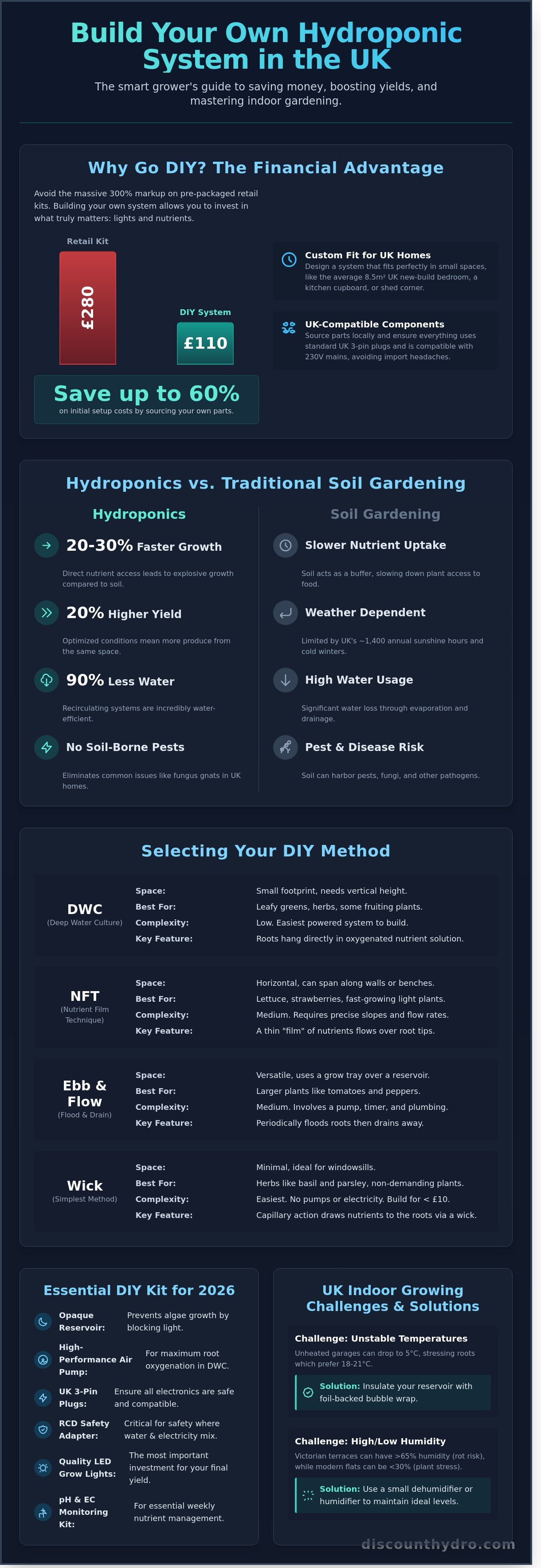
Building a diy hydroponic system uk setup is the smartest way to take control of your indoor garden. Most growers find they save up to 60% on initial setup costs by sourcing their own reservoirs and piping rather than buying premium pre-built kits. A standard four-site Deep Water Culture (DWC) kit can retail for £280 at high-end boutiques. You can build the same functional unit for roughly £110 using heavy-duty 20-litre storage crates and standard 13mm irrigation pipe. These savings mean you can scale your operation faster without a massive upfront investment.
The "Discount Hydro" approach prioritises spending where it matters most. You shouldn't waste your hard-earned budget on branded plastic buckets or fancy stickers. Put those savings into high-performance LED grow lights and premium nutrients from reputable brands. These components dictate your final yield. A £15 DIY reservoir performs exactly like a £100 branded version. A cheap, unbranded light will always result in leggy, weak plants that fail to produce. Focus your cash on the technology, not the containers.
UK growers deal with unique space constraints. The average UK new-build bedroom is only 8.5 square metres. DIY systems let you customise dimensions to fit exactly into a kitchen cupboard, a spare room corner, or a small garden shed. It's also the most reliable way to grow through the British winter. With outdoor temperatures averaging just 2°C to 7°C between December and February, indoor climate control ensures your growing season never ends. You aren't at the mercy of the 1,400 annual sunshine hours we get in the UK; you create your own sun.
Hydroponics vs Soil: Why Go Soilless?
Traditional gardening relies on soil, which acts as a buffer but also a barrier to nutrient uptake. In a soilless setup, plants access minerals instantly through the water. This leads to growth rates that are often 25% to 30% faster than soil-based methods. You also eliminate the headache of soil-borne pests. Fungus gnats are a common plague in UK homes during autumn; removing the soil removes their breeding ground entirely. These systems use 90% less water than traditional pots because the liquid recirculates rather than evaporating or draining away. For a deeper look at these mechanics, What is Hydroponics? provides a solid overview of the science behind soilless cultivation.
Understanding the UK Indoor Growing Environment
Managing an indoor garden in the UK requires specific attention to local housing conditions. Older Victorian terraces often have humidity levels above 65%, which can lead to rot or powdery mildew. Modern flats with constant central heating can drop humidity below 30%, stressing young plants. Temperature stability is equally vital for success. If you're growing in an unheated garage, insulate your DIY reservoir with foil-backed bubble wrap. This keeps root temperatures near the ideal 18°C to 21°C even when the external floor temperature drops to 5°C in mid-winter. Safety is paramount; always use an RCD safety adapter for any setup where water and electricity are in close proximity.
Selecting Your DIY Method: DWC vs NFT for Home Use
Choosing the right layout is the first hurdle when building a diy hydroponic system uk. You need a method that matches your budget and available space. While many beginners look for complex setups, starting with a proven method ensures you don't waste money on failed crops. Ebb and Flow systems, often called Flood and Drain, are versatile enough for larger plants like peppers or tomatoes. These systems use a submersible pump on a 15-minute timer to flood a grow tray before letting the solution drain back into a reservoir. You'll need clay pebbles or perlite to support the root mass during the "dry" cycles. A 400-litre-per-hour pump is usually sufficient for a standard 1-metre tray, costing approximately £20.
For those on a strict budget, Wick systems are the absolute cheapest entry point. They use no pumps or electricity, instead relying on capillary action to pull nutrients through a nylon or cotton wick into the growing medium. While growth rates are slower, it's a zero-risk way to start growing basil or parsley on a windowsill for the cost of a few plastic containers and some string. Most builders can assemble a basic wick kit for under £10 using recycled household materials and a small bag of perlite. It's a silent, low-maintenance choice for kitchens with limited power outlets.
When you're ready to scale up, the choice usually narrows down to DWC or NFT. Both offer high yields but require different levels of plumbing and space. DWC is essentially a vertical system that takes up a small footprint but requires height, whereas NFT is a horizontal method that can span several metres along a wall or greenhouse bench. Both systems benefit from following RHS hydroponics advice regarding nutrient strength and water quality, which helps prevent common issues like algae growth or nutrient lockout in the early stages of your build.
Deep Water Culture (DWC) Deep Dive
DWC systems suspend plant roots in a highly oxygenated nutrient solution using a 20-litre food-grade bucket and an air stone. The air stone creates constant bubbles that prevent the roots from drowning in the static water. It's the most forgiving diy hydroponic system uk because the large water volume buffers against pH swings and temperature spikes. When sourcing containers, look for the "fork and glass" symbol at local catering suppliers or hardware stores like Screwfix to ensure the plastic won't leach chemicals. If you're looking for value, check our range of reliable air pumps and stones to get your first bucket system running efficiently.
Nutrient Film Technique (NFT) for Space Saving
NFT systems use a constant thin film of nutrient solution flowing over the roots in 110mm uPVC soil pipes or square guttering. A successful build requires a precise 1:30 or 1:40 slope to prevent pooling, which can lead to root rot. This method is perfect for lettuce, herbs, and strawberries because it provides constant access to both water and oxygen. You'll need a small submersible pump with a head height of at least 1.5 metres to move the solution from the reservoir to the top of the channels. It's a massive space-saver for urban growers using balconies or small sheds.
The Essential DIY Hydroponics Kit List for 2026
Building a diy hydroponic system uk requires more than just a bucket and some water. You need specific components that handle the unique demands of indoor growing. Start with your reservoir. Choose a heavy-duty, opaque plastic container. Avoid clear storage boxes. Light penetration into the nutrient solution triggers rapid algae growth within 48 hours. This algae robs your plants of oxygen and clogs your equipment. A 50-litre black tote is a reliable standard for a small-scale home setup.
Your pump is the heart of the system. Don't buy cheap imports with flimsy adapters. Source a 240V water pump or a 4L/min air pump that comes with a standard UK 3-pin plug. Reliability is vital here. If a pump fails, your roots can dry out and die in less than six hours. For a Deep Water Culture (DWC) setup, ensure your air stones are large enough to create a constant "rolling boil" effect in the water.
For the plant supports, 3-inch net pots are the industry standard. These allow roots to breathe while providing enough stability for the plant. Fill them with either expanded clay pebbles or coco coir. Clay pebbles are a top DIY choice because they're pH neutral and reusable; just soak them in a weak bleach solution after harvest. Coco coir is better for beginners who want a "buffer" since it holds more moisture if the power goes out.
Precision is what separates a successful harvest from a total loss. You cannot guess your nutrient levels. Every UK grower needs a digital pH pen and an EC (Electrical Conductivity) meter. Keeping your pH between 5.5 and 6.5 is non-negotiable for nutrient uptake. To understand how these variables interact in different setups, read this complete guide to hydroponics for a broader look at system maintenance.
Professional LED Lighting: Where Not to Skimp
Stop buying £20 "blurple" lights from generic marketplaces. They lack the PAR output needed for healthy growth in 2026. Switch to full-spectrum white LED grow lights. These mimic natural sunlight and run much cooler. For a standard UK grow tent, aim for 320 watts per square metre to ensure high yields. If you're unsure about the right specs for your space, consult The Ultimate Guide to LED Grow Lights for a breakdown of wattage and coverage areas.
Nutrients and Supplements: Feeding Your DIY System
Standard garden fertilisers like Tomorite won't work in a diy hydroponic system uk. They lack the chelated micronutrients required for soil-less environments. Stick to proven UK brands like Intense Nutrients, Dutch Pro, or Canna. These are formulated for our specific water profiles. If you live in a hard water area like London or the South East, you must use "Hard Water" versions of these feeds. Always keep a bottle of Cal-Mag on hand. Calcium and magnesium deficiencies affect roughly 18% of UK indoor crops, especially when using RO water or growing in soft water regions like Scotland.
How to Build Your First DWC System: A 6-Step Guide
Building a diy hydroponic system uk doesn't need to be expensive or complicated. Deep Water Culture (DWC) is the most efficient method for beginners because it uses fewer moving parts. You can get professional results at warehouse prices by assembling your own kit from individual components. Follow these six steps to get your first reservoir running.
Step 1: Prep the reservoir. Take a 20-litre black bucket and its matching lid. Use a 75mm hole saw to drill a hole in the centre of the lid. This hole will hold your net pot. Black plastic is essential here. It blocks light from reaching the water, which prevents algae growth. Clean any plastic burrs off the edges to ensure a tight fit.
Step 2: Install the aeration. Your plants need oxygen to survive underwater. Place a 50mm air stone at the bottom of the bucket. Connect this to a 2W air pump using 4mm silicone tubing. You'll need to drill a small 5mm hole near the top rim of the bucket to feed the tubing through. Keep the pump higher than the water level to prevent back-siphoning.
Step 3: Water and pH balancing. Fill the bucket with 15 litres of tap water. Most UK tap water has a pH between 7.5 and 8.5. This is too alkaline. Use a pH meter and "pH Down" solution to bring the level to 5.8. Once the pH is stable, add your base nutrients at 25% strength. Don't add full-strength nutrients to young plants as it will cause root burn.
Step 4: Planting out. Place your seedling into a 75mm net pot. Surround the roots with expanded clay pebbles (hydroleca). These pebbles provide support and keep the plant upright. Set the net pot into the lid. The bottom of the pot should sit 2cm deep into the water during the first week to encourage root stretch.
Step 5: Light positioning. Hang your LED grow light directly above the bucket. For a standard 100W LED, maintain a distance of 50cm to 60cm from the top of the plant. If the light is too close, the leaves will curl and turn yellow. If it's too far, the plant will become "leggy" and weak.
Step 6: Set the timer. Plug your light into a mechanical or digital timer. Set a 18/6 cycle (18 hours on, 6 hours off) for the vegetative stage. This mimics a long summer day and provides the energy needed for rapid growth. Ensure the air pump stays on 24 hours a day. Roots never stop breathing.
Drilling and Plumbing Tips
Precision is vital for a successful diy hydroponic system uk. Always use a hole saw rather than a knife to avoid cracking the brittle plastic lids. If you see any light gaps around the tubing entry point, seal them with black electrical tape. Perform a 24-hour leak test with plain water before you add any expensive nutrient solutions. This ensures your seals are 100% watertight.
The First 48 Hours: Monitoring Your New Build
Check your water level every 12 hours. The roots should touch the water, but the main stem must stay dry to avoid "drowning" or crown rot. Keep your water temperature between 18°C and 22°C. If the water exceeds 24°C, the oxygen levels drop and you risk root rot. If your seedlings look pale, raise the light by 10cm to reduce intensity until they establish.
Ready to start your build? Shop our range of DWC kits and components to get the best prices on pumps, buckets, and nutrients.
Maintaining and Scaling Your DIY Indoor Garden
Keeping a diy hydroponic system uk productive requires a disciplined schedule. Your plants rely on you for every drop of nutrition and every minute of light. Successful growers follow a strict weekly maintenance routine to prevent small issues from becoming total crop failures. You should check your pH levels at least twice every 24 hours. For most UK tap water, which is often hard, you will need phosphoric acid (pH Down) to keep the reservoir between 5.5 and 6.5. If the pH drifts outside this range, your plants cannot absorb nutrients, leading to rapid yellowing and stunted growth.
- Weekly Reservoir Changes: Empty and scrub your reservoir every 7 to 10 days. This prevents salt buildup and keeps the nutrient balance precise.
- Topping Up: Plants drink heavily in warm weather. Top up with plain, pH-adjusted water between full changes to avoid nutrient concentration spikes.
- System Cleaning: Use a 3% hydrogen peroxide solution to flush lines and pumps. This removes biofilm that can clog drippers or air stones.
Troubleshooting is part of the process. Root rot, often caused by the Pythium pathogen, is the most common disaster in a DIY setup. If your reservoir temperature exceeds 22°C, oxygen levels drop, allowing rot to take hold. Keep your water between 18°C and 20°C. If you see brown, slimy roots, treat the water with silver bullets or beneficial bacteria immediately. Nutrient burn is another frequent error. If leaf tips look scorched, your EC (Electrical Conductivity) is too high. Flush the system with fresh water and reduce your nutrient dosage by 25% in the next batch.
The Importance of Environment Control
Control the air to control the outcome. A diy hydroponic system uk built in a spare room or garage needs managed airflow. High humidity over 70% leads to bud rot and powdery mildew. You must use an extraction fan paired with a carbon filter to scrub the air. This setup removes heat from your lights and ensures no odours escape the room. For a professional finish, follow this Choosing a Grow Tent: A Complete Buyer’s Guide to select a light-proof enclosure that fits your space. Always keep your electrical ballasts and power leads off the floor. Use cable ties to secure wires to the tent frame, preventing any contact with water during reservoir changes.
It's also crucial to protect your room's flooring from inevitable water spills during maintenance, as standard carpet or laminate can be quickly damaged. For a more permanent and easy-to-clean setup in a dedicated grow space, you can discover Frankly Flooring and their range of waterproof solutions.
Scaling Your Yields
Once you master a single bucket or small NFT tray, it's time to scale. Moving from a 100W starter light to a professional 720W LED system like the Omega Black can increase your harvest weight by over 150%. This specific LED fixture provides a full spectrum that mimics summer sun, covering a 1.2m x 1.2m area perfectly. As your garden grows, manual watering becomes a chore. You can automate your build by integrating an auto-feeding system like an IWS or Autopot kit. These gravity-fed or pump-driven systems ensure your plants never go thirsty, even if you're away for the weekend. For the best prices on pumps, pipes, and pro-grade lighting, visit Discount Hydro. We stock everything you need to take your UK grow from a hobby to a high-yield powerhouse.
While hobbyist kits often use simple timers, larger commercial setups rely on advanced industrial automation to control pumps and fans for maximum efficiency. Although based in Australia, suppliers like InstroDirect provide equipment and tools that demonstrate the principles of scaling up, which can be an interesting resource for technically-minded growers.
Start Your 2026 Indoor Garden Today
Building your own diy hydroponic system uk setup is the most cost-effective way to achieve professional yields this year. You've seen that a basic Deep Water Culture (DWC) bucket costs roughly £25 to assemble; meanwhile, Nutrient Film Technique (NFT) systems provide the oxygenation needed for larger, commercial-scale crops. Success depends on using high-quality nutrients and precise LED lighting to maximise your plant growth rates. We stock over 2,000 individual components to ensure you have exactly what's needed for your specific grow space. You'll get fast UK-wide delivery on every order; most items arrive within 24 to 48 hours of purchase. Our team offers expert advice on LED lighting to help you choose between 200W and 600W fixtures based on your tent size. We maintain a huge stock of nutrients and growing media so you won't ever run out mid-cycle. It's time to stop planning and start growing. Browse the UK’s best prices on DIY hydroponic components at Discount Hydro to get your project moving. You'll be harvesting your first crop before you know it.
Frequently Asked Questions
Is it cheaper to build your own hydroponic system?
Building a diy hydroponic system uk setup saves you roughly 40% compared to buying pre-made kits. For example, a basic 20-litre DWC bucket costs around £15 to assemble using a storage tub and air pump. Retail versions often start at £25 or more. You'll also save on shipping costs by sourcing bulky parts like reservoirs from local hardware stores.
What is the easiest hydroponic system for a beginner to build?
The Deep Water Culture (DWC) system is the simplest design for beginners to master. It involves a single reservoir and an air stone to oxygenate the water. You can build one in under 30 minutes using a £5 black bucket and a £10 air pump. This setup has fewer moving parts than NFT systems, which reduces the risk of mechanical failure.
Can I use tap water for my DIY hydroponic system in the UK?
You can use UK tap water, but you must treat it before adding your plants. Most UK water contains chlorine, so let it sit in an open container for 24 hours to dechlorinate. If you live in London or the South East, your water is likely "hard" with a pH above 7.5. You'll need pH Down solution to reach the ideal 5.5 to 6.5 range.
What plants are best for a DIY hydroponic setup?
Leafy greens like Romaine lettuce and herbs like basil or mint are the best choices for new setups. These crops reach maturity in 30 to 45 days and require lower nutrient concentrations than fruiting plants. Strawberries also perform well in DIY systems. They just need more light and specific potassium-rich nutrients to produce a high yield of fruit.
How much electricity does a DIY hydroponic system use per month?
A basic diy hydroponic system uk setup uses approximately £5 to £10 of electricity per month. This estimate includes a 20W air pump running 24/7 and a 100W LED grow light running for 12 hours daily. Based on the April 2024 energy price cap of 24.5p per kWh, the air pump costs about £3.50 per month to operate. Lights add the remaining balance.
Do I need a grow tent for my DIY hydroponic system?
You don't need a grow tent if you have a dedicated room with white walls and good ventilation. Tents are useful for containing light and managing humidity, which usually stays between 50% and 70% for healthy growth. A small 60cm x 60cm tent costs roughly £40. It helps prevent light leaks from disturbing your living space during the night.
How often do I need to change the water in my DIY reservoir?
You should change the nutrient solution every 7 to 14 days to prevent salt buildup and pathogen growth. Check your EC levels daily using a digital meter to ensure the concentration is stable. If the water level drops by 20% or more, top it up with plain pH-balanced water. Don't just add more nutrients, as this can burn your roots.
Where can I buy affordable hydroponic components in the UK?
You can find the best prices for pumps, nutrients, and grow lights at specialist online retailers like Discount Hydro. High-street DIY stores sell buckets and PVC piping for under £10. However, technical components like EC meters and HPS lamps are cheaper when bought from dedicated hydroponic suppliers. Buying in bulk can save you an additional 10% on consumables like coco coir.