

Extraction Fan with Filter: The Ultimate Grow Room Setup Guide
Battling high temperatures, runaway humidity, and the constant worry of escaping odours? An incorrectly sized ventilation system is the number one cause of environmental problems in a grow room, leading to stressed plants and disappointing yields. Getting this one piece of kit right is non-negotiable. The right extraction fan with filter is the heart of your setup, creating the perfect atmosphere for vigorous growth while ensuring total privacy. Don’t waste another pound or another minute on guesswork.
This is your no-nonsense guide to achieving complete control. Forget the confusing jargon. We’ll show you exactly how to calculate the fan and filter size you need for any grow tent, master negative pressure, and eliminate 100% of odours, guaranteed. By the end, you will have the confidence to select a quiet, powerful, and cost-effective ventilation kit that creates the stable, healthy environment your plants need to thrive. Let’s get your setup sorted.
Key Takeaways
- Master the three core functions of a ventilation system: precise control over temperature, humidity, and complete odour elimination.
- Discover the simple formula to calculate the exact CFM you need, ensuring you buy the right size fan and filter for your grow tent first time.
- Get a step-by-step guide on how to correctly install your extraction fan with filter kit for maximum performance and airflow.
- Unlock simple optimisation tricks to reduce noise and boost the efficiency of your system, saving on running costs.
Why an Extraction Fan and Carbon Filter are Essential for Your Grow Room
Thinking you can get by with a simple desk fan or by leaving a tent flap open is a common mistake that costs growers their harvest. A proper grow room ventilation system does far more than just move air around. An extraction fan with filter is the engine of your grow room, creating the perfect environment by managing three critical pillars for plant health and security:
- Temperature Control
- Humidity Management
- Odour Elimination
Failing to control any one of these can lead to stressed plants, low yields, or even total crop failure. Let's break down why this kit is a must-have investment for getting the best results at the best prices.
Temperature and Humidity Control
Your grow lights and other equipment generate a significant amount of heat. Left unchecked, this heat builds up, stressing your plants and stunting their growth. An extractor fan's primary job is to pull this hot, stale air out of the grow space. At the same time, it removes excess moisture released by your plants (transpiration), drastically reducing the risk of destructive mould, mildew, and bud rot that thrive in damp, stagnant conditions.
Fresh Air Exchange for Healthy Growth
Plants inhale CO2 for photosynthesis-it's their fuel for growth. In a sealed environment, they quickly use up all the available CO2, and growth grinds to a halt. By constantly removing old air, your extractor fan creates 'negative pressure'. This automatically pulls fresh, CO2-rich air into the tent through intake vents, providing a continuous supply of what your plants need to flourish. This constant airflow also gently strengthens plant stems, preparing them to support heavy yields.
Total Odour Elimination with a Carbon Filter
Many high-value plants produce powerful odours, especially during the flowering stage. A carbon filter is the only way to guarantee total discretion. The filter attaches to your fan and uses activated carbon to trap and neutralise odour-causing organic compounds from the air before they're exhausted. Understanding how carbon filters work reveals their effectiveness at trapping these particles through a process called adsorption. For any serious grower, a quality carbon filter isn't an optional extra; it's a non-negotiable part of a complete extraction fan with filter setup.
How to Choose the Right Size Fan and Filter: Calculating CFM
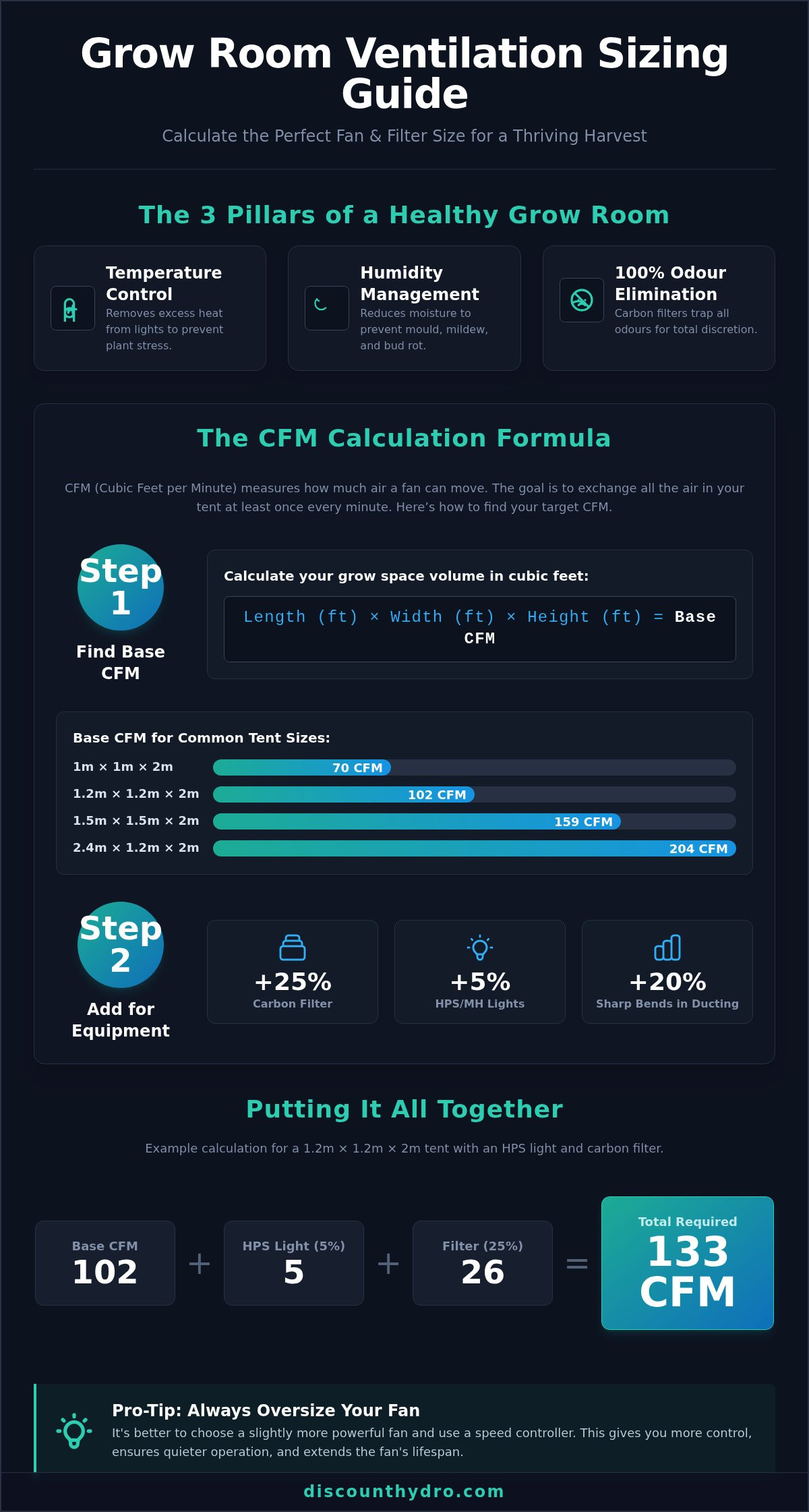
Choosing the correct size for your extraction fan with filter is critical for controlling your grow room's environment. The key metric you need to understand is CFM, or Cubic Feet per Minute. This measures how much air the fan can move in one minute. The goal is to completely exchange the air in your grow space at least once every minute.
The calculation starts with your room's volume, but this is only a baseline. Factors like lights, filters, and ducting add resistance, meaning you'll need a more powerful fan than the base calculation suggests. A simple rule: it's always better to oversize your fan and use a speed controller than to buy one that's underpowered. This gives you more control and ensures the fan runs quieter and lasts longer.
Step 1: Calculate Your Grow Room's Basic CFM
First, find the volume of your grow space in cubic feet. If you're using a tent measured in metres, you'll need to convert. Use the conversion: 1 metre = 3.28 feet.
Formula: Length (ft) x Width (ft) x Height (ft) = Base CFM
Example: For a 1.2m x 1.2m x 2m tent:
(1.2m x 3.28) x (1.2m x 3.28) x (2m x 3.28) = 3.94ft x 3.94ft x 6.56ft ≈ 102 CFM (Base)
Here are some pre-calculated base CFM values for popular tent sizes:
- 1m x 1m x 2m: 70 CFM
- 1.2m x 1.2m x 2m: 102 CFM
- 1.5m x 1.5m x 2m: 159 CFM
- 2.4m x 1.2m x 2m: 204 CFM
Step 2: Factor in Equipment and Environment
Your base CFM is just the start. Add the following percentages to account for efficiency loss from your equipment:
- Carbon Filter: Add 25%. A filter adds significant air resistance (static pressure). Its ability to remove odours and gases is why you need a quality setup, a fact supported by resources like the EPA guide to air cleaners regarding activated carbon's effectiveness.
- HPS/MH Lights: Add 5%. These lights produce more heat than LEDs, requiring extra ventilation.
- Ducting: Add 1% per foot of ducting used, and an extra 20% for any sharp 90-degree bends.
Putting It All Together: A Real-World Example
Let's calculate the total CFM needed for our 1.2m x 1.2m x 2m tent, but this time with an HPS light and a carbon filter.
- Base CFM: 102 CFM
- Add for HPS Light (5%): 102 x 0.05 = 5.1 CFM
- Add for Carbon Filter (25%): 102 x 0.25 = 25.5 CFM
Total Minimum CFM Required = 102 + 5.1 + 25.5 = 132.6 CFM
In this scenario, you need an extraction fan with filter rated for at least 133 CFM. We recommend choosing a fan with a rating of 150-200 CFM and pairing it with a fan speed controller for ultimate performance.
Find the perfect fan & filter kit for your CFM needs.
The Key Components of a Grow Room Ventilation Kit
An extraction fan with filter kit bundles all the essential components you need into one convenient, cost-effective package. For beginners, buying a matched kit is the simplest way to guarantee that your fan, filter, and ducting are all the correct size and specification to work together flawlessly. It removes the guesswork and almost always works out cheaper than buying each item separately.
The Extractor Fan: AC vs EC Inline Fans
The inline fan is the engine of your ventilation system, designed specifically to maintain strong airflow even when pulling air through ducting and a carbon filter. You have two main choices:
- AC (Alternating Current) Fans: These are the industry workhorses. They offer powerful and reliable performance at a great price point. While effective, they can be noisy at full speed and are less energy-efficient.
- EC (Electronically Commutated) Fans: The modern, superior option. EC fans use digital motor technology, making them significantly quieter, more energy-efficient (saving you money on your electricity bill), and far easier to control with precision. They represent a higher initial investment but deliver professional-level performance.
The Carbon Filter: Your First Line of Defence Against Odours
Your carbon filter is what ensures your grow remains discreet. It works by using a bed of activated carbon, typically high-grade RC412, which has a porous surface that adsorbs and traps odour molecules as the air is pulled through it. The deeper the carbon bed (e.g., 50mm vs 30mm), the more effective it is and the longer it will last. All quality filters also come with a washable pre-filter sleeve, which traps dust and debris to protect the carbon and extend the filter's lifespan.
Ducting, Clamps, and Controllers
These components connect everything together. A standard kit includes flexible aluminium ducting, which is lightweight and easy to install. For growers where noise is a major concern, upgrading to insulated acoustic ducting is a worthwhile investment. Everything is secured with simple jubilee clips or fast clamps, which are vital for creating the airtight seals needed to prevent odours from leaking. Finally, a fan speed controller is a highly recommended accessory. It gives you total control over your environment, allowing you to turn the fan speed up or down to manage temperature and noise levels perfectly.
How to Install Your Extraction Fan and Filter: A Step-by-Step Guide
Once you've selected the right equipment, installation is a straightforward process. This guide provides the essential steps for setting up your new extraction fan with filter inside a standard grow tent. A correct installation is critical for odour control and creating the ideal growing environment. Follow these steps carefully to ensure your system is secure, efficient, and completely airtight.
-
Step 1: Assemble The Filter, Fan, and Ducting
Before lifting anything, lay all your components out on the floor to get organised. Identify the intake side of your fan; most units have a printed arrow indicating the direction of airflow. Connect your carbon filter directly to this intake port. Use a fast clamp or heavy-duty duct tape to create a tight, airtight seal. Then, attach a section of ducting to the exhaust side of the fan and secure it just as firmly.
-
Step 2: Hang The System Inside Your Grow Tent
Use the hanging bars and heavy-duty straps provided with your grow tent to suspend the assembled unit from the ceiling frame. For maximum efficiency, position the carbon filter at the highest point inside the tent. Hot air rises, and placing your filter here ensures you are removing the warmest, most stagnant air from your grow space. Always double-check that the straps are secure and can comfortably support the combined weight.
-
Step 3: Route The Exhaust Ducting and Check for Negative Pressure
Feed the loose end of your exhaust ducting through one of the tent's dedicated ducting ports, ensuring it is as straight as possible to maintain good airflow. Now, plug in and turn on your fan. The final, crucial test is to check for 'negative pressure'. The walls of your grow tent should pull inwards slightly. This visual cue confirms that your system is working correctly, pulling more air out than is passively entering. This is essential for preventing untreated air and odours from escaping through seams or zips.
A properly pressurised tent is the sign of an effective ventilation setup. If you're building a new grow room from scratch, save time and money by getting everything you need in one package. Shop our complete grow tent kits with ventilation included.
Optimisation and Maintenance: Getting the Most From Your System
Choosing the right hardware is only half the battle. To maximise performance, protect your investment, and maintain a perfect grow environment, you need to optimise your setup and stick to a simple maintenance schedule. A well-maintained extraction fan with filter runs quieter, lasts longer, and provides consistent, reliable air exchange-saving you money and hassle in the long run.
Reducing Noise from Your Extractor Fan
Grow room noise is a common problem, but it’s easily solved. Instead of running a small fan at 100%, buy a slightly oversized fan and run it at 50-75% speed using a fan speed controller. This moves the same amount of air with significantly less noise. To tackle vibration, suspend your fan using bungee cords or rope ratchets instead of mounting it directly. For the ultimate quiet setup, replace standard aluminium ducting with insulated acoustic ducting to muffle the sound of rushing air.
Carbon Filter Maintenance and Lifespan
Your carbon filter is your first line of defence against odours, but it needs care. The white pre-filter sleeve catches dust and debris before it can clog the activated carbon. Remove and wash it every few weeks to maintain optimal airflow. Crucially, keep your grow room humidity below 70%; high moisture levels will permanently damage the carbon and render the filter useless. Expect to replace your filter every 9-18 months, or whenever you notice odours starting to escape.
Common Ventilation Mistakes to Avoid
Even experienced growers can make simple errors that cripple their ventilation system's efficiency. Avoid these common pitfalls to ensure your equipment works as intended:
- Undersizing Your Kit: Buying an extraction fan that is too small for your tent or room is the most frequent mistake. It will struggle to control heat and humidity, forcing you to run it at maximum speed constantly. Always calculate your required airflow and buy a fan that exceeds it.
- Poor Ducting Runs: Every sharp bend or kink in your ducting drastically reduces airflow. Keep your ducting runs as short and straight as possible. Use gentle, wide curves instead of 90-degree angles to maintain pressure and efficiency.
- Forgetting the Pre-Filter: The pre-filter is not optional. Running a carbon filter without it allows dust to clog the carbon pores directly, shortening its lifespan from over a year to just a few months.
Consistent maintenance ensures your ventilation system delivers peak performance. When it's time for a replacement part or a full upgrade, check out the unbeatable deals on fans, filters, and accessories at discounthydro.com.
Master Your Grow Room Environment with the Right Kit
Mastering your grow room's climate and odour control is non-negotiable for achieving maximum yields. As this guide has shown, selecting the correct size fan and filter by calculating your CFM is the critical first step. Proper installation ensures your system works at peak efficiency, protecting both your plants and your privacy. Investing in a high-quality extraction fan with filter is the single best upgrade you can make for a stable and productive indoor garden.
Ready to build your perfect setup? We stock a massive selection of top-brand fan and filter kits to match any size space. Get everything you need with our guaranteed best prices in the UK, all backed by fast, discreet nationwide delivery. Don't wait to create the ideal environment for your plants.
Shop our full range of Fan & Filter Kits at the UK's best prices.
Take control of your environment and watch your harvest thrive.
Frequently Asked Questions
How long should I run my grow room extractor fan each day?
For best results, your extractor fan must run 24 hours a day, 7 days a week. Continuous operation is essential to maintain a stable environment, removing excess heat and humidity from your grow lights and plants. This constant air exchange also replenishes the CO2 your plants need for healthy growth. Turning the fan off can cause rapid spikes in temperature and humidity, stressing your plants and increasing the risk of mould and pests.
What's the difference between an intake fan and an extractor fan?
An intake fan actively pulls fresh, cool, CO2-rich air into your grow tent or room. An extractor fan does the opposite: it pulls stale, hot, and humid air out. For complete odour control, the extractor fan pulls this air through a carbon filter before venting it outside the space. Using both creates a balanced airflow system, with the extractor typically being more powerful than the intake to create the negative pressure needed to contain all smells.
Can I place the fan and filter outside the grow tent?
Yes, you can position your fan and filter outside the tent to save internal space. However, this setup is less efficient. You will be "pushing" air through the filter rather than "pulling" it, which can reduce the lifespan of the filter and the fan's motor. Pulling air through the filter from inside the tent is the recommended method for maximum efficiency, better odour control, and quieter operation, as the tent itself helps to muffle sound.
My extractor fan is too loud. What can I do to quieten it?
The most effective way to reduce noise is to buy an oversized fan and run it at a lower speed using a fan speed controller. This moves the same volume of air much more quietly. You can also upgrade to acoustic ducting, which has a layer of insulation to dampen the sound of rushing air. For maximum noise reduction, you can add an inline silencer to your ducting. Ensure the fan is securely mounted to avoid vibration.
How do I know when it's time to replace my carbon filter?
The most reliable sign is when you start to notice odours escaping your grow space. When the activated carbon inside the filter becomes saturated, it can no longer absorb smell particles effectively. Depending on the environment (especially humidity) and usage, most carbon filters have a lifespan of 9-18 months. Once you detect any smells, it is time to order a replacement immediately to ensure your grow remains discreet and odour-free.
Is it better to push air through a carbon filter or pull it?
It is always better to pull air through a carbon filter. This is the standard and most effective configuration for any professional extraction fan with filter kit. Pulling air through the filter ensures an even airflow across the entire carbon surface area, which maximises odour removal and prolongs the filter's life. Pushing air through can create air channels, leading to "leaks" where odours pass through untreated and reducing overall performance.