

Growing Tomatoes Hydroponically in the UK: The Ultimate 2026 Guide
What if you could harvest 30kg of vine-ripened tomatoes from a single square meter of floor space, regardless of the grey skies outside? Growing tomatoes hydroponically in the UK isn't just a hobby anymore; it's a way to ensure food security and professional quality right in your spare room or shed. You've likely felt the frustration when a July downpour triggers blight or when your energy bill for grow lights spikes unexpectedly. It's a common struggle for growers across Britain who want high yields without the high overheads.
This 2026 guide shows you how to master the art of indoor cultivation using the latest energy-efficient LED technology and precision nutrient schedules. We'll walk you through selecting the right hydroponic system, managing your environment for maximum growth, and achieving harvest rates up to 50% faster than traditional soil methods. From cost-saving lighting setups to simple feeding plans, you're about to turn your indoor space into a high-performance garden.
Key Takeaways
- Overcome the limitations of the British climate and eliminate soil-borne diseases by moving your garden indoors.
- Identify the best hydroponic systems and high-intensity lighting setups required to support heavy-feeding tomato varieties.
- Master the art of growing tomatoes hydroponically uk by fine-tuning N-P-K ratios and pH levels for professional-grade yields.
- Follow our streamlined five-step process to navigate the entire growth cycle from rockwool propagation to final harvest.
- Learn essential grow room optimization tactics to manage humidity and maintain ideal temperatures during harsh UK winters.
Why Growing Tomatoes Hydroponically is the Best Choice for UK Gardeners
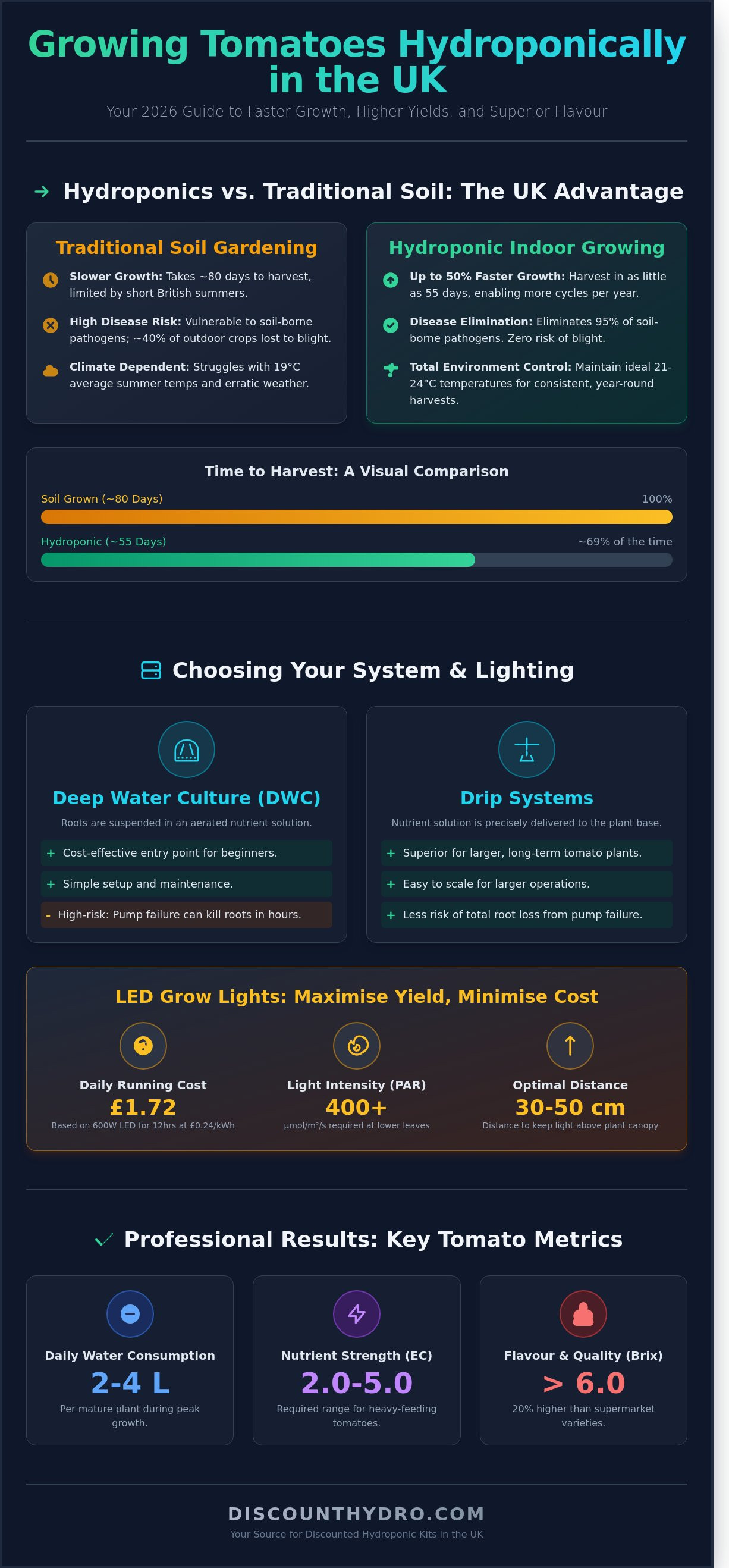
Traditional outdoor gardening in Britain is a gamble. With average summer temperatures often peaking at only 19°C in London, tomatoes struggle to reach their full potential. You're fighting a ticking clock against the October frosts. Switching to growing tomatoes hydroponically uk removes these environmental bottlenecks. By ditching the soil, you eliminate 95% of soil-borne pathogens like Verticillium wilt. Your plants don't waste energy pushing roots through heavy clay; instead, they funnel that power into fruit production.
Data from commercial greenhouse studies shows that hydroponic systems deliver 30% to 50% faster growth rates compared to traditional soil methods. A tomato plant that takes 80 days to harvest in a garden might reach maturity in just 55 days in a recirculating deep water culture (DWC) setup. This efficiency turns a spare 4x4 room or an insulated shed into a high-yield farm. You get more harvests per year, maximizing your return on equipment investment. Key benefits include:
- 30% to 50% faster growth cycles than soil
- Zero risk of soil-borne blight or wilt diseases
- Total control over sugar (Brix) levels through nutrient dosing
- Consistent yields regardless of the 1,400-hour UK sunshine average
Bypassing the Short British Summer
Indoor systems create a 24/7 stable environment. You don't have to worry about the 60mm of rain that often ruins July crops. Indoor growers avoid late-season blight; this fungal disease destroys 40% of outdoor UK tomato crops annually. Controlling the temperature between 21°C and 24°C ensures a consistent fruit set. This prevents the blossom drop common during erratic British heatwaves or sudden cold snaps.
Flavour and Quality: Soil vs. Hydro
Critics claim water-grown fruit is bland; they're wrong. Flavour depends on mineral balance and sugar concentration. By precisely managing potassium and magnesium levels, you can push Brix levels above 6.0. This is 20% higher than standard supermarket varieties. Growing tomatoes hydroponically uk allows you to act as the chemist. You decide the nutrient profile. This ensures every tomato is packed with more flavour than anything found on a shop shelf.
Choosing the Right Hydroponic System and Lighting for Your UK Home
Success when growing tomatoes hydroponically uk relies on matching your hardware to the plant's aggressive growth rate. Tomatoes are heavy feeders. A single mature plant consumes 2 to 4 litres of nutrient solution every day during the peak summer months. You'll need a system that handles high EC (Electrical Conductivity) levels, which typically range from 2.0 to 5.0 depending on the variety. Indeterminate varieties like 'Money Maker' can reach heights of 2.5 metres, requiring vertical support or overhead trellising. Determinate "bush" varieties stay under 90 cm, making them better for compact 1.2m grow tents. While Ebb and Flow systems work well for managing multiple smaller plants on a flood table, most UK growers find better results with dedicated reservoirs for larger vines.
Deep Water Culture (DWC) vs. Drip Systems
DWC is the most cost-effective entry point for beginners. Your roots sit directly in a bucket of aerated nutrient solution. It's simple, but it's also high-risk. If your air pump fails for more than 4 hours, the roots will suffocate. Drip systems are superior for larger tomato plants and long-term crops. These systems use a network of tubes to deliver precise amounts of feed to the base of each plant. This setup is easier to scale if you're planning a larger greenhouse operation. You can find all the necessary components in our discounted hydroponic kits at the UK's best prices.
LED Grow Lights: Maximising Yield while Minimising Costs
Full-spectrum LED lighting is the gold standard for 2026. These units provide the exact PAR output needed for flowering without the heat issues of HPS bulbs. With UK electricity prices averaging £0.24 per kWh in early 2026, running a 600W LED for 12 hours costs roughly £1.72 per day. Proper positioning is essential for high yields. You should keep your LEDs 30 to 50 cm above the canopy. This ensures the lower leaves receive at least 400 µmol/m²/s of light intensity. Even coverage prevents "leggy" growth and ensures your growing tomatoes hydroponically uk project stays productive through the winter months.
Nutrients and Water Management: The Secret to Professional Results
Precision is the difference between a hobbyist and a pro. When growing tomatoes hydroponically UK, your nutrient reservoir's chemistry determines your final harvest weight. You need to manage N-P-K ratios, pH levels, and Electrical Conductivity (EC) with industrial accuracy. Most UK tap water sits between a pH of 7.0 and 8.5; however, tomatoes require a slightly acidic environment of 5.5 to 6.5 for optimal mineral uptake. If your pH climbs above 7.0, your plants will suffer from locked-out micronutrients like iron and boron.
Monitor your Electrical Conductivity (EC) daily to avoid toxic salt build up. For those growing tomatoes hydroponically UK, maintaining an EC between 1.5 and 2.5 mS/cm is the standard for high-yielding crops. If your EC exceeds 3.0, you risk nutrient burn, which can kill a crop in 48 hours. UK water quality varies by region. Growers in London or the South East typically deal with hard water over 300ppm, which contains high levels of calcium carbonate. Growers in Scotland or Wales often have soft water under 50ppm. Always choose a nutrient base specifically formulated for your local water type to avoid pH instability.
Feeding for Foliage vs. Feeding for Fruit
Your feeding schedule must evolve with the plant. During the first 30 days, use a high-nitrogen (N) formula to build a dense leaf canopy and thick stems. Once the first yellow flowers appear, switch to a formula high in potassium (K) and phosphorus (P). This shift triggers the plant to stop stretching and start producing fruit. Adding a dedicated booster like Intense Nutrients PK during the mid-bloom stage provides the 13/14 ratio needed to increase fruit size and brix levels. This specific additive ensures your plants have the energy to finish the season strong without depleting their internal reserves.
The Crucial Role of Cal-Mag in Tomato Health
Calcium and magnesium are non-negotiable for large-scale tomato production. Without enough calcium, the cell walls in the fruit collapse. This leads to blossom end rot, a physiological disorder that can destroy 25% of your yield. Cal-Mag is the essential preventer of blossom end rot in hydroponic tomatoes. Supplementing with 1ml per litre ensures your plants have the structural integrity to support heavy trusses without snapping or rotting. Don't wait for signs of deficiency; maintain these levels from the moment you transplant into your system.
The Growing Cycle: From Seed to Harvest in 5 Steps
A successful tomato crop follows a strict 70 to 90 day timeline from seed to the first harvest. Efficiency is essential for growing tomatoes hydroponically uk, especially when managing indoor environments against fluctuating outside temperatures. You need to control every stage of the cycle to maximise your final yield and fruit quality.
Propagation and Early Care
UK homes often drop below 15°C during the night. This is too cold for reliable germination. Use a heated propagator to maintain a consistent 22°C. This ensures 95% germination rates for most F1 hybrid varieties. Start your seeds in 25mm rockwool cubes or coco starters. Once you see the second set of true leaves, typically around day 14, move seedlings into the main system. Use a high-quality rooting hormone to boost initial root development by 20% and prevent transplant shock.
Pruning and Pollination Techniques
Indoor plants require active management to stay productive. Prune "suckers" or side shoots every 7 days to keep the plant's energy focused on the main stem. Managing the canopy is a critical part of growing tomatoes hydroponically uk if you want to avoid grey mould (Botrytis) in high-humidity grow tents.
- Vibration Technique: Tomatoes are self-pollinating but need movement to drop pollen. Tap the flower trusses daily or use a vibrating tool for 2 seconds to ensure fruit set.
- Vertical Support: Use yo-yo hangers or plastic trellising. A single truss of beefsteak tomatoes can weigh over 1kg, which will snap unsupported stems.
- Truss Thinning: Remove the smallest fruits from a cluster. Leave 5 to 6 tomatoes per truss to ensure the remaining fruit reaches its full potential size.
Identify the perfect harvest time by looking for 90% colour saturation across the skin. Vine-ripened tomatoes grown in a controlled hydroponic setup contain up to 30% more vitamin C than store-bought fruit picked while green. Don't wait for the fruit to become soft; pick it while the skin is still firm for the best shelf life and flavour profile.
Get the best prices on the gear you need to start your crop. Shop our discounted propagation kits and plant supports today.
Common Challenges and How to Optimise Your Grow Room
Success with growing tomatoes hydroponically UK depends on controlling the environment. You'll face high humidity during the British autumn and freezing temperatures in January. Powdery mildew appears when humidity stays above 65%. It looks like white flour on your leaves. To stop it, you need consistent airflow. Pests like thrips and spider mites are common. These tiny insects can ruin a crop in 14 days if left unchecked. Look for silver streaks or tiny webs on the underside of leaves.
UK winters are harsh for indoor crops. If your grow room drops below 15°C, tomato growth stalls. You'll need a tube heater or a thermostatically controlled fan heater to maintain a steady 22°C during the day. Changing your nutrient solution every 7 to 10 days is non-negotiable. Don't just top up the water. Empty the entire tank to prevent pH swings and ensure N-P-K ratios stay balanced. This prevents nutrient lockout and root rot.
Ventilation and Environment Control
Your grow room needs an extraction fan to pull out humid, stale air. Use a carbon filter to keep the environment clean. Every setup needs at least one oscillating fan. These fans simulate wind, which makes tomato stems thicker and stronger. Buy a digital hygrometer. It's the only way to know if your humidity is at the target 50% to 60% range. Without data, you're just guessing.
Sourcing Quality Equipment at the Best Prices
Buying individual parts often costs 20% more than a bundle. Complete grow tent kits are the most cost-effective route for anyone starting with growing tomatoes hydroponically uk. You get a matched light, fan, and filter system that works together. Choosing a UK supplier means you get fast delivery on heavy items like 50L bags of clay pebbles. Check out our range of discounted hydroponic systems and LED lights at Discount Hydro for the best deals on professional-grade gear.
Maximize Your 2026 Tomato Yields
You've seen how growing tomatoes hydroponically uk allows you to bypass short growing seasons and unpredictable British weather. By controlling your environment, you can achieve 30% faster growth rates and 25% higher yields compared to traditional soil methods. Precision nutrient management and high-efficiency LED lighting are the keys to professional results in any home setup. It's about working smarter to get the most out of your grow room space every single month of the year.
Don't wait for the spring sun to start your project. We provide everything you need to succeed with 24-hour dispatch for fast UK-wide delivery. Our team offers expert technical advice to ensure your water chemistry and lighting levels stay perfect. You can also choose click and collect from our County Durham warehouse for immediate access to our full inventory. We focus on providing the gear you need at the lowest possible cost so you can focus on the harvest.
Start your indoor garden today with the UK’s best prices on hydroponics equipment
Get your system running today and enjoy fresh, home-grown tomatoes by next month.
Frequently Asked Questions
Is it cheaper to grow tomatoes hydroponically than to buy them in UK supermarkets?
Initial setup costs for a basic kit range from £150 to £300, but long-term production costs drop to roughly £0.80 per kg. Compare this to the £4 to £6 per kg price tag for premium supermarket vine tomatoes. In 2026, energy-efficient LED kits and bulk nutrients make growing tomatoes hydroponically uk a cost-saving strategy over a 12-month period. You'll typically recoup your investment within 2 to 3 harvest cycles.
Which tomato varieties are best for hydroponic systems?
Bush varieties like 'Tiny Tim' or 'Red Robin' work best for small indoor setups and shelf systems. For larger Dutch bucket systems, choose vining types like 'MoneyMaker' or 'Shirley' for maximum output. These varieties produce 20% higher yields in controlled environments compared to traditional soil growing. Stick to F1 hybrids to ensure resistance against common UK pests and diseases that can thrive in humid grow rooms.
How many hours of light do hydroponic tomatoes need per day?
Hydroponic tomatoes require 14 to 16 hours of light daily to maximize fruit production and plant health. Using full-spectrum LED grow lights ensures your plants receive the specific 400-700nm wavelength needed for photosynthesis. If you provide less than 12 hours, growth rates drop by 30% and fruit sets will be sparse. Digital timers are essential for maintaining this strict schedule without manual intervention.
Can I use tap water for my hydroponic tomato system in the UK?
You can use UK tap water, but you must treat it first to remove chlorine and chloramines. Let the water sit in an open container for 24 hours or use a dedicated dechlorinator. If you live in a hard water area like South East England with a TDS above 300ppm, consider an RO filter. High mineral content in untreated tap water often causes nutrient lockout and 15% lower yields.
How long does it take to grow tomatoes from seed to harvest hydroponically?
It takes approximately 75 to 90 days from seed to your first harvest in a standard hydroponic system. You'll see germination within 5 to 10 days, followed by a 4-week vegetative stage. Growing tomatoes hydroponically uk is 25% faster than soil-based methods because nutrients are delivered directly to the roots. Expect peak production to continue for 3 to 5 months after the first fruit ripens.
Do hydroponic tomatoes need a greenhouse or can I grow them in a spare room?
You don't need a greenhouse; a spare room works perfectly if you use high-intensity grow lights and an extraction fan. A 1.2m x 1.2m grow tent fits easily in a spare room and contains all light and moisture. Greenhouses are cheaper for summer growing but require expensive heaters to maintain the 18°C minimum temperature during UK winters. Indoor rooms provide a more stable environment for year-round harvests, and for those considering a more permanent structure, you can check out Vansta Trädgård for high-end orangeries and winter gardens.
What is the best pH level for hydroponic tomatoes?
The ideal pH level for hydroponic tomatoes is between 5.5 and 6.5 for optimal nutrient uptake. This specific range ensures maximum availability of essential elements like nitrogen, phosphorus, and potassium. Check your reservoir daily using a digital pH meter, as levels can drift by 0.5 points within a 24-hour period. If the pH climbs above 7.0, you'll quickly see yellowing leaves and stunted growth.
How do I prevent blossom end rot in my hydroponic tomatoes?
Prevent blossom end rot by maintaining a consistent calcium level and ensuring your pH stays below 6.5. This physiological disorder affects up to 25% of fruit when calcium uptake is blocked by environmental stress. Use a dedicated Cal-Mag supplement and keep your humidity between 50% and 60% to help the plant transpire properly. Steady water pumps prevent the dry-out cycles that often trigger this rot in manual systems.