

How Long Do Carbon Filters Last? The Ultimate Grower’s Guide (2026)
Your carbon filter doesn't have a fixed expiration date; it has a saturation point. While many hobbyists guess at the timeline, professional air hygiene is what actually dictates your replacement schedule. If you want to know how long do carbon filters last, you have to look at your environment rather than the calendar. A standard 4-inch filter currently retails between $35.99 and $99.99, so swapping it too early wastes your profit. However, waiting until odours escape is a security risk you simply can't afford.
You've likely seen the conflicting advice about "washing" carbon or felt the stress of a sudden smell leak in your grow room. It's frustrating when equipment costs eat into your budget without a clear schedule. We'll show you how to hit the 24-month lifespan maximum and provide the total odour security you need. This guide covers the April 2026 EPA disposal updates, current price benchmarks for 4-inch to 8-inch models, and the specific maintenance steps to lower your long-term equipment costs.
Key Takeaways
- Learn why high-quality activated carbon typically lasts 12 to 24 months and how to calculate the saturation point for your specific setup.
- Identify environmental killers like humidity levels over 70% and dust buildup that clog carbon pores and force expensive, early replacements.
- Master professional detection techniques to determine exactly how long do carbon filters last before odours escape your grow tent.
- Implement a simple 3-month maintenance schedule for your pre-filter to protect your equipment's efficiency and ensure maximum airflow.
- Apply the 20% Rule to match your extraction fan's output with the right filter capacity for peak performance and total odour control.
Understanding Carbon Filter Lifespan: How Long Do They Really Last?
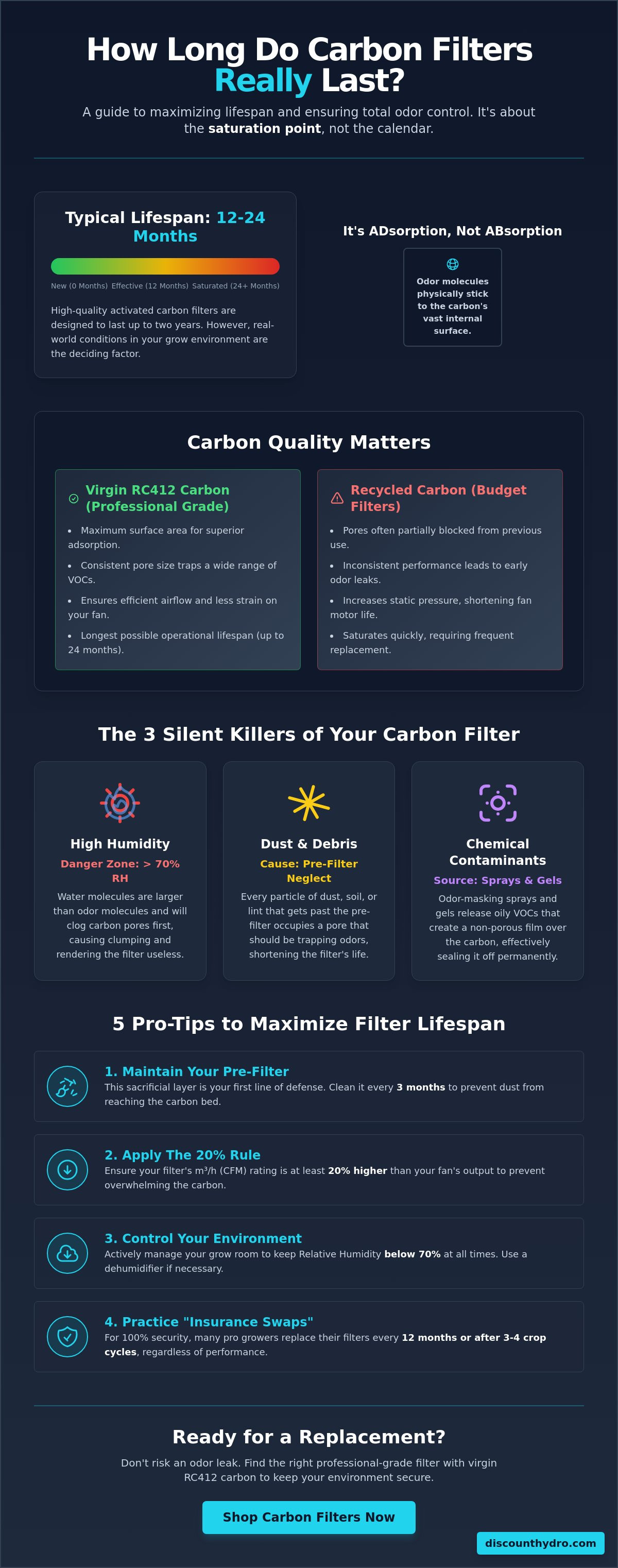
A high-quality carbon filter represents the primary line of defense against escaping odours in your grow room. Most professional-grade units using virgin activated carbon provide a functional lifespan of 12 to 24 months. This duration isn't a random guess; it's based on the physical limits of the carbon's surface area. To understand how long do carbon filters last, you must first understand the science of adsorption. Unlike a sponge that absorbs liquid, carbon uses a process where organic molecules physically stick to the internal pores of the charcoal. You can read more about how carbon filtering works to see how these microscopic craters trap volatile organic compounds.
Budget filters often feature a thin layer of carbon, which saturates quickly and leads to early failure. Professional thick bed filters, like those we stock at Discount Hydro, use a deeper layer of compressed carbon to ensure air has more contact time with the filtering media. If you run your extraction system 24/7, your filter will reach its saturation point faster than a system that only runs during lights-on periods. However, constant operation is usually necessary to maintain negative pressure and prevent smell leaks from your tent.
The 12-Month Rule vs. Reality
Many experienced UK growers don't wait for a filter to fail completely. They treat the 12-month mark or the end of 3-4 crop cycles as a mandatory insurance swap. Your specific air volume, measured in m3/h, dictates the speed of this decline. A fan pulling 1000m3/h through a filter rated for only 800m3/h will force molecules through too quickly for effective adsorption. Breakthrough is the specific moment when the carbon pores are completely full and odours pass through the exhaust entirely untrapped.
Virgin Carbon vs. Recycled Carbon
We prioritise virgin RC412 carbon because it offers the highest surface area per gram. Many cheap filters found on generic marketplaces use recycled carbon, which has already been used in industrial applications and re-activated through heat. This process often leaves the pores partially blocked or inconsistent in size. Poor pore size distribution doesn't just let smells through; it increases the static pressure on your extraction fan, which can shorten the life of your motor. Stick to virgin Australian or RC412 carbon to ensure your equipment stays efficient and your environment stays secure.
Environmental Factors That Kill Your Carbon Filter Early
While the standard rating for professional equipment is up to two years, your local environment often cuts that short. In the UK, ambient moisture is the primary culprit. If you're wondering how long do carbon filters last in a damp basement or a poorly ventilated attic, the answer is significantly less than the manufacturer's estimate. Environmental stress causes physical changes to the carbon bed that no amount of 'recharging' can fix.
High humidity levels above 70% represent the danger zone for your filtration system. Water molecules are physically larger and more "sticky" to carbon than most odour molecules. When RH spikes, the carbon bed pulls moisture directly from the air. This doesn't just make the filter heavy; it causes the activated carbon to clump together. Once clumping occurs, the air takes the path of least resistance, bypassing large sections of the filter and leading to immediate odour leaks.
Dust is the second major killer of air hygiene. Every particle of skin, soil, or lint that hits the carbon bed occupies a pore that should be trapping smells. Using smell-masking sprays or neutralising gels near your intake fan is another common mistake. These products release oily VOCs that coat the carbon in a film, effectively sealing the filter and rendering it useless within weeks. To keep your system running efficiently, check out our range of ventilation equipment to manage your environment better.
The Humidity Trap: Why 70% RH is the Danger Zone
In regions like County Durham or the Scottish Highlands, outdoor humidity often sits at 80% or higher during the winter months. If your intake air isn't pre-warmed or dehumidified, you're pumping saturated air directly into your carbon bed. This competition for space in the carbon pores is a losing battle for your odour control. Frequent temperature fluctuations exacerbate this, as cooling air inside the filter can cause water to condense directly onto the carbon granules, leading to permanent saturation.
Airborne Contaminants and Pre-Filter Neglect
That white fabric sleeve on the outside of your unit is a sacrificial layer designed to stop large debris. Maintaining a clean pre-filter is the easiest way to influence how long do carbon filters last in a working environment. If you use a humidifier with hard tap water, it releases calcium and magnesium dust into the air. This creates a white mineral crust on your pre-filter, choking your fan's ability to pull air and forcing the motor to run hot. Foliar sprays used inside the tent can also drift into the extraction system, gumming up the carbon pores. Clean air is the only way to ensure you get the full value out of your hardware.
How to Tell When Your Carbon Filter Needs Replacing
Identifying the end of a filter's life isn't always obvious until a neighbour complains. While environmental factors dictate the speed of decline, the symptoms of a spent carbon bed are predictable. If you're asking how long do carbon filters last in your specific setup, you need to monitor three key indicators: scent, airflow, and physical debris. Waiting for total failure puts your security at risk, so recognizing these early warning signs is essential for any professional indoor garden.
A saturated filter doesn't just stop trapping odours; it changes the entire dynamic of your grow room. When carbon pores are full, the filter acts like a physical wall. This restriction causes a noticeable spike in relative humidity (RH) inside the tent because the moisture-laden air can't escape fast enough. If your hygrometer shows a 10% to 15% increase in RH that you can't explain through watering or weather changes, your carbon bed is likely choked and requires an immediate swap.
The 'Peak Odour' Diagnostic
Nose blindness is a real threat to growers who spend hours in their rooms every day. To get an accurate reading, you must check the air directly at the exhaust port outside the tent. If you detect even a faint, sweet, or earthy scent during the peak of the flowering cycle, breakthrough has occurred. It's often helpful to bring in a "scent-neutral" observer who hasn't been exposed to the room to verify. Before blaming the filter, check your ducting connections. A loose jubilee clip or a 2mm tear in the foil ducting can leak more smell than a failing filter ever would.
Monitoring Static Pressure and Fan Strain
Your extraction fan provides the best clues about your filter's health. As the carbon bed and pre-filter accumulate dust and moisture, the static pressure increases significantly. You'll notice the fan's pitch change to a higher, more strained whine as it struggles against the resistance. This strain generates excess heat. If your room temperatures have climbed by 2 or 3 degrees Celsius without any changes to your LED settings, your filter is likely the bottleneck.
- Visual Check: Inspect the inside of your fan and ducting for "carbon fines." This fine grey dust indicates the carbon granules are breaking down and exiting the system.
- Airflow Test: Hold a piece of tissue near your intake vents. If the suction has weakened, the filter is likely blocked.
- Cost Ratio: Replacing a 4-inch filter for $35.99 is a minor expense compared to burning out a $200 EC extraction fan due to overwork.
Don't gamble with your equipment's longevity. By the time you see grey dust on your fan blades, the filter has been underperforming for months. Swapping your hardware at the first sign of increased fan noise or humidity spikes ensures total odour security and protects your more expensive ventilation investments.
5 Pro Tips to Make Your Carbon Filter Last Longer
Maximising the lifespan of your equipment is the easiest way to lower your overheads. You don't need expensive laboratory tests to extend the life of your gear. While the environment is the main factor, these five professional techniques directly impact how long do carbon filters last in a high-performance setting. Avoid the common mistake of vacuuming the carbon itself. Physical agitation can fracture the granules and create more dust, which permanently clogs the internal pores.
Keep your humidity levels below 60% whenever possible. As established in previous sections, moisture is the primary enemy of activated charcoal. By maintaining a drier environment, you ensure the carbon's "stickiness" remains reserved for odour molecules rather than water. You should also rotate your filter 180 degrees every six months. Gravity and constant suction can cause carbon granules to settle over time, creating thin spots at the top of the cylinder. A quick flip ensures even air distribution and prevents smells from "short-circuiting" through the bed.
Don't run your filter during the vegetative stage if odours aren't yet present. Many growers waste three or four weeks of a filter's life when the plants are small and scentless. If you don't need it, cap it and store it. Additionally, maintain a strict hydroponic nutrients regime to avoid root zone issues. Root rot doesn't just hurt your yield; it produces anaerobic gases like hydrogen sulfide. These molecules are far more aggressive than standard plant odours and will saturate your carbon bed significantly faster.
Pre-Filter Maintenance Routine
Wash your pre-filter every 8 to 12 weeks to maintain maximum airflow. This fabric sleeve is your first line of defense against dust and debris. To clean it, remove the sleeve and hand wash it in lukewarm water with a mild, residue-free detergent. Avoid hot water and tumble dryers, as these will shrink the fabric and make it impossible to slide back onto the metal cylinder. Use the "light test" to verify its condition. Hold the clean, dry sleeve up to a bright LED. If the light is blocked or patchy, the fibres are permanently clogged with minerals or fine dust, and it's time for a replacement.
Strategic Filter Use and Storage
Carbon is active even when your extraction fan is turned off. If you're between crop cycles, cap both ends of the filter with heavy-duty plastic and tape it shut. This prevents the carbon from "passively" adsorbing moisture or household smells while it's in storage. Furthermore, ensuring you have a correctly sized grow tent prevents your fan from overworking. When a fan runs at 100% capacity to compensate for an undersized space, the high air velocity reduces the contact time between molecules and the carbon bed, leading to faster saturation.
Keep your air clean and your costs low with our replacement carbon filters at the UK's best prices.
Choosing the Right Replacement Filter at Discount Hydro
When your current unit hits its saturation point, selecting the right replacement is about technical compatibility, not just finding the lowest price. To maximise how long do carbon filters last, follow the 20% Rule. Your filter's m3/h rating must be at least 20% higher than your fan's maximum output. If your extraction fan moves 500m3/h, your filter should be rated for at least 600m3/h. This ensures the air stays in contact with the carbon long enough for total adsorption. Swapping out an old unit for a correctly matched system refresh is the only way to guarantee 100% odour security.
We stock industry-leading brands like Rhino and CarboAir because they're built for the damp UK climate. Based on May 2026 market data, a high-quality 4-inch filter costs between $35.99 and $99.99, while larger 8-inch models for professional rooms range from $59.99 to $219.99. Investing in a 'Tall' filter provides more surface area for larger tents, while 'Short' or 'Junior' versions are designed for tight spaces where every centimetre of height matters. Buying a complete fan and filter kit often secures a better deal than purchasing components separately.
Calculating the Correct Size for Your Space
Matching your fan's CFM or m3/h to your filter's capacity is simple math that prevents equipment failure. An oversized filter lasts longer and runs quieter because it creates less static pressure on the fan motor. This reduced resistance means your fan doesn't have to spin at 100% to clear the room, saving you money on electricity and extending the motor's life. The filter's airflow rating must always be higher than the fan's maximum output to prevent odour molecules from being forced through the carbon bed too quickly.
Why Quality Carbon Matters for UK Growers
The difference between a cheap marketplace filter and a professional unit lies in the carbon type. Pelletised carbon is compressed into uniform cylinders, which is excellent for durability and high-pressure fans. Granulated carbon, like the virgin RC412 found in Rhino Pro filters, offers a massive surface area with varied pore sizes to trap a wider range of organic molecules. We prioritise virgin carbon over recycled alternatives because it's the only way to ensure a full 24-month lifespan in typical UK growing conditions.
If you're in the North East, our 'Click and Collect' service in County Durham lets you pick up bulky filters and fans without paying for pallet shipping. It's the fastest way to refresh your air hygiene system and maintain total privacy.
Browse our range of high-performance carbon filters and get the UK's best prices on professional odour control today.
Secure Your Grow Room with Professional Air Hygiene
Maintaining total odour security requires a proactive approach to equipment maintenance. You now know that while 12 to 24 months is the standard, your specific environment and air hygiene habits dictate the real timeline. By managing humidity below 60% and following the 20% sizing rule for your extraction fan, you protect your investment and your privacy. Understanding how long do carbon filters last in your setup is the difference between a successful harvest and a security breach.
Don't wait for odours to escape or for your fan to struggle against a clogged bed. We stock industry-leading brands like Rhino and Omega to ensure you get the maximum possible lifespan from your hardware. With fast UK-wide delivery and Click and Collect available at our County Durham warehouse, refreshing your system is simple and cost-effective. Shop the UK's best prices on Carbon Filters and Extraction Kits today to keep your environment clean and secure. Your equipment should work as hard as you do.
Frequently Asked Questions
Can I wash or 'reactivate' my carbon filter at home?
No, you can't reactivate activated carbon using domestic appliances. Professional reactivation requires industrial furnaces reaching temperatures over 800 degrees Celsius to vaporise trapped organic molecules. Attempting to "bake" a filter in a home oven is a fire hazard and will only release concentrated odours back into your property without restoring the carbon's adsorption capacity.
Does high humidity permanently ruin a carbon filter?
Persistent humidity levels above 75% cause irreversible physical damage to the carbon bed. Water molecules saturate the pores and cause the granules to clump together into a solid mass. Once this clumping occurs, air can't pass through the carbon evenly, and the filter's effective surface area is permanently reduced, even after the unit dries out.
How do I know if the smell is coming from the filter or a leak?
Use a smoke pen or a stick of incense to trace the airflow around your ducting joins and jubilee clips. If you see smoke being pulled into a connection point, you have a mechanical leak that needs sealing with foil tape. Spent filters usually produce a sweet, earthy scent at the exhaust, while leaks carry the raw, pungent odour of the room.
Should I leave my carbon filter on 24/7?
Yes, you must run your extraction system 24/7 to maintain constant negative pressure inside your grow tent. If you turn the fan off, odours will passively escape through intake vents, zips, and stitching. Continuous airflow also prevents moisture from stagnating inside the carbon bed, which protects the unit from premature saturation during the lights-off period.
Is it better to pull air through a filter or push it through?
Pulling air through the filter is the most efficient configuration for both the fan motor and odour control. It ensures the air is distributed across the entire surface of the carbon bed for maximum contact time. Pushing air through the filter is roughly 15% less efficient and increases the risk of odours leaking through ducting seams before they reach the carbon.
Can I use a carbon filter for my kitchen or other household odours?
Carbon filters are excellent for removing household VOCs, tobacco smoke, and strong cooking smells. They trap the gas-phase pollutants that standard HEPA filters can't catch. Many users install a small 4-inch extraction kit in workshops or basements to maintain a neutral scent profile and improve overall indoor air quality.
How much does a replacement carbon filter cost in 2026?
Current May 2026 market rates for a 4-inch filter range from $35.99 to $99.99. A 6-inch filter typically costs between $76.07 and $199.99, while large 8-inch models retail from $59.99 up to $219.99. These price variations depend on the depth of the carbon bed and the quality of the activated charcoal used.
What happens if I don't use a pre-filter?
Skipping the pre-filter allows large dust, hair, and soil particles to clog the microscopic pores of the carbon bed. This physical blockage happens much faster than chemical saturation. Without this sacrificial layer, your estimate of how long do carbon filters last will drop by at least 50% as the unit chokes on airborne debris.