

How to Control Humidity in a Grow Tent: The Ultimate UK Guide 2026
A single week of 75% relative humidity during the final flowering stage can wipe out 100% of your hard-earned yield. Growing in the UK is a constant battle against damp air and fluctuating temperatures. You've likely felt that sinking feeling when you spot the first signs of grey mould or realise your electricity bill is skyrocketing because a dehumidifier never switches off. It's frustrating when you're trying to save money but the environment won't cooperate. Mastering how to control humidity in grow tent uk environments is the only way to protect your investment and ensure a heavy harvest.
This guide shows you exactly how to manage moisture without draining your bank account. You'll learn to balance Vapor Pressure Deficit (VPD) and ambient humidity to keep plants healthy and transpiration rates high. We'll break down the specific equipment upgrades, from efficient extractors to cost-effective dehumidifiers, and the environmental tweaks needed to maintain stable levels despite the 1,200mm of average annual UK rainfall. Get ready to secure a mould-free finish and professional results every time.
Key Takeaways
- Learn how to control humidity in grow tent UK environments by navigating the unique challenges of our damp British climate and managing intake air levels.
- Discover why Vapour Pressure Deficit (VPD) is the true metric for plant health and how to balance leaf temperature with moisture for the "Goldilocks Zone."
- Identify the essential high-efficiency extraction fans and dehumidifiers needed to maintain a stable environment while securing the UK's best prices.
- Master professional techniques for managing sudden night-time humidity spikes and drying out your tent effectively after heavy watering sessions.
- Optimise your grow room layout by selecting the right tent size and air-flow equipment to ensure peak performance without breaking the bank.
Understanding Humidity and the UK Climate Challenge
Relative Humidity (RH) represents the amount of water vapour present in the air compared to the maximum amount that air can hold at its current temperature. For indoor gardeners, this metric is the primary driver of plant health and nutrient transport. In 2026, professional growers must track two distinct environments: the 'lung room' where your tent sits and the internal tent environment itself. A 12% difference between these two spaces can lead to localised microclimates that trigger crop failure. If you don't master how to control humidity in grow tent uk environments, you risk losing your entire investment to environmental stress.
High moisture levels lead to devastating mould outbreaks, particularly Botrytis, which can destroy a harvest in under 48 hours. Conversely, excessively dry air forces plants to close their stomata to preserve water, effectively halting photosynthesis and nutrient uptake. Maintaining the correct balance ensures your fans, filters, and lights work efficiently without overworking your electrical circuits or wasting expensive fertilisers.
Why the UK Climate is Unique for Growers
The British Isles present a specific set of challenges due to naturally high ambient moisture. In coastal regions or during the autumn months, outdoor RH levels often sit between 75% and 92%. When your intake fan pulls this air into a 1.2m or 2.4m tent, you're introducing litres of water into the atmosphere every hour. During 'wet winters', the problem shifts. While central heating might drop your house humidity to 30%, the cold walls of a spare room or garage create condensation points. This temperature differential can cause a 5°C drop at the tent intake, leading to 100% RH at the point of entry. Managing these 20% to 30% swings is essential for consistent yields.
The Biological Impact on Your Plants
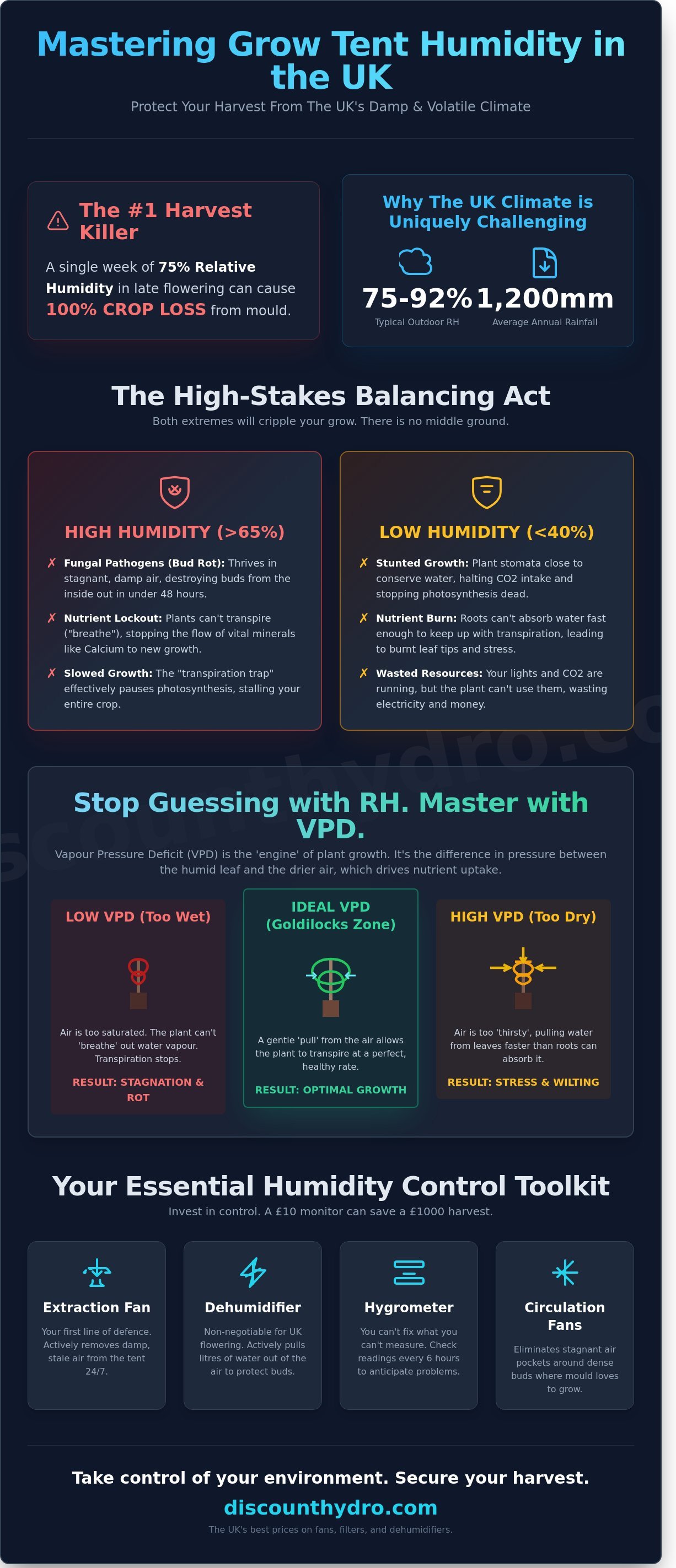
Plants rely on transpiration to move nutrients from the roots to the canopy. This process is entirely dependent on the vapour pressure deficit between the leaf and the air. When humidity exceeds 70% in the flowering stage, the 'transpiration trap' occurs. The air is too saturated to accept more moisture, so the plant stops drinking. This results in calcium deficiencies and nutrient lockout, even if your coco or soil is perfectly balanced. You'll see the first signs of stress as 'clawing' leaves or slow growth rates. By the time visible mould appears, the internal vascular system of the plant has likely been compromised for several days. Monitoring your hygrometer every 6 hours is the only way to catch these shifts before they become permanent failures.
- Stunted Growth: Occurs when RH drops below 40%, causing stomata to close and stopping CO2 absorption.
- Fungal Pathogens: These thrive when RH consistently sits above 65% in stagnant air, leading to bud rot.
- Nutrient Lockout: Triggered by the inability of the plant to transpire in high-moisture environments, preventing mineral transport.
To succeed, you need to treat your grow tent as a closed ecosystem. Knowing how to control humidity in grow tent uk cycles means adapting your extraction rates based on the external weather forecast. A rainy Tuesday in Manchester requires a different fan speed and dehumidifier setting than a dry, frosty morning in London. Every £10 spent on environment monitors can save £100s in lost crops and wasted electricity.
The VPD Framework: Balancing Heat and Moisture
Most UK growers fixate on Relative Humidity (RH) as a standalone figure. This is a fundamental mistake. RH only tells you how much moisture the air holds relative to its maximum capacity at a specific temperature. It doesn't tell you how your plants actually feel. Vapour Pressure Deficit (VPD) is the metric that matters. It measures the difference between the moisture inside the leaf and the moisture in the surrounding air. This pressure gap is the "Goldilocks Zone" for plant health. Understanding this relationship is the most effective way to master how to control humidity in grow tent uk setups during any season.
Think of VPD as the engine driving your plant's metabolism. Inside a healthy leaf, the humidity level is nearly 100%. If the air in your tent is too dry, the VPD is high. This forces the plant to lose water too quickly, leading to wilt or nutrient burn as the roots struggle to keep up. If the air is too damp, the VPD is low. The plant stops transpiring entirely. This creates a stagnant environment where calcium can't move through the plant tissue, and pathogens like botrytis take hold. A 70% RH might be perfect at 25°C, but at a cooler 18°C, it becomes a lethal environment for your crop.
What is VPD and Why Should You Care?
VPD acts as the primary force pulling water and nutrients from the root zone to the canopy. When the air is drier than the leaf interior, water evaporates through the stomata. This creates a suction effect. It's how essential minerals like calcium and magnesium reach the top of the plant. If you don't manage this pressure, the "suction" breaks. You'll see stunted growth and yellowing leaves even if your nutrient solution is perfect. High humidity is acceptable at high temperatures because the air can hold the moisture. At low temperatures, that same humidity level prevents evaporation, effectively choking the plant's vascular system.
Practical VPD Management for Beginners
You don't need a degree in physics to manage VPD. Start by getting an accurate reading of your environment. A standard hygrometer is a good start, but you also need an infrared thermometer to check your leaf surface temperature (LST). In most UK grow rooms using LED lights, the leaf temperature is usually 2°C lower than the ambient air temperature. Once you have these figures, you can use a VPD chart to see if you're in the "green zone."
- Vegetative Stage: Aim for a VPD between 0.8 and 1.1 kPa. This encourages lush leaf growth without over-stressing the roots.
- Flowering Stage: Target a higher VPD of 1.2 to 1.5 kPa. This helps prevent mould in dense flower clusters and encourages resin production.
If your VPD is too high, you can bring it back into range by increasing humidity or lowering the room temperature. If it's too low, you'll need to turn up your extraction fans or introduce a dehumidifier to strip moisture from the air. Small adjustments often yield the best results. Opening a passive intake vent or increasing your fan speed by 10% can move your kPa readings significantly within thirty minutes.
Modern LED light intensity also dictates your humidity requirements. LEDs don't emit the same radiant heat as old HPS bulbs, meaning leaves stay much cooler. Because cool leaves transpire less, you'll often need to run a lower RH in a UK winter to keep the VPD in the sweet spot. If you're running high-performance LEDs at 100% power, your plants have a higher metabolic demand. They need the air to be dry enough to allow for cooling through evaporation, but moist enough to prevent the stomata from slamming shut in self-defence. Balancing these factors is the secret to professional-grade results.
Essential Equipment for Humidity Control
Managing moisture levels requires more than just opening a tent zip. You need a coordinated system of hardware to maintain the "sweet spot" for plant health. High-quality extraction fans serve as your primary tool for removing humid air. Without constant air exchange, transpiration from leaves quickly saturates the environment, leading to stagnant pockets of air where mould thrives. Relying on cheap, undersized fans is a common mistake that leads to crop failure. Investing in the right kit from the start saves money on lost yields and energy bills.
Extraction and Air Exchange
To determine the fan size you need, calculate the volume of your tent in metres. Multiply Length x Width x Height to get the cubic capacity. For a standard 1.2m x 1.2m x 2m tent, the volume is 2.88m3. You should aim to cycle this air 60 times per hour. Factor in a 25% to 30% efficiency loss caused by your carbon filter and ducting bends. A fan rated for at least 350m3/h is the minimum requirement for this setup. Using an active intake fan is a reliable way of how to control humidity in grow tent uk setups because it forces fresh, drier air into the space rather than relying on passive vents. If your carbon filter is over two years old, it may be clogged with dust, significantly reducing your fan's ability to pull moisture out of the tent.
Dehumidification Strategies
UK growers face unique challenges due to the damp maritime climate. When selecting a dehumidifier, choose between compressor and desiccant models. Compressor units are cheaper to run but lose efficiency below 15°C. Desiccant models work brilliantly in cold UK sheds or garages but consume more electricity. Instead of cramming a bulky unit inside your tent, use the 'lung room' technique. Place the dehumidifier in the room where your tent is located. This treats the air before it's pulled into the intake, creating a stable buffer zone. With UK electricity prices averaging 28p per kWh in 2024, running a 250W dehumidifier costs roughly £1.68 per 24 hours. Use a plug-in timer to run the unit during off-peak hours if you're on an Economy 7 tariff to slash these costs.
The LED Temperature Paradox
Modern LED grow lights are efficient, but they create a specific problem: they don't produce enough waste heat. Cold air holds less water vapour than warm air, meaning your relative humidity (RH) will naturally spike when the lights are on. If your tent temperature drops to 18°C, your RH might hit 80%, even if the actual water content in the air hasn't changed. To fix this, you must raise the temperature. Small 120W tube heaters or 60W heat mats are essential for LED growers. These tools raise the ambient temperature, which lowers the RH percentage. Digital fan controllers are also vital. They automatically slow down your extraction fans when temperatures drop, helping you retain heat while still exhausting enough moisture to prevent bud rot. This balance is the most effective way of how to control humidity in grow tent uk during the winter months.
- Circulation Fans: Use at least two 6-inch clip-on fans for a 1.2m tent to eliminate micro-climates.
- Smart Controllers: Units like the AC Infinity Controller 69 allow for automated triggers based on VPD (Vapour Pressure Deficit).
- Hygrometers: Always use a calibrated digital hygrometer with a min/max memory function to track humidity spikes during the dark cycle.
Troubleshooting Common Humidity Problems
Managing a grow environment in the UK is a constant battle against external conditions. You'll face damp autumns and bone-dry winters where central heating wreaks havoc on your internal climate. Learning how to control humidity in grow tent UK setups involves more than just plugging in a machine; it requires a tactical response to daily and seasonal shifts. If your hygrometer shows a reading above 70% during the flowering stage, you're in the danger zone for rot and mould. You must act within 24 hours to bring those levels down to a safe 45% to 50% range.
When you finish a heavy watering session, your pots can release litres of moisture into the air through evaporation and transpiration. This often leads to a "damp tent" scenario. To dry it out, increase your extraction fan speed by 20% for at least four hours post-watering. Ensure your oscillating fans are positioned to move air across the top of the pots and the undersides of the leaves. This prevents stagnant pockets of wet air from settling around the stems, which is where most fungal issues begin.
Solving the Night-Time Spike
The most common failure point for UK growers is the lights-off period. When your HPS or LED lights shut down, the temperature in the tent can drop from 25°C to 18°C in minutes. Cold air cannot hold as much water vapour as warm air, so your relative humidity (RH) will naturally spike, often by 15% or more. This creates a "dew point" where moisture condenses directly onto your flowers. To stop this, you must leave your extraction fans running 24/7. Never put your extraction on the same timer as your lights. Keeping the air moving ensures that moist air is constantly replaced by fresh air from the room.
- Use a tube heater: A small 45W or 80W greenhouse heater can maintain a stable minimum temperature, preventing the RH from hitting 80% during the night.
- Dehumidify the intake room: It's easier to dry the air in the room where your tent sits than to fight the air inside the tent itself.
- Check sensors: Cheap sensors can drift by 10% over six months. Recalibrate or replace them every two cycles to ensure your data is accurate.
Seasonal Adjustments for the UK
UK winters present a unique challenge. While the air outside is often wet, your indoor air becomes incredibly dry due to central heating. This can pull your tent humidity down to 30%, which stalls growth. In this specific case, you might need to turn your extraction down to its minimum setting to trap moisture. Conversely, during a UK summer heatwave, humidity often surges right before a thunderstorm. During these 30°C peaks, you'll need maximum extraction and potentially a dedicated dehumidifier to keep your late-stage flowers from spoiling.
Managing the final three weeks of flowering is the most critical period for any grower. At this stage, your plants are at their densest and most vulnerable. You should aim for a rock-solid 40% to 45% RH. If you can't reach these numbers with fans alone, it's time to invest in professional kit. High-quality gear pays for itself by protecting your harvest from total loss due to grey mould or mildew.
Don't let high humidity ruin your hard work. Check out our range of discounted extraction fans and climate controllers to keep your environment perfect all year round.
Optimising Your Setup with Discount Hydro
Maximising your yields depends on your ability to maintain a stable environment. At Discount Hydro, we provide the hardware you need to manage moisture levels without overspending. Choosing the right grow tent size is your first line of defence. A tent that's too small for your plant count leads to stagnant air pockets and rapid moisture buildup. For example, a 1.2m x 1.2m tent provides 2.88 cubic metres of air volume. Increasing this to a 1.5m x 1.5m space adds nearly 60% more air volume, which acts as a buffer against sudden spikes. This extra space allows for better air circulation around the canopy, making it much easier to understand how to control humidity in grow tent uk setups during a damp British autumn.
Your extraction system is the engine of your grow room. We stock high-efficiency EC fans that offer precise speed control. Unlike older AC fans that run at 100% or hum loudly when dimmed, modern EC fans use up to 30% less electricity. Investing £150 in a high-quality silenced fan often pays for itself within 12 months through reduced energy bills. Pair these with our premium carbon filters to ensure 100% odour control while maintaining maximum airflow. A clogged or cheap filter can restrict air movement by 40%, forcing your fan to work harder and allowing humidity to climb to dangerous levels above 70%.
Data is your best tool for success. Smart sensors and monitors allow you to track Vapor Pressure Deficit (VPD) in real-time. VPD is a more accurate metric than relative humidity alone because it measures the drying power of the air. If your VPD drops below 0.8 kPa during the flowering stage, your plants stop transpiring effectively. Our digital hygrometers provide min/max readings, so you'll know exactly if your levels peaked while you were asleep. Preventing a single case of grey mould can save a crop worth over £500, making a £30 sensor a vital investment.
Professional Gear for Precise Control
We supply complete extraction kits designed for the UK climate. These kits include matched fans, filters, and ducting to ensure 100% compatibility. Our tents feature thick 600D or 1680D Mylar lining, which provides superior thermal insulation and light containment. This helps maintain a steady internal temperature, which is essential for humidity control. We recommend matching your extraction to your light wattage; a 600W HPS light typically requires a fan capable of moving at least 400m3 of air per hour to stay cool and dry.
Start Your Humidity-Controlled Grow Today
If you're unsure which fan or dehumidifier fits your space, contact our Chester-le-Street team for a custom equipment recommendation. We've helped thousands of growers solve climate issues with practical, budget-friendly solutions. We offer fast UK-wide delivery, ensuring you get your gear exactly when you need it. Don't let high moisture levels ruin your hard work. Check out our inventory today to see why we're known for the UK's best prices on professional gardening hardware.
Master Your Environment for Maximum 2026 Yields
Managing an indoor garden in Britain means fighting external humidity levels that often exceed 80% during the wet winter months. You've now got the blueprint to maintain a Vapour Pressure Deficit between 0.8 and 1.2 kPa during the vegetative stage. This precision prevents stalled growth and keeps your plants transpiring at peak efficiency. Success relies on high-quality dehumidifiers and extraction fans capable of 20 full air changes every hour. Learning how to control humidity in grow tent uk environments is the most effective way to protect your investment from damp and rot.
Don't leave your crops to chance when the weather turns. We stock the industry's most reliable climate kit at our County Durham trade centre. You'll benefit from our best price guarantee on leading brands and fast UK-wide delivery to your door. Our team offers expert technical advice based on 15 years of professional hydroponic supply experience to ensure you get the right setup for your specific floor space.
Shop the UK’s best prices on grow tent climate control
Take control of your grow room today and see the results in your next harvest.
The principles of quality and protecting your investment are universal. For those who appreciate fine craftsmanship in other areas of life, you might want to visit Primehide Trade for their range of high-quality leather goods.
Frequently Asked Questions
What is the ideal humidity for a grow tent in the UK?
Your ideal relative humidity (RH) depends entirely on the growth stage of your plants. Seedlings require high levels between 70% and 80%, while the vegetative stage performs best at 50% to 70% RH. Once you enter the flowering stage, you must drop levels to 40% or 50% to prevent bud rot. These specific targets ensure your plants transpire correctly in the UK's often damp temperate climate.
How do I lower the humidity in my grow tent without a dehumidifier?
Increase your extraction fan speed to pull more moisture-laden air out of the tent immediately. This is the most effective method for how to control humidity in grow tent uk setups when you don't have extra equipment. You can also add 2 or 3 clip-on fans to improve internal airflow or remove 15% of the lower fan leaves to reduce transpiration. Keeping the floor bone dry and avoiding over-watering prevents excess moisture from building up.
Why is my humidity so high when the lights are off?
Humidity spikes during the dark cycle because cool air cannot hold as much water vapour as warm air. When your LED or HPS lights turn off, temperatures typically drop by 5 to 10 degrees Celsius in a standard UK spare room. This causes the relative humidity to rise even if the actual water content in the air remains the same. You'll need to keep your extraction fans running 24 hours a day to stop this moisture from settling on your plants.
Can I use a bowl of water to increase humidity in my tent?
You can use a bowl of water to raise humidity, but it usually only increases levels by 2% to 5% in a 1.2m x 1.2m tent. Placing a wet towel in front of an intake fan is a more effective low-cost trick because the increased surface area speeds up evaporation. For a reliable solution, a 4-litre ultrasonic humidifier is a better choice. It provides consistent moisture levels that a simple bowl can't match during dry winter months.
Does an extraction fan actually lower humidity?
An extraction fan lowers humidity by replacing the damp air inside your tent with drier air from the surrounding room. If your room humidity is 45% and your tent is 70%, a high-quality 4-inch or 6-inch extractor will quickly balance these levels. It's your primary tool for air exchange. Without a constant flow of fresh air, moisture from plant transpiration becomes trapped, leading to stagnant conditions and potential mould issues.
How much does it cost to run a dehumidifier in a grow tent UK?
Running a 250W compressor dehumidifier costs approximately 6p per hour based on the April 2024 UK energy price cap of 24.5p per kWh. If you run the unit for 12 hours a day, you'll spend about 72p daily or £5.04 per week. Smaller peltier units use only 20W to 40W of power, costing less than 1p per hour. However, these smaller models only remove about 250ml of water daily, which isn't enough for larger grow spaces.
Is 70% humidity too high for the flowering stage?
Yes, 70% humidity is far too high for the flowering stage and significantly increases the risk of botrytis or powdery mildew. You should aim for a range of 45% to 55% during this critical period to protect your harvest. High moisture levels trapped in dense flower clusters can ruin a crop in less than 48 hours. If your levels stay above 65%, you must increase extraction or invest in a dehumidifier to protect your investment.
What is the difference between a hygrometer and a VPD sensor?
A hygrometer measures the percentage of water vapour in the air, whereas a Vapor Pressure Deficit (VPD) sensor calculates the relationship between temperature and humidity. While a standard £10 hygrometer tells you the RH, a VPD controller uses 2 or 3 data points to tell you if your plants can actually breathe. Maintaining a VPD between 0.8 and 1.2 kPa ensures your plants' stomata stay open, which is much more accurate than following RH levels alone.