

How to Prepare Tap Water for Hydroponics: A Step-by-Step Guide (2026)
Buying distilled water is an unnecessary drain on your grow room budget when the solution is already in your pipes. Most indoor gardeners assume tap water is a constant variable, but untreated water is often the hidden cause behind nutrient lockout and chemical burn. If you've seen your plants struggle despite using high-quality LED grow lights and premium nutrients, your water source is the likely culprit. Learning how to prepare tap water for hydroponics is the most cost-effective way to stabilize your system and protect your root zones from algae or mineral buildup.
You want healthy plants without the high price tag of constant water deliveries. We agree that managing pH and EC readings shouldn't feel like a chemistry experiment. This guide provides a clear, low-cost method to transform standard UK tap water into a perfect, nutrient-rich environment for your indoor garden. You'll learn how to handle chlorine, account for 2026 water safety standards, and use tools like digital pH pens to get professional results. We'll walk through every step to ensure you can use your nutrients with total confidence.
Key Takeaways
- Neutralise chlorine and chloramine using simple aeration or chemical methods to prevent root damage and chemical burn.
- Follow the step-by-step guide on how to prepare tap water for hydroponics to avoid nutrient lockout and ensure healthy root systems.
- Use pH adjustment tools and specific hard-water nutrients to manage mineral levels and maintain an optimal 5.5 to 6.5 pH range.
- Save on operational costs by transforming standard UK tap water into a reliable nutrient base instead of buying distilled water.
- Recognise the EC 0.8 limit where tap water minerals interfere with plant growth and require a move to professional filtration.
Understanding Tap Water Composition for Hydroponic Systems
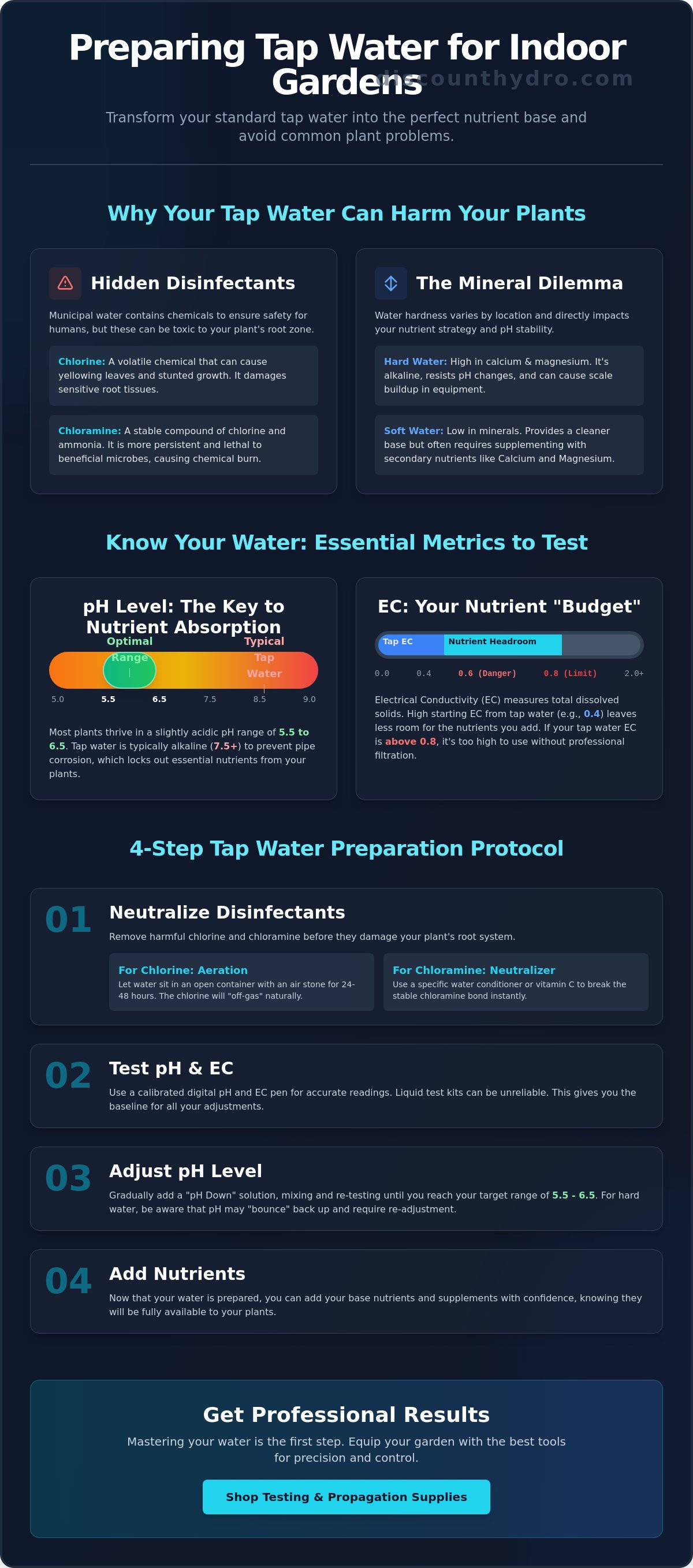
Tap water is a complex chemical solution. It contains minerals, disinfectants, and heavy metals that impact plant health. Soil provides a buffer for these elements, but hydroponic systems do not. Understanding your water's contents is the first step in learning how to prepare tap water for hydroponics. Background minerals contribute to your initial EC (Electrical Conductivity) readings. If you don't account for these, your final nutrient concentration will be too high. This leads to nutrient lockout and wasted supplies. Heavy metals like lead or copper can also accumulate in systems over time. For a comprehensive overview of hydroponics, you can see how water quality remains the foundation of every successful grow.
The Problem with Chlorine and Chloramine
UK municipal supplies rely on chlorine and chloramine for disinfection. These chemicals are effective for safety but lethal to beneficial microbes. Disinfectants don't discriminate; they kill the biology you want in your root zone. Chlorine toxicity symptoms include yellowing leaves and stunted growth. Chlorine is volatile and eventually leaves the water as a gas. Chloramine is different. It's a bond of chlorine and ammonia that stays stable for weeks. Standard "off-gassing" won't remove it. You must use specific neutralisers or high-quality filtration to clear it. Without treatment, these disinfectants cause chemical burn on sensitive root tissues.
Hard Water vs. Soft Water in the UK
UK water hardness depends on your postcode. Regions in the South and East typically have hard water. This means high levels of calcium carbonate. Hard water is alkaline and resists pH changes. You'll need more "pH Down" to hit your target range. Soft water regions, common in the North and West, have low mineral content. While this provides a "cleaner" base, it often lacks essential calcium and magnesium. Growers in these areas must add secondary nutrients to avoid deficiencies. Water hardness dictates your choice of Plant Nutrients & Supplements. Hard water also tends to cause scale buildup in pumps and Pots, Trays, and Systems.
For those looking to manage hard water at the source without using plant-damaging salts, you can explore Hydrokube (Modèle domestique), an ecological CO2-based solution that prevents limescale and protects your hydroponic equipment.
Testing Your Water: Essential Metrics for Success
Your local water report is a historical document, not a live guide. It provides a general idea of what flows through municipal pipes, but it doesn't account for seasonal shifts or the specific plumbing in your building. Professional growers don't guess. They test. Real-time testing before every reservoir change is the only way to establish a reliable baseline for your indoor garden. If you want to know how to prepare tap water for hydroponics effectively, you need a snapshot of what's in your bucket right now. This data allows you to adjust your inputs rather than following a generic feeding schedule that might overwhelm your plants.
Measuring Electrical Conductivity (EC) and PPM
Electrical Conductivity (EC) measures the total dissolved solids and salts in your source water. In many UK regions, tap water starts with an EC between 0.3 and 0.5. If your reading hits the "danger zone" of 0.6 or higher, you have a problem. A high starting EC significantly limits your nutrient overhead. For example, if your target is 2.0 EC and your water starts at 0.7, you can only add 1.3 EC of actual plant food. Pushing beyond these limits leads to tip burn and root stress. You must know your starting number to calculate exactly how much room you have for additional minerals.
Monitoring pH Levels and Alkalinity
Tap water is almost always alkaline. Water companies typically keep it between 7.5 and 8.5 pH to prevent pipe corrosion. Most hydroponic crops require a much lower range of 5.5 to 6.5. You must also understand alkalinity, which is the water's buffering capacity. High alkalinity means the water will fight your efforts to lower the pH, causing the level to "bounce" back up within hours. This introduction to home hydroponics systems confirms that maintaining the correct nutrient balance is the primary driver of yield.
Precision requires the right gear. Digital pH and EC pens are the industry standard for a reason. While liquid drop kits are a low-cost entry point, they're difficult to read accurately under the specific spectrum of modern LED Grow Lights. Investing in reliable Propagation Supplies and testing tools ensures your data is accurate. Mastering how to prepare tap water for hydroponics requires this daily monitoring to catch shifts in alkalinity before they cause nutrient lockout. Establishing a consistent testing routine is the most pragmatic way to protect your investment and ensure a high-value harvest.
Practical Methods for Neutralising Chlorine and Chloramine
Testing your water reveals the chemical baseline, but active removal is the next phase. Most UK tap water contains disinfectants that stay active long after the water leaves the tap. If you don't remove these, you risk damaging the delicate root hairs of your plants. Learning how to prepare tap water for hydroponics involves choosing between time-based methods and immediate chemical solutions. Both have specific roles depending on your reservoir size and schedule.
The Aeration and Off-Gassing Technique
Chlorine is a volatile gas. It naturally leaves standing water over time. To use this method, fill your reservoir and let it sit. The industry standard is 24 to 48 hours for complete off-gassing. You can accelerate this by using an air stone and a powerful pump. Increased surface agitation forces the gas out faster. However, this technique has a major limitation. Modern municipal supplies often use chloramine. Unlike standard chlorine, chloramine is stable. It won't leave the water through aeration alone. If your water report shows chloramine, you need a different approach.
Chemical Conditioners and De-chlorinators
Chemical neutralisation is the fastest way to prep water for immediate use. Sodium thiosulphate is the primary active ingredient in most commercial de-chlorinators. It breaks the bond between chlorine and ammonia instantly. While aquarium-style conditioners are cheap and available, ensure they don't contain heavy slime-coat additives. These can clog your Pots, Trays, and Systems. Stick to professional-grade products designed for horticulture.
- Dosage: Always follow the manufacturer's label. Over-dosing can interfere with nutrient uptake.
- Speed: Chemical treatment works in minutes. It's ideal for emergency reservoir changes.
- Safety: High-quality conditioners are safe for food crops when used at the correct concentration.
Active carbon filtration offers a physical alternative. Passing water through a carbon block removes both chlorine and chloramine through adsorption. This is a reliable method for growers who manage multiple Grow Tents and need large volumes of clean water quickly. Another effective trick is using Vitamin C, also known as ascorbic acid. Approximately 100mg of Vitamin C can neutralise the chloramine in 40 litres of water. It's a clean, safe option that won't negatively impact your pH as long as you don't over-apply. Combining these methods ensures your water is a safe carrier for your Plant Nutrients & Supplements.
Adjusting Nutrient Solutions and Managing Hard Water
Hard water is more than just a source of minerals. It is a chemical variable that dictates how your plants feed. In many UK regions, tap water contains high levels of dissolved calcium and magnesium. If you use standard feeding charts without accounting for these, you risk over-saturating the solution. This leads to a condition called nutrient lockout. Lockout happens when mineral levels are so high or imbalanced that the plant's roots can no longer absorb food. Learning how to prepare tap water for hydroponics requires you to treat these background minerals as part of your total nutrient profile rather than an empty base.
Selecting Hard Water Nutrients
Most major brands offer specific "Hard Water" versions of their Hydroponic Nutrients. These formulas are not just a marketing gimmick. They contain lower concentrations of calcium and magnesium to compensate for what is already in your tap water. Using standard nutrients in a hard water area often results in precipitate. This is the white, chalky "fallout" that settles at the bottom of your tank. Precipitate is essentially plant food turning into unusable stone. Switching to a hard water variant ensures your N-P-K ratios remain balanced and your solution stays clear. This simple change prevents clogged pumps and stunted growth in your Grow Tents.
The Order of Operations for Mixing
Your mixing sequence is just as important as the nutrients themselves. Never add water to concentrated nutrients. This causes a localized chemical reaction that can "lock" certain elements before they even reach your reservoir. Always add nutrients to the full volume of water. Follow this specific order of operations for every reservoir change:
- Step 1: Treat the water for chlorine and chloramine as described in previous sections.
- Step 2: Add your nutrients one by one. Mix thoroughly between each component to prevent mineral binding.
- Step 3: Measure and adjust the pH using a digital pen.
Adjusting pH before adding nutrients is a common beginner mistake. Concentrated plant food is highly acidic. It will naturally lower the pH of your alkaline tap water as you mix it. If you adjust the pH first, you will have to do it again after the nutrients go in, wasting your supplies. Use a high-quality "pH Down" solution to hit your target of 5.5 to 6.5. Tap water has a high buffering capacity, meaning the pH may "bounce" back up after a few hours. Always wait 15 to 30 minutes after mixing for the solution to stabilise before your final check. Stock up on professional-grade Plant Nutrients & Supplements to ensure your indoor garden has the best possible start.
Professional Water Filtration: When to Move Beyond Tap Water
Basic conditioning works for most UK growers, but there is a clear threshold where tap water becomes a liability. If your starting EC is higher than 0.8, the mineral concentration is too dense. At this level, background elements leave almost no room for necessary Plant Nutrients & Supplements. You end up with a high total EC but a low concentration of the specific minerals your plants actually need. Understanding how to prepare tap water for hydroponics effectively requires knowing when to stop treating and start filtering. Moving beyond simple conditioning to professional filtration provides a "blank canvas" of 0.0 EC. This total control eliminates variables and ensures your root systems remain free from algae or chemical burn.
Reverse Osmosis (RO) Systems Explained
Reverse Osmosis is the gold standard for water purity. These systems use a semi-permeable membrane to strip away 99% of all dissolved solids, heavy metals, and disinfectants. It is the most reliable way to handle emerging contaminants like PFAS, which are subject to increased regulatory scrutiny in 2026. Because RO water is essentially pure, it lacks the trace calcium and magnesium found in tap water. You must add Cal-Mag supplements back into the reservoir to prevent deficiencies. Maintenance is straightforward. Replace sediment and carbon pre-filters every 6 to 12 months and the RO membrane every 2 to 3 years to maintain high flow rates and purity.
Choosing the Right Setup for Your Grow Room
The choice between an inline carbon filter and a full RO system depends on your specific water quality. An inline carbon filter is a cost-effective physical barrier. It removes chlorine and chloramine but doesn't lower the EC. If your tap water has a low EC but high chemical content, this is a pragmatic choice. For growers in hard water regions with an EC over 0.8, a full RO system is a necessary investment. Integrating these filters into your existing hydroponics setup reduces long-term costs by preventing equipment failure and crop loss.
Knowing how to prepare tap water for hydroponics means recognizing when the water source is too compromised to fix with chemicals. Investing in filtration is more sustainable than buying distilled water. It ensures consistent results across multiple Grow Tents. Use this final checklist for your water management strategy:
- Verify starting EC; if above 0.8, prioritise RO filtration.
- Install pre-filters to protect your RO membrane from sediment.
- Always keep Cal-Mag on hand when using purified water.
- Monitor filter output regularly with a digital EC pen.
This data-driven approach is the most efficient way to scale your indoor garden. Check our latest stock of Pots, Trays, and Systems to find the best fit for your filtered water setup.
Optimise Your Water for Maximum Yields
Managing your water quality is the most direct way to improve plant health and reduce operational waste. You now know that successful growing starts with accurate data from digital pH and EC testing. Whether you choose 24-hour aeration to remove volatile chlorine or invest in a full reverse osmosis system to clear high-mineral loads, these proactive steps prevent nutrient lockout. Mastering how to prepare tap water for hydroponics ensures your nutrient solutions remain stable and effective from the propagation stage through to the final harvest. Correcting your water profile is a one-time setup that pays off with every reservoir change.
Don't let poor water quality compromise your results or damage your equipment. Shop Professional Water Testing and Filtration Tools at Discount Hydro today. We provide competitive pricing on top-tier nutrient brands and offer specialist technical support for growers at every level. Our UK-wide fast delivery ensures you have the tools needed to maintain a perfect environment without delay. Start treating your water source as a precision variable rather than an unknown constant. You have the knowledge to build a more resilient and productive indoor garden now.
Frequently Asked Questions
Can I use tap water for hydroponics without treating it?
Using untreated tap water is risky because it contains disinfectants and heavy metals that damage root systems. These chemicals kill the beneficial biology your plants need to thrive. If you don't learn how to prepare tap water for hydroponics, you risk immediate nutrient lockout and stunted growth. Untreated water also has an unstable pH that fluctuates rapidly as plants feed.
How long does it take for chlorine to evaporate from tap water?
Chlorine typically takes 24 to 48 hours to evaporate from an open container. You can reduce this time by using an air stone and pump to increase surface agitation. This process only works for standard chlorine gas. It won't remove chloramine, which is a stable disinfectant used in many modern UK water supplies.
Does boiling tap water remove chloramine for plants?
Boiling is not an effective way to remove chloramine for hydroponic use. While it eventually breaks down the chemical, it causes water to evaporate and concentrates the remaining minerals. This increases your starting EC and makes the water harder. Use sodium thiosulphate or a dedicated water conditioner for faster and safer results.
What is the ideal pH for tap water in a hydroponic reservoir?
The ideal pH range for most hydroponic reservoirs is between 5.5 and 6.5. Tap water is usually alkaline, often measuring between 7.5 and 8.5 to protect municipal pipes from corrosion. You must use digital pH pens and adjustment solutions to bring the water into the correct range after adding your nutrients.
How do I know if my local water contains chloramine?
Check the water quality report from your local supplier. Look for terms like "combined chlorine" or "monochloramine" in the analysis. If the report only lists "free chlorine," standard aeration will work. Most UK urban areas now use chloramine because it stays active in the piping network longer than standard chlorine gas.
Why are my plant leaves turning yellow when using tap water?
Yellowing leaves often indicate a nutrient deficiency caused by high pH or mineral lockout. Tap water with a high calcium content can prevent plants from absorbing iron and magnesium. If you haven't mastered how to prepare tap water for hydroponics, these background minerals will interfere with your feeding schedule and cause leaf chlorosis.
Can I use a Brita filter for my hydroponic water?
Brita filters are unsuitable for professional grow rooms. They use activated carbon to improve taste, but they don't lower the Electrical Conductivity (EC) enough for precise nutrient management. The cost of replacement cartridges makes them more expensive than a dedicated reverse osmosis system or inline carbon filter over a single season.
Is rainwater better than tap water for indoor growing?
Rainwater provides a clean, low EC base but carries risks of pathogens and environmental pollutants. It often requires UV sterilisation or fine sediment filtration to be safe for sterile indoor systems. Tap water is more consistent and easier to manage once you have neutralised the disinfectants and adjusted the mineral levels.