

Hydroponic Nutrients: A Beginner's Guide to Feeding Your Plants
Staring at a wall of nutrient bottles can feel like a chemistry exam you didn't study for. N-P-K, pH, EC-it's enough to make any grower feel overwhelmed, worried that one wrong move could spell disaster for their plants. Getting your feeding schedule right is the single biggest factor in achieving massive yields. The secret isn't complicated science; it's understanding the fundamentals of hydroponic nutrients and how they give your plants exactly what they need, when they need it.
Forget the confusion and stop wasting money on the wrong products. This straightforward guide cuts through the jargon to show you how to choose the right nutrients, mix them perfectly, and create a simple feeding schedule for explosive growth. You'll learn the crucial difference between soil and hydro fertilisers, gain the confidence to troubleshoot common issues, and finally unlock the secret to bigger, healthier yields from your system. Let's get your plants fed correctly.
What Are Hydroponic Nutrients and Why Are They Different from Soil Fertiliser?
In a traditional garden, soil does more than just hold a plant upright. It’s a complex ecosystem, providing a slow release of minerals, hosting beneficial microbes, and buffering against rapid pH changes. The fertiliser you add is a supplement to what’s already there.
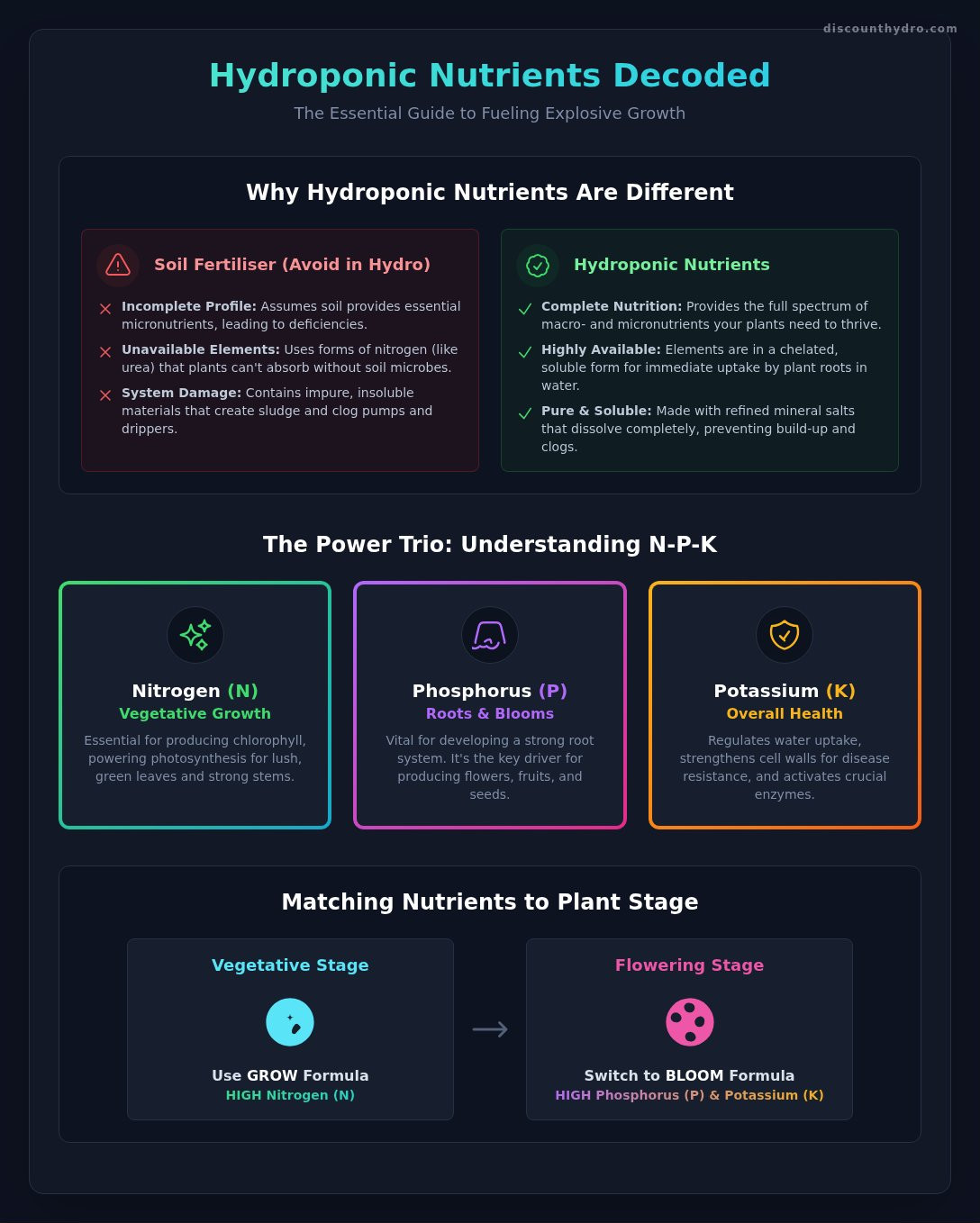
In hydroponics, there is no soil. Your water and nutrient solution must provide everything your plants need to survive and thrive. This is the fundamental reason why hydroponic nutrients are not the same as standard plant food. They are precisely engineered, complete nutritional packages designed for immediate uptake by roots in a water-based environment. Using the wrong type of feed will lead to deficiencies, system blockages, and ultimately, a failed crop.
The Building Blocks: Macronutrients vs. Micronutrients
Every quality hydroponic nutrient formula is built on a complete profile of all the essential plant nutrients, which are split into two core groups:
- Macronutrients: These are the elements plants consume in large quantities. They are the primary fuel for growth. This group includes Nitrogen (N), Phosphorus (P), Potassium (K), Calcium (Ca), Magnesium (Mg), and Sulphur (S).
- Micronutrients: Often called trace elements, these are required in much smaller doses but are just as critical for plant health. They include Iron (Fe), Manganese (Mn), Boron (B), Zinc (Zn), and others.
A simple analogy: macronutrients are the main meal, while micronutrients are the essential vitamins. A plant needs both to be healthy.
Why Regular Plant Food Won't Work
Attempting to use a general-purpose garden fertiliser from a DIY store in your hydroponic system is a costly mistake. These products are unsuitable for three key reasons:
- Incomplete Profile: Most soil fertilisers lack a full spectrum of micronutrients, as they assume the soil will provide them. In a hydro system, this leads directly to deficiencies.
- Unavailable Elements: They often use forms of nitrogen (like urea) that require microbes in the soil to break them down. In a clean hydroponic reservoir, these elements remain locked and unavailable to your plants.
- System Damage: Standard fertilisers contain impure salts and binders that don't dissolve completely. This residue builds up, creating sludge that will clog drippers, pumps, and irrigation lines, starving your plants and damaging your equipment.
Decoding Nutrient Labels: N-P-K, Grow vs. Bloom, and More
Stepping into the world of hydroponic nutrients can feel overwhelming with rows of bottles covered in numbers and charts. The good news is that it's simpler than it looks. Understanding a few key concepts is all you need to give your plants the exact fuel they require to produce impressive results. The most important information is right on the front of the bottle: the N-P-K ratio.
The Role of N-P-K in Plant Growth
Every bottle of base nutrient will display three numbers, such as 10-5-5. This is the N-P-K ratio, representing the percentage of the three most critical macronutrients your plants need to thrive. Getting this balance right is the foundation of successful hydroponic growing.
- Nitrogen (N): This is the engine for vegetative growth. Nitrogen is essential for producing chlorophyll, which powers photosynthesis and results in lush, green leaves and strong stems.
- Phosphorus (P): Think of this as the "roots and fruits" element. Phosphorus is vital for developing a healthy root system and is a key driver for producing flowers, fruits, and seeds.
- Potassium (K): This is the all-rounder for plant health. Potassium regulates water uptake, strengthens cell walls to improve disease resistance, and activates enzymes crucial for overall plant function.
Recognising the signs of an imbalance is a key skill for any grower. For a detailed breakdown of specific nutrient functions and deficiencies, university resources like Penn State Extension offer an excellent scientific reference.
Understanding Grow vs. Bloom Formulas
Plants have different nutritional needs depending on their life stage. That's why you'll see "Grow" and "Bloom" formulas. Grow formulas are used during the vegetative stage and have a high Nitrogen (N) ratio to promote vigorous foliage. Once your plants are ready to flower, you must switch to a Bloom formula. These have lower Nitrogen and higher levels of Phosphorus (P) and Potassium (K) to channel the plant's energy into producing dense, heavy flowers and fruits. Making this switch at the right time is non-negotiable if you want to maximise your final yield.
Secondary Nutrients and Key Additives
Beyond N-P-K, plants also need secondary nutrients. Calcium (Ca) is crucial for building strong cell walls, and Magnesium (Mg) is a core component of chlorophyll. If you use reverse osmosis (RO) or soft tap water, it's often stripped of these minerals, making a Cal-Mag supplement essential. As you approach the final weeks of flowering, many growers also use a PK Booster. These supplements provide a huge dose of Phosphorus and Potassium to increase the size, density, and weight of your harvest. Always read the label carefully-following the recommended feeding schedule is the surest way to avoid nutrient burn and achieve professional-grade results.
How to Choose the Right Nutrients for Your System and Budget
Choosing the right plant food is the most critical decision after setting up your system. The goal of hydroponics is essentially growing plants using a water-based nutrient solution, so getting that solution right is everything. Your choice will come down to three key factors: your experience level, your system type, and your budget. Let's break down the main options to find the best fit for your grow.
Liquid vs. Powdered Nutrients
This is the first major choice you'll face. Liquid nutrients are pre-dissolved and incredibly easy for beginners to use-just measure and mix with water. Powdered nutrients, on the other hand, offer the best value for money, especially for larger setups.
- Liquid Nutrients: Simple to use and perfect for starting out. The main drawbacks are higher shipping costs due to weight and a higher price per litre.
- Powdered Nutrients: Highly concentrated and cost-effective. They have a longer shelf life but require precise weighing and thorough mixing to avoid issues.
Our Recommendation: Start with liquids for your first few grows. As you scale up, switch to powders to maximise your budget.
One-Part vs. Multi-Part (A+B) Formulas
Nutrient formulas come in different configurations to prevent essential minerals from reacting and becoming unavailable to your plants (nutrient lockout).
- One-Part Formulas: The simplest option. All necessary nutrients are combined in one bottle. It’s convenient but offers less control over specific growth phases.
- Two/Three-Part (A+B) Formulas: The industry standard. Separating key minerals into two or three bottles gives you precise control to tailor feeding schedules for vegetative growth and flowering.
Crucial Tip: When using multi-part nutrients, always mix Part A into your water reservoir first and let it fully dissolve before adding Part B. Never mix the concentrates directly together, as this will cause nutrient lockout instantly.
Synthetic vs. Organic Nutrients
This choice depends on your growing philosophy and system type. Both can produce excellent results, but they work very differently.
- Synthetic Nutrients: Made from refined mineral salts. They are immediately available for plant uptake, offering fast, predictable results and precise control. They are the cleanest option for systems like DWC and NFT.
- Organic Nutrients: Derived from natural sources. Many growers believe they improve the final taste and aroma. However, they can be thicker and may require more system maintenance, making them better suited for media-based systems like coco coir.
Ultimately, the best hydroponic nutrients for you depend on your specific needs. Whether you prioritise ease-of-use with a one-part liquid, long-term value with a powdered formula, or precise control with a multi-part synthetic, we have a solution that fits. Find the perfect feed for your grow and budget in our massive selection.
Browse our full range of nutrients for every budget.
The Art of Mixing: A Step-by-Step Guide to a Perfect Feed
You've bought the best hydroponic nutrients, and now comes the most critical hands-on skill: mixing them correctly. Get this right, and you unlock maximum growth and yield. Get it wrong, and you're just pouring money down the drain. This guide gives you the direct, no-nonsense process for creating the perfect feed every single time, ensuring your investment pays off.
Essential Tools for Your Nutrient Station
Precision is key. Don't guess - measure. Having the right tools on hand makes the process fast, repeatable, and accurate. You'll need these basics to control your feed and get professional results. Find everything you need, from meters to reservoirs, right here at Discount Hydro.
- A clean reservoir or bucket with clear volume markings.
- Accurate measuring tools like syringes or pipettes.
- A calibrated digital pH meter and an EC/PPM meter.
- Bottles of pH Up and pH Down adjustment solution.
The Correct Mixing Procedure
Order matters. Never mix concentrated nutrients directly together. This causes a chemical reaction that "locks out" essential minerals, making them unavailable to your plants. Follow this exact order to avoid nutrient lockout and ensure your plants can access everything you're feeding them.
- Start with Water: Fill your reservoir with clean, preferably reverse osmosis (RO), water.
- Add Part A / Micro: Add your base mineral or "Micro" nutrient concentrate. Mix the reservoir water thoroughly.
- Add Part B / Grow/Bloom: Now, add the second part of your base nutrient set and mix thoroughly again.
- Add Supplements: Finally, add any boosters or supplements like Cal-Mag one at a time, mixing well after each addition.
Mastering pH: The Gateway for Nutrients
Think of pH as the key that unlocks the door for nutrient absorption. If your pH is wrong, your plants can't eat the hydroponic nutrients you've just mixed. For most systems, the sweet spot is a pH range of 5.5 to 6.5. Test your solution after mixing everything and use a few drops of pH Up or Down to hit your target. Check it daily.
Measuring Nutrient Strength with EC/PPM
EC (Electrical Conductivity) or PPM (Parts Per Million) measures the total amount of dissolved mineral salts in your water-in short, how strong your feed is. Use your EC/PPM meter to check the strength. This prevents over-feeding (which burns plants) and under-feeding (which stunts growth). Always start with the manufacturer's recommended dose or slightly less and increase gradually as your plants mature.
Feeding Schedules and Spotting Common Deficiencies
Mastering your feeding schedule is the final step to maximising yield. A plant’s nutritional needs are not static; they change dramatically between the vegetative and flowering stages. During vegetative growth, plants crave Nitrogen for leaf and stem development. When flowering begins, they demand more Phosphorus and Potassium to produce dense flowers and fruits. Using the right hydroponic nutrients at the right time is critical for success.
Most nutrient brands provide a feeding chart. Treat this as your starting point, not a strict rule. A typical schedule might look like this:
- Weeks 1-4 (Vegetative): Use a "Grow" formula rich in Nitrogen. Start at a quarter or half strength and gradually increase.
- Weeks 5-12 (Flowering): Switch to a "Bloom" formula high in Phosphorus and Potassium. Introduce PK boosters as needed.
Always observe your plants. If they show signs of stress, reduce the nutrient strength. Your goal is to find the sweet spot for your specific setup and plant strain.
How Often Should You Change Your Reservoir?
To prevent nutrient imbalances and salt build-up, a complete reservoir change is recommended every 7-14 days. In between changes, you can 'top off' the reservoir with a half-strength nutrient solution to replace the water your plants have consumed. The ideal frequency depends on your system-smaller reservoirs with large plants will need more frequent changes than larger systems with small plants.
A Visual Guide to Nutrient Deficiencies
Your plants will tell you when something is wrong. Before you add more nutrients, always check your pH first, as an incorrect pH is the most common cause of nutrient lockout. If the pH is correct, look for these visual cues:
- Nitrogen (N) Deficiency: Yellowing starts on the older, lower leaves and moves up the plant.
- Calcium (Ca) Deficiency: New growth is stunted or distorted, often with small brown spots appearing on young leaves.
- Iron (Fe) Deficiency: Classic interveinal chlorosis-new, upper leaves turn yellow while the veins remain green.
When to Use Boosters and Additives
Base nutrients provide everything a plant needs to survive, but additives can push your results from good to great. They are designed for specific growth phases to solve problems or enhance performance.
- PK Boosters: Use these in mid-to-late flowering to increase the size, density, and weight of your flowers.
- Rooting Stimulators: Apply during the seedling and early vegetative stages to build a powerful root system.
- Enzymes: Use throughout the grow to break down dead root matter, keeping your system clean and turning waste into available food for the plant.
Take your harvest to the next level with our range of boosters. We stock everything you need at the UK's best prices.
Mastering Your Nutrients: The Final Word
Getting to grips with feeding your plants is the most important step towards a successful hydroponic harvest. Remember that understanding the N-P-K ratio and knowing when to switch from Grow to Bloom formulas gives you direct control over your plant's development. By carefully measuring, mixing, and following a consistent schedule, you can prevent common deficiencies and ensure your garden gets exactly what it needs. Mastering your hydroponic nutrients is the key to unlocking bigger, healthier yields and getting the most out of your system.
Ready to put this knowledge into action? We stock a huge selection from the UK's top brands, including Dutch Pro, Intense Nutrients, and Canna, all backed by our price match guarantee. With fast, discreet UK-wide delivery, you can have everything you need in no time. Shop our full range of hydroponic nutrients at the UK's best prices.
Now you have the knowledge. It's time to get mixing and watch your plants thrive. Happy growing!
Frequently Asked Questions About Hydroponic Nutrients
What are the best hydroponic nutrients for beginners?
For beginners, the best option is a simple two-part liquid nutrient system, like a "Grow" and "Bloom" formula from a reputable brand. These are pre-formulated for specific growth stages, making them incredibly easy to measure and mix. This straightforward approach minimises errors and ensures your plants get a balanced diet from the start. Look for popular brands that offer clear feeding charts; you'll find them all here at the UK's best prices.
How often do I need to feed my hydroponic plants?
As a general rule, you should completely change the nutrient solution in your reservoir every 7 to 14 days. This prevents the build-up of salts and ensures a fresh, balanced mix of elements is always available to your plants. For high-performance systems or fast-growing plants, a weekly change is optimal. Monitoring your solution's EC (strength) daily will give you a more precise indication of when your plants have consumed the available nutrients.
Can I mix different brands of hydroponic nutrients together?
No, you should not mix different brands. Each manufacturer formulates their nutrient lines to work as a complete, balanced system. Combining products from different brands can lead to chemical reactions, nutrient imbalances, or "lockout," where plants are unable to absorb essential elements. For predictable and reliable results, stick with a single nutrient brand throughout your entire grow cycle. It's the most cost-effective way to guarantee success.
What is the shelf life of liquid and powdered hydroponic nutrients?
Powdered hydroponic nutrients have an excellent shelf life, often lasting 5 years or more if kept in a cool, dry, and dark place. Liquid nutrients typically last for 1 to 2 years after opening. Always store them away from direct sunlight and extreme temperatures to prevent degradation. Check the manufacturer's expiration date on the bottle to ensure you're always using a fresh, effective product for maximum yield.
Do I really need to use a pH and EC meter?
Yes, absolutely. A pH meter ensures your plants can actually absorb the nutrients you provide, while an EC meter measures the strength of your nutrient solution. Skipping these tools is like growing blind. An incorrect pH can ruin a crop, wasting time and money. For a small investment, often under £30, these meters provide the critical data needed for consistent, heavy yields and are essential pieces of equipment for any serious grower.
Is it necessary to use reverse osmosis (RO) water for hydroponics?
While not strictly necessary, using RO water is highly recommended for the best results. Tap water across the UK varies in mineral content (hardness) and can contain chlorine, which can affect your nutrient solution's balance. RO water gives you a pure, neutral starting point of 0 EC. This provides you with total control over your plant's nutrition, eliminating guesswork and preventing potential issues caused by inconsistent tap water quality.
What's the difference between nutrients for coco coir and DWC?
The main difference is the mineral composition. Coco coir naturally holds onto calcium and magnesium, making these elements less available to the plant. Therefore, coco-specific nutrients contain elevated levels of Cal-Mag to compensate for this. Nutrients for DWC (Deep Water Culture) are formulated for a pure water environment and have a standard mineral balance, as there is no medium to interfere with nutrient uptake. Using the correct formula is vital for plant health.