

Lighting for Growing Plants: The Complete Beginner's Guide
Struggling to make sense of PAR, lumens, and watts? Worried you'll choose the wrong gear and end up with a huge electricity bill and weak, wilting plants? Getting the right lighting for growing plants is the most critical investment for a successful indoor harvest, but it doesn't have to be complicated or expensive. This guide is designed to cut through the technical jargon and get you the results you want, at a price that makes sense for your budget.
We’ll break down the main types of grow lights, from powerful LEDs to high-yield HPS kits, and explain exactly what you need to look for based on your specific plants and your available space. You will learn how to set up your lights correctly for maximum growth and confidently choose a powerful, energy-efficient system that delivers. Forget the guesswork-it's time to invest in a lighting solution that lets you grow thriving plants year-round without breaking the bank.
Why Your Plants Need More Than Just a Windowsill
Many new growers ask: can I use a regular light bulb to grow plants? The short answer is no. Your standard household lamp, whether incandescent or halogen, is designed for human eyes, not plant biology. It produces a lot of heat and the wrong type of light, wasting energy and potentially scorching your plant's leaves. For serious results, you need dedicated lighting for growing plants that delivers the right kind of energy for robust growth.
Photosynthesis: Turning Light into Life
Think of light as the food your plants eat. Through a process called photosynthesis, a pigment in the leaves called chlorophyll absorbs light energy. This energy is used to convert carbon dioxide and water into sugars, which are the plant's fuel. This fuel powers everything from developing strong roots and lush leaves to producing dense flowers and heavy fruits. Without the right intensity and quality of light, this entire process stalls.
Understanding the Light Spectrum
Sunlight isn't just white; it's a full spectrum of different colours (wavelengths) of light. Plants are picky eaters and only use specific parts of this spectrum to grow. The usable light that fuels growth is what scientists call Photosynthetically Active Radiation (PAR). A standard bulb produces very little PAR, while a quality grow light is engineered to maximise it. The key is providing the right colours at the right time.
Different colours in the light spectrum act as signals, telling the plant how to grow:
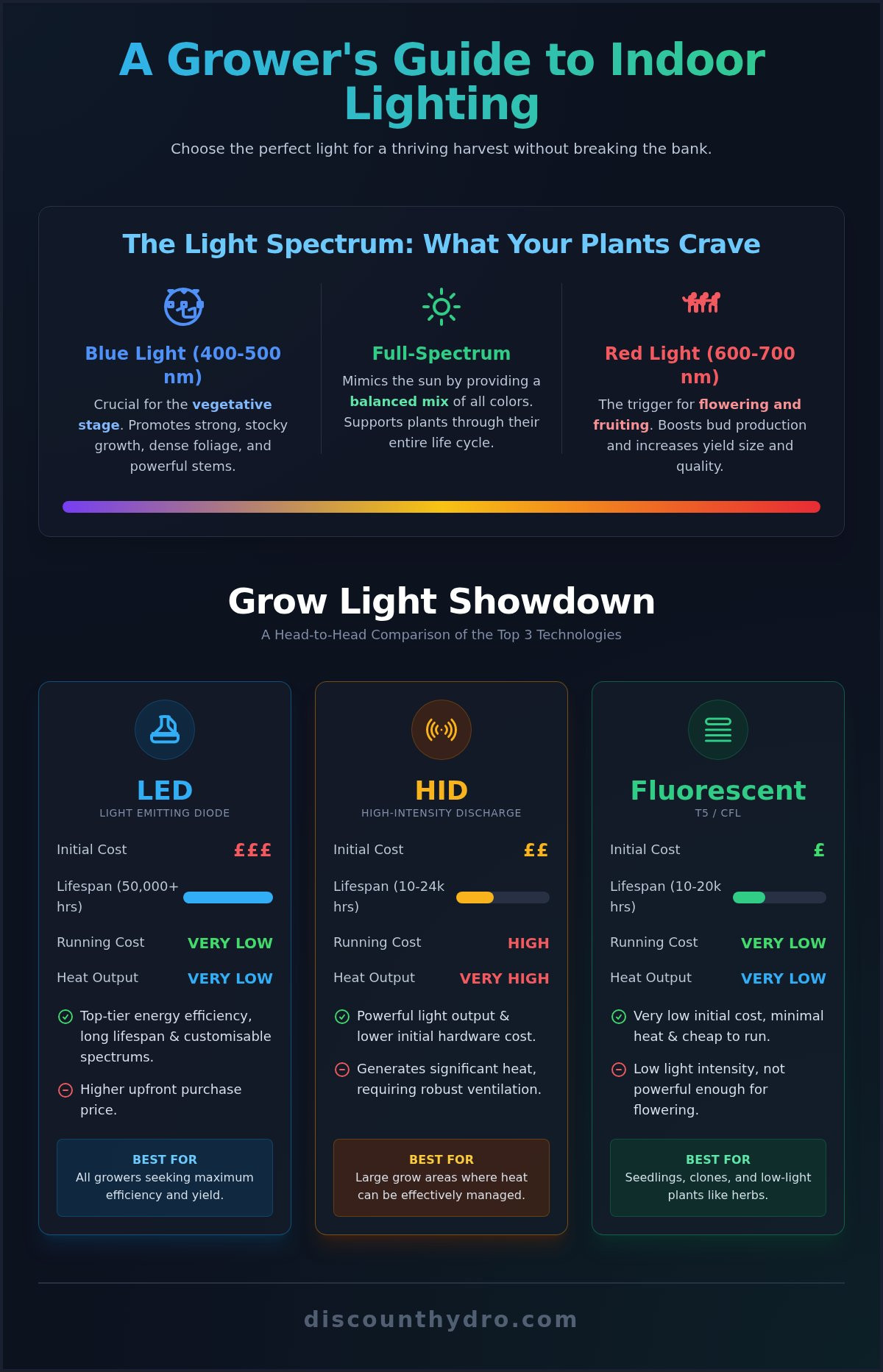
- Blue Light (400-500 nm): This is crucial for the vegetative stage. It promotes strong, stocky growth, encouraging dense foliage and powerful stem development. It's the foundation for a healthy plant.
- Red Light (600-700 nm): This is the trigger for flowering and fruiting. Red light signals to the plant that it's time to reproduce, boosting bud production and increasing the size and quality of your yield.
- Full-Spectrum Light: The best choice for most growers, full-spectrum lights mimic the sun by providing a balanced mix of blue, red, and other colours. This supports your plants through their entire life cycle, from seedling to harvest, without needing to switch lamps.
A windowsill, especially in the UK, simply can't provide the consistent intensity or the targeted spectrum your plants crave. To move beyond basic survival and achieve explosive growth and impressive yields, investing in the correct lighting for growing plants is the most critical step you can take.
Types of Grow Lights: A Head-to-Head Comparison
Choosing the right lighting for growing plants indoors is the most critical decision you'll make for your setup. The best option depends entirely on your budget, the size of your grow space, and what you plan to grow. Understanding the core differences in cost, efficiency, and heat output is essential. This direct comparison cuts through the noise to help you find the best value and performance for your needs.
| Feature | LED | HID | Fluorescent |
|---|---|---|---|
| Initial Cost | Medium - High (£££) | Low - Medium (££) | Very Low (£) |
| Lifespan | Very Long (50,000+ hrs) | Medium (10,000-24,000 hrs) | Medium (10,000-20,000 hrs) |
| Efficiency / Running Cost | Very High / Low Cost | Low / High Cost | High / Very Low Cost |
| Heat Output | Very Low | Very High | Very Low |
LED (Light Emitting Diode) Grow Lights
LEDs are the modern standard for a reason. They offer incredible energy efficiency, converting more electricity into usable light and less into waste heat. This means lower electricity bills and less need for complex ventilation. With long lifespans and full-spectrum options that cover every growth stage, they are a fantastic long-term investment for almost any home grower. The initial price is higher, but the savings on running costs pay off quickly.
- Pros: Top-tier energy efficiency, minimal heat, extremely long lifespan, customisable spectrums.
- Cons: Higher upfront purchase price compared to other types.
- Best For: All growers, from beginners to commercial experts seeking maximum efficiency and yield.
See our best deals on LED Grow Lights and get the best prices in the UK.
HID (High-Intensity Discharge) Grow Lights
HID lighting has been the workhorse of indoor growing for decades. This category includes two main bulb types: Metal Halide (MH) for vegetative growth and High-Pressure Sodium (HPS) for flowering. HIDs offer immense light intensity at a lower initial cost than premium LEDs. However, this power comes at a price: they run extremely hot, requiring powerful ventilation and extraction fans to manage temperatures, and their energy consumption leads to higher electricity bills.
- Pros: Powerful light output, proven results, lower initial hardware cost.
- Cons: Generates significant heat, requires robust ventilation, high running costs.
- Best For: Large grow tents or rooms where heat can be effectively managed.
Fluorescent Grow Lights
Ideal for growers on a tight budget or with limited space, fluorescent lights like T5 tubes and CFL bulbs are an excellent entry point. They produce very little heat and are cheap to buy and run, making them perfect for placing close to delicate plants. The trade-off is their lower light intensity, which makes them unsuitable for the demanding flowering and fruiting stages of larger plants. For more on light science, the University of Minnesota Extension guide to indoor plant lighting is a great resource.
- Pros: Very low initial cost, minimal heat output, cheap to run.
- Cons: Low light intensity, not powerful enough for flowering/fruiting.
- Best For: Seedlings, clones, and low-light plants like herbs and leafy greens.
Decoding the Jargon: Key Grow Light Metrics Explained
Shopping for grow lights means wading through a sea of technical specs. Watts, Lumens, PAR, PPFD-it's easy to get lost. We'll cut through the jargon and focus on the numbers that directly impact your yield. Forget the marketing fluff; this is what you need to know to make a smart purchase and get the results you're paying for.
Watts vs. Lumens vs. PAR
When choosing lighting for growing plants, these three terms cause the most confusion. Here’s the simple breakdown:
- Watts (W): This is simply power consumption. It tells you how much the light will cost to run on your electricity bill, not how well it grows plants. A modern, efficient 300W LED can easily outperform an old 600W HPS light.
- Lumens (lm): This measures brightness as perceived by the human eye. Our eyes are most sensitive to yellow and green light, which plants use the least. For horticulture, lumens are an almost useless metric.
- PAR (Photosynthetically Active Radiation): This is the one that matters. PAR represents the specific spectrum of light that plants actually use for photosynthesis. It is the true measure of a grow light’s value to your crop.
PPF and PPFD: Measuring Your Light's Power
PPF and PPFD are two measurements derived from PAR that tell you a light's real-world performance. Think of it like rain in a bucket. PPF (Photosynthetic Photon Flux) is the total amount of "rain" (usable light) the fixture produces per second. It’s the light's total output.
PPFD (Photosynthetic Photon Flux Density) is the most critical metric for your setup. It measures how much of that light actually lands on your plant canopy-the "rain" that makes it into your bucket. As this detailed University of Minnesota Extension guide to indoor plant lighting explains, PPFD is the number that drives growth because it reflects the light intensity your plants actually experience. Always check a light's PPFD chart to match its output to your tent size and plant type.
Colour Temperature (Kelvin)
Kelvin (K) describes the visual colour of the light, from warm to cool. Different colours trigger different growth responses in plants.
- 6500K (Cool Blue): Ideal for seedlings, clones, and the vegetative stage. This blue-heavy light promotes short, bushy, and compact growth.
- 3000K (Warm Red): Best for the flowering and fruiting stage. The higher amount of red light encourages stretching, budding, and resin production.
Many of our best-selling full-spectrum LED lights are engineered to deliver the perfect blend of these spectrums, providing an excellent all-in-one solution from seed to harvest.
How to Choose the Right Light for Your Grow
Forget the "one-size-fits-all" approach. The best grow light is the one that fits your space, your plants, and your wallet. Follow this simple three-step process to find the perfect lighting for growing plants and get the results you want without overspending.
Step 1: Assess Your Grow Space Size
The size of your tent or grow room is the most critical factor. As a general rule, aim for 30-40 watts of actual power draw per square foot for high-yield flowering. Pay close attention to the manufacturer's recommended light "footprint"-the area it can effectively illuminate at the correct height.
- Small Spaces (up to 1m x 1m): A compact, full-spectrum LED board (100W-250W) or a T5 fluorescent fixture is efficient and manages heat well.
- Medium Tents (e.g., 1.2m x 1.2m): This is the sweet spot for a powerful 600W HPS kit or a high-performance 400W-650W LED system for maximum canopy penetration.
- Large Rooms (over 1.5m x 1.5m): Use multiple lights to ensure even coverage. Daisy-chainable LEDs or several 600W-1000W HPS lights are the standard for serious growers.
Step 2: Consider Your Plant Types
Different plants have different demands. Leafy greens, clones, and herbs like basil don't need intense light and will thrive under lower-wattage LEDs or T5 fluorescents. However, if you're growing heavy-fruiting plants like tomatoes or chillies, you need maximum power during the flowering stage. This is where high-intensity HPS lights or powerful, full-spectrum LEDs really pay off, driving bigger and denser yields. Some advanced LEDs offer an adjustable spectrum, allowing you to switch from blue-dominant light for vegetative growth to red-dominant light for flowering.
Step 3: Set Your Budget
Your budget involves two costs: the initial purchase price and the long-term running cost. HPS systems have a very low upfront cost, but they use more electricity and produce more heat, which can increase your ventilation costs. Modern LED grow lights cost more to buy but run far more efficiently, saving you a significant amount on your electricity bill over their long lifespan. For many growers, an LED pays for itself in energy savings alone. No matter your budget, we have a solution that delivers results.
Find grow lights for every budget at Discount Hydro and get the UK's best prices.
Essential Setup Tips for Maximum Growth
You've invested in a quality grow light - that's the first step. But buying the hardware is only half the battle. To get the heavy yields you're after, a proper setup is non-negotiable. The right lighting for growing plants indoors is about more than just the bulb; it's about how you use it. Get these two factors right-height and duration-and your plants will thrive.
Getting the Height Right
The distance between your light and your plant canopy is critical. Too close, and you risk 'light burn'-scorched, yellowing leaves and stunted growth. Too far, and your plants will stretch desperately towards the light source, resulting in weak, 'leggy' stems and poor development. The correct height depends entirely on the type and power of your unit.
- LEDs: A good starting point is 18-24 inches above the plant canopy. High-power models may need more distance. Always check the manufacturer's specific recommendations.
- HID (HPS/MH): These run hot. A 400W lamp should be at least 12-18 inches away, while a 1000W beast needs 24-30 inches of clearance to prevent heat stress.
- Fluorescents (CFL & T5): These have low heat output, so you can get them much closer. Aim for 2-6 inches from the canopy for maximum intensity without risk of burning.
Always start with these guidelines and adjust based on your plants' response. The manufacturer's data sheet is your best source of information.
Light Cycles and Timers
Plants need a period of darkness to rest and respire, a process vital for healthy development. Running your lights 24/7 is not only a waste of electricity but is also detrimental to most plants. The key is consistency, delivered in specific cycles:
- Vegetative Growth: A cycle of 18 hours on and 6 hours off (18/6) is standard.
- Flowering/Fruiting: Switching to 12 hours on and 12 hours off (12/12) triggers this stage for many plants.
Manually switching your lights is a recipe for error. The single best investment you can make for consistency is an automatic timer. It guarantees your plants get the exact light cycle they need, every single day, without fail. Set it and forget it.
Basic Grow Light Safety
An efficient setup is a safe setup. Water and high-powered electronics are a dangerous mix, so follow these basic rules to prevent accidents:
- Never place plugs, extension leads, or ballasts directly on the floor where spills can occur. Mount them securely on a wall.
- Ensure your home's circuits can handle the electrical load from your lights and other equipment. Avoid overloading sockets.
- Regularly inspect all cables and wiring for any signs of wear, fraying, or damage.
- Maintain good air circulation to dissipate the significant heat generated by HID lights and keep the environment safe.
Power Up Your Grow: The Final Word on Plant Lighting
You now understand that a sunny windowsill is just the beginning. The key to a truly successful indoor garden lies in choosing the right tool for the job. By understanding the differences between LED, HPS, and CFL systems and decoding crucial metrics like PAR, you are fully equipped to make an informed decision that will directly impact the health and yield of your plants.
Investing in the correct lighting for growing plants is the most critical step you can take towards a prize-winning harvest. Now it’s time to turn that knowledge into action. At Discount Hydro, we cut through the noise with the UK's best prices on all hydroponic gear, backed by fast, nationwide delivery and expert advice from seasoned growers. Stop guessing and start growing with equipment you can trust.
Shop the UK's best value grow lights now!
Your best harvest yet is waiting.
Frequently Asked Questions About Grow Lights
How many hours a day should I run my grow lights?
The ideal duration depends on your plant's growth stage. For plants in the vegetative stage, an 18-hour on, 6-hour off cycle is standard. When you switch to the flowering stage, you must reduce this to a 12/12 cycle to trigger budding. Seedlings and clones can often handle 18 to 24 hours of light to encourage rapid, healthy growth. Using a simple plug-in timer is the best way to ensure this cycle is consistent and automated.
How far should grow lights be from seedlings?
Seedlings are fragile and can be easily damaged by intense light or heat. For most LED grow lights, a starting distance of 24 to 30 inches is a safe bet. You can gradually lower the light as the plants grow stronger. If using fluorescent lights (like T5s), they can be much closer, around 4 to 6 inches. Always check for signs of stress like leaf curling or bleaching, and adjust the height accordingly to protect your young plants.
Can a plant get too much light?
Yes, absolutely. This condition is known as light burn or photo-oxidation. It occurs when a plant receives light that is too intense (too close) or for too long without a dark period. Symptoms include yellowing or white leaves, brown spots, and stunted growth. Plants require a period of darkness for respiration and to process the energy they've stored during the day. Stick to proven light cycles to avoid damaging your crop and wasting electricity.
What's the difference between a full-spectrum light and a regular white LED?
A standard white LED bulb is designed for human eyes, providing a balanced light that appears white. A full-spectrum grow light is engineered specifically for horticulture. It provides all the wavelengths of light-including crucial blue and red peaks-that plants need for robust photosynthesis through all life stages. Using proper full-spectrum lighting for growing plants indoors results in healthier growth, better structure, and higher yields compared to a household bulb.
How much will running a grow light increase my electricity bill?
Your cost depends on the light's wattage and your electricity tariff. As an example, let's use a 400W LED light and an average UK electricity rate of 27p per kilowatt-hour (kWh). Running it for an 18-hour vegetative cycle would cost approximately £1.94 per day (0.4kW x 18h x £0.27). In a 12-hour flowering cycle, the daily cost would drop to about £1.30. Check your light's actual power draw and your energy bill for an exact figure.
Do I need a grow tent to use a grow light?
While not strictly essential, a grow tent is highly recommended for maximum efficiency and control. The reflective interior walls of a tent can increase the light reaching your plants by over 30%, ensuring none of your power is wasted. A tent also makes it far easier to manage temperature, humidity, and pests, creating a stable environment for a better harvest. It makes your lighting for growing plants a much more effective investment.