

Magnesium Nitrate: A Grower's Guide to Boosting Plant Health
Are your plant leaves turning yellow between the veins? Do they look stunted or unhealthy, even with a consistent feeding schedule? Before you spend more on base nutrients, consider the real problem might be a specific deficiency that’s capping your yield. For growers looking to solve these exact issues and boost overall plant vigour, the solution is often a targeted supplement. This is where the power of magnesium nitrate comes into play, delivering two essential elements for rapid, visible results.
This no-nonsense guide is designed to get you the results you're paying for. Forget the confusion of endless additives and the fear of burning your plants. We’ll show you exactly how to identify a magnesium deficiency, the correct way to mix and apply this powerful compound, and how to integrate it into your feed schedule. Get ready to fix yellowing leaves for good and achieve the kind of lush, green, vigorous growth that leads to a heavier harvest.
What Is Magnesium Nitrate & Why Is It Vital for Your Plants?
Get straight to the point: if you want explosive growth and vibrant green leaves, you need the right fuel. Magnesium nitrate is a high-performance fertiliser salt that delivers two essential macronutrients directly to your plants: Magnesium (Mg) and Nitrogen (N). Think of it as a 2-for-1 deal on core plant nutrition. Unlike other supplements, it's engineered for rapid uptake, making it a non-negotiable part of any serious grower's nutrient arsenal, especially in hydroponic systems where every drop counts.
The Powerhouse Combo: Magnesium and Nitrogen
This isn't just a random mix; it's a strategic combination that fuels both energy production and physical growth. The two elements work together to build stronger, more productive plants from the roots up. When you use magnesium nitrate, you’re providing the critical components for peak performance.
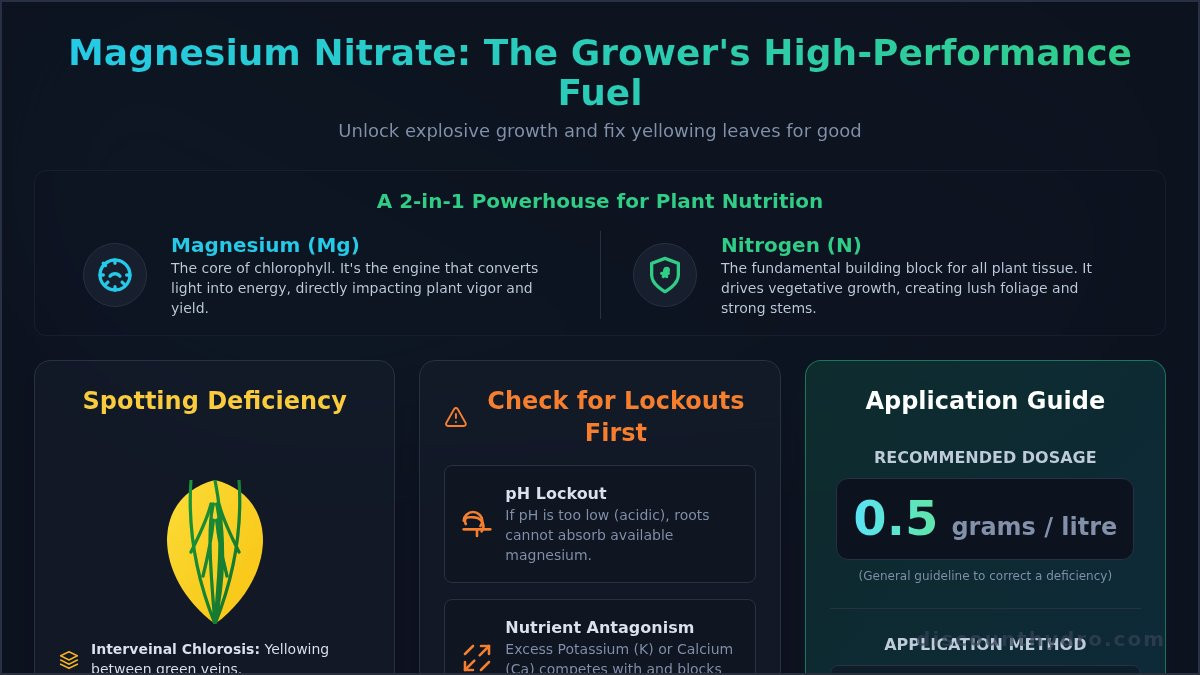
- Magnesium (Mg): This is the central atom in every chlorophyll molecule. Without enough magnesium, your plants can't perform photosynthesis efficiently. It's the engine that converts light into usable energy, directly impacting plant vigour and final yield.
- Nitrogen (N): As a primary component of amino acids and proteins, nitrogen is the fundamental building block for all plant tissue. It drives vegetative growth, leading to the development of robust stems, lush foliage, and a strong plant structure ready for flowering.
Key Properties for Hydroponic Growers
The physical properties of this compound make it the perfect choice for high-efficiency growing systems. It’s designed to work seamlessly in your reservoir, delivering consistent and reliable results without causing issues like blockages or nutrient lockout.
- Chemical Formula & Purity: With the formula Mg(NO₃)₂, you get a clean, highly refined source of nutrients. This purity ensures there are no unwanted elements that could disrupt your nutrient solution's balance.
- High Solubility: It dissolves completely and quickly in water. This means it's immediately available for your plants' roots to absorb, providing a rapid response when plants show signs of deficiency. No residue, no clogged lines.
- Excellent Compatibility: It integrates perfectly into most nutrient feeding schedules. It works alongside your base nutrients and other additives, allowing you to fine-tune your formula for specific growth stages without negative interactions.
Spotting Magnesium Deficiency: Are Your Plants Asking for Help?
Your plants can't speak, but they show you when something is wrong. A magnesium deficiency is one of the most common issues growers face, but it's easy to fix if you know what to look for. Magnesium is a 'mobile' nutrient. This means the plant can move it from older growth to new, younger leaves where it's needed most. The result? The first warning signs will always appear on the older, lower leaves of your plant. If the yellowing starts at the top, your problem lies elsewhere.
A Visual Checklist for Deficiency
Get your diagnosis right the first time. Look for a combination of these classic Magnesium deficiency symptoms to confirm the issue before you treat it. A true deficiency requires a direct nutrient fix, often with a product containing fast-acting magnesium nitrate.
- Interveinal Chlorosis: This is the hallmark sign. The areas between the leaf veins turn yellow or pale, while the veins themselves stay dark green. This can create a distinctive 'marbled' or 'Christmas tree' pattern.
- Location, Location, Location: Check the bottom of the plant first. Symptoms will start on the lowest, oldest leaves and slowly climb up the plant if left untreated.
- Crispy Edges: As the deficiency worsens, the leaf margins may feel dry, become brittle, and start to curl upwards.
- Severe Signs: In advanced stages, you might see necrotic (dead) brown spots or even purple and reddish blotches appearing between the veins.
Is It Really a Deficiency? Other Potential Causes
Before you add more nutrients, check for lockouts. Sometimes your plant has access to magnesium, but other factors are preventing it from absorbing it. Wasting nutrients costs money and can create new problems. Check these first:
pH Lockout: If your growing medium's pH is too low (acidic), your plant's roots simply cannot absorb available magnesium. Always check and adjust your pH before adding supplements like magnesium nitrate.
Nutrient Antagonism: Feeding too much potassium (K) or calcium (Ca) can interfere with magnesium uptake. These nutrients compete, and an excess of one can create a deficiency in another. Ensure your base nutrient formula is well-balanced.
Cold Root Zone: Low temperatures can shock the roots, slowing down all nutrient absorption and mimicking deficiency symptoms. Make sure your root-zone temperature is within the optimal range for your specific crop.
How to Use Magnesium Nitrate: Dosage and Application Guide
Using any nutrient supplement effectively starts with a proper diagnosis. Before adding magnesium nitrate to your regimen, confirm your plants are actually showing signs of a magnesium deficiency. Once confirmed, precise application is crucial to restore plant vigour without causing nutrient lockout or burn. The vital role of magnesium in plant health is well-documented, impacting everything from chlorophyll production to energy transfer, as detailed in comprehensive studies like The Power of Magnesium in Horticultural Crops. Below are the two primary methods for application.
Root Feeding in Hydroponic Systems
For systemic correction in hydroponic setups, adding the supplement directly to your nutrient reservoir is the standard method. Follow these steps for best results:
- Measure Accurately: To correct an existing deficiency, a general guideline is to start with 0.5 grams per litre of reservoir water.
- Dissolve Separately: Always dissolve the crystals in a small amount of warm water before adding them to the main reservoir. This prevents clumping and ensures even distribution.
- Add and Mix: Pour the dissolved solution into your reservoir and mix thoroughly.
Since accurate dosing is crucial for avoiding nutrient burn, having properly calibrated scales is essential. You can read more about the services that keep weighing equipment precise.
After adding the supplement, always use a calibrated meter to check and adjust your nutrient solution's overall EC (Electrical Conductivity) or PPM (Parts Per Million) to prevent overfeeding. Accurate dosing is non-negotiable. Find precision scales and measuring tools here.
Foliar Spraying for a Fast-Acting Boost
When you need a rapid fix for acute symptoms like yellowing leaves (chlorosis), a foliar spray provides the fastest absorption. It delivers magnesium directly to the leaves where it's needed most.
- Mixing Ratio: Use a concentration of 1-2 grams of magnesium nitrate per litre of pH-adjusted water.
- Application: Use a fine mist sprayer and apply during low-light periods (like early morning or just before lights-off) to avoid leaf burn.
- Technique: Ensure complete coverage, paying special attention to the undersides of the leaves where the plant's stomata are most concentrated. Adding a drop of a non-ionic surfactant or wetting agent can improve adhesion and absorption.
Safety and Storage Best Practices
Nutrient salts are concentrated chemicals and must be handled correctly. Always prioritise safety in your grow room.
- Protection: Wear gloves and eye protection when handling the dry crystals or concentrated solutions.
- Storage: Keep the product in a tightly sealed, clearly labelled container. Store in a cool, dry place away from moisture and direct sunlight to prevent caking.
- WARNING: This product is an oxidizer. It must be stored away from flammable materials, acids, and combustible substances like wood, oil, or sulphur.
Magnesium Nitrate vs. Cal-Mag vs. Epsom Salt: Which Do You Need?
Choosing the right magnesium supplement is a common problem for growers. Magnesium nitrate, Cal-Mag, and Epsom salt all provide magnesium, but they are not interchangeable. Using the wrong one can disrupt your nutrient balance, leading to lockouts or toxicities that harm your plants. This guide cuts through the confusion and breaks down the key differences, ensuring you buy the right product for the job and get maximum value from your nutrient budget.
Here’s a quick comparison of the three most popular options:
| Supplement | Nutrient Content | Primary Use | Best For... |
|---|---|---|---|
| Magnesium Nitrate | Magnesium (Mg) & Nitrogen (N) | Fast-acting Mg & N boost | Vegetative growth; RO water setups; correcting Mg & N deficiencies simultaneously. |
| Cal-Mag Supplement | Calcium (Ca) & Magnesium (Mg) | Preventing common deficiencies | Coco coir grows; RO/soft water; all-in-one convenience. |
| Epsom Salt (Magnesium Sulfate) | Magnesium (Mg) & Sulfur (S) | Nitrogen-free Mg & S boost | Flowering/fruiting stage; correcting a simple Mg deficiency without adding nitrogen. |
When to Choose Magnesium Nitrate
Use this when you need to fix a magnesium deficiency and give your plants a direct nitrogen boost. It's ideal for the vegetative stage when plants are hungry for nitrogen to fuel leafy growth. Because it contains nitrate nitrogen, it's immediately available to the plant for rapid uptake. If you're using soft or RO water and building a custom nutrient schedule, magnesium nitrate gives you precise control. The trade-off? Using it in late flower can promote unwanted leaf growth at the expense of buds.
The Case for a Complete Cal-Mag Supplement
A complete Cal-Mag supplement is your go-to for prevention and convenience. It provides calcium and magnesium in a balanced ratio, crucial for avoiding issues in inert media like coco coir, which is known to bind with calcium. It's the simplest all-in-one solution for growers using RO water to prevent the most common secondary nutrient deficiencies from the start. While convenient, it's a blended product, offering less specific control than using separate components.
When to Use Epsom Salt (Magnesium Sulfate)
Epsom salt is the choice when you need magnesium and sulfur, but critically, no nitrogen. This makes it perfect for the flowering or fruiting stage when you want to reduce nitrogen to focus energy on buds and flowers. It’s also a very cost-effective way to treat a straightforward magnesium deficiency without altering your core N-P-K ratios. A bag costs just a few pounds and is a staple for any serious grower's toolkit.
Ultimately, the right choice depends on your grow stage, medium, and base nutrients. Analyse your plant's needs carefully to make the most efficient and cost-effective decision. Check out our full range of specialist nutrients and additives to find the perfect solution for your setup.
Unlock Peak Growth with the Right Nutrients
Mastering your nutrient regimen is the key to a successful harvest. As we've covered, understanding how to spot magnesium deficiency and when to act is crucial for plant vitality. Choosing a targeted supplement like magnesium nitrate gives you precise control over your feed, ensuring your plants get exactly what they need for vigorous photosynthesis and robust growth, without the extra elements found in Cal-Mag or Epsom salt.
Don't let a simple deficiency limit your yield. Getting the right, high-purity nutrients is a non-negotiable. At Discount Hydro, we provide the tools you need at prices you won't find anywhere else. We guarantee the UK's best prices on all leading brands, with fast, discreet UK-wide delivery straight to your door. Need help? Our team of experienced growers is ready with expert advice.
Ready to see the difference the right nutrients can make? Shop our full range of high-purity nutrients and supplements. Give your plants the professional-grade fuel they deserve and watch them thrive.
Frequently Asked Questions About Magnesium Nitrate
Can you use too much magnesium nitrate and cause nutrient burn?
Yes, absolutely. Over-application of any concentrated nutrient salt can lead to nutrient burn. An excess of magnesium nitrate raises the electrical conductivity (EC) of your nutrient solution too high, which dehydrates roots and prevents them from absorbing other essential elements. Symptoms include yellow or brown, crispy leaf tips. Always follow the manufacturer's dosage instructions and use an EC meter to ensure your feed strength is correct for your plant's growth stage.
Is magnesium nitrate considered an organic nutrient?
No, it is not an organic product. Magnesium nitrate is a synthetic mineral salt, created by reacting magnesium with nitric acid. It is highly refined to ensure it is pure and completely water-soluble, making it ideal for hydroponic systems where nutrient availability is key. For certified organic growing, you would need to use alternative, naturally derived sources of magnesium and nitrogen which are often less soluble and slower to be absorbed by the plant.
How should I store magnesium nitrate and what is its shelf life?
Store your magnesium nitrate in a cool, dry place, away from direct sunlight and moisture. It is hygroscopic, meaning it will attract and absorb water from the air, which can cause it to clump or turn into a liquid. Always keep it in its original, tightly sealed container to prevent this. When stored correctly, crystalline magnesium nitrate has an extremely long, practically indefinite shelf life, making it a cost-effective purchase for any grower.
Can I mix magnesium nitrate directly with my other A/B base nutrients?
No, you should never mix concentrated nutrients directly together. Specifically, mixing concentrated magnesium nitrate with nutrients high in phosphates or sulphates (often found in "Part B" or bloom formulas) can cause precipitation. This chemical reaction creates an insoluble solid, locking out essential nutrients and making them unavailable to your plants. Always dissolve each nutrient component separately into your main reservoir of water, mixing thoroughly before adding the next one.
Will magnesium nitrate affect the pH of my nutrient solution?
Yes, it can have a minor effect on your solution's pH. Magnesium nitrate is slightly acidic, so adding it to your reservoir will typically cause a small drop in the pH level. However, this effect is usually minimal compared to the impact of your main A/B base nutrients. Best practice is to always test and adjust the pH of your final nutrient solution *after* all components have been added and fully dissolved to ensure it is in the optimal range for your crop.
Is magnesium nitrate suitable for soil and coco coir grows?
Yes, it is highly effective in all growing mediums. Because magnesium nitrate is 100% water-soluble, it provides readily available magnesium and nitrogen that plants can absorb immediately. This makes it perfect for fast-acting correction of deficiencies in soil and coco coir. It is a staple in hydroponics but is equally valuable for container growers who need precise control over their nutrient delivery without waiting for organic matter to break down.