

Perlite for Hydroponics: The Ultimate Guide to Aeration and Drainage
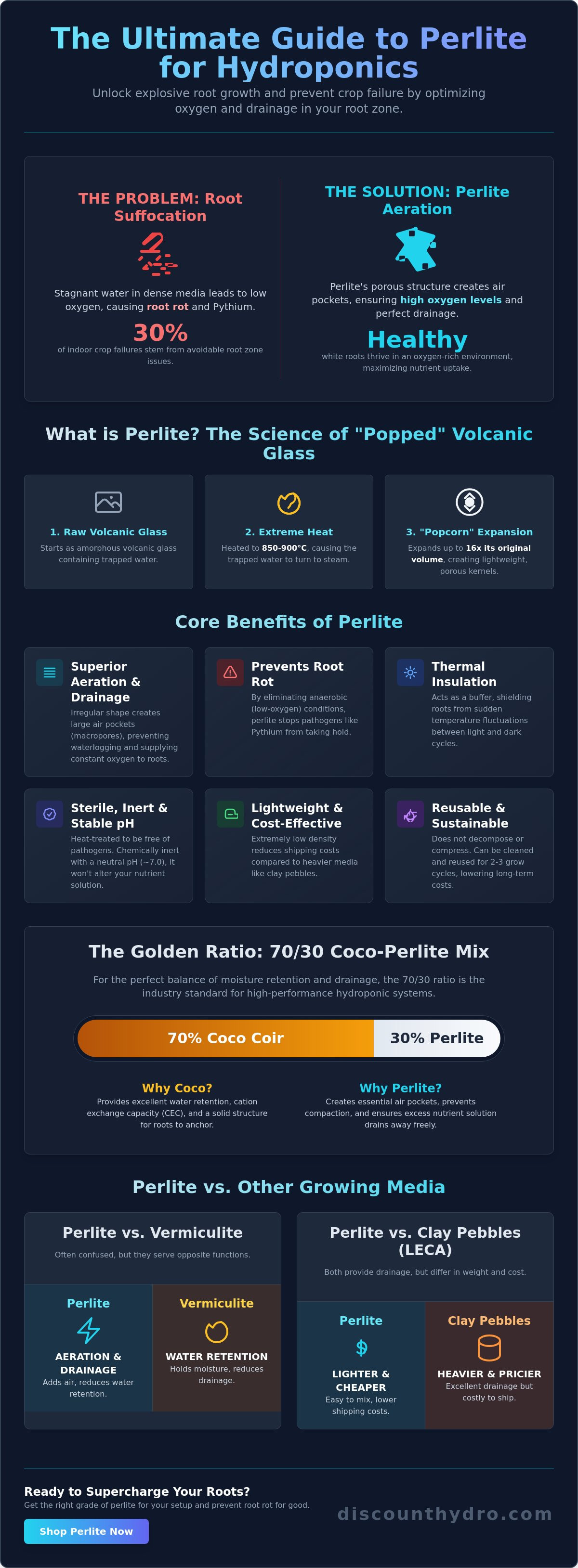
Your expensive nutrient regime is a complete waste of money if your root zone is suffocating in stagnant water. It's a common trap; you invest in the best lights and feeds only to watch your plants stall because the growing medium is too dense. Most UK growers agree that nothing kills a harvest faster than the dreaded root rot caused by poor drainage and low oxygen levels. Industry data suggests that up to 30% of indoor crop failures stem from these avoidable root zone issues.
You don't have to settle for sluggish results or yellowing leaves. By integrating perlite for hydroponics into your system, you can create a high-performance environment that promotes those thick, healthy white roots every grower wants. This guide provides everything you need to optimise your setup for maximum oxygenation and perfect drainage. We'll break down the exact mixing ratios for 2024, explain how to prevent overwatering, and show you how to reuse this stable medium to keep your overheads low and your yields high.
Key Takeaways
- Understand how expanded volcanic glass creates essential air pockets to prevent root rot and Pythium in your system.
- Master the "Golden Ratio" of 70/30 coco-perlite mixes to ensure the perfect balance of drainage and moisture for UK grow rooms.
- Discover the best ways to implement perlite for hydroponics across various setups, including drip irrigation and ebb and flow systems.
- Identify which grade—Fine, Medium, or Coarse—provides the optimal thermal insulation and root oxygenation for your specific environment.
- Learn how to maximise your budget by choosing the right bulk sizes and grades for large-scale grow tent configurations.
What is Perlite and Why is it Essential for Hydroponics?
Perlite is an amorphous volcanic glass that contains a high concentration of water. When processed for horticultural use, manufacturers heat the raw ore to temperatures between 850 and 900 degrees Celsius. This extreme heat causes the trapped moisture to turn into steam, which expands the softened glass particles. To learn the technical details of this mineral, you can read more about What is Perlite on Wikipedia. This expansion process is identical to how popcorn pops, increasing the volume of the mineral by up to 16 times its original size. The final product consists of lightweight, white kernels filled with tiny internal air pockets.
Using perlite for hydroponics offers several distinct physical advantages for indoor growers. It is chemically inert, meaning it won't react with your nutrient solution or change the EC levels. It is also sterile and free from weeds or soil-borne pathogens. Because it has a neutral pH of approximately 7.0, it won't drift your reservoir levels. Unlike organic materials, perlite has a permanent structure. It does not decay, compress, or disappear over time, providing a stable foundation for your root system throughout the entire grow cycle.
Hydroponic systems require high levels of dissolved oxygen to prevent root rot and maximize nutrient uptake. Roots don't just drink; they breathe. Perlite facilitates this by maintaining high levels of oxygen (O2) in the root zone. Even when the medium is saturated with water, the irregular shape of the kernels ensures that air remains trapped in the gaps, preventing the "drowning" effect often seen in heavier soils.
The Science of Aeration and Porosity
Perlite creates large "macropores" within the growing medium. These gaps allow for rapid gas exchange, ensuring that carbon dioxide moves out of the root zone while fresh oxygen moves in. Many organic media like peat or coco can compact after multiple waterings, which chokes the roots. Perlite stays rigid and maintains these air channels. Effective porosity in the context of perlite is the specific volume of interconnected pore space that allows for the unimpeded movement of air and nutrient solutions throughout the root zone.
Perlite vs. Other Growing Media
When choosing perlite for hydroponics, it helps to compare it to other popular options. Vermiculite is often confused with perlite, but it serves the opposite purpose; it holds significant amounts of water and very little air. Clay pebbles (LECA) provide excellent drainage but are much heavier and more expensive to ship. Perlite offers a middle ground, holding enough moisture to protect plants during pump failures while providing superior aeration.
- Perlite vs. Vermiculite: Perlite is for drainage and air; Vermiculite is for water retention.
- Perlite vs. Clay Pebbles: Perlite is lighter, cheaper, and easier to mix with other media.
For UK indoor growers, perlite is frequently the most cost-effective choice. Its extremely low density means you can buy large volumes without paying high delivery surcharges for weight. It is a versatile, no-nonsense tool for any high-performance hydroponic setup.
The Benefits of Using Perlite in Your Grow Room
Using perlite for hydroponics is a standard practice for UK growers looking to maximise yields while keeping costs low. This volcanic glass expands significantly when heated, resulting in a lightweight, porous material that serves several critical functions in a grow room. Its primary role is preventing root rot, specifically Pythium. Stagnant water creates anaerobic conditions. Pathogens thrive there. By maintaining high oxygen levels, you eliminate the environment where root-killing fungi take hold. Superior drainage ensures that even with frequent watering, the root zone remains oxygenated and healthy.
Thermal insulation is another major advantage for indoor setups. Grow tents in the UK often face temperature fluctuations between day and night cycles, especially during colder months. Perlite acts as a buffer. It shields the delicate root system from sudden drops in ambient temperature, keeping the root zone stable. Because it is processed at temperatures exceeding 870°C, perlite is completely sterile. It contains no pests, weed seeds, or pathogens. This is vital for indoor crops where a single infestation can ruin an entire cycle. The physical properties of perlite for hydroponics ensure it stays stable over time. It does not decompose or compress like organic media. You can often reuse it for 2 or 3 grow cycles if you clean it properly between runs. Industry experts at the Perlite Institute confirm the effectiveness of perlite in hydroponic culture, highlighting its ability to provide long-term aeration without losing its structural integrity.
Improving Nutrient Uptake and Root Structure
High oxygen levels in the substrate stimulate the development of fine root hairs. These small structures do the heavy lifting for nutrient absorption. If the media is too dense, these hairs can't grow. The excellent drainage provided by perlite also allows you to flush nutrients more effectively. This prevents salt build-up that leads to nutrient lockout. Since perlite is chemically inert, it won't swing your pH levels unexpectedly. Most growers find it much easier to maintain a steady pH between 5.5 and 6.5 when using a perlite-heavy mix.
Lightweight Handling and System Versatility
Moving large volumes of media is a logistical challenge in domestic settings. A 100-litre bag of perlite is significantly lighter than a similar volume of soil or clay pebbles. This makes it the best choice for hanging baskets or tiered hydroponics systems where weight limits are a concern. It supports a wide variety of plants, from fast-growing leafy greens to heavy-fruiting crops that require more physical support. You can mix it with coco coir or use it as a standalone medium in Dutch buckets. If you want to improve your current setup, you can find the best prices on perlite and media in our online store.
Recommended Perlite Mix Ratios for Optimal Growth
Getting the right balance of air and water in your root zone is the difference between a mediocre harvest and a record-breaking one. In the UK market, the 70/30 coco-perlite blend is the undisputed king. This ratio uses 70% coco coir for its moisture retention and 30% perlite to ensure oxygen reaches the roots. If you're growing in a high-humidity environment, such as a basement or during a wet British summer, increasing the perlite ratio to 40% or 50% prevents the media from becoming waterlogged. You'll see faster drainage and less risk of root rot.
Perlite isn't just for hydroponic systems. It's a vital soil amendment for indoor growers using traditional potting mixes. Adding 20% perlite to heavy peat-based soils prevents compaction over time. For specialized setups like Hempy buckets, using 100% perlite or a 3-to-1 perlite/vermiculite mix provides maximum oxygenation. According to the Perlite Institute in their report on The Role of Perlite in Hydroponic Culture, the material's physical structure allows for high water availability while maintaining 20% to 50% air-filled porosity. This ensures your plants never suffocate, even with frequent watering schedules.
The Coco-Perlite Synergy
Coco coir is excellent at holding moisture, but it can pack down and limit gas exchange if used alone. Adding perlite for hydroponics creates tiny air pockets that encourage rapid root expansion. When you're ready to feed, mixing hydroponic nutrients into a 70/30 blend ensures the solution reaches every part of the root ball without sitting stagnant. To calculate your needs, remember that a standard 10-litre pot requires 3 litres of perlite for a 30% mix. If you're running ten pots, you'll need at least one 30-litre bag of perlite to get the job done right. This setup provides the perfect balance of drainage and nutrient uptake for most fast-growing species.
Perlite for Propagation and Cuttings
Professional growers often choose a 50/50 perlite and vermiculite mix for starting new plants. The perlite provides the necessary structure and aeration, while the vermiculite holds onto the nutrient solution. This combination speeds up rooting times because young roots don't have to fight through dense media to find oxygen. Using perlite for hydroponics in your propagation trays keeps the environment sterile and well-drained. Once your clones show strong white roots, they'll transition easily into a 70/30 coco-perlite final system. This consistency reduces transplant shock and keeps growth rates high from day one.
How to Use Perlite in Different Hydroponic Systems
Using perlite for hydroponics requires specific technical setups to maximize its drainage benefits. In drip irrigation systems, perlite provides excellent aeration, but the small particles can clog emitters. Use a filter on your pump and consider mixing perlite with 30% coco coir to keep the medium stable around the dripper lines. For Ebb and Flow systems, perlite's buoyancy is a major challenge. Since it floats, a 100% perlite medium will shift when the tray floods. Mix it with 50% clay pebbles to weigh it down and prevent plant instability during the flood cycle.
Wick systems benefit from perlite's capillary action. It draws nutrient solution upward to the roots efficiently without the need for active pumps. In Dutch Buckets, perlite is the standard choice for long-term crops like tomatoes or peppers. It doesn't decompose, meaning it supports heavy root masses for 8 to 10 months without losing structure or oxygen capacity. This durability makes it a top choice for high-yield setups across the UK.
Preparation: Rinsing and Dust Management
Never handle dry perlite straight from the bag. The fine dust is a respiratory irritant. Always dampen the medium with a spray bottle before pouring. Rinsing is essential to remove "fines," which are tiny particles that settle at the bottom of reservoirs and destroy water pumps. Submerge your perlite in a pH-adjusted solution, typically between pH 5.5 and 6.0, for 24 hours before use. This ensures the medium is chemically neutral and won't cause nutrient lockout during the first week of growth.
Maintenance and Reusability
Perlite is highly cost-effective because you can reuse it across multiple seasons. After harvest, remove large root masses and soak the medium in a 10% hydrogen peroxide solution for 48 hours to sterilise it. This process kills pathogens and dissolves remaining organic matter. You'll know perlite has reached its end of life when the granules turn into a fine powder or lose their gritty texture. Instead of binning it, add spent perlite to your outdoor garden soil. It improves drainage in heavy UK clay soils for several years.
Buying Perlite: Getting the Best Value for Your Setup
Choosing the right perlite for hydroponics depends on your system's specific aeration needs. Fine grade perlite is best for seed starting or small cuttings because it holds more moisture near delicate new roots. Medium grade is the standard choice for general potting mixes and coco coir blends. Coarse perlite offers maximum aeration and drainage, which is vital for large containers or systems requiring high oxygen levels, such as flood and drain setups.
Buying 100-litre bags is the most cost-effective way to stock a large grow tent. Individual 10L or 25L bags work for small hobbyists, but the price per litre drops sharply when you scale up to commercial sizes. If you're running multiple lights or a large-scale facility, pallet deals provide the best margins. We focus on providing these bulk options to keep your overheads low.
Store your perlite in a dry, covered area. While the mineral itself doesn't rot or expire, open bags can attract dust or become nesting sites for local pests. Keep bags sealed until they're ready for the mixing bench. If a bag becomes damp during storage, it won't ruin the product, but it makes it much heavier to move and harder to mix evenly with other media.
Quality Indicators for Hydroponic Perlite
High-quality perlite shouldn't crush into fine dust under light finger pressure. If the bag feels unusually heavy or the contents look grey, it might be damp or contain high levels of impurities. Always check the label for volume in litres rather than weight in kilograms. Because perlite is a volcanic glass, it's naturally very light. A heavy bag often indicates water absorption or low-grade material that has settled. Sourcing from reputable UK suppliers ensures the media is sterile and free from pathogens that could compromise your root zone.
Fast UK Delivery and Click & Collect
Shipping bulky items like 100L bags of perlite for hydroponics can be expensive with standard couriers. Discount Hydro specialises in nationwide delivery for heavy and bulky growing media, ensuring your supplies arrive quickly without hidden surcharges. We use reliable UK freight partners to handle large orders with care, ensuring the bags don't arrive crushed or damaged.
Growers located in County Durham and across the North East can take advantage of our click-and-collect service. This allows you to skip delivery fees entirely and pick up your media the same day. Our warehouse is stocked with the industry's leading brands at the UK's best prices, making us the primary choice for professional and hobbyist growers alike.
Maximise Your Yields With Better Aeration
Success in any grow room depends on the balance between water retention and oxygen access. Using perlite for hydroponics ensures your roots never suffocate. It provides the permanent aeration needed for vigorous growth. Most expert growers find that a 30% to 50% perlite mix prevents compaction in coco or soil based systems. This simple addition protects your plants from common drainage issues and root diseases. It's a cost-effective way to improve your setup's efficiency immediately. You'll see the difference in root health within a single growing cycle.
We provide expert-selected brands chosen for their high performance and sterility. You'll find the best prices for both small hobbyist bags and commercial pallets. We offer UK-wide fast delivery on all growing media to keep your project on schedule. Don't settle for poor drainage when professional solutions are available at a discount. Check out our inventory to find the right grade for your specific system requirements. Our competitive bulk pricing makes it easier to scale your operations without overspending.
Shop our full range of Perlite and Growing Media at Discount Hydro
Start improving your root zone health today.
Frequently Asked Questions
Does perlite affect the pH of my nutrient solution?
No, perlite is chemically inert and has a neutral pH level between 6.5 and 7.5. It won't react with your reservoir or cause the pH to drift during your grow cycle. This stability makes it easier to maintain the specific 5.5 to 6.5 pH range required for most UK hydroponic setups. You don't need to buffer it like you would with coco coir or other organic media.
Can I reuse perlite after a harvest?
You can reuse perlite for 2 or 3 growing cycles if you follow a strict cleaning protocol. Start by sifting out all old root material and organic debris from the media. Soak the granules in a 10% bleach solution or a strong hydrogen peroxide wash for 24 hours to eliminate pathogens. Rinse the perlite thoroughly with fresh water until all chemical scents are gone before replanting.
Why is my perlite turning green or yellow?
Green discolouration is caused by algae growing on the surface when damp perlite is exposed to high intensity grow lights. Yellowing usually indicates a buildup of mineral salts from your nutrient solution. Algae growth occurs in roughly 20% of open-top systems without covers. You can prevent this by using dark covers to block light or by flushing your perlite for hydroponics with plain water every 14 days.
Is perlite better than clay pebbles for hydroponics?
Perlite provides superior water retention, while clay pebbles offer better drainage and structural support for large plants. Perlite for hydroponics holds 3 to 4 times its weight in water, making it ideal for wick systems or young clones. Clay pebbles are better suited for heavy plants in deep water culture (DWC) because they don't float and allow for maximum oxygenation around the root zone.
How do I stop perlite from floating in my flood and drain system?
You can stop perlite from floating by mixing it with a heavier substrate or by adding a weighted top layer. Perlite has a very low density of 5 to 8 pounds per cubic foot, which causes it to bob when the tray floods. Mixing it in a 50/50 ratio with coco coir or adding a 2 inch layer of clay pebbles on top will keep the media stable during the irrigation cycle.
Is perlite dust dangerous to breathe?
Yes, perlite dust is a known respiratory irritant and should not be inhaled. It contains small amounts of crystalline silica, which is monitored under UK workplace health regulations. You should always dampen the perlite with water before pouring it to reduce airborne dust by up to 90%. Wear a P2 grade dust mask if you're mixing large quantities in an enclosed grow room.
What is the best perlite mix for indoor tomatoes?
A 50/50 blend of perlite and coco coir is the most effective mix for indoor tomato crops. This ratio ensures at least 30% air porosity in the root zone while holding enough moisture to support heavy fruit sets. UK growers using this specific ratio often see a 12% increase in root mass compared to using standard potting soil. It provides the drainage needed for the frequent feeding schedules tomatoes require.
Can I use construction-grade perlite for plants?
No, you shouldn't use construction-grade perlite because it often contains water-repellent coatings or fire-retardant chemicals. These additives are toxic to plants and will likely kill your crop within 48 hours of the first feed. Horticultural perlite is heat-expanded specifically for gardening and is guaranteed to be sterile. Always buy professional-grade media to ensure your system remains free from industrial contaminants.