

Plastic Grow Pots: The Ultimate Buyer's Guide for Growers
Don't let the wrong container compromise your harvest. A simple choice, like the pot you use, can be the difference between a massive yield and a disappointing one plagued by root rot. Are you confused by the endless options for grow pots plastic? Unsure if you need a 2L square pot or a 10L air pot? Wasting money on the wrong equipment is a mistake no grower can afford to make, especially when the solution is this straightforward.
This is your no-nonsense guide to making the right choice, every time. We'll break down everything you need to know: selecting the correct size for explosive root growth, understanding the real-world difference between round and square pots, and guaranteeing optimal drainage to prevent costly crop failure. Get ready to stop wasting money and start maximising your plant's potential. Find the best value pots for your setup and secure a bigger, healthier yield.
Key Takeaways
- Understand the key advantages of plastic pots - low cost, durability, and water retention - to decide if they're the right choice for your setup.
- Match your pot size to your plant's growth stage with our simple guide to prevent root-bound issues and support maximum growth.
- Discover the different types of grow pots plastic and learn the proper cleaning techniques to reuse them season after season, saving you money.
- Look beyond size and learn to inspect critical features like drainage design and rim strength to ensure you get the best performance for your money.
Why Choose Plastic Pots? (And When Not To)
When setting up your grow room, the choice of container is fundamental. For most indoor growers, standard plastic pots are the go-to option, and for good reason. They offer an unbeatable combination of price, performance, and practicality that is hard to ignore. But are they always the best choice for every situation? Let's break down the core benefits and potential drawbacks.
Plastic Pots: At a Glance
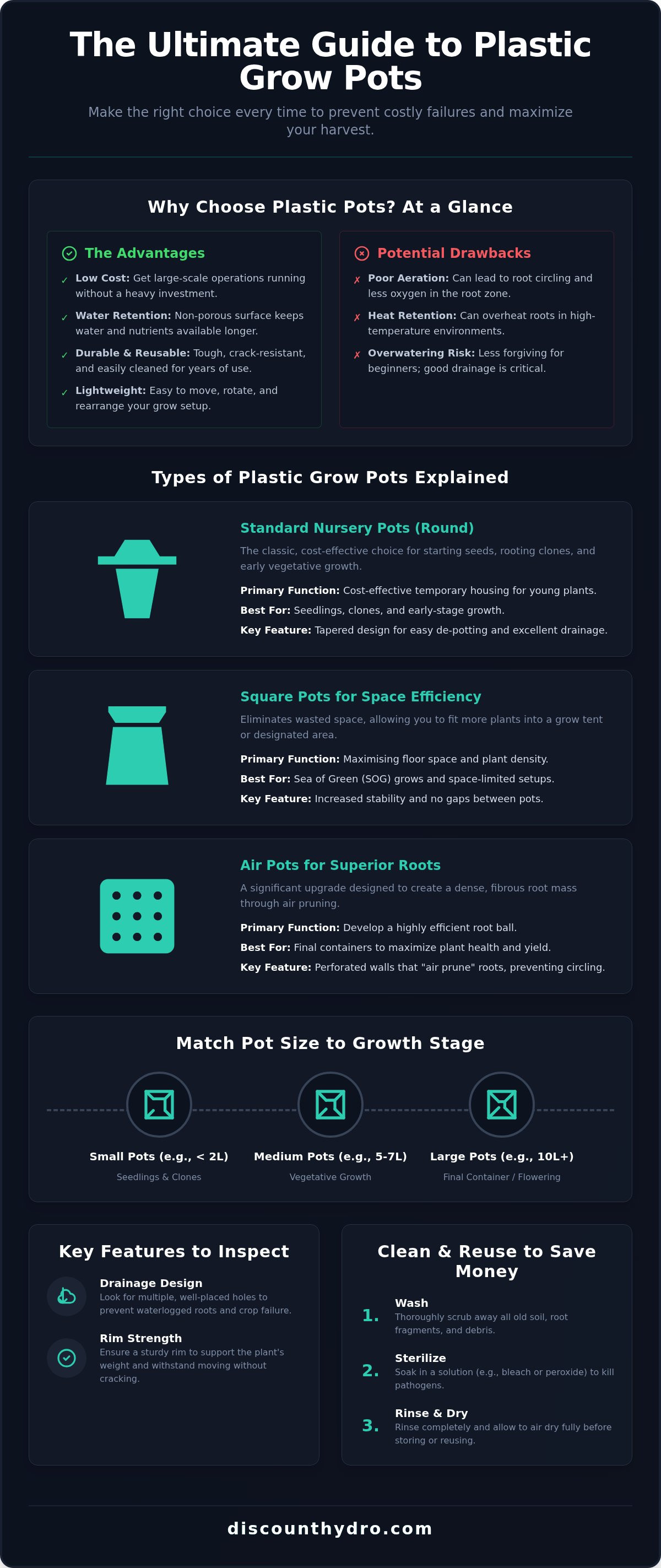
- Pros: Low cost, excellent water retention, durable, reusable, and lightweight.
- Cons: Poor root aeration (can cause root circling), retains heat, and can make overwatering an issue for beginners.
The Core Advantages of Plastic
The primary driver for choosing plastic is value. A set of plastic pots costs a fraction of fabric or terracotta alternatives, allowing you to get a large-scale operation running for just a few pounds. They are tough, resistant to cracking, and with a simple cleaning between cycles, they can be reused for years, delivering an excellent return on your initial investment.
Plastic's non-porous surface is key for moisture control. It prevents water and expensive nutrients from evaporating or leaking out, keeping them available to your plant's roots for longer. This means less frequent watering and less waste. Their lightweight design makes rearranging your grow tent or rotating plants for even light exposure a hassle-free task. For a full overview of different Flowerpot materials and sizes, Wikipedia offers a solid background resource.
Plastic vs. Fabric Pots: A Quick Comparison
While plastic pots are the industry workhorse, fabric pots offer a key advantage: air pruning. When roots reach the breathable fabric wall, they are naturally pruned, encouraging a denser, more fibrous root ball. However, this superior aeration means fabric pots dry out much faster, requiring more frequent watering.
In terms of cost and maintenance, plastic almost always wins. It's cheaper upfront and far easier to sterilise completely between grows. For growers on a tight budget, beginners still mastering their watering schedules, or those running automated drip systems, grow pots plastic are the more practical and forgiving choice. Choose fabric only if you are an experienced grower prioritising maximum root zone oxygenation and can commit to a more demanding watering routine. For those who appreciate working with durable, natural materials in other crafts, you can discover Hab-To Leather House for unique supplies.
Types of Plastic Grow Pots Explained
Not all grow pots plastic are created equal. The design of a pot directly impacts root health, water retention, and even your overall yield. Understanding the function of each type ensures you're buying the right tool for the job, saving you time and money. Below, we break down the most common types you'll find and their ideal applications.
Standard Nursery Pots (Round)
This is the classic, no-frills pot you see everywhere. Its tapered design isn't just for stacking; it allows for easy removal of plants when transplanting. The tiered drainage holes at the base are crucial for preventing waterlogged roots, a fundamental principle highlighted in this Oklahoma State University container selection guide. Their low cost and wide availability make them the go-to choice for starting seeds, rooting clones, and for plants in the early vegetative stage.
- Primary Function: Cost-effective temporary housing for young plants.
- Best For: Seedlings, clones, and early-stage growth before potting up.
- Key Feature: Excellent drainage and easy de-potting.
Square Pots for Space Efficiency
For growers looking to maximise their canopy, square pots are the logical choice. Their main advantage is eliminating the wasted space between round pots, allowing you to fit more plants into a grow tent or designated area. This design also helps prevent roots from circling, encouraging a better-structured root system. Their stability and space-saving nature make them perfect for Sea of Green (SOG) setups where high plant density is key to success.
- Primary Function: Maximising floor space and plant density.
- Best For: Sea of Green (SOG) grows and any space-limited setup.
- Key Feature: No wasted space, increased stability.
Air Pots for Superior Root Pruning
Air pots are a significant upgrade designed to create a superior root system. The perforated walls expose root tips to the air as they reach the edge of the pot. This "air pruning" process causes the root to stop growing in that direction and instead branch out, creating a dense, fibrous root mass that can absorb nutrients more efficiently. The trade-off is that they dry out much faster, requiring more frequent watering. They are the best final container for high-value plants where maximising growth is the top priority.
- Primary Function: To develop a dense, highly efficient root ball through air pruning.
- Best For: Final containers to maximise plant health and yield.
- Key Feature: Perforated design that promotes a fibrous root system.
Net Pots for Hydroponic Systems
Net pots are specialist equipment exclusively for hydroponic and aeroponic systems. They are not designed for use with soil or coco coir. The open mesh design provides structural support for the plant while allowing its roots to grow out and directly access the oxygen-rich nutrient solution below. Typically filled with an inert medium like clay pebbles, they are essential components in systems like Deep Water Culture (DWC) and flood and drain tables.
- Primary Function: Supporting plants in a soilless hydroponic environment.
- Best For: DWC, aeroponics, and flood and drain systems.
- Key Feature: Mesh design for maximum root exposure to water and nutrients.
How to Choose the Right Pot Size
One of the most common questions new growers ask is, "What size pot do I need?" When using grow pots plastic, choosing the right size is not just about giving your plant space; it's about managing water, nutrients, and root health effectively. Getting this right from the start prevents common problems and sets you up for a heavier yield. This guide cuts straight to the facts to help you select the correct pot for every stage of growth.
General Sizing Guide (Litres/Gallons)
Use this simple chart as your starting point. While every plant is different, these guidelines are a reliable rule of thumb for most species grown indoors. Remember to match the pot to the plant's current size, not its future potential.
| Plant Stage | Recommended Pot Size |
|---|---|
| Seedlings & Clones | 0.5 - 1 Litre |
| Vegetative Stage | 5 - 10 Litres |
| Final Flowering Stage | 10 - 25+ Litres |
The Art of 'Potting Up'
‘Potting up’ is the process of moving your plant into a slightly larger container as it grows. Instead of starting in a final, large pot, this gradual process encourages the roots to form a dense, compact mass. A stronger root system means a stronger plant, better nutrient uptake, and faster growth.
Watch for these clear signs it’s time to pot up:
- Roots are visibly growing out of the drainage holes.
- The plant is top-heavy and unstable.
- Growth has slowed down or stopped completely.
- The growing medium dries out extremely quickly after watering.
Find the perfect size for every stage in our Pots & Trays selection.
The Risk of Over-Potting
Putting a small seedling in a huge pot is a classic beginner mistake. A large volume of soil holds a large volume of water, which a small root system cannot absorb quickly. This waterlogged soil starves the roots of oxygen, leading directly to root rot, fungus gnats, and nutrient lockout. The key with any grow pots plastic or fabric pot is to ensure the root mass can colonise the soil volume relatively quickly. Always choose a pot that is just one or two sizes bigger than the current root ball.
Key Features to Inspect Before You Buy
Once you've settled on a size, the finer details separate a pot that lasts one cycle from one that serves you for years. Looking beyond the dimensions ensures you get the best value for your money and peak performance for your plants. These features directly impact root health, plant stability, and the overall efficiency of your grow.
Drainage: The Most Critical Feature
Poor drainage leads to root rot-it’s the one feature you cannot compromise on. A single hole at the bottom is not enough for serious growing. For optimal root health, look for a superior drainage system with these key features:
- Number and Size: Multiple, well-distributed holes provide even drainage and are less likely to clog than one large hole.
- Placement: The best pots have holes on the base and lower side walls, promoting excellent aeration.
- Raised Base: Feet or channels on the bottom lift the pot out of runoff, stopping roots from becoming waterlogged and improving airflow.
Before filling, always check for plastic flashing from manufacturing that could cause a blockage.
Material Quality and Durability
The material directly impacts a pot’s lifespan and value. The cheapest grow pots plastic options are often flimsy, thermoformed models that crack after a single use. For a reliable setup, you need sturdy, injection-moulded pots made from quality Polypropylene (PP). Give the rim a squeeze-it should be flexible but strong, not thin and crackly. Investing a little more in a durable, reusable pot saves you money and hassle season after season. It’s a smart investment that pays for itself. Shop our range of heavy-duty pots built to last.
Pot Colour: Does it Matter?
Yes, but the right choice depends on your environment. For indoor tent growing, black is the industry standard. It completely blocks light from reaching the root zone, preventing algae growth, and its heat absorption is not a concern in a controlled space. However, if you're growing in a greenhouse or outdoors during a hot UK summer, white or light-coloured pots are a better choice. They reflect sunlight, keeping the root zone cooler and preventing heat stress that can stunt your plants' growth.
How to Clean and Reuse Your Plastic Pots
One of the biggest advantages of using high-quality plastic pots is their durability and reusability. Investing in sturdy containers pays off season after season, but only if you clean them properly. A thorough post-harvest cleanup isn't just about tidiness; it's a critical step to prevent the transfer of diseases and pests to your next crop, protecting your investment and future yields. Following these two simple steps ensures your pots are ready for action and maximises their lifespan.
Step 1: Physical Cleaning
First, you need to remove all the physical debris left over from your last grow. Caked-on soil and old root matter can harbour pathogens and pest eggs. Get them spotless with this process:
- Empty Completely: Tip out all old growing media, root balls, and any remaining plant stalks. A quick tap on a hard surface can help dislodge stubborn substrate.
- Scrub Down: Using a stiff-bristled brush and plain water, scrub every surface inside and out. Don't neglect the rim or the base.
- Focus on Details: Pay close attention to corners and drainage holes, as this is where mineral salt deposits and hidden debris tend to accumulate.
- Rinse Thoroughly: Once scrubbed, give the pots a final, powerful rinse with clean water to wash away any remaining particles.
Step 2: Sterilizing for the Next Grow
This is the most crucial part of the process. While a pot may look clean, it can still host microscopic fungal spores, bacteria, or insect eggs. Sterilization eliminates these invisible threats. The most common and cost-effective method is a bleach soak.
Create a solution of 1 part household bleach to 9 parts water in a large tub or basin. Submerge your cleaned pots completely and let them soak for a minimum of 20-30 minutes. This is long enough to kill off any lingering pathogens. If you prefer not to use bleach, specific horticultural cleaning agents or a 3% hydrogen peroxide solution are also effective alternatives.
After soaking, rinse the pots extremely well with fresh water to remove all traces of the cleaning solution. Allow them to air dry completely in the sun if possible before stacking them away for storage. Properly maintained grow pots plastic will serve you reliably for many harvests to come, proving their excellent value. For a full range of heavy-duty pots built to last, browse our selection at discounthydro.com.
The Right Plastic Pots for a Bumper Harvest
You're now equipped with the essential knowledge to make the right choice. Remember, success comes down to selecting the correct pot size for your plant's root system, understanding the benefits of different designs, and checking for critical features like drainage. Following our cleaning guide will also ensure you get maximum value by reusing your pots season after season, saving you money and reducing waste. Investing in the right grow pots plastic is a simple step that delivers huge results for your plants.
Ready to put this knowledge into action? Find exactly what you need in our massive selection. Shop our huge range of durable plastic grow pots at the UK's best prices. We offer fast, nationwide UK delivery on all orders, and if you're local, click and collect is available from our Durham store. Stop planning and start planting for your best yield yet.
Frequently Asked Questions About Plastic Grow Pots
What's the difference between a 1-gallon nursery pot and a 1-gallon trade pot?
A "trade gallon" is a term used in the horticulture industry and is not a true gallon measurement. It is significantly smaller. A standard UK gallon is 4.54 litres, while a 1-gallon trade pot typically holds only around 3 litres. This smaller size allows growers and nurseries to fit more pots onto shipping pallets and retail benches, reducing costs. Always check the pot's volume in litres to ensure you are buying the size you actually need for your plant.
How do I know when it's time to transplant my plant to a bigger pot?
There are several clear signs it's time to repot. Look for roots growing out of the drainage holes at the bottom. If the soil dries out extremely quickly, requiring daily watering, the pot is likely too small. Other indicators include slowed or stalled growth, or if you can see a dense, tangled mass of roots when you gently lift the plant from its pot. Moving to a larger pot will give the roots fresh space and nutrients to expand and support new growth.
Can I drill extra drainage holes in my plastic pots?
Yes, absolutely. Modifying our durable grow pots plastic is simple and often recommended, especially for plants that are sensitive to overwatering. Use a standard power drill with a medium-sized bit to add several extra holes to the bottom of the pot. This improves aeration and ensures excess water can escape freely, which is one of the most effective ways to prevent root rot. Just be sure to drill from the inside out for a cleaner hole on the exterior.
Are black plastic pots safe for growing edible plants?
Yes, the black plastic pots sold for horticulture are safe for growing edible plants like vegetables and herbs. They are typically made from inert, UV-stabilised plastics such as polypropylene (#5) or high-density polyethylene (#2). These materials are stable and do not leach harmful chemicals into the soil or your plants. The primary consideration with black pots is that they absorb more heat, which can be beneficial in cooler UK climates but may require more frequent watering in direct summer sun.
What is the best type of plastic pot for a beginner grower?
For a beginner, the best choice is a standard, round black nursery pot with pre-formed drainage holes. These pots offer the best value, are extremely durable for reuse, and are lightweight and easy to handle. Their simple, functional design works for almost any plant type. Starting with a common size like a 3-litre or 5-litre pot provides ample room for most young plants without a significant initial investment. These basic grow pots plastic are a cost-effective and reliable foundation for any new growing project.