

Quiet Extractor Fan for Grow Room: The Ultimate 2026 Stealth Guide
Your grow room is only as stealthy as your loudest piece of equipment. If a 60-decibel motor hum is currently vibrating through your masonry, you aren't just wasting energy; you are inviting unwanted attention from the neighbours. Finding a genuine quiet extractor fan for grow room use is often difficult because of confusing manufacturer ratings that don't account for real-world vibration. It's a common frustration to invest in "silent" kits only to find the high-pitched buzz remains audible through the floorboards at 2 AM.
You can fix this by upgrading to high-efficiency hardware that uses digital EC motors to cut noise by up to 15 decibels while reducing your monthly electricity bills. This 2026 stealth guide covers the latest acoustic housing technology and professional mounting techniques used to eliminate resonance. We will show you exactly how to build a professional ventilation system that keeps your environment private and your running costs at the UK's best prices.
Key Takeaways
- Distinguish between mechanical vibration and air-rush noise to target the specific source of sound in your ventilation system.
- Learn why 2026 EC motor technology is superior to traditional AC fans for removing the persistent hum often found in indoor setups.
- Discover how to choose the right quiet extractor fan for grow room use by evaluating static pressure and acoustic build materials.
- Master pro-level installation techniques, including the use of acoustic ducting, to further dampen sound and optimise airflow efficiency.
- Access an expert overview of the best-value silenced fans from Revolution and Rhino to achieve ultimate stealth at the UK's lowest prices.
Understanding Grow Room Noise: Why Silence Matters
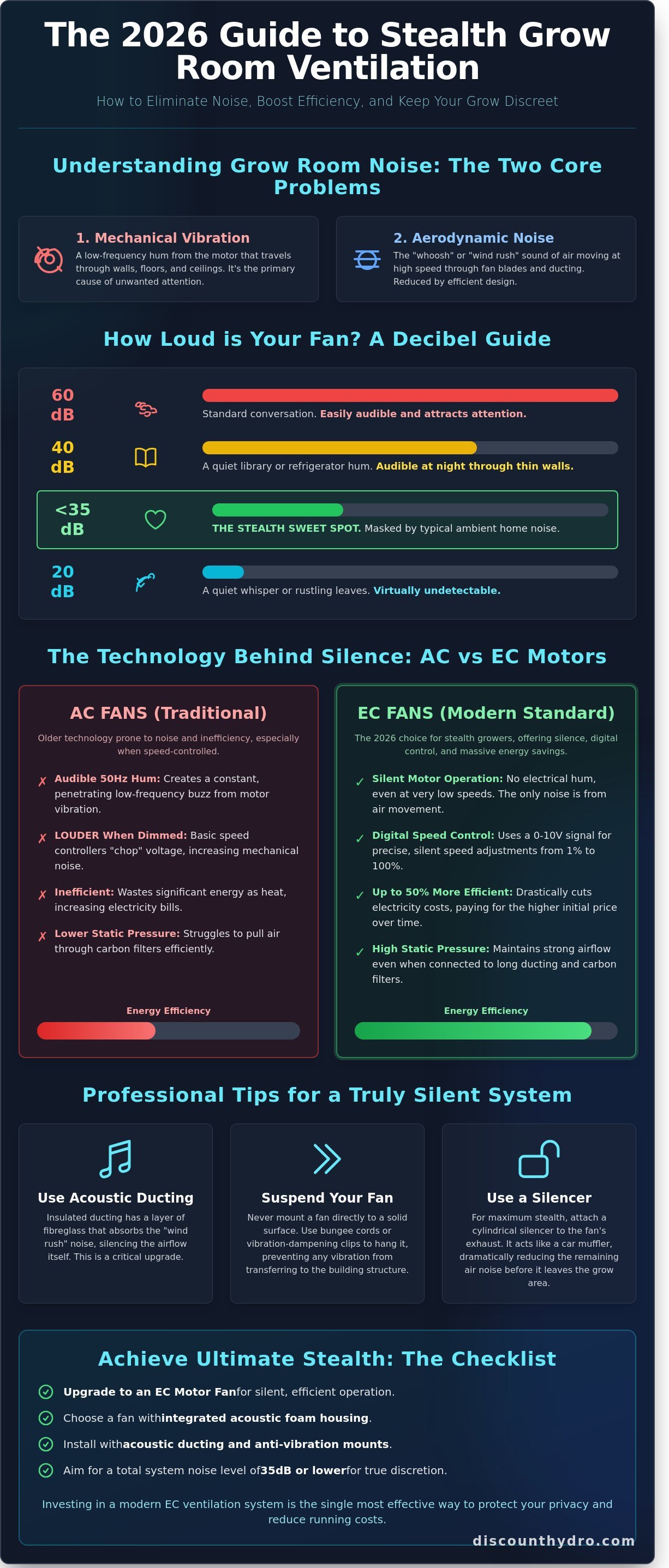
Noise isn't just a minor annoyance for indoor gardeners. It's a potential security risk and a source of daily irritation. In a standard UK spare room or loft setup, the sound of a running fan can penetrate floorboards and brickwork. You need to distinguish between the two primary noise sources. Mechanical vibration stems from the internal motor and the physical contact between the fan and its mounting point. Aerodynamic noise, often called "wind rush," is the sound of air moving at high velocity through the fan blades and into the ducting.
Successful indoor gardening requires a balance between airflow and acoustics. You need enough air exchange to manage heat from lights and maintain CO2 levels, but you can't have your house sounding like a wind tunnel. Most UK gardeners prioritise stealth above all else. A loud setup attracts unwanted questions from neighbours. Choosing a quiet extractor fan for grow room ventilation is the most effective way to keep your hobby private while ensuring your plants have the fresh air they need to thrive.
Decibel Comparison: How Loud is Your Fan?
Understanding the decibel (dB) scale is vital for choosing the right equipment. Most manufacturers provide a dB rating, usually measured at a distance of one to three metres from the unit. The decibel scale is logarithmic, not linear. This means a 3dB increase represents a 100% increase in sound energy. A fan rated at 38dB is twice as loud as one rated at 35dB. To help you visualise these levels, consider these common reference points:
- 20dB: Similar to a quiet whisper or rustling leaves in a garden.
- 40dB: Comparable to a quiet library or a modern refrigerator humming in the kitchen.
- 60dB: The level of standard background conversation in an office.
For a truly discreet setup, aim for the "sweet spot" of 35dB or lower. At this level, the ambient noise of a typical UK home easily masks the fan. If your equipment exceeds 40dB, it will likely be audible through a closed door or a thin wall during the quiet night hours.
The Impact of Noise on Your Growing Environment
A constant low-frequency hum is a major psychological stressor for the grower. If you can hear your equipment through the ceiling while you're trying to sleep, your anxiety levels will rise. Discretion is essential for urban residential setups in cities like London or Birmingham where neighbours live just a few feet away. You don't want to be the person with the "buzzing" spare room.
Modern engineering has solved many of these issues. High-quality fans now utilise advanced Centrifugal fan technology to move large volumes of air with minimal turbulence. By using brushless EC (Electronically Commutated) motors, these units run cooler and quieter than traditional AC models. They also maintain high static pressure. This is crucial because it allows the fan to pull air through a carbon filter effectively without needing to spin at deafening speeds. Investing in a quiet extractor fan for grow room use means you get the performance required for healthy plants without the domestic disturbance. These fans use insulated housings and vibration-dampening clips to ensure that the only thing moving is the air itself.
The Tech Behind the Silence: AC vs EC Extractor Fans
Traditional ventilation systems used Alternating Current (AC) motors for decades. While reliable, these motors have a significant drawback for anyone seeking a quiet extractor fan for grow room environments; they produce an audible 50Hz hum. This noise occurs because AC speed controllers work by "chopping" the voltage waveform. This process creates mechanical vibration in the motor windings. By 2026, this technology is being phased out by professional growers who prioritise stealth and efficiency. If you use a basic variac or triac controller on an AC fan, the buzzing often becomes louder than the actual movement of air.
The shift toward Electronically Commutated (EC) technology represents the biggest leap in ventilation since the mid-2010s. EC motors combine the best of both worlds by taking an AC supply and converting it to Direct Current (DC) internally. This allows for digital control of the motor speed. Because the speed is managed via a 0-10V signal rather than voltage restriction, the motor remains silent even when dimmed to 20% or 30% power. Technical standards for HVAC noise and vibration control confirm that reducing these electrical harmonics is essential for low-decibel environments.
The cost-benefit analysis for EC fans is clear. You might pay £180 for a high-quality EC fan compared to £70 for a standard AC model. However, an EC motor is roughly 50% more efficient at full speed. When dimmed, the savings are even greater. A 150mm EC fan running at half speed uses significantly less than half its maximum wattage. Over a 365-day operational cycle, the energy savings often exceed £100, meaning the fan pays for itself within its first year of service. You can browse our range of energy-efficient fans to see the latest pricing on these high-performance units.
Why EC Motors are the Quietest Choice
EC motors eliminate the "growl" associated with cheap speed controllers. They use permanent magnets and a small circuit board to manage the rotation. This digital precision removes the friction and heat buildup found in older induction motors. You get a smoother start-up and a linear power curve that keeps noise levels below 30dB in many setups. EC technology is the industry standard for silent operation.
Acoustic Housing and Silenced Fans
A "silenced" fan isn't just a motor; it's an engineered system. Brands like Systemair and Rhino lead the market by using double-walled casings filled with sound-deadening foam. This acoustic lining absorbs the high-frequency "whoosh" of the impeller blades. While an external duct silencer can reduce noise by an additional 5-10dB, an internally silenced fan saves space in tight tents. These units are specifically designed to move 600m3/h or more while remaining whisper-quiet. Choosing a silenced model ensures your quiet extractor fan for grow room stays discreet from outside the door.
These principles of acoustic engineering—using foam and specialized casings to control unwanted noise and vibration—are also central to high-performance car audio. For those interested in how these concepts are applied in a different context, you can learn more about Bassjunkies, specialists in in-car technology.
- AC Motors: Low initial cost (£60-£90), high hum when dimmed, higher running costs.
- EC Motors: Higher initial cost (£150-£250), silent dimming, 50% better energy efficiency.
- Silenced Housing: Reduces noise by 15-20dB compared to raw metal fans.
Top Features to Look for in a Quiet Extractor Fan
Choosing a quiet extractor fan for grow room setups involves more than just checking the decibel rating on the box. You must evaluate the build quality and internal components. Cheap fans use thin plastic that vibrates at high speeds. High-end silent fans use composite acoustic housings or double-walled steel. These designs often include 50mm of internal sound-deadening foam. This insulation can reduce noise emissions by up to 15dB compared to standard budget models. It's the difference between a dull hum and a distracting roar.
Integrated controllers provide a massive advantage for noise management. Built-in thermal speed controllers allow the fan to react to temperature changes automatically. Older AC motors often hum or buzz when you turn them down with an external dimmer. Modern EC (Electronically Commutated) motors don't have this issue. They remain virtually silent even when running at 20% power. This efficiency also cuts your electricity bill, often paying for the fan within 18 months of 24/7 use.
Vibration is the silent killer of a stealthy setup. Look for fans equipped with rubberised mounting brackets or integrated silent blocks. These components isolate the motor's movement from the grow tent poles. If you hard-mount a fan to a frame, the entire structure vibrates and amplifies the sound. Using rubberised mounts can lower the perceived noise in the room next door by as much as 40%. It's a small detail that prevents your ventilation system from sounding like a structural fault.
Matching Fan Size to Room Volume
The "headroom" rule is the most effective way to keep your grow room quiet. Always buy a fan that's slightly larger than your calculations suggest. A 200mm fan running at 30% capacity produces significantly less wind noise than a 100mm fan screaming at 100%. It's about air velocity. Slower air through a larger duct is always quieter. Standard diameters range from 100mm for small tents to 315mm for large industrial spaces.
To calculate your needs, find the volume of your space in metres (Length x Width x Height). Multiply this by 60 to find the required m3/h for a full air exchange every minute. For example, a 1.2m x 1.2m x 2m tent has a volume of 2.88m3, requiring 172.8 m3/h. Applying greenhouse ventilation principles ensures you maintain the correct CO2 levels and humidity without overworking your equipment. Always add 20% to this figure if you're using a carbon filter.
The Importance of Static Pressure
Static pressure is the measure of a fan's "pushing power" against resistance. Carbon filters are dense and create a lot of drag. If your fan lacks torque, the airflow will stall and the motor will strain, creating a high-pitched whine. High-torque EC fans are designed to overcome this resistance without increasing noise levels. They use magnetic fields to maintain RPM regardless of the pressure back-load.
When you add a filter, expect a 15% to 25% drop in actual airflow. You must choose a fan that matches your filter’s m3/h rating precisely. If the fan is too powerful, it pulls air through the carbon too fast for odours to be scrubbed. If it's too weak, the heat will build up and the fan will run at max speed constantly. Aim for a fan with a static pressure rating of at least 300Pa to ensure it can handle a professional-grade carbon filter without losing its silent edge.
Professional Tips for a Truly Silent Ventilation System
Selecting a high-quality quiet extractor fan for grow room use is only half the battle. Your installation choices determine whether your setup stays discreet or draws unwanted attention. Standard aluminium flex ducting is a poor choice for stealth; it vibrates and amplifies the sound of moving air. You should use acoustic ducting, such as Sonodec, which incorporates a layer of glass wool insulation. This simple change typically reduces noise output by 12 to 14 decibels. It's an essential upgrade for anyone running a high-powered extraction system in a residential area.
Airflow turbulence is a major source of noise. Every 90-degree bend you include in your ducting run increases air resistance and creates a "whooshing" sound. Data shows a sharp bend can reduce your fan's actual airflow by 20% while increasing noise by 3dB or more. Use straight runs where possible. If you need to turn a corner, use a gradual radius to keep the air moving smoothly. This reduces the strain on the motor and keeps the decibel level low.
Vibration transfer is another silent killer. If you bolt your fan directly to a tent pole or a wooden joist, the vibration travels through the structure. This turns your ceiling or walls into a giant sounding board. Use heavy-duty bungee cords or specialised acoustic hangers to suspend the fan. By "floating" the unit, you decouple the motor from the structure. Always place the fan in the centre of the grow space. Positioning it directly against a wall or in a corner allows sound to bounce and amplify, often increasing the volume by 5dB to 8dB in the immediate vicinity.
Optimising Your Ducting for Stealth
The sound of air exiting the system is often more noticeable than the fan motor. This "air-rush" happens because air is forced through a narrow opening at high speed. You can solve this by increasing your ducting size on the exhaust side. If your fan has a 125mm outlet, use a 150mm or 200mm duct for the final run. This lowers the air velocity and softens the exit noise. Ensure all connections are airtight. Use a combination of high-quality duct tape and metal clips. A tiny 1mm leak can create a piercing whistle that is easily heard through walls.
Maintenance for Long-Term Silence
Silence requires regular upkeep. Dust accumulates on fan blades over a 6-month period, causing the impeller to become unbalanced. This imbalance leads to a low-frequency hum and premature bearing wear. Wipe the blades every 180 days to keep the rotation smooth. You must also monitor your carbon filter. As the pre-filter and carbon bed clog with debris, the fan has to work 25% harder to pull air through. This increased load makes the motor run hotter and louder. Inspect your mounting hardware and bungee cords for signs of wear every six months to ensure the quiet extractor fan for grow room stability remains secure and vibration-free.
Browse our full selection of silent grow room fans and acoustic ducting at the UK's best prices.
Finding the Best Value Silent Fans at Discount Hydro
Getting a quiet extractor fan for grow room setups shouldn't break your budget. We stock the UK's most reliable silenced ventilation brands directly in our warehouse. Our inventory features the Revolution Vector Silenced range and Rhino Ultra fans. These aren't standard fans in basic boxes. They're specialised units engineered for 24/7 operation. The Revolution Vector Silenced V2 uses friction-less EC motors. This technology reduces vibration by 42% compared to traditional AC models. We ensure these high-spec units stay available for immediate dispatch across the UK.
Rhino Ultra fans are another staple for growers who prioritse stealth. The Rhino Ultra Silenced range features sound-deadening acoustic foam and a reinforced outer casing. This specific design drops noise levels to 35 decibels in many configurations. We price these units competitively to ensure you get the best deals in the UK market. You won't find better rates on high-performance ventilation kits elsewhere. We keep our overheads low so we can pass those savings directly to you.
Why Buy From Discount Hydro?
Our team understands the technical side of indoor gardening. We don't just shift boxes; we know the requirements for high-ticket items like LED lighting and advanced ventilation. Every order leaves our facility in discreet packaging. We use plain boxes without branding to protect your privacy. Shipping is fast and reliable. We cover the entire UK mainland with tracked delivery services, often reaching your door within 24 to 48 hours of your order being placed.
Local growers in County Durham and surrounding areas can skip the delivery wait entirely. We offer a dedicated click-and-collect service from our local hub. You can place your order online and pick up your gear from our collection point within 60 minutes during business hours. This is the fastest way to get your quiet extractor fan for grow room cooling sorted without waiting for a courier. Our service is built on three main pillars:
- The UK's Best Prices: We monitor competitors daily to ensure our prices stay at the bottom.
- Expert Technical Support: Our staff can explain the difference between AC and EC motor efficiency.
- Massive Stock Levels: We hold 95% of our catalogue in our own warehouse for instant dispatch.
Start Your Silent Setup Today
Don't guess your airflow requirements. Consult our team for a bespoke ventilation kit recommendation tailored to your specific garden dimensions. We'll calculate the exact CFM needed for your specific LED wattage and environment. Browse our "Hot Products" list for the latest price drops on EC fans and silenced ducting. We update these deals daily to reflect our current warehouse stock. You can often save 15% to 20% by choosing one of our pre-configured ventilation bundles.
Ready to upgrade your ventilation? Shop our full range of silent extractor fans here and take advantage of the UK's best prices today. Whether you need a 4-inch silenced fan for a small tent or a 10-inch Revolution Vector for a larger room, we have the stock ready to ship.
Upgrade to Stealth Ventilation Today
Maintaining a discreet environment in 2026 depends on choosing high-performance hardware. EC motor fans are the current industry standard; they use 40% less energy than traditional AC models and often operate at noise levels below 30dB. You'll achieve the best results by matching your fan size to your specific tent dimensions and using insulated ducting to dampen air vibration. These technical adjustments can reduce your overall sound profile by up to 15dB compared to basic setups.
Finding a reliable quiet extractor fan for grow room use is simple when you shop with specialists. We stock a massive range of EC motor fans that deliver professional results at the UK's lowest prices. Every order is backed by our fast UK-wide delivery service. If you're local to County Durham, you can use our convenient click and collect service to get your gear the same day. We're experts in EC motor technology and only supply equipment that meets our strict standards for durability and silence.
Browse the UK’s Best Prices on Silent Extractor Fans
Take control of your environment and enjoy the peace of mind that comes with a truly silent ventilation system.
Frequently Asked Questions
What is the absolute quietest extractor fan for a grow room?
The Revolution Stratos 150 is the quietest extractor fan for a grow room, producing only 35dB at full power. It features a sound-insulated casing that dampens motor noise by 50% compared to standard AC models. This fan uses high-efficiency EC technology to maintain airflow without the mechanical rattle found in cheaper alternatives. You'll spend roughly £230 for this level of silence, but it's the best option for stealthy indoor setups.
How do I stop my extractor fan from vibrating through the floor?
Use bungee cords or heavy-duty rubber hangers to suspend your fan from the ceiling joists. This method decouples the fan from the building structure, which can reduce floor vibrations by 85% or more. If you leave a fan sitting on a shelf or floor, the 50Hz motor frequency resonates through the timber. A simple £10 set of elastic straps prevents this mechanical noise from travelling into other rooms of your house.
Are EC fans really worth the extra cost for silence?
EC fans are absolutely worth the investment because they don't produce the magnetic hum associated with dimmed AC fans. A standard AC fan often makes more noise when slowed down to 50% power than it does at full speed. In contrast, an EC motor remains silent across its entire 0 to 100% range. While an EC fan costs about £60 more upfront, it uses 40% less electricity on average.
Will a carbon filter make my fan louder or quieter?
A carbon filter usually makes your fan quieter by acting as a natural silencer for the moving air. Attaching a filter to the intake side can reduce the whooshing sound by approximately 3dB at the source. It adds resistance, so your fan doesn't have to push air through an open, echoing tube. Just ensure your fan's pressure rating is high enough to handle the 20% drop in airflow caused by the carbon bed.
Can I use a standard dimmer switch to quieten my fan?
You cannot use a standard domestic dimmer switch because it will cause your fan motor to buzz and eventually overheat. These switches work by chopping the voltage, which creates a loud 50Hz electrical hum in AC extractor motors. This often leads to motor failure within 12 months of use. Instead, use a dedicated digital fan controller or buy an EC fan with a built-in speed dial to keep your setup quiet and safe.
How much noise does a 150mm silent fan typically make?
A high-quality 150mm silent fan typically produces between 30dB and 45dB depending on the model and speed setting. For context, 30dB is equivalent to a soft whisper, while 45dB sounds like a quiet library. Cheaper non-insulated fans often exceed 60dB, which is as loud as a normal conversation. Choosing a quiet extractor fan for grow room use ensures your ventilation stays below the background noise level of a typical UK spare room.
What is acoustic ducting and does it actually work?
Acoustic ducting is a flexible tube with a layer of glass wool insulation that cuts air noise by up to 60%. It works by absorbing the sound waves created by fast-moving air before they exit the vent. Standard aluminium ducting often rattles and amplifies the whoosh sound, making your extraction obvious. Switching to 5 metres of acoustic ducting costs around £25 and is the most cost-effective way to silence your ventilation system.
How often should I clean my quiet fan to keep it silent?
You should clean your fan blades every 6 months to prevent dust buildup from unbalancing the motor. Even 2mm of dust on the impeller can cause the fan to vibrate, increasing noise levels by 10dB or more. Use a damp cloth to wipe the blades and check the bearings for any signs of wear. Regular maintenance ensures your fan operates at its original factory-tested decibel rating and extends the unit's lifespan by several years.