

Reverse Osmosis for Hydroponics: Is an RO System Worth It?
Are you tired of fighting nutrient lockout? Seeing yellowing leaves or burnt tips on your plants, even when you're using the best nutrients on the market? The problem might not be your feeding schedule-it's your starting water. High PPM and unpredictable mineral content in UK tap water can sabotage your efforts, locking out essential elements and wasting your investment in premium feeds.
This is where a reverse osmosis system comes in. It strips your water of virtually all impurities, giving you a perfect, clean slate. This guarantees your plants get exactly what you feed them, and nothing else. But with prices from £100 and up, is an RO system a smart investment or an unnecessary expense for your specific setup?
In this guide, we get straight to the point. Discover if a reverse osmosis system is the key to unlocking your plants' full potential, preventing nutrient issues for good, and getting the absolute most from your hydroponics setup. We'll give you the facts to make a confident, cost-effective decision and protect your investment.
What is Reverse Osmosis and Why is it a Game-Changer for Hydroponics?
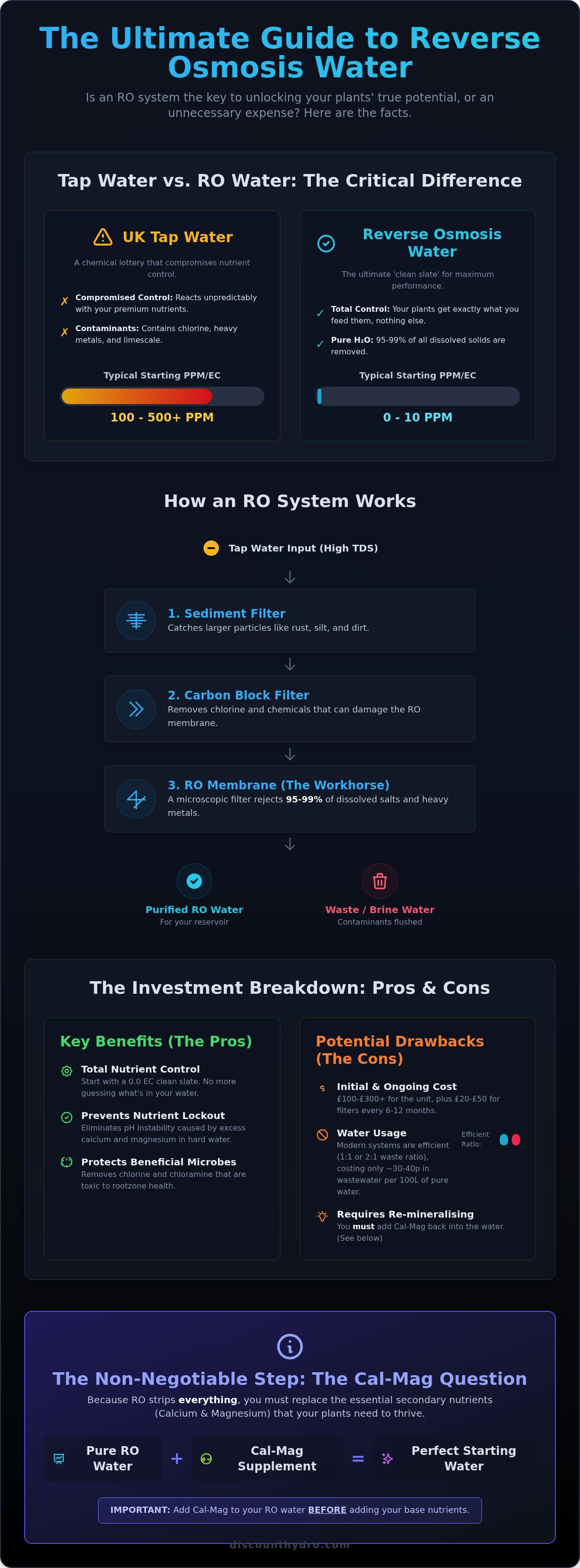
In hydroponics, what you don't feed your plants is just as important as what you do. Your tap water, while safe to drink, is full of unknown variables. This is where a reverse osmosis system becomes an essential piece of kit for any serious grower. Simply put, Reverse osmosis (RO) is a hyper-filtration process that forces water through a semipermeable membrane, aggressively stripping out 95-99% of all Total Dissolved Solids (TDS). It turns unpredictable tap water into ultra-pure H₂O, giving you the ultimate 'clean slate' to build your nutrient solution from the ground up for maximum performance.
How an RO System Works: A Quick Breakdown
An RO system purifies water through a multi-stage process. The core of the system is the RO membrane, but it works alongside other filters for peak efficiency:
- Sediment Filter: Catches larger particles like rust, silt, and dirt.
- Carbon Block Filter: Removes chlorine, chloramines, and other chemicals that can damage the RO membrane and harm your plants.
- RO Membrane: The workhorse. This microscopic filter allows only water molecules to pass, rejecting dissolved salts, heavy metals, and other contaminants.
The system produces two outputs: the purified water you need for your reservoir and a small amount of waste/brine water containing the rejected contaminants, which is flushed down the drain.
Tap Water vs. RO Water: The Critical Differences
The water from your tap is a chemical lottery. Depending on your location in the UK, it can be loaded with chlorine, limescale, and heavy metals, giving it a high starting PPM/EC. These dissolved solids don't just add unknown elements to your feed; they can react with your nutrients, causing pH instability and lockout. The difference is stark:
| Characteristic | Typical UK Tap Water | RO Water |
|---|---|---|
| Starting PPM/EC | Highly variable (100-500+ PPM) | Near zero (0-10 PPM) |
| Contaminants | Chlorine, heavy metals, minerals | None |
| Nutrient Control | Compromised | Total control |
The 'Clean Slate' Advantage for Your Nutrients
Using RO water means one thing: total control. You are no longer guessing what's in your water. Every part-per-million of nutrients your plants receive comes from the bottle you paid for, not from your local water authority. This completely prevents nutrient lockout caused by excess calcium and magnesium found in hard water, ensuring your plants can absorb the precise ratios you provide. Think of a reverse osmosis system as insurance-it protects your investment in premium nutrients and guarantees your plants have the perfect foundation for explosive growth.
The Real Pros and Cons of Using RO Water in Your Grow
Let's be direct: a reverse osmosis system isn't a must-have for every grower. But if you're serious about dialling in your nutrients and achieving consistent, top-tier results, it's the single biggest upgrade you can make to your water source. It's an investment, so here’s the no-nonsense breakdown of what you're buying into.
Key Benefits: Why Top Growers Swear By It
The main advantage is total control. UK tap water varies wildly by region, with high levels of limescale (calcium carbonate) and other dissolved solids. An RO system strips this all out, giving you a pure H2O baseline (0.0 EC). From here, you build a nutrient profile from scratch, ensuring your plants get exactly what they need, when they need it. This absolute control is fundamental to the Principles of Plant Nutrition, leading to stabler pH and preventing nutrient lockout. Plus, it eliminates chlorine and chloramine-chemicals used in tap water that are toxic to the beneficial microbes in your rootzone. The result? Predictable, repeatable results, every single time.
Potential Drawbacks: What You Need to Know Before Buying
The two main concerns are always cost and water waste. Let's tackle them head-on.
- Cost: The initial unit will set you back anywhere from £100 to over £300. After that, you have ongoing costs for replacement filters, typically every 6-12 months, which can range from £20-£50. Think of it as an investment in quality control for your entire grow.
- Water Usage: Old RO units were notoriously wasteful. Modern systems are far more efficient. Many now operate on a 2:1 or even a 1:1 waste-to-pure-water ratio. With average UK water rates, producing 100 litres of pure water might only cost you an extra 30-40p in wastewater. It's a manageable operational cost, not a deal-breaker.
The Cal-Mag Question: Re-Mineralising Your Water
Because a reverse osmosis system strips everything out, it also removes essential secondary nutrients like calcium and magnesium. Feeding plants with pure RO water without adding these back is a recipe for deficiencies. This is non-negotiable: you must add a quality Cal-Mag supplement to your RO water before adding your base nutrients. Don't see this as a hassle. It’s the entire point of the process-you're removing the inconsistent, low-grade minerals from your tap water and replacing them with a precise, highly-available dose that your plants can actually use.
Do YOU Need an RO System? A Practical Checklist
Stop guessing. A reverse osmosis system is a serious investment, but for many growers, it’s the difference between a mediocre harvest and a record-breaking one. This straightforward checklist gives you a clear yes or no answer based on your specific setup. Don't waste money on gear you don't need, but don't cripple your grow by ignoring your water quality.
You Almost Certainly Need RO If...
If any of these points describe your situation, buying a reverse osmosis unit is a smart move that will pay for itself. You are essentially creating a blank slate for your nutrients to work perfectly, free from interference.
- Your tap water PPM is consistently above 200. This is common in hard water areas across the UK. Your water is full of dissolved minerals that can lock out nutrients. As the U.S. EPA notes, Point-of-use RO systems are specifically designed to remove these total dissolved solids (TDS), giving you pure water.
- You use high-performance nutrients. Brands like Intense Nutrients or Dutch Pro are scientifically formulated to work with pure water. Adding them to hard tap water is like putting performance fuel in a dirty engine - you're just wasting money.
- You grow sensitive or high-value plants. Don’t leave your results to chance. Finicky strains or high-value crops demand precision, and that starts with a pure water source.
- You run a recirculating system (DWC, NFT, etc.). In these systems, minerals and salts from tap water build up rapidly, throwing off your pH and EC levels and leading to nutrient lockout.
You Might Not Need RO If...
An RO system isn't essential for everyone. Save your budget for other core equipment if you fall into these categories:
- Your tap water PPM is below 100. If you're lucky enough to have soft water, you can likely get great results without RO purification.
- You are a beginner growing in soil. Soil acts as a natural buffer, making it much more forgiving of water quality imperfections than hydroponics.
- Your budget is extremely limited. If you're choosing between an RO system and essential gear like a quality light or fan, focus on the essentials first and plan to upgrade later.
How to Test Your Tap Water: The First Step
The only way to know for sure is to test. Don't rely on your local water report, which can be inaccurate for your specific address. Get a digital TDS or EC meter - they are cheap and give you an instant reading. Simply turn it on, stick the probe in a glass of tap water, and read the number. A reading of "250" on a PPM meter means your water has 250 parts per million of dissolved solids. It’s that simple. Get the data you need to make the right call.
For growers scaling up or running automated systems, the reliability of these measurements is paramount. Sourcing professional-grade sensors and controllers from industrial automation specialists, such as the equipment offered by InstroDirect, is key to ensuring precision across the entire operation.
Stop guessing and start measuring. Shop for EC & pH Meters at the best prices.
Choosing the Right RO System for Your Grow Room
You've decided that a reverse osmosis system is the key to unlocking your plants' potential. Now the question is which one? Choosing the right unit comes down to matching its specifications to your grow room size and your budget. Getting this right means you're not overspending on a system that's too big or waiting around for one that's too small. Here’s a no-nonsense breakdown of what you need to know to get the best value.
GPD (Gallons Per Day): Sizing Your System
GPD stands for Gallons Per Day. It’s the maximum amount of purified water a system can produce in 24 hours under ideal conditions. Don't feel pressured to buy the highest number; a higher GPD simply means you fill your reservoir faster. For most hobby grows, small tents, or mother plants, a 50-100 GPD system provides more than enough water without any delay. If you're running a larger operation, you'll need to scale up accordingly, but for the average grower, this range is the sweet spot for price and performance.
Key Features to Look For
Beyond the GPD rating, a few key features separate a basic unit from a great one. Look for these specs to ensure you get an efficient, long-lasting system:
- Waste Water Ratio: Older systems could waste 4 or more litres for every litre of pure water produced. Look for modern, efficient units with a 1:2 or even a 1:1 ratio. Less waste means a lower water bill.
- Pressure Gauge: A built-in pressure gauge is essential for monitoring performance. If the pressure drops, you know it’s time to check your pre-filters. This simple tool helps you maintain the system and protect the expensive RO membrane.
- Optional DI Filter: For growers who demand absolute purity, a De-ionisation (DI) filter is the final stage that strips the last remaining solids, delivering true 0 PPM water. It's a must-have for certain advanced nutrient lines and growing styles.
Installation & Maintenance: What to Expect
Most RO systems are designed for simple DIY installation. They typically connect directly to a standard garden tap, laundry tap, or can be plumbed into a mains cold water pipe using the included fittings. Once it's running, maintenance is straightforward. The sediment and carbon pre-filters generally require replacement every 6 months to a year, depending on your water quality. The core reverse osmosis membrane is the workhorse and has a long lifespan, typically lasting 2-3 years before it needs changing. Sticking to a simple replacement schedule ensures you get pure water and protects your investment for years to come.
Ready to get the perfect water for your plants? Check out our range of RO Systems and replacement filters.
The Verdict: Is Reverse Osmosis Right for Your Grow?
Ultimately, the decision to invest in a reverse osmosis system comes down to control. If your tap water has a high EC or contains unwanted contaminants, you're starting at a disadvantage. RO water gives you a pure, 0 PPM baseline, ensuring your plants get nothing but the precise nutrients you provide. This eliminates guesswork, prevents nutrient lockout, and is often the key to unlocking next-level health and yield. While not essential for every grower, for those serious about optimisation, the benefits are undeniable.
Ready to take control of your water quality? Shop our full range of Reverse Osmosis Systems now. We guarantee the UK's best prices on all hydroponic gear, so you can upgrade your setup for less. With fast, discreet nationwide delivery and Click and Collect available from our Durham store, getting the kit you need has never been easier.
Give your plants the pure foundation they need to thrive. Your harvest will thank you for it.
Frequently Asked Questions About Reverse Osmosis
How often do I really need to change the filters on an RO system?
For optimal performance, pre-filters like sediment and carbon blocks should be changed every 6-12 months. This protects the main membrane. The reverse osmosis membrane itself is more durable and typically requires replacement only every 2-3 years. Your replacement schedule will depend on your local water quality and how much water you use. Using a TDS meter to check performance is the best way to know when a change is due.
What is the difference between reverse osmosis and a normal water filter?
Standard water filters, like jug filters, use carbon to adsorb contaminants like chlorine and some sediment. A reverse osmosis system is far more comprehensive. It uses a semi-permeable membrane to force water through at a molecular level, removing up to 99% of all total dissolved solids (TDS). This includes salts, heavy metals, and fluoride, giving you a pure baseline that standard filters cannot achieve. This level of purity is why it's also used by professional services that depend on perfect results, such as the premium cleaners at Hustle Laundry.
Can I use the waste water from my RO system for anything?
Yes. The "waste" water is not toxic; it's simply concentrated tap water containing the minerals and contaminants that were filtered out. While not suitable for hydroponics or drinking, it is perfect for other tasks. You can collect it and use it for watering garden plants, flushing toilets, or for general cleaning like mopping floors. This is a great way to reduce your overall water consumption and get more value from your system.
Will an RO system lower the water pressure in my house?
No, an RO system will not affect the water pressure in your main taps, shower, or appliances. The system is installed on a single cold water line, usually under a sink, and feeds its own dedicated, smaller tap. The flow from this specific RO tap is slower due to the intensive, multi-stage filtration process, but your home's overall mains pressure remains completely unchanged. You get pure water on demand without compromising your household plumbing.
Is buying bottled distilled water a good alternative to an RO system?
For short-term or very small-scale use, perhaps. However, an RO system is a far better long-term investment. The cost per litre from an RO system is mere pennies, whereas bottled water can cost £1 or more per litre. Over a year, an RO system pays for itself and saves you money. It also eliminates the hassle of buying, transporting, and storing heavy plastic bottles, and it significantly reduces plastic waste, making it the superior economic and environmental choice.
What should the PPM/EC of my water be after running through an RO system?
A high-quality reverse osmosis system will remove 95-99% of Total Dissolved Solids (TDS). In the UK, tap water can range from 150 to over 400 PPM. After filtration, your RO water should ideally be below 20 PPM, and often as low as 5-10 PPM (an EC of 0.01-0.02). This provides the perfect blank slate for hydroponic growers, ensuring you have total control over the nutrient profile you provide to your plants without any interference from tap water contaminants.