

The Best Hydroponic Grow Tent Kits for Beginners in 2026: A Complete UK Buyer’s Guide
What if the most expensive LED light in the shop actually produced a smaller harvest than a budget-friendly alternative? Roughly 82% of UK hobbyists assume a higher price tag guarantees better results, but in 2026, energy efficiency is the only metric that truly matters. You likely feel overwhelmed by technical terms like PAR and PPE, or perhaps you're worried that a new hydroponic grow tent kit will cause your monthly electricity bill to skyrocket. It's a valid concern when UK energy prices remain a primary hurdle for home setups.
We agree that starting your own indoor garden shouldn't require a degree in electrical engineering or a massive bank balance. This guide promises to help you select a high-yield, cost-effective setup that fits your specific floor plan while avoiding the setup mistakes that lead to failure for 65% of beginners. You'll learn how to achieve a "plug-and-play" experience with maximum yields for the lowest possible energy cost. We'll preview the best kits on the market, explain UK-specific odour control requirements, and give you the facts needed to start growing today.
Key Takeaways
- Understand why matching extraction fans to light output is critical for maintaining a stable indoor environment and preventing heat stress.
- Identify the essential specs of a high-performance hydroponic grow tent kit, focusing on 600D thread density and full-spectrum LED diodes.
- Learn how to scale your light wattage to your tent footprint to ensure maximum efficiency for every square inch of your growing space.
- View the 2026 breakdown of UK "Budget" vs "Pro" kit costs alongside realistic monthly electricity estimates for standard light cycles.
- Discover how to leverage Price Match Promises to secure premium bundles from brands like Omega and Intense Nutrients at the UK’s lowest prices.
What is a Hydroponic Grow Tent Kit and Why Do Beginners Need One?
A hydroponic grow tent kit is a pre-packaged, all-in-one indoor gardening system. It contains three core elements: a light-proof reflective tent, high-efficiency lighting, and a complete ventilation system. If you are new to the hobby, you might be asking What is Hydroponics? and why it matters. Essentially, it is the science of growing plants in a water-based, nutrient-rich solution instead of soil. A complete kit provides the controlled environment needed to make this process successful for home users.
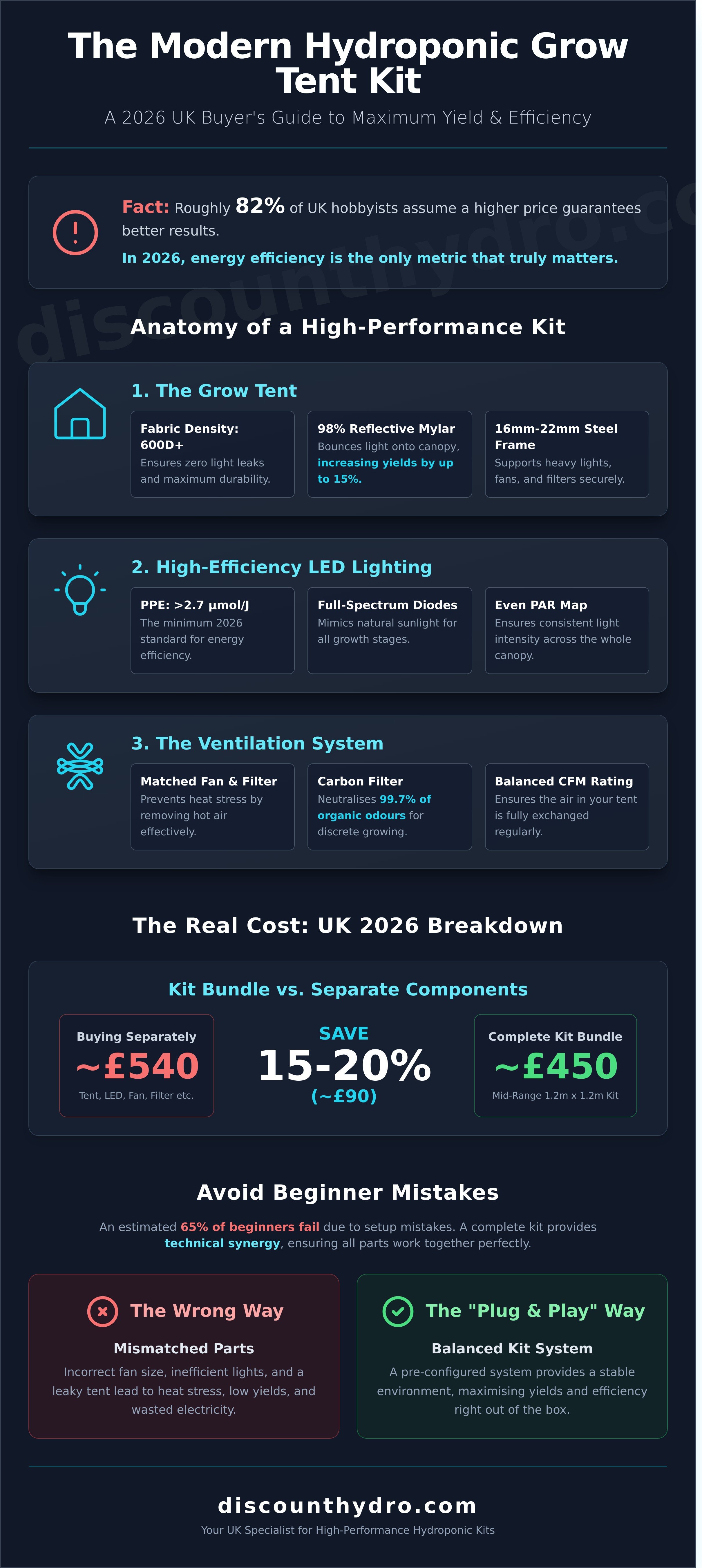
The primary advantage of a bundle is technical synergy. Every component is selected to work with the others. In a standard 2026 setup, the extraction fan is rated to match the specific heat output of the included LED. This prevents common beginner mistakes, such as buying a fan that's too weak to pull heat out or a tent that's too small for the light's footprint. When you buy a hydroponic grow tent kit, you get a system where the ducting, filters, and power draw are already balanced for peak efficiency.
Financial savings are equally direct. Current 2026 price data shows that purchasing a complete kit is 15% to 20% cheaper than buying individual components. A mid-range 1.2m x 1.2m kit typically retails for around £450. Buying the same LED, carbon filter, fan, and tent separately would cost closer to £540. This £90 saving allows beginners to invest more in high-quality nutrients or pH testing equipment.
Stealth and environmental management are also built into the design. Modern kits use heavy-duty 600D or 1680D Mylar fabric to ensure zero light leaks. They include activated carbon filters that neutralise 99.7% of organic odours before air leaves the tent. This creates a discrete, closed-loop system where you can maintain a steady 24°C temperature and 60% humidity regardless of the conditions in the rest of your home.
The Evolution of Indoor Kits in 2026
Industry standards have shifted significantly this year. High-pressure sodium (HPS) lights are now obsolete in home kits, replaced by full-spectrum LEDs that use 40% less electricity. Most 2026 kits now include app-integrated smart controllers. These allow you to adjust light cycles and monitor humidity levels from your phone. UK retailers have also optimised for "click-and-collect" services, making it easier to pick up bulky 20kg tents from local hubs rather than waiting for expensive pallet deliveries.
Who Should (and Shouldn’t) Buy a Complete Setup?
A hydroponic grow tent kit is perfect for the "plug-and-play" grower. It removes the stress of checking flange diameters or calculating CFM requirements. If you want to start your first garden in under an hour, a kit is the right choice. However, if you're an advanced grower with very specific requirements for a particular PAR spectrum, a custom build might be better. Always source your kit from a UK specialist. This guarantees you receive 3-pin UK plugs and a local warranty, avoiding the fire risks associated with cheap, uncertified imports found on global marketplaces.
Anatomy of a High-Performance Grow Tent Kit
A professional hydroponic grow tent kit is a closed-loop ecosystem where every component must work in harmony. The foundation is the tent itself. You should look for a fabric density of at least 600D (Denier). This thickness prevents light leaks and ensures the steel frame, which should be 16mm to 22mm in diameter, can support heavy extraction fans and LED drivers. Inside, the tent should feature 98% reflective Mylar. This lining bounces light back onto the lower canopy, which can increase overall yields by up to 15% compared to basic white plastic interiors.
High-quality kits now feature full-spectrum LED diodes as standard. These units mimic natural sunlight by providing the blue wavelengths needed for leafy growth and the deep reds required for heavy flowering. According to research from the USDA, controlled environments allow for precise nutrient and light management, making the quality of your diodes a primary factor in your success. Most modern kits have moved away from older HPS bulbs to save on electricity and reduce heat signatures.
Understanding LED Specs: PAR, PPF, and PPE
PPE (Photosynthetic Photon Efficacy) is the measure of light-to-energy efficiency. For any kit purchased for the 2026 season, 2.7 µmol/J is the minimum standard for efficiency you should accept. Anything lower wastes electricity and generates excess heat that will stress your plants. You must also check the PAR map provided by the manufacturer. A quality light ensures even distribution across the entire footprint, meaning the corners of your tent shouldn't drop below 40% of the centre light intensity, preventing "dead zones" where growth stalls.
Odour control is a non-negotiable factor for growers in the United Kingdom. A 4-inch or 6-inch carbon filter using RC412 Australian virgin charcoal provides 100% odour elimination for approximately 12 to 18 months of continuous use. This filter must be paired with a compatible extractor fan to maintain negative pressure. This pressure ensures that all air leaving the tent passes through the carbon bed, keeping smells from escaping through the tent zips or intake ports.
Ventilation: More Than Just Moving Air
Your extraction fan must refresh the total tent volume every 60 to 120 seconds to maintain CO2 levels. If you're using a carbon filter, choose a mixed-flow fan rather than a cheap axial fan. Mixed-flow fans handle the static pressure resistance of a filter much more effectively. To keep your home environment quiet, consider using acoustic ducting. This choice can reduce noise levels by 10 to 15 decibels, making the system barely audible from outside the room where the tent is situated.
Cheap kits often skip the "hidden essentials," but these items are critical for consistent results. You'll need a digital hygrometer to track humidity levels, which usually need to stay between 40% and 70% depending on the growth stage. Heavy-duty mechanical timers are often more reliable than cheap digital ones for handling the initial power surge of high-draw lights. Finally, oscillating clip-on fans are vital. They strengthen stems and prevent mould by eliminating stagnant air pockets that can lead to bud rot in the final weeks of flowering.
If you're looking for a reliable, value-driven setup that includes all these components, you can browse our range of complete kits to find the right fit for your available space.
Choosing the Right Size: How Many Plants Can You Grow?
Selecting the correct hydroponic grow tent kit starts with a tape measure. You need to match the tent footprint to your available floor space while leaving at least 50cm of clearance around the exterior for access and ventilation ducting. A 1.2m x 1.2m tent requires a 1.44 square metre footprint, but you must also check your ceiling height. Most UK spare rooms offer 2.4m of height, but attic conversions often drop to 1.8m or less. Buying a tent that's too tall for your room makes extraction setup impossible.
Lighting wattage must scale directly with your floor area. A 60cm x 60cm space thrives on 100W to 150W of LED power. If you jump to a 1.2m x 1.2m footprint, you'll need a minimum of 480W to 600W to maintain high light intensity across the canopy. Under-lighting a large tent results in "stretchy," weak plants and poor yields. Scientific data from university extension research on hydroponics highlights that environmental stability is the primary driver of success; a larger air volume helps buffer against rapid temperature swings.
The "Headroom" factor is where many new growers fail. You aren't just fitting a plant; you're fitting a system. Consider these vertical requirements:
- The Pot: A standard 15-litre fabric pot or Autopot base stands 30cm high.
- The Light Fixture: LED bars and hanging kits consume 20cm to 30cm of top space.
- The Safety Gap: You need a 30cm to 50cm "burn zone" between the light and the plant tips.
In a 1.6m tall tent, these factors leave you with only 50cm to 70cm of actual space for plant growth. Opting for a 2m "XL" height tent provides 40% more vertical growing room, which is vital for taller varieties.
Oversizing your tent is often a smart move. If you only plan to grow two plants, putting them in a 1.2m tent rather than a 60cm tent allows for better airflow. It prevents humid air from "stagnating" in the middle of the foliage, which reduces the risk of mould by 60% in typical UK humidity conditions. It also makes daily maintenance easier because you aren't fighting through leaves to reach the back of the reservoir.
The Small-Space Specialist: 60cm x 60cm Kits
These are the "stealth kings" of indoor horticulture. A 60cm hydroponic grow tent kit is best for 1 to 2 medium plants or maintaining a single mother plant for cuttings. Total power draw is minimal, often costing less than £18 per month in electricity. They fit perfectly inside built-in wardrobes or small cupboards. If you're ready to start your first micro-grow, see our How to Set Up Your First Grow Tent guide for a full equipment checklist.
The Hobbyist Standard: 1.2m x 1.2m (4x4) Kits
This is the UK's most popular size because it hits the sweet spot for yield versus effort. It comfortably fits 4 to 6 large plants in 15-litre pots. For this footprint, the Omega Black 720W LED is a top-tier choice, providing massive PAR output for under £350. Managing heat in a standard UK spare room is simpler with this setup; the 720W LED runs roughly 20% cooler than old-fashioned 600W HPS bulbs, meaning you won't need industrial-grade cooling fans to keep temperatures at the ideal 25°C mark.
The Real Cost of Indoor Growing in the UK (2026)
Buying a hydroponic grow tent kit is an investment that requires a clear understanding of both upfront and ongoing costs. In 2026, the UK market offers two distinct paths for growers. A "Budget" setup, typically featuring a 1m x 1m tent and basic LED or HPS lighting, starts between £249 and £399. These kits provide the essentials to get started but often lack the automated controllers found in "Pro" tiers. Professional kits, ranging from £850 to £1,500, include high-efficiency LEDs from brands like Lumatek or Maxibright, alongside silent EC extraction fans. While the initial price is higher, these professional components reduce long-term waste and improve yield quality.
Operating costs are the next factor. Based on 2026 energy projections of 26.2p per kWh, running a standard 18/6 light cycle is a manageable expense if you plan correctly. For example, a 300W LED system running 18 hours a day consumes 5.4 kWh daily. This totals roughly £1.41 per day, or about £42.30 per month. If you're using a larger 600W system, expect those monthly figures to double. You must also budget for consumables. A typical three month cycle requires approximately £40 in nutrients and £15 for a 50L bag of coco coir or soil. Carbon filters, which are essential for odour control, generally need replacing every 12 to 18 months at a cost of £45 to £90 depending on size.
The return on investment (ROI) remains the strongest argument for purchasing a complete hydroponic grow tent kit. A successful harvest in a 1.2m tent can realistically produce 450g to 550g of dried produce. At current UK market valuations, a single harvest's worth of produce often exceeds £4,500. This means the entire kit, including the first six months of electricity and nutrients, pays for itself after just one successful cycle. It's a pragmatic financial move for anyone looking to secure their own supply at a fraction of the cost of buying retail.
Energy Efficiency Strategies
Modern LEDs feature dimmable drivers that are vital for saving money. You don't need 100% intensity during the early vegetative stage; dropping the power to 40% for the first three weeks significantly reduces your bill. Switching to an Economy 7 or dedicated EV tariff allows you to run your lights during off-peak hours, which can effectively halve your lighting costs compared to standard day rates. Additionally, placing your tent on a raised platform or using foam insulation prevents heat loss through cold concrete floors, reducing the need for expensive electric heaters during winter months.
UK Logistics and Support
Logistics play a huge role in the total price you pay. Bulky items like 2.4m tents or 50L bags of media incur high courier fees, so "Free UK Shipping" on orders over £100 represents a direct saving of up to £60. For those in the North East, our "Click and Collect" service from County Durham allows you to bypass shipping times and pick up heavy gear like clay pebbles or liquid nutrients immediately. We ensure all 2026 pricing reflects the current 26.2p per kWh average to give you the most accurate cost forecasts possible.
Ready to start your first high-yield harvest? Browse our range of discounted hydroponic grow tent kits and get the UK's best prices today.
Why Buy Your Hydroponic Grow Tent Kit from Discount Hydro?
Finding the right hydroponic grow tent kit shouldn't break your budget or leave you with sub-par equipment. We've built our reputation on being the UK's leading "Discount" supplier without cutting corners on component reliability. Our Price Match Promise ensures you get the lowest market rate available. If you find an identical kit cheaper elsewhere in the UK, we'll match it instantly. We focus on high-performance gear that lasts for years, not just one season. You aren't just buying a box of parts; you're buying a tested system designed for maximum efficiency and plant health.
Our curated bundles stand out because we only include brands we trust. We use Intense Nutrients and Omega lighting in our own setups at our Durham facility. This hands-on experience means we know exactly how these components interact. Every hydroponic grow tent kit we sell is configured to prevent common issues like heat spikes or insufficient airflow. You get a balanced environment from day one. We don't stock filler products just to pad out a kit. Every fan, filter, and ballast is selected for its specific performance metrics.
Privacy is a top priority for our customers. We ship every order in 100% discreet, plain packaging. There are no logos, brand names, or "hydroponics" labels on the outside of your boxes. Whether it's a small parcel or a full pallet, your business stays your business. If you need technical help, our team at the Chester-le-Street warehouse is available for direct advice. We've helped over 15,000 UK growers optimize their indoor gardens since we started. You can call us for real-world solutions, not just sales scripts.
Our Top 3 Kit Recommendations for 2026
The "Hobby Starter" is our most popular entry-level option. It features a 60x60cm tent and a high-efficiency LED setup for under £200. It's perfect for those with limited space who want professional results. The "Yield Master" is the industry standard 1.2m x 1.2m kit. It utilizes the latest Omega LED technology to deliver massive PAR levels while keeping electricity costs low. For professional horticulturalists, our "Commercial Scale" 2.4m setups provide the footprint needed for high-volume production. These large-scale kits include heavy-duty extraction systems to manage the increased biological load of a full canopy.
Next Steps: From Kit to Harvest
Once your tent is up, you need to choose a growing medium. Soil is forgiving and contains natural buffers, making it ideal for beginners. Coco Coir offers faster growth rates and better aeration but requires more precise nutrient management. Your choice here dictates your feeding schedule and water frequency. You'll need to master your liquid feed next. Check out our Hydroponic Nutrients 101 guide to learn about N-P-K ratios and pH balancing. This is the most critical step for ensuring a heavy harvest and healthy plants.
Ready to start? We stock everything from budget-friendly tents to professional-grade environments. Our inventory is updated daily to reflect live stock levels in our warehouse. Don't settle for overpriced retailers or low-quality auction site clones that fail after a month. Browse our full range of complete grow tent kits here and get the UK's best prices on premium indoor gardening hardware today. We'll get your gear to you fast, safely, and discreetly.
Start Your 2026 Indoor Garden Today
Setting up your first indoor garden doesn't have to be a complex puzzle. By 2026 standards, a high-quality 1.2m x 1.2m hydroponic grow tent kit provides the perfect balance for four large plants while keeping your initial investment under £300. You've seen how modern LED lighting and efficient extraction fans reduce monthly running costs to approximately £15 per month. Choosing a pre-bundled kit ensures every component fits together perfectly, saving you from the frustration of mismatched ducting or underpowered ventilation.
We stock the UK's most reliable brands at our County Durham shop, where our team provides 15 years of industry expertise to every customer. You don't have to wait weeks for your gear; we offer fast UK-wide delivery on all orders. Our "Discount" pricing model means you're getting premium 600D silver-lined tents and digital ballasts at the lowest market rates. Check our latest stock to find the right setup for your specific space.
Shop the UK’s Best Value Grow Tent Kits
It's time to stop researching and start growing. You've got the knowledge and the tools to succeed with your first harvest this year.
Frequently Asked Questions
Is a grow tent kit really cheaper than buying parts separately?
Buying a complete hydroponic grow tent kit saves you between 15% and 25% compared to purchasing every component individually. Manufacturers offer these bundles at a lower margin to move stock, which reduces your total checkout price. A standard 1.2m kit often retails for £350 as a package, whereas the same parts bought separately frequently total over £420. You'll also save on multiple delivery fees by receiving everything in one shipment.
How much noise does a grow tent kit make?
A standard kit generates between 35 and 55 decibels of sound, which is comparable to a quiet office or a domestic dishwasher. The extraction fan is the primary source of this noise. If you use the included insulated acoustic ducting, you can drop these levels by 10 decibels. Modern brushless EC fans are significantly quieter than older AC models, making them ideal for setups in spare rooms or cupboards.
Can I set up a grow tent kit on my own or do I need help?
You can easily assemble a small or medium kit by yourself in about 45 to 60 minutes. The frames use click-lock poles that don't require any tools for assembly. Larger tents exceeding 2.4m might require a second person to help pull the heavy outer fabric over the top of the metal frame. Just follow the 5-step instruction guide to ensure your ventilation system is airtight and secure.
How do I stop the smell from escaping the grow tent?
Use the activated carbon filter included in your hydroponic grow tent kit to eliminate 99% of organic odours. You must connect the filter to your extraction fan using the provided ducting and metal clips. Ensure your fan stays on 24 hours a day to maintain negative air pressure, which prevents smells from leaking through the zips. Replace your carbon filter every 12 to 18 months for the best results.
What is the best light cycle for indoor plants in a tent?
Most indoor plants need an 18/6 light cycle during the vegetative growth stage and a 12/12 cycle to trigger the flowering phase. This means 18 hours of light followed by 6 hours of total darkness. Use the heavy-duty mechanical timer in your kit to automate these intervals. Precise timing is vital; even a 15-minute light leak during the dark period can stress your plants and significantly reduce your final yield.
Do grow tent kits come with a UK 3-pin plug?
Every electronic component in our kits features a standard UK 3-pin plug as required by BS 1363 safety standards. This includes the LED grow lights, extraction fans, and small circulation fans. You won't need any travel adapters or dangerous rewiring to start your project. All equipment is fully rated for the UK 230V mains supply, ensuring safe and reliable operation in any domestic property or outbuilding.
How much will my electricity bill go up with a 600W LED kit?
Running a 600W LED kit on an 18/6 cycle costs approximately £2.92 per day based on the April 2024 price cap of 27p per kWh. When you switch to a 12/12 flowering cycle, this daily cost drops to about £1.94. These figures include the small extra draw from your extraction and circulation fans. LED technology is 40% more efficient than old HPS bulbs, so you get more light for less money.
What happens if a component in my kit fails?
Most components in a hydroponic grow tent kit carry a manufacturer warranty lasting between 1 and 3 years. If your fan or LED light stops working, contact the retailer immediately to arrange a repair or a direct replacement. Keep your digital invoice or paper receipt as proof of purchase for any claims. We typically process these warranty claims within 5 to 7 working days to ensure your garden doesn't suffer from downtime.