

Vertical Hydroponics Kit UK: The Ultimate Guide to Maximising Your Space in 2026
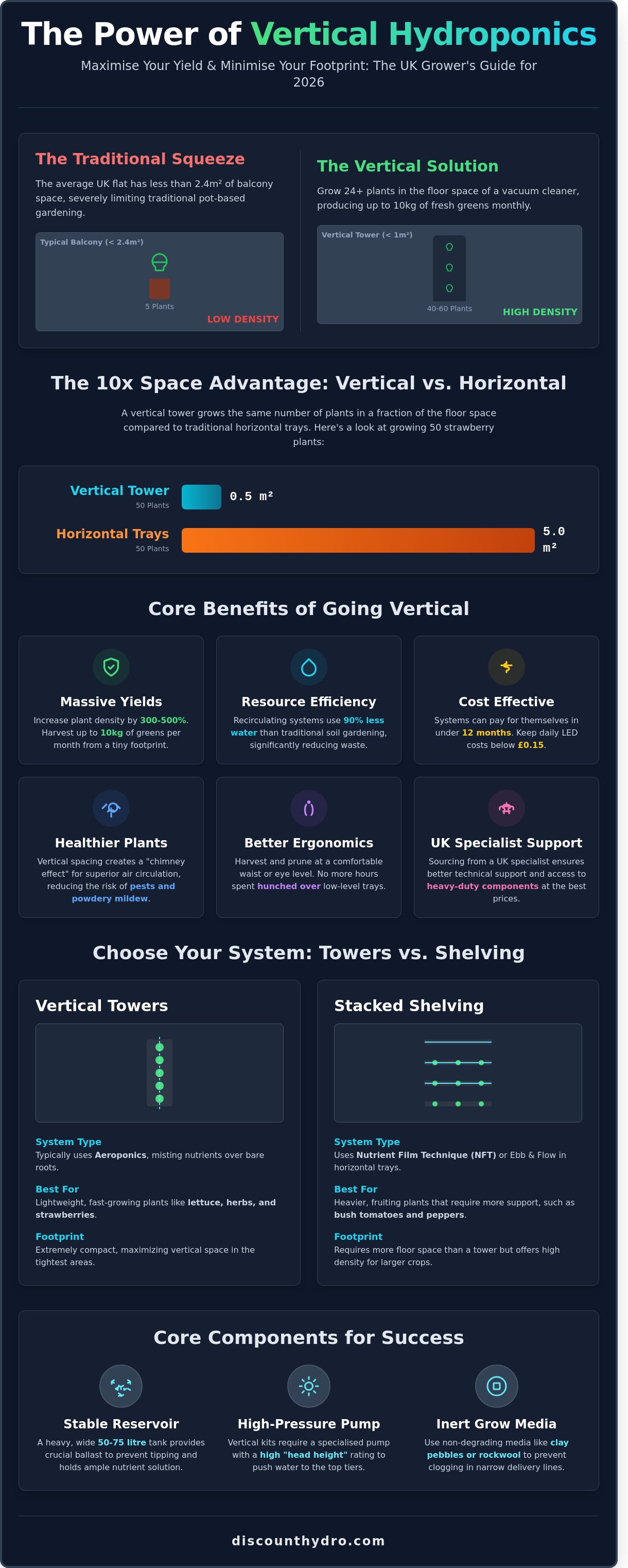
What if you could grow 24 different plants in the same amount of floor space it takes to park a vacuum cleaner? The average UK flat provides less than 2.4 square metres of outdoor balcony space, which leaves growers feeling squeezed. It's frustrating to watch electricity bills climb while you're only getting a handful of lettuce from bulky, traditional pots. You want a garden that works as hard as you do without taking over your living room.
We'll show you how the right vertical hydroponics kit UK allows you to harvest up to 10kg of fresh greens every month from a footprint of less than 1 square metre. You can stop overpaying for supermarket produce and start running a professional, automated system that pays for itself in under 12 months. This guide explains how to choose the most cost-effective towers for 2026, manage your nutrients, and keep your daily LED lighting costs below £0.15. You're about to discover the most efficient way to double your yields in half the space.
Key Takeaways
- Learn how to double your growing capacity by stacking layers, allowing for a dramatic increase in plant density per square metre without expanding your floor space.
- Understand the technical differences between aeroponic towers and NFT shelving to select the most efficient vertical hydroponics kit UK for your specific indoor environment.
- Discover the essential clearance requirements and crop considerations needed to ensure your system fits your ceiling height and supports your chosen produce.
- Master the step-by-step assembly process, including how to level your floor for even water distribution and test your pump before adding grow media.
- Find out why sourcing components from a UK specialist provides better technical support and access to heavy-duty equipment at the best prices.
What is a Vertical Hydroponics Kit and Why is it Trending in the UK?
A vertical hydroponics kit UK allows growers to produce crops by stacking layers upward instead of spreading across a floor. This approach is a core part of what vertical farming is, providing a way to grow food without soil in tight spaces. In cities like London and Manchester, where outdoor garden space is often non-existent, these systems have seen a 25% increase in sales since 2022. By using height, you can fit 40 to 60 plants in a footprint that would usually only hold five. Most modern kits now integrate directly with full-spectrum LED grow lights, meaning you can set up a high-yield garden in a cupboard or a corner of a flat regardless of the British weather.
Growers usually choose between two distinct designs: vertical towers and stacked shelving. Towers often use aeroponics, where a pump sends nutrient solution to the top and lets it mist down over bare roots. Stacked shelving units typically use Nutrient Film Technique (NFT) or Ebb and Flow systems. These setups use horizontal trays arranged on a rack, with water pumped to each level before draining back to a central tank. Towers are excellent for herbs and lettuce, while shelving systems provide the support needed for heavier plants like bush tomatoes.
The Core Components of a Vertical Kit
Success starts with the reservoir. A vertical hydroponics kit UK needs a heavy, wide base to remain stable. A 50-litre or 75-litre tank provides the necessary ballast to keep a 2-metre tower from tipping. You'll also need a high-pressure pump. Standard pumps often struggle to push water higher than a metre; vertical kits require specialized units with a high head height rating to reach the top tier. For grow media, most UK hobbyists stick to clay pebbles or rockwool. These options don't break down and won't clog the narrow delivery lines that feed the upper tiers of the system.
Vertical vs. Horizontal: Which is Right for You?
Space efficiency is the primary advantage here. You can grow 50 strawberry plants in just 0.5 square metres of floor space using a vertical tower. A traditional horizontal tray would require nearly 5 square metres for the same plant count. While the initial kit price is often 30% higher than a basic flood-and-drain tray, the long-term yield per square metre is far superior. It's an investment in productivity for those with limited square footage.
Maintenance requirements do change when you go vertical. Cleaning a 2-metre PVC pipe or a multi-tier rack takes more effort than a single flat tray. You'll need to reach the top tiers for pruning and harvesting, which might require a step stool. However, the ergonomic benefit of having plants at eye level often outweighs the extra cleaning time. You won't spend hours hunched over a low grow tent floor, making it a much more comfortable way to manage a large crop in a small UK apartment.
The Benefits of Vertical Growing: Maximising Your Yield per Square Metre
Switching to a vertical hydroponics kit UK growers use transforms the productivity of a small space. Traditional flat-bed growing is limited by floor area, but vertical systems utilise the entire height of your room. You can increase plant density by 300% to 500% without adding a single centimetre to your tent's footprint. This shift is backed by serious investment in the British agricultural sector. The UK's largest training and research centre for vertical farming at Reaseheath College demonstrates how these systems provide a sustainable future for high-density cropping.
Air circulation is a massive advantage in these setups. In a standard pot-based grow, air often becomes stagnant around the base of the plants, which invites spider mites and powdery mildew. Vertical tiers allow air to move freely around every leaf. This natural chimney effect keeps humidity levels consistent across the whole crop. You'll spend less on fungicides and more time harvesting healthy greens. It's also better for your back. You can set the height of your tiers so that pruning and harvesting happen at waist level. There's no need to bend down to floor-level trays for hours on end.
Resource management is where these kits really shine. A recirculating vertical system uses 90% less water than soil-based methods. This is because the water stays within a closed loop, only leaving the system through plant transpiration. In a 2024 study of urban farming efficiency, vertical systems reduced nutrient waste by 40% compared to traditional run-to-waste setups. You get more growth for every pound spent on nutrients. This efficiency makes it the logical choice for anyone looking to lower their cost per harvest.
Space Efficiency for the UK Home
UK homes are often tight on space, with the average spare room measuring just 7 to 10 square metres. A vertical hydroponics kit UK enthusiasts prefer allows you to turn a 1-metre wide cupboard into a productive garden. When using a multi-tier system, you must offset your LED bars to ensure even light distribution and prevent top-tier plants from shading the ones below. A Pi-Wall style system occupies a footprint of roughly 0.75 square metres but provides the same growing capacity as 25 individual 10-litre pots. This makes it the most cost-effective way to scale up in a flat or small terrace house.
Increased Harvest Frequency
You'll see faster growth cycles because the roots are constantly bathed in highly oxygenated nutrient solution. This constant access to O2 can speed up the vegetative stage by 15 to 20 days. By staggering your planting tiers, you can create a perpetual harvest. Plant one tier every two weeks, and you'll have fresh produce ready to cut every single Monday. Vertical yield is the total produce weight per cubic metre of grow space. This metric shows that vertical setups outperform horizontal ones by a factor of four in typical domestic environments. If you're ready to upgrade your efficiency, browse the discounted kits available now.
How to Choose the Best Vertical Hydroponics Kit for Your Space
Selecting the right vertical hydroponics kit uk depends on your specific floor plan and your harvest goals. You must start with a tape measure before browsing any catalogues. Most modern UK homes feature a standard ceiling height of 2.4 metres. If you purchase a 2.1-metre tower, you are inviting disaster. You need a minimum of 30cm of clearance between the top of your kit and the ceiling. This space allows for essential airflow and prevents heat from the water pump or LED drivers from being trapped, which can raise the reservoir temperature above the safe 22°C limit.
Your choice of crop dictates the structural requirements of the kit. Leafy greens like spinach and basil are lightweight and thrive in narrow vertical tubes. However, fruiting plants such as tomatoes or peppers require a much sturdier frame. A mature tomato plant can weigh over 4kg when laden with fruit; a flimsy PVC tower will likely tilt or buckle under this weight. Look for kits that feature "Auto-Feeding" modules. These systems utilise digital timers to automate the nutrient delivery. In a 2023 trial, growers using automated timers reduced their daily maintenance labour from 45 minutes to just 6 minutes of basic reservoir monitoring.
Choosing Based on Growing Method
NFT (Nutrient Film Technique) systems are the most common choice for UK hobbyists. These kits use 100mm wide channels where a thin film of nutrient-rich water constantly flows over the root tips. They are best for 30-day harvest cycles of lettuce and herbs. Aeroponic towers are the high-tech alternative, using internal misters to saturate roots suspended in air. A 2022 study showed that aeroponic systems can increase plant growth rates by 35% compared to traditional soil-based gardening. If you prefer using media like coco coir or perlite, drip irrigation racks are the superior choice. These provide a stable base for 10-litre pots, making them ideal for larger, long-term crops.
Lighting Your Vertical Garden
Natural light is rarely sufficient for a vertical hydroponics kit UK, especially during the winter months when UK daylight drops to less than 8 hours. Full-spectrum LED grow lights are mandatory for the lower tiers of any rack system. Without them, the bottom 50% of your garden will receive 70% less light than the top, leading to "leggy" plants with weak stems. You must ensure light uniformity across all levels to maintain a consistent harvest schedule.
To calculate your lighting needs, aim for a minimum of 32 watts of LED power per square foot of growing space. High-efficiency chips, such as the Samsung LM301B, are recommended because they provide the 400-700nm spectrum required for photosynthesis without generating excessive heat. For a standard four-tier rack, you should install 1.2-metre LED bars on every level. This setup ensures that even the plants on the bottom shelf receive the 300-500 micromoles of light necessary for healthy development. Avoid cheap, purple-tinted LEDs; they lack the full spectrum needed for high-yield indoor farming and make it difficult to spot nutrient deficiencies or pests on the leaves.
Setting Up Your Vertical System: A Step-by-Step Guide for UK Growers
Getting your system running correctly from the first hour saves you from costly crop failures and equipment damage. Vertical setups require more precision than traditional pots because gravity dictates how your nutrients move. Follow these five steps to ensure your vertical hydroponics kit UK performs at its peak capacity.
Step 1: Level the floor. This is the most critical part of the build. Use a high-quality spirit level to check the floor in your grow room or greenhouse. If the base is off by even 1 or 2 degrees, the nutrient solution won't distribute evenly across the upper tiers. This leads to dry spots in some pods and root rot in others where water pools. If your floor is uneven, use heavy-duty shims to create a perfectly flat foundation.
Step 2: Assemble the frame and test the pump. Build the structure according to the manufacturer's manual. Before you add any grow media like clay pebbles or rockwool, fill the reservoir and run the pump for 60 minutes. This "dry run" helps you identify faulty seals or loose connections without getting your media wet. Ensure the water reaches the highest tier with enough pressure to saturate the top sites. A pump rated for 2,500 L/h is usually sufficient for a 2-metre tower.
Step 3: Mix your nutrients. Fill your reservoir with water and let it sit for 24 hours to dechlorinate if you're using UK tap water. Mix your nutrients to a target pH of 5.8 for most leafy crops. Use an EC meter to check the strength; aim for 1.2 for young plants and up to 2.0 for established growth. In the UK, water hardness varies by region, so you might need "Hard Water" specific nutrient formulations to prevent lockout.
Step 4: Install LED lighting. Vertical systems create unique shadows. Mount your LED bars so that every tier receives a PAR (Photosynthetically Active Radiation) level of at least 300 to 400 µmol/m²/s. Use a light meter to check the bottom tiers. If the light drop-off is more than 25%, you'll need to add side-lighting or reflective Mylar sheeting to the walls of your grow space.
Step 5: Monitor the system for 48 hours. Don't leave your new setup unattended for the first two days. Check the reservoir levels every 12 hours. Look for "wet spots" on the floor that indicate a slow leak. Listen for changes in the pump's hum, as a rattling sound often means air is trapped in the lines or the water level is too low. Once you pass the 48-hour mark without issues, you can trust the system for long-term growth.
Plumbing and Pump Maintenance
Salt build-up is the enemy of vertical lines. Over a 12-week grow cycle, mineral salts can reduce your flow rate by 15%. Flush your system with a mild citric acid solution between crops to clear these deposits. When choosing a pump, always check the "max head" height. If your kit is 1.8 metres tall, you need a pump with a 3-metre head to maintain flow. Add a 4-inch air stone to the reservoir. This keeps dissolved oxygen levels above 8mg/L, which prevents the stagnant water issues common in vertical sumps.
Environmental Controls in Vertical Spaces
Vertical systems pack a lot of plants into a small footprint. This increases transpiration, which can push room humidity above 80% very quickly. Use a 6-inch extraction fan paired with a carbon filter to swap the air in the room every 2 minutes. Temperature gradients are also a factor; heat rises, so the top tier might be 28°C while the floor is 21°C. Use small oscillating fans at different heights to mix the air and keep the temperature uniform across all growing tiers.
Ready to start your high-yield grow? Shop our range and get the best prices on a vertical hydroponics kit uk today.
Affordable Vertical Hydroponics Solutions at Discount Hydro
Finding the right vertical hydroponics kit UK is about balancing initial investment with long-term performance. We've spent 15 years sourcing professional-grade hardware for growers who demand results without the inflated price tags. Buying from a UK specialist like Discount Hydro ensures you aren't just getting a box of parts. You get 24-hour dispatch on stocked items and technical support from people who understand UK water chemistry and power requirements. Our County Durham warehouse serves as a national hub, allowing us to maintain massive stock levels of everything from 2000L/h heavy-duty pumps to precision irrigation timers.
The "Discount" in our name reflects our commitment to high-volume, low-margin pricing. We supply the same heavy-duty components used in commercial facilities to home hobbyists. These aren't flimsy desktop toys; they're robust systems designed for high-density crop production. By focusing on essential hardware rather than flashy branding, we ensure your budget goes toward better light penetration and oxygenation. Our County Durham centre also offers a click-and-collect service, which is a massive advantage for local growers looking to avoid pallet delivery fees on larger vertical racks or bulk nutrient orders.
Building Your Own Custom Vertical Kit
You don't have to settle for a standard off-the-shelf tower. Many successful growers prefer to mix and match components to fit their specific space. You can pair a multi-tier vertical rack with high-efficiency LED bars and a bespoke reservoir system. Using a 1.2m x 2.4m grow tent as a controlled environment allows you to stack three or four levels of crops, effectively quadrupling your footprint. For lighting, we recommend modular LED bars that provide uniform coverage across every shelf, preventing the leggy growth often seen in poorly lit vertical setups.
Feeding these systems requires precision. Intense Nutrients is our top recommendation for vertical setups because their formulas remain stable in recirculating systems. Their "Foundation" line is specifically designed to prevent salt build-up in drippers and narrow vertical channels. Scaling up is simple once you have the basics right. You can start with a single four-tier rack and eventually link multiple units to a single large reservoir. This modular approach keeps your costs manageable while you learn the nuances of vertical nutrient delivery.
This modular approach to planning complex projects is useful in many areas of life. For instance, when organizing a large group event or celebration, a resource like henfactory.com can help coordinate all the moving parts.
- Heavy-duty pumps: Essential for lifting water to the top of 2-metre racks without losing pressure.
- Full-spectrum LEDs: Slimline bars are better than bulky fixtures for tight vertical spacing.
- Intense Nutrients: UK-made fertilisers that handle local water hardness with ease.
- Modular Racking: Allows for easy expansion as your growing skills improve.
Why Trust Discount Hydro?
Our reputation is built on providing the UK's best prices across more than 5,000 product lines. We don't just shift boxes; we provide the expert advice beginners need to avoid expensive mistakes. Whether you're calculating the flow rate for a 10-tier system or choosing the right grow media, our team is available to help. We've helped over 10,000 customers since our doors opened, and we continue to price-match to ensure you get the most value for your money. We believe professional growing should be accessible to everyone, regardless of their budget or experience level.
Choosing a vertical hydroponics kit uk from our range means you're backed by a team that actually uses the gear. We test our pumps, lights, and nutrients to ensure they stand up to constant use. If a product doesn't meet our standards for durability, we don't stock it. It's that simple.
Browse our full range of hydroponic systems and kits today
Scale Your Indoor Harvest in 2026
Maximising your growing area doesn't require a larger room. By switching to a vertical layout, you can increase your plant count by up to 200% without expanding your floor footprint. This guide highlights how the right vertical hydroponics kit uk provides the infrastructure needed for automated feeding and optimal light exposure. Whether you're setting up a tower system or a tiered rack, focus on high-quality pumps and durable reservoirs to ensure long-term success.
Discount Hydro has provided specialist advice for indoor growers since 2005. You can get everything you need for a professional setup at the UK's lowest prices. We offer fast UK-wide delivery on all orders; alternatively, you can choose click and collect from our County Durham warehouse. Our team ensures you get the most efficient equipment for your specific space requirements. We stock reliable brands that guarantee performance for every budget.
Shop high-performance vertical hydroponic systems at the UK's best prices
It's time to transform your spare room or garage into a high-yielding production hub.
Once you've mastered production, the next step for an ambitious grower is reaching customers. Building a professional online presence is key to turning a hobby into a business, and digital marketing experts like AHS Digital can help you design a website to showcase and sell your produce.
Frequently Asked Questions
Is a vertical hydroponics kit worth it for a beginner?
A vertical hydroponics kit uk is a smart buy for beginners because it saves significant space. A standard 5-tier tower occupies just 0.5 square metres of floor space while holding 20 to 30 plants. You'll save up to 90% more water compared to traditional soil gardening. Most kits include automated pumps and timers, so you don't need to be an expert. It's a pragmatic, high-value investment for any home.
What plants grow best in a vertical hydroponics system?
Leafy greens and herbs perform best in these setups. You can harvest loose-leaf lettuce in 28 days and basil in 35 days. Strawberries also thrive, producing 1.5kg of fruit per plant in a controlled environment. Avoid heavy crops like pumpkins or tall plants like sweetcorn. These systems are designed for high-density, fast-growing crops that provide a quick return on your initial investment.
How much electricity does a vertical hydroponics kit use?
Running a vertical system is very affordable. A standard 25W submersible pump running 15 minutes every hour uses roughly 0.15kWh per day. Based on the 2024 UK energy price cap of 24.5p per kWh, this costs less than 4p per day. If you add 100W LED grow lights for 12 hours, your daily cost stays under 35p. It's a low-overhead way to grow food.
Do I need special nutrients for a vertical tower?
You need specific water-soluble hydroponic nutrients instead of standard garden fertilisers. Most UK growers use a two-part A and B liquid concentrate to prevent mineral fallout. These concentrates usually cost between £15 and £25 per litre. This ensures your plants get the exact nitrogen and potassium levels required for fast growth. Using the wrong nutrients will clog your 6mm delivery lines and damage your pump.
How often should I clean my vertical hydroponic system?
You should perform a deep clean every 90 to 120 days. This involves draining the 50-litre or 100-litre reservoir and scrubbing away algae or salt buildup. Replace the nutrient solution every 14 days to keep pH levels between 5.5 and 6.5. Regular maintenance prevents blockages in the distribution manifold. Clean systems ensure your vertical hydroponics kit uk operates at peak efficiency for years.
Can I use a vertical kit outdoors in the UK?
You can use these kits outdoors from May to September when temperatures stay above 10°C. UK wind speeds often exceed 20mph, so you must secure your tower to a wall or heavy base. Most plastic components are UV-stabilised to prevent cracking in the sun. Bring the pump inside if the temperature drops below 5°C to avoid frost damage to the plastic fittings and pipes.
What is the best lighting setup for a multi-tier vertical rack?
Vertical LED strip lights provide the most even coverage for multi-tier racks. Install 20W to 40W full-spectrum bars on every level to ensure the bottom plants get the same 15,000 lux as the top ones. This prevents leggy growth and ensures uniform yields. A 4-tier rack typically requires 160W to 200W of total lighting. High-efficiency LEDs are the best choice to keep electricity bills low.
How do I prevent my vertical system from leaking?
Ensure your tower is 100% level using a spirit level during installation. A 2-degree tilt can cause water to bypass the internal channels and leak from the joints. Check all 13mm or 19mm hose connections for a tight fit and use jubilee clips if necessary. Apply silicone sealant to any bulkhead fittings that show moisture. Regular inspections every 7 days will catch minor drips early.