

What Do I Need for a Grow Tent Setup? The Ultimate 2026 UK Beginner’s Guide
Growing your own produce indoors can save you over £550 a year on premium groceries, yet 65% of UK beginners waste money on mismatched gear during their first month. It's stressful to worry about electricity prices sitting at 24.5p per kWh or whether a cheap carbon filter will fail to hide odours in a quiet residential street. You're likely asking, "what do i need for a grow tent setup" because you want a system that works perfectly without the trial and error that drains your wallet.
We've designed this 2026 guide to give you the exact checklist of equipment required for a high-yielding indoor garden at the UK’s best prices. You'll learn how to select energy-efficient LED lighting and silent extraction kits that keep your running costs low and your setup completely discreet. We'll walk you through every essential component, from nutrient-rich soil to automated timers, ensuring your first harvest is both successful and cost-effective. It's time to stop overpaying for shop-bought greens and start building a professional-grade garden in your own home today.
Key Takeaways
- Access a comprehensive 10-point checklist of must-have equipment to build a high-yielding indoor garden at the UK’s best prices.
- Learn exactly what do i need for a grow tent setup to transition from traditional HPS to high-efficiency LED lighting for professional-grade results.
- Compare the pros and cons of soil, coco coir, and hydroponics to choose the best growing medium for your experience level and desired growth rates.
- Master environmental control for the UK climate, including winter heating strategies and techniques to keep your tent under 28°C during summer heatwaves.
- Find out how to secure professional performance on a hobbyist budget with high-value gear like the Omega Black 720W.
The 10 Essentials: What Do You Need for a Grow Tent Setup?
Building a high-yield indoor garden starts with the right hardware. Understanding what a grow tent setup is involves more than just buying a fabric box; it's about creating a sealed ecosystem where you control every variable. When beginners ask what do i need for a grow tent setup, they're usually looking for a balance of light intensity, air exchange, and environmental stability. You can't cut corners on these five core hardware pieces if you want a successful harvest.
While many enthusiasts grow plants for personal use or to create their own wellness products, it's a significant commitment. For those interested in the benefits of plant-based products without the setup, exploring a reputable source like the CBD Health Collection can be a great alternative.
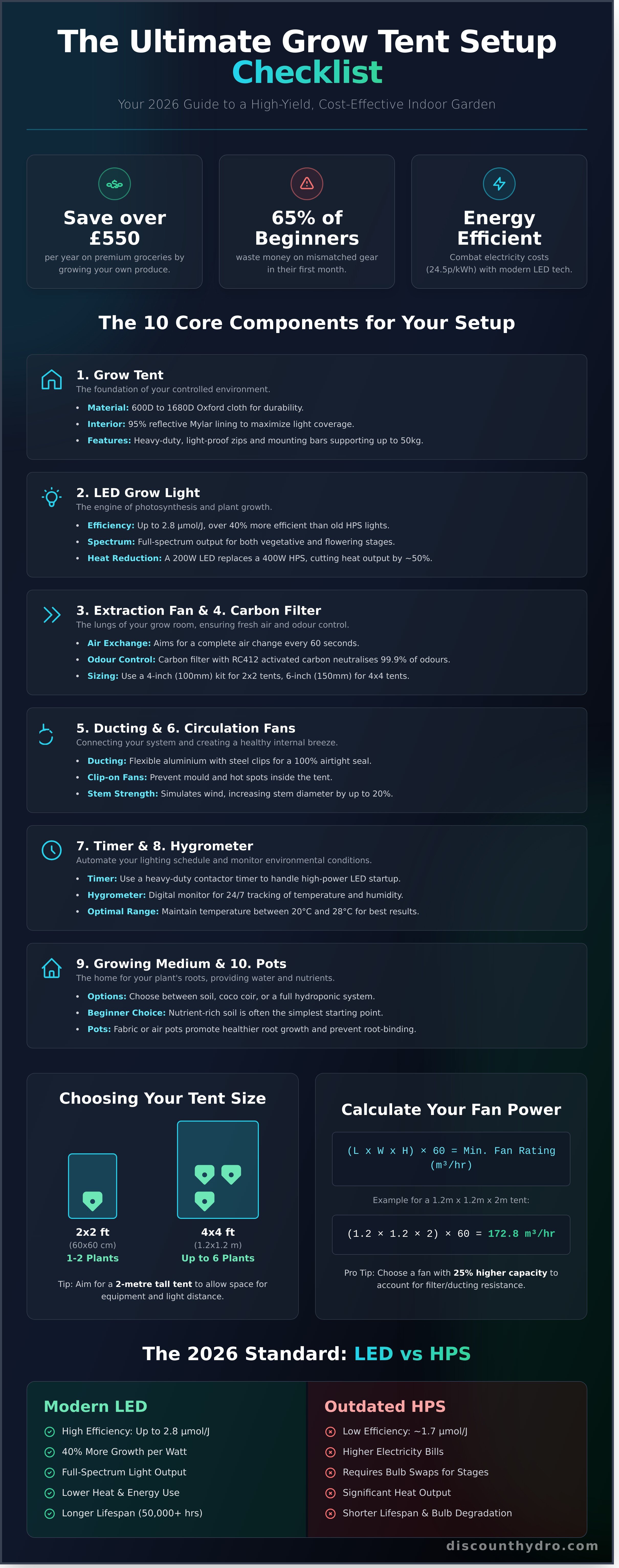
The tent is your foundation. Professional-grade tents use 600D to 1680D Oxford cloth with a Mylar lining. This reflective interior ensures 95% of your light reaches the plants rather than being absorbed by the walls. Heavy-duty zips and double-stitched seams prevent light leaks, which is critical for plants that require total darkness during their rest cycle. A quality tent also provides mounting bars that can support up to 50kg of equipment, like fans and filters.
LED grow lights are the industry standard for 2024. They offer a 2.7 µmol/J efficiency rating, far surpassing old HID lamps. This means more light for less cash on your electric bill. A 200W LED can easily replace a 400W HPS, reducing your heat output by nearly 50%. You need a full-spectrum light that provides the blue wavelengths for growth and red wavelengths for the flowering stage. This eliminates the need to swap bulbs mid-cycle.
Ventilation acts as the lungs of your operation. An extraction fan pulls out CO2-depleted air and excess moisture. You must pair this with a carbon filter containing RC412 activated carbon. This setup ensures that 99.9% of organic odours are neutralised before the air leaves the room. Use a 4-inch (100mm) fan for 2x2 tents and a 6-inch (150mm) fan for 4x4 spaces to ensure a complete air change every 60 seconds.
Ducting and clips connect your ventilation system. Use flexible aluminium or combi-ducting and secure it with steel jubilee clips for a 100% airtight seal. Inside the tent, use 6-inch clip-on circulation fans. These prevent micro-climates where mould thrives. They also strengthen plant stems by simulating a natural breeze, which can increase stem diameter by 20% over the first four weeks of growth.
Choosing the Right Tent Size for Your Space
A 2x2 (60cm x 60cm) tent is perfect for small corners, housing 1 or 2 plants comfortably. The 4x4 (1.2m x 1.2m) remains the UK industry standard for home growers, providing 1.44 square metres of space for up to 6 large pots. Don't forget verticality. A 2-metre tall tent allows for 30cm of extraction gear at the top and 50cm of distance between your LED and the plants. If you're still wondering what do i need for a grow tent setup, always measure your ceiling height first.
The "Invisible" Essentials: Timers and Power
Reliable power management prevents disasters. Use a heavy-duty contactor timer to handle the inductive load of your lighting system. A standard 13-amp UK plug timer can't always handle the high 'inrush' current of modern LEDs, leading to fused circuits. Add a digital hygrometer to monitor your stats 24/7. You need to keep your tent between 20°C and 28°C for optimal growth rates. Use surge-protected extension leads to keep cable management tidy and safe.
Lighting and Ventilation: The Engine of Your Indoor Garden
A grow light is a high-intensity light source designed to trigger photosynthesis. By 2026, LED technology has fully replaced HPS as the gold standard for indoor gardening. This shift happened because modern LEDs deliver up to 2.8 µmol/j of light intensity, while old HPS bulbs rarely exceed 1.7 µmol/j. This 40% increase in efficiency means you get more growth for every pound spent on electricity. When you're figuring out what do i need for a grow tent setup, the relationship between light and air is your top priority. High-intensity lighting creates energy, but it also generates heat that must be managed. Proper Lighting and Ventilation ensures your plants don't wilt under the pressure of a stagnant environment.
Calculating the "pull" of your ventilation system is a non-negotiable step. You need to match your extraction fan to the total volume of your tent. To find this, multiply the length, width, and height of your tent in metres. For a standard 1.2m x 1.2m x 2m tent, the volume is 2.88m³. You want to refresh this air at least once every minute. Multiplying your volume by 60 gives you the minimum m³/hr rating for your fan. In this case, you'd need a fan rated for at least 172.8m³/hr. Most growers choose a fan with a 25% higher capacity, around 220m³/hr, to account for the resistance caused by ducting and carbon filters.
LED Grow Lights: Efficiency and Spectrum
Plants don't see light the way humans do. While we see brightness, plants react to specific wavelengths. Full-spectrum LEDs have overtaken old "blurple" (red and blue) lights because they mimic natural sunlight, providing a balanced output that supports both leafy growth and heavy flowering. You should ignore total wattage when comparing lights. Instead, look for the PAR (Photosynthetically Active Radiation) value. This tells you how much usable light the unit actually produces rather than just how much power it draws from the wall. A 300W LED can often outperform a 600W HPS because the light is targeted and efficient. Heat management is another massive win for LEDs. They run significantly cooler; a high-end LED panel might only increase your tent temperature by 3°C, whereas an HPS bulb can easily push it up by 10°C or more during a UK summer.
Airflow and Odour Control
Maintaining a discreet setup requires a high-quality carbon filter. These units use activated charcoal to trap organic compounds before they leave the tent. To make this work, you must achieve "negative pressure." This happens when your extraction fan pulls air out faster than it enters, causing the tent walls to slightly bow inward. This ensures every bit of air passes through the filter. You'll need to distinguish between your fans:
- In-line fans: These are high-pressure units mounted at the top of the tent to pull air through the filter and out of the room.
- Clip-on fans: These small fans sit inside the tent to circulate air around the leaves, preventing mould and strengthening stems.
A carbon filter doesn't last forever. Most professional growers replace their filters every 12 to 18 months. If you start to notice even a faint scent outside the tent, the charcoal is likely saturated and needs immediate replacement. If you're still mapping out your shopping list and asking what do i need for a grow tent setup, starting with a matched extraction kit is the most cost-effective way to ensure your fan and filter work in perfect harmony. Don't cut corners on the fan motor; a brushless EC motor will save you roughly £40 per year in running costs compared to older AC models.
Growing Media and Systems: Soil vs. Coco vs. Hydroponics
Choosing your substrate is a critical decision when asking what do i need for a grow tent setup. Your choice affects how often you feed and how fast your plants develop. Every medium has a different learning curve and potential for yield.
Soil remains the most forgiving entry point for beginners. High-quality potting mixes like BioBizz All-Mix contain enough organic nutrition to sustain plants for the first 3 to 4 weeks. This buffer acts as a safety net, protecting against pH fluctuations and minor over-feeding. It's the simplest way to start because you only need to add water for the first month. Most growers find soil produces the most natural flavour profiles, even if growth is slightly slower than other methods.
Coco Coir is a medium made from coconut husks that offers the drainage of hydroponics with the look of soil. Because it's inert, it contains zero nutrients. You must provide 100% of the plant's food from day one. In exchange for this extra work, you'll see growth rates up to 25% faster than soil-based grows. It's a high-performance middle ground that requires daily feeding but offers massive control over plant development.
Hydroponic Systems, such as Deep Water Culture (DWC) or Flood and Drain, remove the medium entirely or use clay pebbles. These setups automate the feeding process for maximum yields. Understanding the principles of controlled environment agriculture is vital here; these systems rely on precise nutrient delivery directly to the roots. While the initial cost of a DWC kit might be £50 to £100 higher than pots and soil, the 30% increase in harvest weight often pays for itself in a single cycle.
Matching your pots to your media is essential. Fabric pots, like Root Nurseries or Smart Pots, provide "air-pruning." This prevents roots from circling and increases oxygen levels to the root zone. Plastic pots are cheaper, often costing under £2 for a 10-litre pot, but they lack the breathability of fabric versions. For coco and soil, fabric is almost always the superior choice for root health.
Nutrient Essentials for UK Growers
Plants require specific N-P-K (Nitrogen, Phosphorus, Potassium) ratios. During the vegetative stage, look for higher Nitrogen. During bloom, shift to high Phosphorus and Potassium. We recommend Intense Nutrients and Dutch Pro for UK beginners. These brands are formulated specifically for British water profiles. If you live in a hard water area like London or the South East, Cal-Mag is an essential supplement. UK tap water often lacks the correct Calcium and Magnesium balance, leading to yellowing leaves if not corrected early.
Automated vs. Manual Watering
Hand-watering in soil is simple but time-consuming. If you have four 15-litre pots, you'll spend roughly 20 minutes every two days feeding them. For those with busy schedules, automated systems are better. Dripper systems or flood-and-drain tables ensure your plants never go thirsty. When using these, you must measure pH and EC (Electrical Conductivity) daily. A pH swing of just 0.5 can cause nutrient lockout, wasting your investment. Accurate digital meters, starting around £30, prevent these costly errors. When planning what do i need for a grow tent setup, always budget for reliable testing equipment.
Practical Setup and Environmental Control in the UK Climate
Managing the internal environment of a grow room in the UK requires constant attention to external weather shifts. Our maritime climate often sees humidity levels exceed 80% during the winter months. This moisture leads to mould issues if you don't act. To prevent this, you should integrate a 120W or 240W tubular heater into your space. These heaters are cost-effective and keep the temperature above 15°C during the "lights off" period. When asking yourself what do i need for a grow tent setup, a reliable heater is often the most overlooked component for year-round success.
Summer presents the opposite challenge. During July and August heatwaves, indoor temperatures can easily spike above 30°C. High heat causes plants to wilt and stops growth entirely. You must ensure your extraction fan is powerful enough to replace the total volume of air in the tent every 60 seconds. Aiming for a target temperature below 28°C is the industry standard for maintaining healthy transpiration rates. If your room regularly hits 30°C, consider running your lighting cycle at night when the ambient air is cooler.
Safety is a non-negotiable factor in water-heavy environments. Most UK domestic sockets are rated for 13 amps, so you must calculate your total load to avoid tripping breakers. Always mount your ballasts and power strips at least 0.5 metres off the floor. This simple step prevents electrical fires in the event of a spill or a leak. Using a Residual Current Device (RCD) on every circuit adds a vital layer of protection for you and your property. We recommend checking every plug for heat discolouration once a month.
Logistics and privacy are just as vital as the gear itself. We understand that discretion is a priority for our customers. Every order we ship arrives in plain, unbranded packaging with no mention of hydroponics on the exterior. For larger orders involving heavy items like 50L bags of coco or large tents, we use pallet delivery to ensure the items arrive without damage. This method is far safer than standard couriers for bulky glass or fragile filters.
Step-by-Step Tent Assembly Tips
Always build your tent frame inside the final room. A standard 1.2m x 1.2m tent won't fit through a 762mm UK doorway once it's fully assembled. Use the bungee cord trick to hang your extractor fan; this isolates vibrations and can reduce noise levels by up to 15 decibels. Finally, zip yourself inside the tent with the lights off to check for pinhole leaks. Even a tiny light leak can disrupt the dark cycle and stress your plants.
Buying Locally: County Durham and UK Delivery
If you're based in the North East, use our Click and Collect service at our Drum Ind Est warehouse in County Durham. This saves on shipping costs and gets your gear in your hands immediately. For those farther away, remember that buying a Complete Kit typically saves you between 15% and 20% compared to purchasing individual items. These kits are pre-configured to ensure your fan, filter, and light are perfectly matched for the tent size. Check out our latest deals and buy grow tent kits online to get the best value for your setup.
Building Your Setup with Discount Hydro: Quality at the UK’s Best Prices
Discount Hydro operates on a simple, no-nonsense principle: high-performance hydroponic gear shouldn't cost a fortune. We've built our reputation by cutting out the fluff and focusing on stocking the UK's most reliable brands at warehouse prices. When you're figuring out what do i need for a grow tent setup, the answer usually starts with a balance of power and cost. We prioritise that balance every single day. Our County Durham base serves as more than just a storage facility; it's a hub of technical knowledge where the staff understand the practical difference between a standard extraction fan and a silenced EC motor.
The Omega Black 720W LED represents a massive shift in the market. It delivers professional-grade performance for a hobbyist price point. With a 2.7 µmol/J efficiency rating, this fixture rivals lights that often retail for over £1,000. It's built for growers who want heavy yields without the heavy investment. The foldable design and dimmable driver make it a perfect fit for a standard 1.2m x 1.2m tent. It's gear like this that defines our inventory; we only stock equipment that provides a measurable return on your investment.
Scaling a setup requires precision and reliable logistics. If you're still wondering what do i need for a grow tent setup for a larger space, our team can map out the transition from a single 60cm starter tent to a full-scale multi-room environment. We provide palletised deliveries of essential media, such as 50L bags of coco or bulk orders of 600W HPS kits, ensuring you have the volume required for expansion. Our experts calculate the exact requirements for ventilation and power distribution so your larger project stays efficient, safe, and within budget.
Why Discount Hydro Wins on Price
We leverage massive bulk buying power to secure lower unit costs directly from manufacturers. These savings aren't kept as profit; they're passed straight to you. Our "Hot Deals" section features frequent price drops on essential nutrients and clay pebbles, often beating competitors by 15% or more. We offer price matching and maintain a reputation for fast nationwide shipping. Whether you're in the Highlands or Cornwall, your gear arrives quickly and discreetly.
Get Started Today
Ready to build? Check out our Complete Grow Tent Kits for a one-click solution that includes everything from the tent to the carbon filter. You can also visit us in-store in County Durham for a hands-on look at the latest LED tech and extraction systems. For larger projects or commercial expansions, contact our experts for a custom quote on your dream setup. We don't just sell boxes; we provide the tools you need to succeed at the UK's best prices.
Start Your 2026 Indoor Garden Today
Success begins with mastering the 10 essentials of environmental control. You've learned that balancing high-spec LED lighting with robust ventilation is the only way to handle the unpredictable UK climate. Whether you choose soil or a hydroponic system, using professional-grade Intense Nutrients will provide the specific mineral profile your plants need to thrive throughout the year. It's about getting the foundation right so you can focus on the results.
When you're figuring out what do i need for a grow tent setup, you want the best gear without the massive price tag. We specialize in high-performance LED lighting and complete kits that take the guesswork out of your shopping list. We offer fast UK-wide delivery on every order to ensure you're never waiting around. If you're near County Durham, you can even use our Click and Collect service to pick up your equipment directly from our warehouse. We're committed to providing the UK's best prices on every single item in our inventory.
Shop our complete range of Grow Tent Kits at the UK’s best prices and transform your spare space into a high-yielding garden right now.
Frequently Asked Questions
How much does a basic grow tent setup cost in the UK?
A basic 60cm x 60cm setup costs between £220 and £350 for entry-level equipment. This price includes a tent, a budget 100W LED light, an extraction kit, and fabric pots. For a professional 1.2m x 1.2m kit with high-performance components, expect to pay between £600 and £950. Buying a complete kit often saves 15% compared to purchasing items individually.
Is a grow tent setup expensive to run on my electricity bill?
Running a standard 200W LED light for 18 hours a day costs approximately £29.16 per month, based on a UK average price of 27p per kWh. Adding a 30W extraction fan adds another £4.37 to your monthly bill. Modern LED fixtures are 40% more efficient than old-fashioned HPS bulbs, significantly lowering the long-term running costs of your indoor garden.
What size grow tent do I need for 4 large plants?
A 1.2m x 1.2m tent is the ideal size for 4 large plants. This provides 1.44 square metres of floor space, which allows each plant roughly 0.36 square metres of room to spread out. You should choose a tent with a height of at least 2m. This ensures there's enough vertical clearance for your LED light and carbon filter without heat-stressing the foliage.
Do I really need a carbon filter for indoor gardening?
Yes, a carbon filter is mandatory for indoor gardening if you want to remove 100% of organic odours. It is a core part of what do i need for a grow tent setup to maintain a discreet environment. Most carbon filters last between 12 and 18 months before the activated carbon becomes saturated and needs replacing to stay effective.
Which is better for a beginner: soil or coco coir?
Soil is the best choice for beginners because it acts as a natural buffer for pH levels and contains enough nutrients for the first 3 or 4 weeks of growth. Coco coir is an inert medium that requires you to provide 100% of the nutrition from day one. Soil is more forgiving, while coco requires daily monitoring and precise nutrient measurements to avoid plant stress.
Can I set up a grow tent in a cold garage or loft?
You can set up in these areas, but you'll need a tubular heater or a heat mat to keep temperatures above 15°C during the night. Lofts often reach temperatures over 32°C in the summer, which requires a powerful 6-inch extraction fan to pull in cooler air. Using a tent with 16mm or 22mm steel poles and thick 600D fabric helps provide better insulation against external temperature swings.
How often should I run my extraction fan?
You must run your extraction fan 24 hours a day, 7 days a week. Constant airflow is vital for replacing CO2 and keeping humidity levels below 55% to prevent bud rot or mould. Leaving the fan on also maintains negative pressure inside the tent. This ensures all air passes through the carbon filter so no smells escape into your home.
What is the best LED grow light for a 1.2m x 1.2m tent?
A 480W to 600W bar-style LED fixture is the best option for a 1.2m x 1.2m space. These lights provide a more even footprint across the 1.44 square metre area than single-point boards. When shopping, look for a fixture with an efficacy rating of at least 2.7 µmol/j. This ensures you're getting the most light output for every watt of electricity you pay for.