

Coco Coir for Hydroponics: The Ultimate 2026 Grower’s Guide
Most growers fail with coco coir not because the medium is difficult, but because they treat it like soil. If you're looking to switch to coco coir for hydroponics, you want the rapid growth rates of a hydro system without the technical headache of complex reservoirs. It's a practical choice. With the UK's 2030 peat ban approaching, moving to a sustainable, reusable organic medium is a necessary performance upgrade. You likely know that coco offers superior aeration, yet concerns regarding nutrient lockout or overwatering often stop growers from making the transition.
You can master this medium to achieve explosive root growth and higher yields with less maintenance than traditional setups. This ultimate 2026 guide provides the technical steps to manage pH, prevent salt buildup, and eliminate calcium deficiencies. We'll cover buffering techniques, specific nutrient requirements, and how to choose between compressed bricks or pre-buffered bags to ensure your indoor garden operates at peak efficiency.
Key Takeaways
- Learn why this inert medium gives you 100% control over your nutrient solution for precision indoor gardening.
- Understand the science of Cation Exchange Capacity (CEC) to stop nutrient lockout and calcium deficiencies before they start.
- Compare coco coir for hydroponics against rockwool and clay pebbles to find the most cost-effective solution for your setup.
- Master a simple 4-step preparation guide to rehydrate bricks and rinse away salts for perfect drainage.
- Discover how to identify high-quality, RHP Certified media to ensure consistent yields and low maintenance.
What is Coco Coir for Hydroponics?
What is Coco Coir? It is an inert growing medium manufactured from processed coconut husks, specifically the pith, fibres, and chips. Unlike soil, it contains no nutritional value. This makes coco coir for hydroponics a superior choice for growers who want 100% control over their nutrient solution. You decide exactly what your plants eat. It acts as a perfect gateway for those transitioning from traditional soil methods into hydroponics because it looks and feels like dirt but performs like a high-octane water culture system.
The medium is prized for its unique physical structure. It can hold up to 10 times its weight in water while maintaining high oxygen levels. This balance prevents the root zone from becoming anaerobic. You get the benefits of aggressive feeding without the high risk of root rot common in other substrates. Because it is chemically inert, it doesn't interfere with your EC (electrical conductivity) levels, provided you've rinsed it properly before use.
The Different Forms of Coco Media
You'll typically find coco coir for hydroponics in two main formats based on your budget and labour availability:
- Compressed Bricks: These are the most cost-effective option for shipping and storage. They are dense and light but require manual rehydration and thorough rinsing to remove residual salts.
- Loose-fill Bags: These are often pre-washed and pre-buffered. They are ready for immediate use in the grow room, saving time and effort.
The texture also matters. Pith holds the most moisture, while coco chips or croutons increase drainage and aeration. Mixing these allows you to customise the medium for specific plant types or automated drip systems. A high-porosity mix is usually better for fast-growing indoor crops that require frequent watering cycles.
Sustainable Growing in the UK
Coco is a renewable byproduct of the coconut industry, making it an eco-friendly alternative to finite resources. With the UK government targeting a peat ban for amateur gardeners by 2030, coco has become the primary peat-free choice for indoor gardeners. It isn't just sustainable; it's highly functional for the UK climate. It handles moisture well in cooler environments without compacting like peat-based mixes.
The medium is also fully recyclable. Once your indoor cycle finishes, you don't have to throw it away. You can mix it into outdoor garden beds to improve soil structure and moisture retention. This ensures zero waste from your grow and provides a long-term benefit to your outdoor plants.
The Science of Coco: Understanding CEC and pH
Understanding the chemistry of coco coir for hydroponics is the difference between a record harvest and a nutrient lockout. Unlike rockwool, which is truly inert, coco has a Cation Exchange Capacity (CEC). Think of the fibres as having magnetic sites that hold and release nutrients. These sites are naturally loaded with sodium and potassium. When you introduce a nutrient solution, the coco wants to swap its sodium for your calcium and magnesium. This creates the "Calcium/Magnesium Trap." If your medium isn't properly buffered, it will steal these minerals from your plants. A Washington State University study on coco coir highlights these chemical differences, showing how coco's structure affects nutrient availability differently than peat.
pH management is simpler in coco. The medium naturally sits in the 5.5 to 6.5 range, which is the sweet spot for most indoor crops. It also contains high levels of lignins. These are complex organic polymers that encourage the growth of beneficial bacteria like Trichoderma. This bio-activity helps protect roots from pathogens and improves overall plant vigour. It's a living environment that supports faster growth than traditional soil.
Why You Need Coco-Specific Nutrients
Standard hydroponic nutrients often lack the specific mineral ratios needed to satisfy coco's CEC. Coco-specific formulas, like those from Intense Nutrients, provide elevated calcium levels to compensate for what the medium absorbs. To prevent salt buildup in the fibres, use a "run-to-waste" system. Aim for 10% to 20% runoff during every feed to wash away old salts. If you notice yellowing between leaf veins, a Cal-Mag supplement is usually the fix. You can find professional coco nutrients and additives at Discount Hydro to keep your EC levels stable.
UK Water Quality and Coco
UK growers must account for local water hardness. If you're in a hard water area like London or the South East, your tap water already contains calcium carbonate. In soft water areas like Scotland or Wales, your water is nearly empty. Use an EC meter to monitor your base water before adding nutrients. This ensures you don't overfeed and cause "nutrient burn" as the salts accumulate in the coco fibres. Matching your nutrient strength to your local water profile prevents the most common grower errors in coco systems.
Coco Coir vs. Other Hydroponic Media
Choosing the right medium depends on your system and experience level. Coco coir for hydroponics offers a middle ground between the high-speed growth of rockwool and the stability of soil. Rockwool is a mineral-based product with a significant environmental footprint, often difficult to dispose of after use. Coco is a renewable byproduct that is easier for beginners to manage because it doesn't dry out as instantly as rockwool. When compared to soil, coco allows for much faster nutrient uptake. You'll see quicker growth rates because the roots have better access to oxygen while remaining hydrated.
Clay pebbles are another common choice, but they are often too porous for smaller plants or automated drip systems. Coco provides a finer texture that supports young root systems more effectively. Many growers prefer a hybrid approach, mixing 70% coco with 30% perlite. This combination increases drainage and prevents the medium from becoming too heavy or waterlogged. It's a reliable way to ensure oxygen reaches the root zone even with frequent watering cycles.
When to Choose Coco Coir
This medium is ideal for drip irrigation, Ebb & Flow, or even simple hand-watering. Beginners should start with coco rather than pure Deep Water Culture (DWC) or Nutrient Film Technique (NFT). It's more forgiving. If a pump fails or a timer misses a cycle, the moisture retention in the fibres buys you time to fix the issue. In terms of cost-efficiency, coco provides better long-term value than high-end soil mixes. You can reuse it across multiple cycles, making it a pragmatic choice for large-scale indoor gardening.
Potential Drawbacks to Consider
You must be aware of the risks associated with low-quality media. Poorly processed coir can lead to salt burn because it hasn't been properly washed. This is why buying triple-washed or RHP-certified products is essential. Initial setup also requires more labour if you choose compressed bricks; they must be rehydrated and potentially buffered. Finally, remember that your plants are entirely dependent on you. Since the medium is inert, any mistake in your nutrient solution will show up quickly in the foliage.
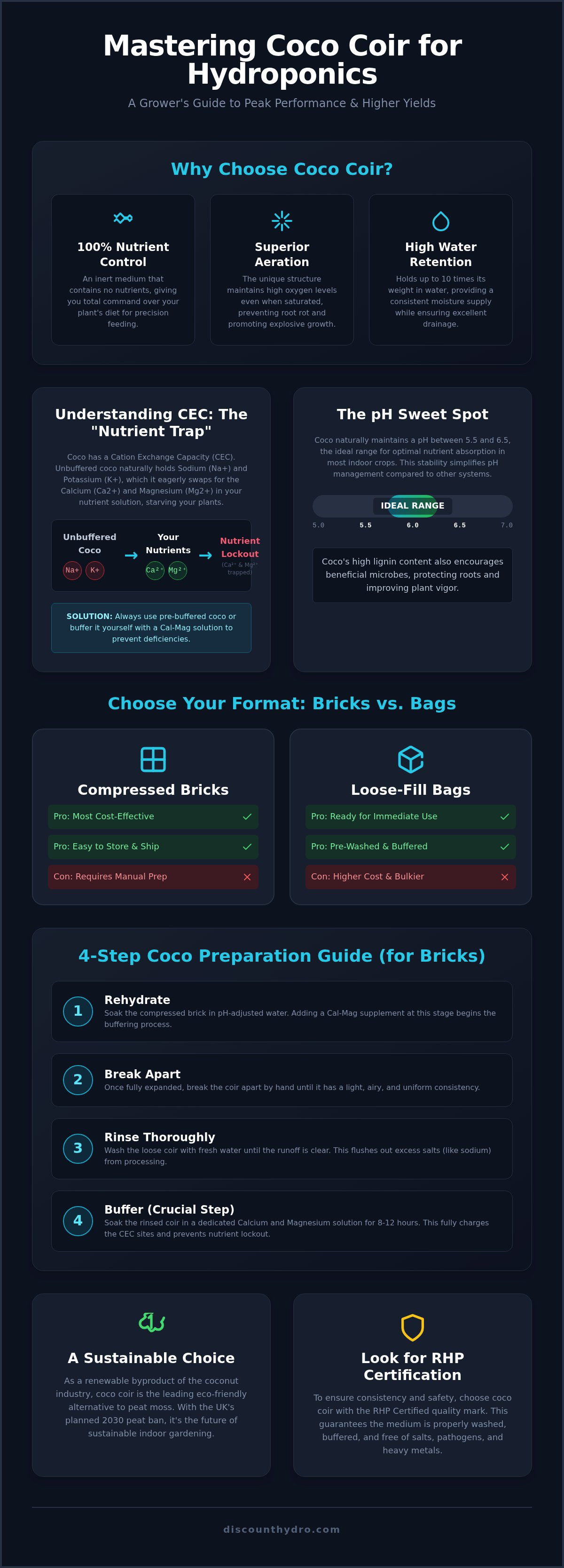
How to Prepare Coco Coir: A 4-Step Guide
Properly preparing coco coir for hydroponics ensures your plants don't hit a wall during the early vegetative stage. If you're using compressed bricks, the process requires more than just adding water. You must address the chemical and physical properties of the fibres to create a stable environment for root development. Follow these four steps to get your medium ready for planting.
- Rehydration: Place your compressed brick in a large container, ideally 30 litres or more for a standard 5kg block. Add lukewarm water to speed up the expansion. A single brick can expand to five times its original size, so ensure you have enough space.
- Rinsing: Once expanded, rinse the coir thoroughly using a fine mesh bag or a colander. This step is vital for removing fine dust and residual sea salts that can clog drainage systems or cause salt burn.
- Buffering: This is the most critical step. Soak your rinsed coco in a high-calcium solution. This "charges" the Cation Exchange Capacity (CEC) sites, preventing the medium from stealing calcium and magnesium from your plants later.
- Mixing: For most indoor setups, a "70/30" blend of coco and perlite is the gold standard. This ratio provides the perfect balance of water retention and oxygen porosity.
The Buffering Process Explained
Professional growers use a double-buffering technique for high-value crops. This involves soaking the medium in a Cal-Mag solution twice, for 8 to 12 hours each time. Use a ratio of 10ml of Cal-Mag per litre of water. After the second soak, test the runoff with an EC meter. The runoff EC should be close to your input EC. If it's significantly higher, continue rinsing. This ensures the medium is chemically stable and won't cause nutrient fluctuations during the first few weeks of growth.
Best Practices for Planting
When you're ready to transplant, ensure the coco is pre-moistened but not dripping wet. Avoid "transplant shock" by using a weak nutrient solution for the first feed, typically around 0.5 to 0.8 EC. Plants in coco rely entirely on you for food, so don't use plain water. To manage moisture, use the "lift test." Pick up the pot; if it feels light, it's time to water. This is more reliable than checking the surface, as coco can look dry on top while remaining wet at the bottom. You can find all the necessary growing media and nutrients at Discount Hydro to get your system started correctly.
Buying Quality Coco Coir in the UK
Success with coco coir for hydroponics starts with the quality of your raw material. You can't rely on unbranded or poorly processed products without risking your crop's health. Always check the label for three specific markers. "Triple Washed" ensures that the coconut fibres have been thoroughly rinsed to remove sodium and potassium salts. "Low EC" indicates a low starting salt level, allowing you to feed your plants at full strength without fear of burn. Finally, "RHP Certified" products meet the highest European horticultural standards for consistency and cleanliness. These markers are essential for predictable results.
Discount Hydro stocks proven brands like Intense Nutrients and Dutch Pro. These manufacturers provide the reliability needed for professional-grade indoor gardening. When planning your 2026 grow room budget, evaluate your volume requirements. Individual 50-litre bags are perfect for hobbyists, but commercial growers should look at bulk pallet rates for maximum savings. We offer fast nationwide shipping and a convenient click-and-collect service from our County Durham warehouse. Our logistics are designed to get your media to you quickly and cost-effectively.
Essential Add-ons for Your Coco Grow
Coco works best when paired with the right containers and tools. Fabric pots are the perfect partner. They provide superior aeration and root-zone cooling compared to standard plastic. Because coco has excellent capillary action, it's also the best choice for automated feeding systems. These systems allow for the "high-frequency fertigation" that produces massive yields. To manage this precision, you'll need accurate monitoring tools. High-quality pH and EC pens are mandatory for tracking the nutrient solution and runoff. Without these, you're just guessing.
Expert Support from Discount Hydro
Our team helps UK growers transition from traditional soil to high-performance coco setups. We provide direct advice on nutrient management and system configuration to ensure you hit the ground running. If you're scaling your operation, contact us for bulk pallet rates on growing media. We prioritise transactional efficiency and competitive pricing above all else. Our goal is to be your reliable partner in the UK hydroponics market.
Shop our full range of Coco Coir and Nutrients
Optimise Your Grow Room with High-Performance Coco
Switching to coco coir for hydroponics is one of the most effective ways to boost root health and final yields in any indoor setup. Success relies on understanding the medium's unique chemistry. By mastering the buffering process and using coco-specific nutrients, you eliminate the risk of calcium deficiencies and salt buildup. This sustainable, peat-free substrate provides the aeration of a hydro system with the stability required for consistent plant growth. It's the pragmatic choice for 2026 growers looking for reliable results.
At Discount Hydro, we provide everything you need to transition your setup. We stock leading brands like Intense Nutrients and Dutch Pro, offering competitive pricing on bulk media for larger operations. Our team provides expert technical advice to help you avoid common setup errors. Benefit from fast UK-wide shipping or collect directly from our County Durham warehouse. We ensure you get high-quality, triple-washed media without the premium price tag.
Browse Professional Coco Coir & Growing Media at Discount Hydro today and start your next cycle with confidence.
Frequently Asked Questions
Do I need to wash coco coir before using it in hydroponics?
Yes, you should wash it unless the packaging explicitly states the medium is pre-washed and RHP-certified. Even then, a quick rinse removes fine dust that settles during shipping. Washing removes excess sodium and potassium salts found in raw coconut husks. Using unwashed coir leads to immediate salt burn and stunted growth. It's a necessary step to ensure your starting EC remains at zero before adding nutrients. Professional growers always rinse until runoff is clear.
Can I use regular plant fertilizer with coco coir?
No, you should avoid standard fertilizers and use coco-specific nutrients instead. Standard hydroponic feeds don't account for the medium's tendency to bind with calcium and magnesium. Coco-specific formulas provide elevated levels of these secondary nutrients to satisfy the medium's chemical sites. Using a general fertilizer often results in mid-cycle deficiencies that are difficult to correct once established. These specialised nutrients ensure your plants receive a balanced diet throughout their entire life cycle.
How often should I water plants in coco coir?
You should water once the top layer of the medium starts to feel light, but never let it dry out completely. Unlike soil, coco coir for hydroponics thrives on frequent watering cycles. Most growers water once or twice a day in the vegetative stage and increase frequency during flowering. Aim for 10% to 20% runoff during each feed to wash away accumulated salts from the root zone. This prevents toxic salt buildup.
What is the best pH for coco coir hydroponics?
The ideal pH range for feeding in this medium is 5.8 to 6.2. While 5.5 to 6.5 is technically acceptable, staying within the 5.8 to 6.0 window ensures maximum availability of all essential minerals. If your pH drifts outside this range, nutrient lockout occurs, particularly with manganese and iron. Always calibrate your pH pen weekly to maintain the precision needed for high-performance indoor gardening. Consistent monitoring prevents the most common errors that lead to crop failure.
Is coco coir reusable for multiple grow cycles?
Yes, you can reuse this medium for two or three cycles if you process it correctly between grows. Remove the main root ball and soak the remaining fibres in an enzyme solution to break down dead organic matter. After soaking, rinse the coir thoroughly to remove old salt buildup and re-buffer it with a Cal-Mag solution. Reusing the medium is a cost-effective strategy for high-volume UK growers. It reduces waste and lowers your overall overhead costs.
Why are my plant leaves turning yellow in coco coir?
Yellowing leaves usually indicate either a pH imbalance or a calcium deficiency. If the yellowing occurs between the veins of older leaves, it's likely a magnesium issue caused by the medium's chemical properties. Check your runoff EC and pH levels first. If these are within range, you probably need to increase your Cal-Mag dosage to satisfy the medium's demand while still feeding the plant. Addressing this early prevents permanent damage to your foliage.
Can I mix coco coir with soil or perlite?
You can mix it with perlite, but mixing it with soil changes the system from hydroponic to organic. A 70/30 mix of coco coir for hydroponics and perlite is the industry standard for increasing drainage and oxygen levels. Mixing with soil is possible for outdoor gardening, but it makes nutrient management much more complex in an indoor hydro setup. Stick to perlite for the best results. This ensures your roots always have access to oxygen.
Does coco coir attract pests like fungus gnats?
Coco is significantly less likely to attract fungus gnats than peat-based soils because it lacks the same level of decaying organic matter. However, gnats can still appear if the medium remains constantly saturated without proper airflow. Maintaining a dry top layer and using fabric pots helps prevent infestations. If gnats do appear, they are generally easier to manage in an inert medium than in traditional soil. Proper drainage is your best defence against pests.