

Common Grow Tent Mistakes: 10 Operational Errors to Avoid in 2026
Your high-spec 4x4 grow tent kit is only as effective as your daily operational discipline, and ignoring common grow tent mistakes can destroy your harvest before it even begins. Even with a premium setup, a single oversight in ventilation or light timing often leads to total crop failure. Most growers assume expensive gear guarantees success, but the reality is that subtle environmental imbalances cause the most damage.
You've likely invested heavily in LED grow lights and professional nutrients, yet you might still face yellowing leaves or skyrocketing utility bills. It's frustrating to buy the best gear and still deal with plant stress or the constant worry of odour leaks. You want a discreet, high-yielding setup that doesn't waste your money. This guide identifies the specific errors that lead to wasted energy and poor plant health. By fixing these subtle environmental issues, you'll master your indoor space and lower your overheads. We'll cover ten critical operational errors, from ignoring modern LED efficacy standards of 2.7 to 2.9 µmol/J to using low-density tent fabrics that compromise your environment.
Key Takeaways
- Identify and fix common grow tent mistakes like mismatched light footprints and poor tent placement to prevent crop failure.
- Understand Vapour Pressure Deficit (VPD) and why active intake systems are necessary for managing high-wattage LED heat.
- Eliminate silent yield killers like light leaks from internal electronics and excess heat from LED drivers.
- Improve tent hygiene and irrigation techniques to stop root rot and prevent outside pests from entering your clean room.
- Use digital environment monitors and high-density fabrics to save money on utility bills and equipment replacement costs.
Foundation Failures: Sizing and Environmental Placement Mistakes
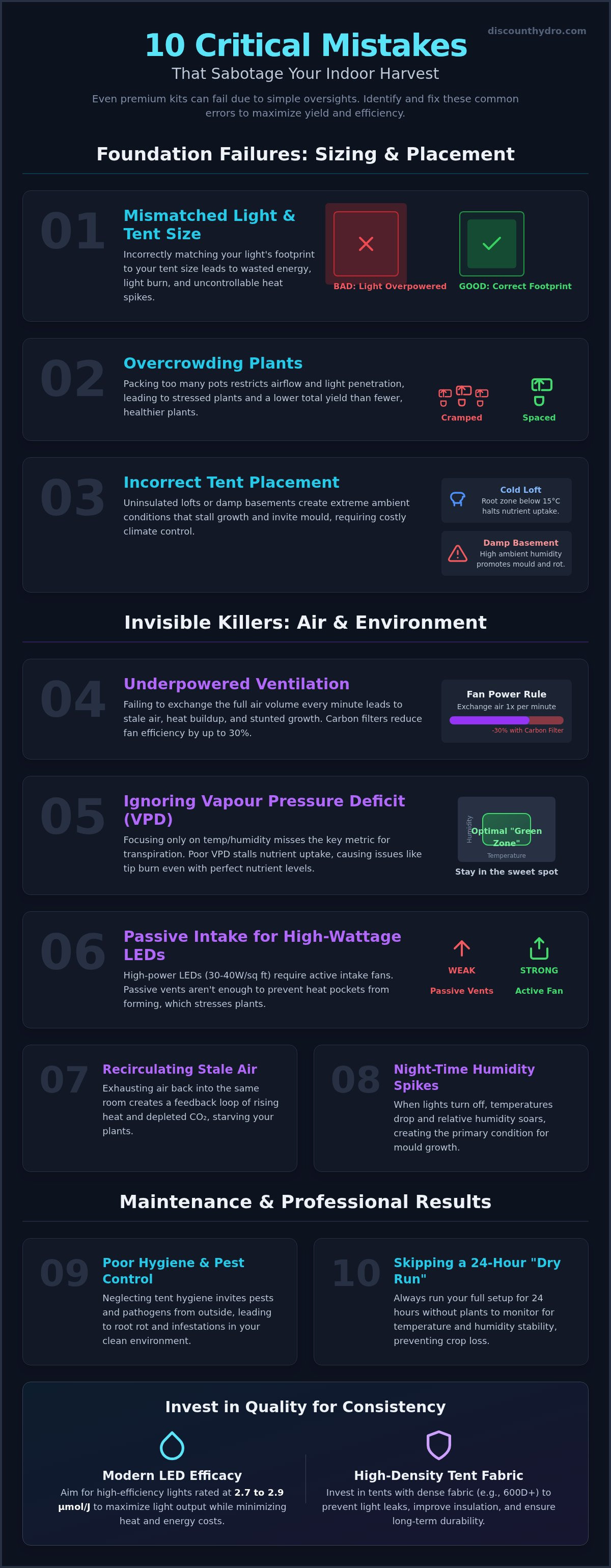
Success in indoor cultivation depends on creating controlled conditions for plant growth, yet many growers sabotage their results before the first seedling emerges. One of the most common grow tent mistakes is failing to match the tent size to the light's effective footprint. If your LED grow light is designed for a 1.2m x 1.2m area but you've squeezed it into a 0.6m tent, you'll face uncontrollable heat spikes and light burn. Conversely, using a small light in a massive tent wastes electricity and valuable floor space. You must align your equipment specifications with your physical environment to ensure efficiency.
Overcrowding is another frequent error that leads to lower total yields. It's tempting to pack as many pots as possible into the space, but this restricts airflow and prevents light from reaching the lower canopy. Fewer, healthier plants often produce a larger, higher quality harvest than a cramped tent full of spindly, stressed ones. Always conduct a "dry run" by running your lights and extraction system for 24 hours before adding plants. This allows you to track temperature stability and humidity levels without risking your crop.
The Relationship Between Volume and Ventilation
A smaller tent volume means the air inside heats up significantly faster. This requires a higher air exchange rate to maintain stability. You should aim to replace the entire volume of air in your tent at least once every minute. To calculate this, multiply your tent's length, width, and height to find the cubic volume. When selecting an extraction fan, remember that adding a carbon filter reduces fan efficiency by up to 30%. If your fan is underpowered, heat and stale air will linger, leading to stunted growth and increased pest risks.
Location Pitfalls in the UK Climate
Placing a tent in an uninsulated UK loft or a damp basement presents unique challenges. During winter, lofts become freezing voids. Cold root zones lead to "purple stems" and a complete halt in nutrient uptake. If you can't keep the floor temperature above 15°C, your plants won't thrive. In autumn, garages and basements suffer from high ambient humidity, which creates the perfect environment for mould and rot. For more detail on selecting the right setup for your specific space, see our Choosing a Grow Tent: A Complete Buyer’s Guide for UK Growers. Fixing these placement errors early saves you from expensive heating and dehumidification bills later.
The Invisible Killers: Ventilation, Humidity, and VPD
Vapour Pressure Deficit (VPD) represents one of the most technical yet vital common grow tent mistakes for modern growers to address. While most people only track simple temperature and relative humidity, plants respond more directly to the pressure difference between their internal moisture and the surrounding air. If this pressure isn't balanced, your crops won't thrive regardless of how much you spend on nutrients. VPD is the difference between the moisture in the air and how much moisture the air can hold when saturated.
High humidity effectively shuts down plant transpiration. When the air is too wet, plants cannot "sweat" through their stomata. This stall in movement stops the upward flow of water and minerals from the roots. You might see calcium deficiencies or tip burn even if your reservoir is perfectly balanced. Using a digital hygrometer and a VPD chart allows you to stay in the "green zone" where nutrient uptake is most efficient. Without this data, you're just guessing at your plant's metabolic rate.
Mastering VPD for Maximum Uptake
Maintaining a stable environment requires more than just a single fan. Many growers rely on passive intake vents at the bottom of the tent. However, Mistake 5 occurs when using high-wattage LEDs that draw 30 to 40 watts per square foot. These fixtures require active intake fans to force fresh, cool air into the canopy. Without active cooling, heat pockets form around the LED drivers, causing the VPD to spike and stressing the plants. Following strict hygiene and sanitization protocols won't save a crop that is suffocating in stagnant, humid air.
Odour and Airflow Management
Mistake 6 involves recirculating "stale" air. Exhausting your tent back into the same room creates a feedback loop of rising heat and CO2 depletion. You must vent exhausted air directly outside or into a separate room to ensure a constant supply of fresh, oxygenated air. This is especially critical during the "night-time" humidity spike (Mistake 7). When lights turn off, temperatures drop rapidly, causing relative humidity to soar. This is the primary cause of bud rot in the final weeks of flowering. Keep your extraction fans running 24/7 to maintain negative pressure, which ensures all air passes through your carbon filter for total odour control.
Whether you are learning What is Hydroponics? A Beginner’s Guide to Soil-Free Growing or using traditional media, air exchange is your foundation. Don't let an old or undersized carbon filter ruin your privacy. If you can smell your grow room from the hallway, your ventilation has already failed. You can find professional-grade extraction kits that are designed to handle these specific pressure requirements without breaking your budget.
Lighting Blunders: Beyond Just Hanging the Lamp
Modern LEDs are highly efficient, but assuming they generate zero heat is one of the most common grow tent mistakes seen in 2026. While the diodes themselves run cooler than old HPS bulbs, the LED drivers are significant heat sources. In a confined tent, a driver can raise ambient temperatures by several degrees, potentially pushing your environment out of the "green zone" discussed in previous sections. High-quality fixtures often allow you to mount the driver outside the tent. If yours is fixed, you must ensure your extraction system is powerful enough to pull that heat away from the canopy immediately.
Precision matters when positioning your equipment. The Inverse Square Law dictates that light intensity changes exponentially with distance. Moving your light just 10cm closer can double the intensity, while moving it 10cm away can halve it. Without a PAR meter, you risk light bleaching at the top of your plants or spindly, weak growth at the bottom. Additionally, poor light distribution causes hotspots. This is often a result of using low-quality tent linings that don't reflect light evenly, leading to inconsistent development across your canopy.
Light leaks during the dark cycle are silent yield killers. Even a tiny red LED on an extension lead or a pinhole in a cheap zip can cause enough light pollution to stress your plants. This interruption often leads to hermaphroditism, where plants develop male flowers and ruin your entire harvest with seeds. You should physically sit inside your tent with the lights off and the zips closed to check for any visible glow. If you can see light, your plants can too.
PPFD vs. Wattage: The 2026 Standard
Stop using "watts from the wall" as your primary metric. In 2026, the industry standard for high-efficiency lighting is between 2.7 and 2.9 µmol/J. Following research from Cornell's CEA program, professional growers focus on Photosynthetic Photon Flux Density (PPFD) to measure actual light reaching the plant. Over-lighting young plants with high-intensity bars is a frequent error. Seedlings only require 200 to 400 PPFD, while the flowering stage needs 600 to 900 PPFD. For a deeper dive into these technical specs, check our LED Grow Lights: The Ultimate 2026 Buyer’s Guide.
Light Cycles and Timers
Consistency is vital for plant hormones. Cheap mechanical timers are prone to sticking, which can leave your lights "on" during a scheduled dark period. This single failure can revert a flowering plant back to the vegetative stage, adding weeks to your timeline and increasing electricity costs. Digital timers or smart controllers provide better reliability. Ensure your light cycle is rock-solid; even a 30-minute shift in timing can trigger stress responses that reduce final yields and potency.
Maintenance Mishaps: Hygiene, Pests, and Nutrient Lockout
Maintaining a sterile environment is your first line of defence against crop failure. One of the most common grow tent mistakes involves bringing outside contaminants directly into your clean room. Don't wear garden shoes inside your tent. Bringing in pests like spider mites or aphids on your clothing is a fast track to a ruined harvest. These hitchhikers thrive in the warm, dry conditions of a grow room and can multiply before you notice the first leaf speckle. Keep a dedicated pair of indoor shoes and a clean lab coat by your tent entrance to minimize this risk.
Hygiene also extends to the floor of your tent. Leaving dead leaves or standing water creates an invitation for fungus gnats and mould. Dead organic matter provides the perfect breeding ground for larvae, which then feed on your plant's root systems. Standing water also causes localized humidity spikes that contribute to the bud rot issues mentioned in previous sections. A clean tent floor is a functional requirement for a high-yielding environment, not just a preference.
Irrigation errors are equally destructive. Over-watering is the leading cause of root rot, but the rules change depending on your media. In soil, you must allow for wet-dry cycles to let the roots breathe. In coco coir, however, letting the medium dry out completely causes salt buildup and nutrient lockout. Finding the balance between these two methods is essential for maintaining root health and ensuring your plants can actually process the food you provide.
The Hygiene Protocol
A clean tent is the most effective pesticide you can use. You must disinfect your entire setup between every single grow cycle. Use a professional-grade cleaning solution to wipe down the reflective walls, trays, and even the exterior of your pots. This prevents the carryover of pathogens or dormant pest eggs from one run to the next. If you are already dealing with an infestation, see our guide on Spider Mites: The Ultimate Guide to Identification, Elimination, and Prevention for specific recovery steps.
Nutrient Management Errors
Nutrient lockout occurs when the pH levels in your root zone drift outside the optimal range, usually 5.5 to 6.5 depending on the medium. When this happens, your plants cannot absorb specific minerals regardless of how much you feed them. Adding more supplements to a "hungry" looking plant often makes the problem worse by further crashing the pH and increasing the Electrical Conductivity (EC) to toxic levels. Avoid over-complicating your feed schedule with too many additives. Start with a solid base and monitor your runoff daily. For a reliable feeding foundation, browse our range of professional plant nutrients and supplements at competitive UK prices. You can also learn more about balancing your reservoir in our Hydroponic Nutrients: A Beginner’s Guide to Feeding Your Plants.
Professional Results: Investing in Quality and Consistency
Cutting corners on your initial setup is one of the most expensive common grow tent mistakes you can make. Cheap tents often use thin 210D fabric which is prone to tearing and pinhole light leaks. These failures compromise your environment and often force you to buy replacements mid-cycle, costing you more than if you had invested in quality from the start. Consistency in your environment beats "magic" nutrient additives every time. If you can't maintain stable temperatures or a light-proof space, the most expensive supplements won't save your yield.
Why Quality Gear Saves Your Harvest
Professional-grade tents use 600D or 1680D Mylar for a reason. This thickness ensures total light-proofing and provides the structural integrity needed to hang heavy LED fixtures and carbon filters safely. UK-sourced LED lights from brands like Omega offer the benefit of local warranties and proven efficiency ratings of 2.7 µmol/J or higher. Discount Hydro helps you avoid technical pitfalls by offering curated kits where every component is matched for compatibility. This removes the guesswork and ensures your extraction, lighting, and tent volume work in perfect synchronization for maximum efficiency.
Final Checklist for a Mistake-Free Grow
Use this schedule to maintain environmental stability and identify common grow tent mistakes before they escalate:
- Daily: Check your reservoir pH and EC levels. Record the maximum and minimum temperature and humidity from the last 24 hours to ensure you stay within the VPD "green zone."
- Weekly: Inspect all zips and ducting joins for light or air leaks. Check the underside of leaves for any signs of pests like spider mites.
- Monthly: Calibrate your digital meters and wipe down reflective surfaces to maintain light efficiency. Check your carbon filter for any drop in odour control performance or airflow restriction.
Ready to upgrade your environment? Browse our range of professional grow tents and equipment at Discount Hydro for competitive pricing and expert UK support.
Master Your Environment for Maximum Yield
We provide the professional tools you need to achieve these results. Benefit from our expert advice for indoor gardeners and competitive pricing on top-tier LED and nutrient brands. With fast UK-wide delivery, you can fix your setup issues immediately. Upgrade your setup with professional grow tents from Discount Hydro and secure your future yields. You now have the checklist to turn a struggling room into a high-performance space. Start today and see the impact of professional-grade gear and operational discipline.
Frequently Asked Questions
What is the most common grow tent mistake for beginners?
The most frequent of the common grow tent mistakes for beginners is ignoring air exchange. New growers often spend their entire budget on high-spec lights but forget that a tent is a sealed box. Without a properly sized extraction fan to replace the air every minute, heat and humidity build up instantly. This leads to stunted growth and increased pest risks before the first month is over.
How far should my LED grow light be from my plants?
Distance is determined by the growth stage and the specific PPFD output of your fixture. Seedlings require lower intensity, usually 200 to 400 PPFD, meaning the light should be positioned further away. During flowering, plants need 600 to 900 PPFD. Always check your light's manual for recommended hanging heights. Using a PAR meter is the only way to be 100% accurate in 2026.
Do I really need a carbon filter if I only have two plants?
You need a carbon filter if you require discreet operation. Even a small number of plants will produce a strong, distinct aroma during the final weeks of flowering. Without a filter, these odours will leak into the rest of your property. A correctly sized filter paired with an extraction fan maintains negative pressure, ensuring all air is scrubbed before exiting the tent.
Why are the tips of my plant leaves turning brown in the tent?
Brown tips are typically caused by nutrient burn or light stress. If you've over-concentrated your nutrient solution, the plant's tips will "fry" as they try to process excess salts. Check your EC levels immediately. If your nutrients are balanced, the brown tips might be light burn from an LED that is positioned too close to the canopy, causing the leaves to overheat.
Can I put my grow tent in a cold garage or loft in the UK?
You can use these spaces, but you must compensate for the UK's fluctuating temperatures. Lofts and garages drop to near-freezing in winter, which stops nutrient uptake. You'll need tube heaters or oil-filled radiators controlled by a thermostat. Insulating the floor of the tent with polystyrene boards also helps prevent cold roots and the stunted growth associated with low temperatures.
How often should I run my extraction fan in a grow tent?
Your extraction fan must run 24 hours a day. Turning it off during the dark cycle causes humidity to spike as the temperature drops. This creates the perfect environment for bud rot and mould. Constant airflow also maintains negative pressure, which is vital for keeping odours contained within your carbon filter system at all times, even when the lights are off.
What is VPD and why should I care about it?
Vapour Pressure Deficit (VPD) is the difference between the moisture in the air and how much it can hold when saturated. It's more important than simple humidity because it controls how fast your plants transpire. If the VPD is too high or too low, the plant stops taking up water and nutrients. This leads to deficiencies and slow growth regardless of your feed schedule.
Is it okay to open my grow tent during the dark cycle?
Avoid opening your tent during the dark period. Plants need total darkness to regulate their hormones correctly. Even a small amount of light from a hallway or a phone screen can trigger stress. This often leads to hermaphroditism, where the plant produces seeds and ruins your final yield quality. If entry is essential, use a dedicated green-spectrum LED that doesn't disrupt the dark cycle.