

Grow Lamp Light: The Ultimate Beginner's Guide to Indoor Growing
Worried that choosing the wrong grow light will either scorch your plants or send your electricity bill skyrocketing? It’s a common fear for indoor growers. The market is flooded with options, and technical terms like PAR, spectrum, and wattage can make a simple purchase feel complicated. But selecting the perfect grow lamp light for your setup doesn't have to be a guessing game. This guide is designed to cut through the confusion and give you the essential facts, fast.
We'll break down the different types of lights, from budget-friendly LEDs to high-output HPS kits, and explain what features truly matter for healthy plants. Forget the jargon-we'll give you the straightforward information you need to keep your houseplants alive through the dark UK winters or successfully grow herbs and vegetables indoors. Get ready to choose your next grow light with complete confidence, knowing you've found the best value for your space and your budget.
Key Takeaways
- Learn why a standard household bulb won't work and what specific light spectrum your plants need to thrive indoors.
- Get a clear comparison of the main grow light technologies (LED, HPS, etc.) to find the most cost-effective option for your setup.
- Decode the technical jargon on packaging like PAR and wattage, so you can confidently compare models and invest in the right power.
- Choose the perfect grow lamp light for your needs by matching your plant type, grow space, and budget to our straightforward selection guide.
Why Your Plants Need a Grow Lamp (And Not Just Any Lamp)
You can't grow healthy, high-yield plants with a standard desk lamp. While any light might seem better than none, using the wrong type is a waste of electricity and leads to poor results. To get strong, productive plants, you need a specialised grow lamp light source designed specifically for horticulture. The difference isn't just brightness; it's about providing the right kind of light energy your plants need to thrive.
Using the wrong light forces plants to stretch desperately towards an inadequate source. This results in weak, 'leggy' stems and minimal flowering. Investing in a proper grow lamp is the first and most critical step to a successful indoor harvest.
The Science of Light for Plants: A Simple Breakdown
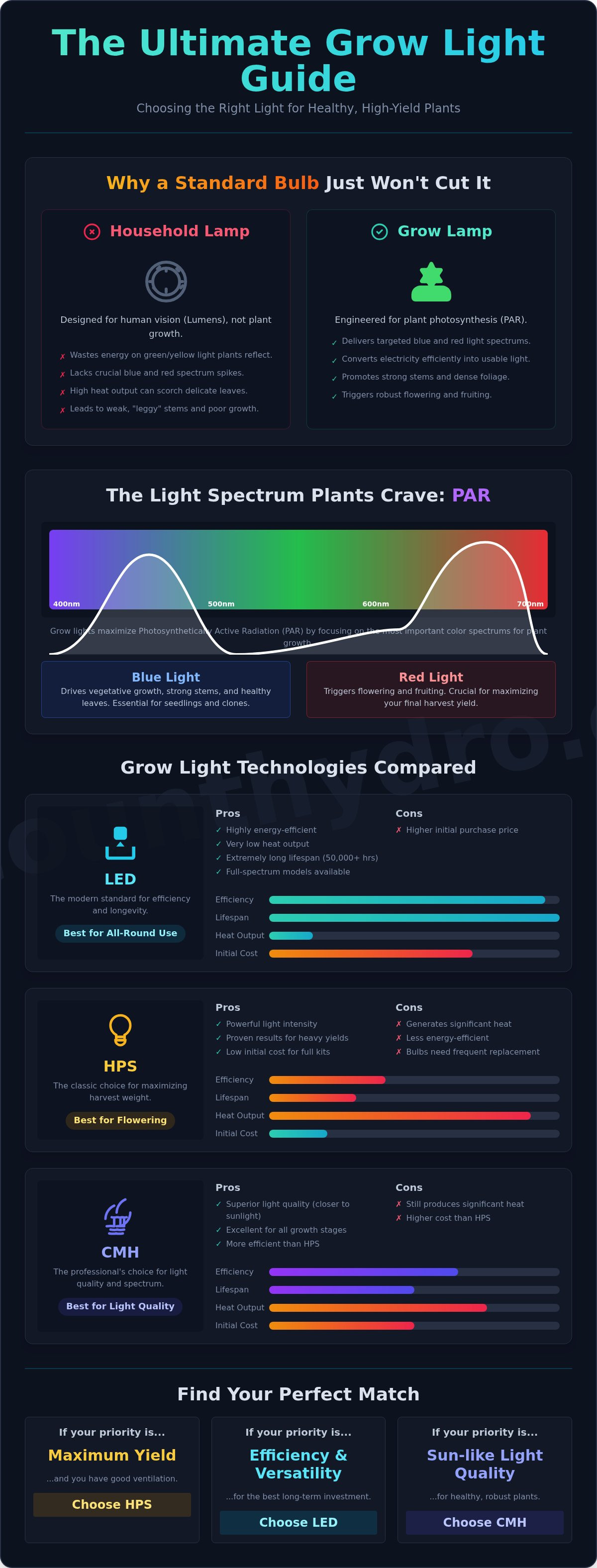
Plants use light for photosynthesis, the process of converting light energy into chemical energy for growth. But they can't use just any light. Plants are selective, primarily using specific colours within the light spectrum. This usable light is measured as Photosynthetically Active Radiation (PAR). Think of PAR as the nutritional value of light for your plants. The most crucial colours are:
- Blue Light: Drives vegetative growth, promoting strong stems and healthy leaves. Essential for seedlings and clones.
- Red Light: Triggers flowering and fruiting, crucial for maximising your final yield.
Standard bulbs ignore this. A proper grow lamp, however, is engineered to maximise PAR output across these vital spectrums. For a deeper dive, you can review The Main Types of Grow Lamp Technology, which covers the fundamentals of horticultural lighting.
Household Lamp vs. Grow Lamp: A Direct Comparison
The lamp lighting your living room is fundamentally different from a horticultural grow lamp light. A standard household bulb-whether incandescent, halogen, or a basic LED-is built for human eyes, not plant biology. Here’s the direct comparison:
- Purpose: Household lamps are measured in lumens, which indicates brightness to the human eye. Grow lamps are measured in PAR, which measures the light plants actually use for photosynthesis.
- Spectrum: Your typical lamp produces a lot of green and yellow light, which looks bright to us but is largely reflected by plants. It lacks the intense blue and red spikes needed for vigorous growth.
- Heat & Efficiency: Old-style incandescent and halogen bulbs waste most of their energy as heat, which can easily scorch your plants' leaves. Grow lamps are far more efficient at converting electricity into usable light, not excess heat.
The Main Types of Grow Lamp Technology Explained
Choosing the right grow lamp light is the most critical decision for your indoor garden. The technology you select directly impacts your energy costs, heat output, and ultimately, your harvest's success. To make the best choice, it's vital to understand the fundamental differences between the main types. For those wanting a deeper dive into the science behind light measurement, the University of Missouri offers an excellent guide on Key Features to Understand Before You Buy, explaining concepts like PAR and DLI. Here’s a straightforward breakdown of the four primary technologies available today.
LED (Light Emitting Diode) Grow Lights
LEDs are the modern standard for a reason. They offer incredible efficiency and a long lifespan, making them a fantastic long-term investment. While the initial price can be higher, their low energy consumption and minimal heat output save you money on electricity and ventilation equipment over time.
- Pros: Highly energy-efficient, low heat, extremely long lifespan (50,000+ hours), and available in targeted full-spectrum models.
- Cons: Higher initial purchase price, with quality units starting from £80 and going up significantly.
- Best For: Almost any application, from keeping a single houseplant healthy to powering a professional multi-tent setup.
HPS (High-Pressure Sodium) Grow Lights
For decades, HPS lights were the go-to for serious growers focused on heavy yields. They produce an intense, yellow-orange light that is exceptional for the flowering and fruiting stages of a plant's life. Their low initial cost makes them an attractive entry point for those with larger spaces.
- Pros: Powerful light intensity, proven results for flowering, and a lower initial cost, with full kits available for around £60.
- Cons: Generates significant heat requiring powerful ventilation, less energy-efficient, and bulbs need replacing more often.
- Best For: Growers with dedicated, well-ventilated spaces aiming to maximise the weight of their harvest.
CMH (Ceramic Metal Halide) Grow Lights
CMH lights offer a fantastic middle ground, providing a superior quality of light that's much closer to natural sunlight than HPS. This full-spectrum output is excellent for all growth stages, particularly vegetative growth, resulting in healthier, more robust plants. They are more efficient and run cooler than HPS, but still produce considerable heat.
- Pros: Excellent full-spectrum light quality, better efficiency than HPS, and a longer bulb lifespan.
- Cons: More expensive than HPS kits and still requires active heat management.
- Best For: Cultivators who prioritise the overall quality and health of their plants and can manage the heat output.
Remember that managing heat is also linked to controlling humidity. A poorly ventilated, humid grow space can cause damp problems in your home. If you're concerned about structural dampness, professional services like those detailed at hypersec.fr can offer solutions.
Fluorescent Grow Lights (CFL & T5)
The most budget-friendly option, fluorescent lighting is perfect for specific, low-intensity tasks. Because they produce very little heat, you can place them extremely close to your plants without risk of burning them, making them ideal for delicate seedlings and clones.
- Pros: Very low initial cost (often under £20), minimal heat, and gentle on young plants.
- Cons: Low light intensity makes them unsuitable for flowering or fruiting larger plants.
- Best For: Starting seeds, rooting cuttings (clones), and growing small leafy greens like lettuce and herbs.
Decoding the Jargon: Key Features to Understand Before You Buy
Shopping for a grow light can feel like reading a science textbook. Manufacturers plaster boxes with technical specs, but what do they actually mean for your plants? Understanding a few key terms is the secret to moving beyond the price tag and finding the best value for your setup. Let's cut through the noise and focus on what really matters.
Light Spectrum: What Does 'Full Spectrum' Mean?
The 'spectrum' of a grow lamp light refers to the different colours (or wavelengths) of light it produces. A full-spectrum LED is designed to mimic natural sunlight, providing every wavelength your plants need to go from seedling to harvest. This makes them the best and most straightforward choice for beginners. You may still see older "blurple" lights, which focus only on blue and red light, but modern full-spectrum technology delivers better, healthier growth.
Wattage: Why It's Not the Whole Story
Wattage is one of the most misunderstood metrics. It doesn't measure brightness or power; it measures energy consumption. A higher wattage means a higher electricity bill. The number you should care about is the 'actual wattage' or 'power draw'. Be wary of cheap lights claiming a "1000W equivalent" while only drawing 100W from the wall-this is a marketing tactic, not a true measure of performance. Focus on the actual power draw to compare lights accurately.
Light Intensity (PPF & PPFD) and Coverage Area
This is where we measure the light that actually fuels plant growth. Here’s a simple breakdown:
- PPF (Photosynthetic Photon Flux): The total amount of usable light the lamp produces per second. Think of this as the fixture's total potential.
- PPFD (Photosynthetic Photon Flux Density): The amount of that usable light that actually reaches your plant canopy.
Imagine your grow light is a showerhead. PPF is the total volume of water coming out of the head. PPFD is how wet you get standing under it. The closer you are, the higher the PPFD. Manufacturers provide PPFD charts and a recommended coverage area (e.g., 3'x3' for flower) to help you match the light's intensity to your grow space perfectly.
Armed with this knowledge, you can confidently choose a high-performance light that delivers real results without breaking the bank. Shop our full range of LED Grow Lights to find the best value for any budget.
How to Choose the Right Grow Lamp for Your Needs
Selecting the correct grow lamp doesn't have to be complicated. The best choice comes down to your specific goal, available space, and budget. Forget the technical jargon-let's match the right light to your project for maximum results at the best price.
For Houseplants and Winter Survival
To keep your decorative plants thriving through the dark UK winters, you don't need a high-powered setup. A simple, low-cost solution is best. Look for single-bulb or clip-on full-spectrum LED lights. They use minimal electricity, often have built-in timers for set-and-forget convenience, and are designed to blend into your home decor. One small bulb is usually enough for one or two medium-sized houseplants.
For a Kitchen Herb Garden or Leafy Greens
Growing fresh herbs, lettuce, or microgreens right in your kitchen is easy with the right light. We recommend T5 fluorescent fixtures or slim LED bar lights. Their key advantage is low heat output, allowing you to place them just inches above your plants without scorching the leaves. This makes them perfect for mounting under cabinets for a clean, integrated setup. A single 2-foot bar can easily support a full tray of seedlings or 4-6 small herb pots.
For Your First Grow Tent (e.g., 2'x2' or 3'x3')
When you're ready for serious, controlled growing, a full-spectrum LED panel is the most efficient and effective choice. This type of grow lamp light provides the complete range of light needed for both vegetative growth and flowering. For a standard 2'x2' tent, a 100W-150W LED is a solid investment. For a 3'x3', aim for 250W-300W. The most critical factor is matching the light's coverage area, or "footprint," to your tent size. This ensures no light or energy is wasted, giving you the best return on your investment. Getting the light and tent perfectly matched from the start saves money and hassle. Check out our Grow Tent Kits for a perfect match.
Find Your Perfect Grow Light Today
Stepping into the world of indoor growing can seem complex, but you're now armed with the essential knowledge to succeed. You understand that providing the right light spectrum is non-negotiable for healthy plants, and you can confidently tell the difference between the main technologies like LED, HPS, and CMH. Most importantly, you know how to decode the jargon-from PAR to Kelvin-to make a truly informed decision for your space and budget.
The right grow lamp light is the cornerstone of any successful indoor garden, transforming your potential into a powerful harvest. Don't let confusion stop you from getting started. At Discount Hydro, we have the hardware to match your new expertise. Shop our huge selection of grow lights at the UK's best prices! We guarantee you're getting the best deal with our price match promise. Plus, with fast, nationwide UK delivery and a handy click and collect option, you can get your new setup running in no time.
Your journey to a thriving, year-round harvest starts now. Get the right gear and watch your plants flourish.
Frequently Asked Questions About Grow Lights
How long should I leave my grow lamp light on each day?
The daily duration for your grow lamp light depends on the plant's growth stage. For plants in the vegetative stage, an 18-hour-on, 6-hour-off cycle is standard. When you switch to the flowering stage, reduce this to a 12/12 cycle. Seedlings and clones benefit from 16 to 18 hours of light to encourage strong initial growth. Using a simple plug-in timer is the best way to automate this schedule for consistent results and maximum yield.
How far should the grow light be from my plants?
Hanging height varies by light type and power. High-intensity HPS lights should be kept 12-24 inches from the plant canopy. Modern LED grow lights can often be placed closer, typically 6-18 inches, as they produce less heat. Always check the manufacturer's specific recommendations for your model. If you can feel significant heat on the back of your hand at canopy level, the light is too close and should be raised to prevent damage.
Can a grow light be too strong for my plants?
Yes, a grow light can be too intense, causing light burn or photo-bleaching. Symptoms include yellowing or white patches on the leaves closest to the light, or leaves curling upwards at the edges. If you notice these signs, either raise the light fixture further away from the plant canopy or, if your light has a dimmer, reduce its intensity. Acclimatise new plants gradually to high-intensity lighting to prevent shock and ensure healthy development.
Do grow lamps use a lot of electricity?
Electricity consumption depends on the technology. A 400W LED grow light running for 12 hours a day will use 4.8 kWh. Based on average UK electricity prices of around £0.25 per kWh, this would cost approximately £1.20 per day. While older HPS lamps are less efficient, investing in a high-efficiency LED model significantly reduces running costs over the long term, offering better value and a superior return on your initial investment.
What's the difference between a grow lamp and a grow bulb?
The terms are often used interchangeably, but there is a technical difference. A "grow bulb" is the replaceable light-emitting part, like an HPS or MH bulb. A "grow lamp" or "fixture" typically refers to the complete unit, including the bulb, reflector, and ballast. With modern integrated LED units, the entire fixture is often just called a grow light or lamp, as the diodes are not user-replaceable like a traditional bulb.
Can you use a grow light for any type of plant?
Yes, but you must match the light to the plant's needs. Low-light plants like herbs and lettuces thrive under less powerful T5 fluorescent or LED lights. High-light plants, such as tomatoes or peppers that produce fruit, require a much more intense, full-spectrum light to grow successfully through their vegetative and flowering stages. Always research the specific light requirements for the plants you intend to grow before you buy your equipment.
While it's exciting to grow your own, some exotic produce can be particularly difficult to cultivate in a UK climate, even with the best equipment. For those times you want to enjoy unique tropical flavours without the challenge, you can explore Seasonal Filipino Fruits for fresh delivery options.
What is the average lifespan of an LED grow light?
Quality LED grow lights have an exceptional lifespan, typically rated for 50,000 to 100,000 hours of use. This is a massive improvement over HPS bulbs, which need replacing every 10,000 hours. For a grower running a 12/12 flowering cycle, a 50,000-hour LED light can last for over 11 years before its output significantly degrades. This long-term reliability and performance make them a cost-effective investment for any serious grower.