

LED Grow Lights: The Ultimate 2026 Buyer's Guide
Feeling lost in a sea of technical jargon like PAR, PPFD, and full-spectrum? Overwhelmed by the endless options and worried about picking a light that will just drive up your electricity bill? You're not alone. Choosing the right led grow light is one of the most critical decisions for your indoor garden, directly impacting your yields and your running costs. A bad choice means wasted money and disappointing results. It's time to stop the guesswork and get the facts.
This is your no-nonsense 2026 buyer's guide. We're cutting through the marketing hype to give you the straight-up information you need to make a smart purchase. You will learn exactly how to match a light to your grow tent size, understand the specs that actually matter for plant growth, and find an energy-efficient model that saves you pounds (£) in the long run. By the end of this guide, you'll have the confidence to select the perfect high-performance light to maximise your harvest and grow healthier, stronger plants than ever before.
What is an LED Grow Light & Why is it Essential?
If you're serious about indoor growing in 2026, an LED grow light is no longer an option-it's the standard. Gone are the days of bulky, inefficient High-Pressure Sodium (HPS) and Metal Halide (MH) lamps. Today's technology is all about precision and efficiency. In simple terms, an LED (Light-Emitting Diode) grow light is a highly advanced fixture that uses semiconductor chips to convert electricity into specific, targeted wavelengths of light that plants need for photosynthesis. This technology has rapidly evolved, making it the most cost-effective and powerful choice for cultivators across the UK. For a deeper dive into the history and science, Wikipedia offers a comprehensive overview of grow lights and their various forms.
How LED Grow Lights Fuel Plant Growth
Unlike old-school bulbs that waste energy producing broad, untargeted light (and a lot of heat), LEDs are engineered for performance. They produce precise light spectrums tailored to a plant's needs. The key is providing the right light at the right time: intense blue light (400-500nm) fuels strong vegetative growth for robust leaves and stems, while a rich red light (600-700nm) is essential for triggering and maximising the flowering or fruiting stage. The ultimate goal of a quality fixture is to replicate and even improve upon the most useful aspects of natural sunlight, delivering exactly what your plants crave without the waste.
The Main Advantages of LED Technology
Switching to LED technology is a direct investment in better yields and lower running costs. The benefits are clear and immediate:
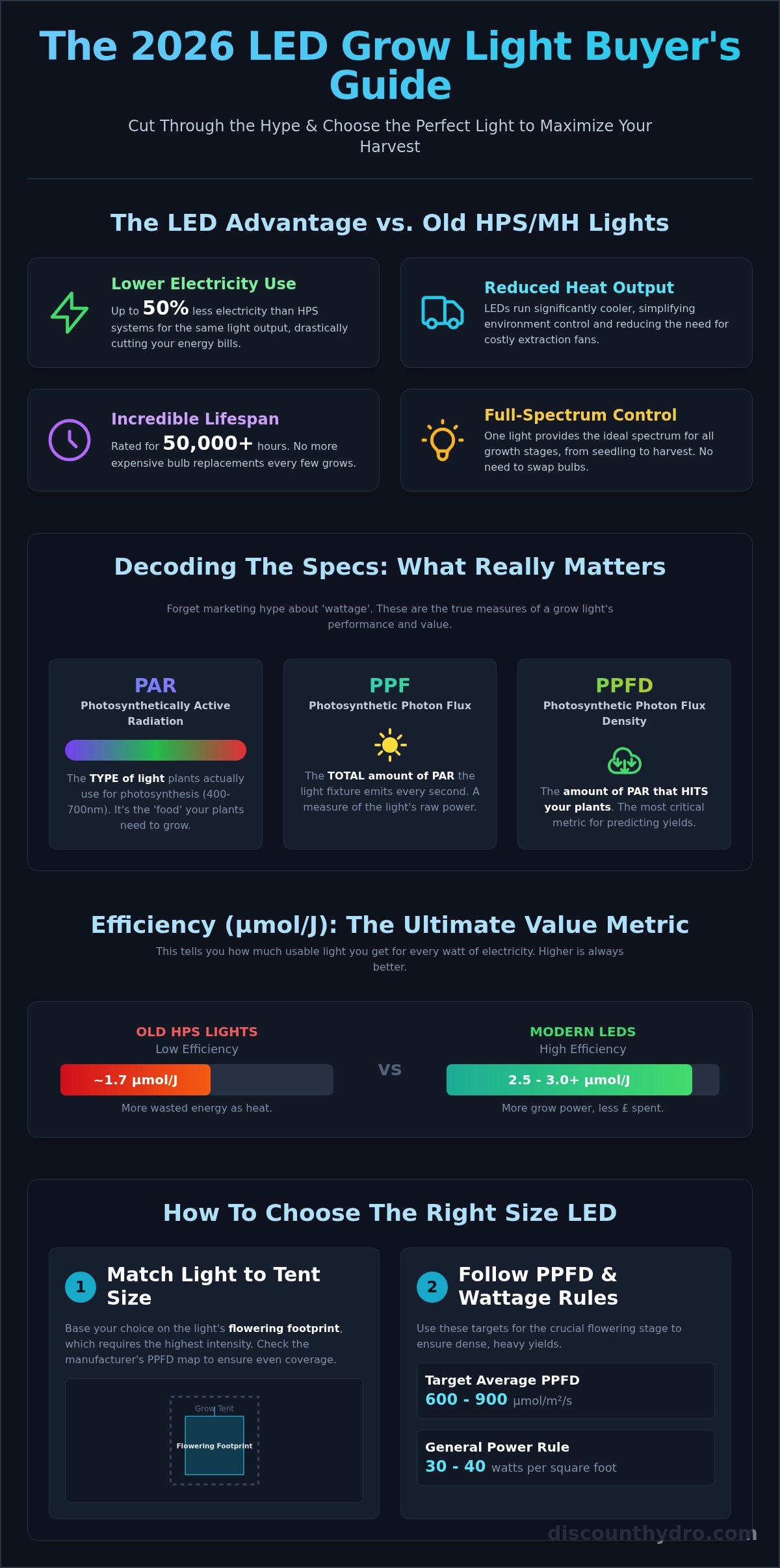
- Lower Electricity Consumption: LEDs use up to 50% less electricity than HPS systems to produce the same amount of usable light. This translates directly into significant savings on your energy bill every single month, putting more money back in your pocket.
- Reduced Heat Output: LEDs run substantially cooler, making it far easier and cheaper to manage your grow room environment. You'll spend less on powerful extraction fans and reduce the risk of heat stress damaging your plants.
- Incredible Lifespan: A quality LED fixture is rated for 50,000 hours or more. That means no more costly bulb replacements every few grow cycles. You buy it once, and it performs reliably for years.
- Full-Spectrum Control: Modern full-spectrum LEDs provide the ideal light recipe for every stage of growth, from seedling to harvest. There's no need to switch between different MH and HPS bulbs, simplifying your entire operation.
These same advantages of efficiency and longevity have also made LEDs the top choice for other specialized applications beyond horticulture. In landscape and architectural design, for example, the technology is used to create stunning and energy-efficient visual effects. Companies specializing in outdoor lighting installation Tampa Bay showcase how custom LED systems can transform outdoor environments, illustrating the versatility of the technology.
Decoding the Specs: PAR, PPFD, and Full Spectrum Explained
When shopping for a new led grow light, the biggest mistake is focusing on wattage. Watts only measure power consumption-how much the light will add to your electricity bill. They don't tell you how well it will grow your plants. To get the best value and the biggest yields, you need to look at the metrics that measure the actual light your plants use to thrive.
PAR, PPF & PPFD: The Metrics That Actually Matter
These three acronyms are the true measure of a light's performance. Forget the marketing hype; these numbers tell you exactly what you're getting. Understanding them is simple:
- PAR (Photosynthetically Active Radiation): This isn't a measurement, but a type of light. It’s the specific range of the light spectrum (400-700nm) that plants use to photosynthesise and grow.
- PPF (Photosynthetic Photon Flux): This measures the total amount of PAR the light fixture produces every second. A higher PPF means a more powerful light overall.
- PPFD (Photosynthetic Photon Flux Density): This is the most practical metric for you. It measures the amount of PAR that actually lands on your plant canopy. Look for PPFD maps that show strong, even coverage across your specific grow space.
What 'Full Spectrum' Really Means
You'll see 'full spectrum' on almost every box, but what does it mean for your grow? A true full spectrum light mimics the sun, providing all the wavelengths your plants need for a full life cycle. It delivers a balanced diet of light, including blue, green, red, and far-red wavelengths. As detailed in studies on Optimized Light Spectrum for Plant Growth, these varied wavelengths trigger crucial growth responses. The biggest advantage for you is efficiency: a single, high-quality full spectrum unit handles your entire grow cycle, from seedling to harvest, saving you the cost of buying separate veg and bloom lights.
Efficiency (μmol/J): Getting More Light for Your Watt
This is the ultimate measure of value for money. Efficiency, measured in micromoles per joule (μmol/J), tells you how effectively a light converts electricity into usable PAR. A higher number means more light for your plants and a lower energy bill for you. Old HPS lights might manage 1.7 μmol/J, but a good modern led grow light should be 2.5 μmol/J or higher.
When comparing models, always check this rating. A fixture with a 2.8 μmol/J rating will deliver more growing power and cost you less in electricity than a 2.3 μmol/J model of the same wattage. That difference translates directly into lower running costs and more pounds in your pocket.
How to Choose the Right Size LED for Your Grow Space
Choosing the correct LED grow light starts with one thing: the size of your grow area. This is the single most important factor. Get it wrong, and you either waste money on electricity for light your plants can't use, or you end up with disappointing yields. Matching the light's footprint to your tent is the first step to a successful harvest.
Step 1: Match Light Coverage to Your Tent Size
First, measure your grow tent or space accurately (e.g., 1.2m x 1.2m). Every light manufacturer provides a recommended coverage area for both the vegetative and flowering stages. Always base your decision on the flowering footprint, as this is smaller and requires higher intensity. For proof of performance, check the light's PPFD map. This chart shows you the exact light intensity across the entire canopy, ensuring there are no weak spots at the edges.
Step 2: General Wattage & PPFD Guidelines
As a simple rule, aim for 30-40 watts of actual power draw per square foot. For the crucial flowering stage, your goal is to provide an average PPFD of 600-900 μmol/m²/s across the canopy. Modern fixtures are incredibly efficient, a topic explored in depth by research into Horticultural LED Systems, so while wattage is a good starting point, PPFD is the true measure of a light's output. Use this chart to find the right power for your space:
| Tent Size | Recommended Wattage | Target Average PPFD |
|---|---|---|
| 0.8m x 0.8m | 150W - 250W | 600-900 μmol/m²/s |
| 1.0m x 1.0m | 300W - 450W | 600-900 μmol/m²/s |
| 1.2m x 1.2m | 480W - 650W | 600-900 μmol/m²/s |
| 1.5m x 1.5m | 650W - 800W | 600-900 μmol/m²/s |
Remember, the type of plant and your desired yield also matter. High-light plants like tomatoes or cannabis will need to be at the higher end of these ranges, while leafy greens and herbs require less intensity.
Step 3: Consider Light Style: Boards vs. Bars
The physical shape of your led grow light also impacts performance. The two main styles are quantum boards and bar lights.
- Quantum Boards: These are single, solid panels that offer incredible intensity and are often the best value for your money. They are perfect for square tents where their powerful central hotspot can cover the majority of the canopy.
- Bar-Style Lights: These fixtures use multiple strips of LEDs spread across a frame. This design delivers the most even, wall-to-wall coverage possible, eliminating corner drop-off and maximising your entire grow space. They are the premium choice for serious growers.
Choose based on your budget and whether you prioritise value or perfect uniformity.
Key Features to Look For in a Quality Grow Light
When you're ready to invest in an LED grow light, it's crucial to understand that not all fixtures are created equal. The market is flooded with cheap options that promise the world but fail to deliver, costing you more in the long run through low yields and high electricity bills. A high-quality light is defined by its components, build quality, and features that give you precise control over your grow environment. Focusing on these key areas ensures you get a durable, efficient fixture that maximises your results.
Dimmability: Full Control Over Light Intensity
The ability to dim your light is not a luxury; it's an essential feature for serious growers. Plants have different light requirements at each stage of their life. A non-dimmable light running at 100% power is wasteful and potentially harmful to young plants. Dimmability offers critical advantages:
- Energy Savings: Run your light at 25-50% for seedlings and clones, saving a significant amount on your electricity bill.
- Plant Health: Prevent light burn and stress on delicate seedlings and cuttings by providing a gentler intensity.
- Total Control: Gradually increase power as your plants move from the vegetative stage to the demanding flowering phase, matching the light output perfectly to their needs.
Top-Bin Diodes and Drivers
The diodes (the chips that produce light) and the driver (the power supply) are the engine of your LED. This is where quality really counts. Top-tier manufacturers use premium components that directly translate to better performance and a longer lifespan. Look for lights built with industry-leading parts like Samsung (LM301H/B) or Osram diodes and reliable drivers from brands like Mean Well. These components are more efficient, meaning they convert more electricity into usable light (higher PPF/W) and less into wasted heat. A professional-grade led grow light with these parts will cost more upfront, but it pays for itself through superior yields and durability.
Passive Cooling and Build Quality
Reliability is key in a grow room. The best LED lights use passive cooling, which means they dissipate heat through a large, solid aluminium heatsink with no moving parts. This is far superior to lights that rely on small computer fans, which add noise, are a common point of failure, and can circulate dust. Also, check the fixture's overall build. A robust frame and a water-resistance rating (like IP65) protect your investment from the humidity and accidental splashes common in any grow space. Finally, check the warranty. A manufacturer offering a 3-5 year warranty is confident in their build quality.
Ready to invest in a light that delivers real results? Browse our range of professional-grade LED lights.
Setup and Best Practices for Maximum Yields
You've invested in a high-performance LED grow light, but your work isn't done. A premium light with a poor setup will deliver poor results. Getting the most from your new equipment comes down to dialling in two critical factors: hanging height and the daily light schedule. Get these right, and you're on the path to achieving maximum yields.
Follow these straightforward guidelines to establish a powerful baseline for your grow room. Remember to observe your plants closely and adjust as needed for your specific strain and environment.
Finding the Correct Hanging Height
Positioning your light too high reduces its intensity, leading to stretched, weak plants. Too low, and you risk light burn and heat stress on the canopy. Always start with the manufacturer's recommendation, but use these industry-standard distances as a reliable starting point:
- Seedlings & Clones: 24-30 inches (60-76 cm) from the canopy. Young plants are sensitive and require gentle light.
- Vegetative Stage: 18-24 inches (45-60 cm). As plants grow stronger, you can lower the light to increase intensity and drive vigorous growth.
- Flowering Stage: 12-18 inches (30-45 cm). During this critical phase, plants need maximum light energy for bud production.
A simple way to check for excessive heat is the 'hand test'. Place your hand, palm down, at the top of your plant canopy for 30 seconds. If it feels uncomfortably warm, your light is too close. Raise it a few inches and test again.
Typical Light Schedules for Indoor Growing
Consistency is key. Plants thrive on a predictable day/night cycle, which triggers essential biological processes for growth and flowering. The two standard schedules for most photoperiod plants are non-negotiable for success.
- Vegetative Stage: 18/6. This means 18 hours with your led grow light on and 6 hours of complete darkness. This long "day" encourages rapid leaf and stem development.
- Flowering Stage: 12/12. An equal 12 hours of light and 12 hours of uninterrupted darkness signals to the plant that it's time to produce flowers and fruit.
Do not rely on switching your lights manually. The easiest and most cost-effective way to guarantee this schedule is with a simple plug-in timer. Forgetting to turn lights on or off can stress your plants and ruin a cycle. Find a range of durable, low-cost timers and contactors on our site to automate the process and protect your investment.
Finally, always prioritise safety. Ensure all wiring is secure and away from water, and that your grow space has adequate ventilation to manage heat and humidity. Modern LEDs run much cooler than old HPS systems, but proper environmental control remains essential for a successful and safe harvest.
This level of control and safety often extends to the entire grow room. For serious growers who manage their schedules, logs, and research from a dedicated command center, having a proper workspace is key. High-quality ergonomic workstations from specialists like StudioDesk can help organize any complex project, ensuring comfort and efficiency for hours of detailed work.
Your Path to a Perfect Harvest Starts Now
You are now equipped with the essential knowledge to make an informed decision. Remember, success hinges on matching the right light specs, like PPFD and spectrum, to your specific grow space. Understanding these fundamentals empowers you to look past the marketing hype and focus on the features that truly deliver powerful results and massive yields.
Choosing the perfect led grow light is the most critical step towards achieving your growing goals. At Discount Hydro, we make that step simple and affordable. We are committed to providing the UK's best prices, and we back it up with our Best Price Guarantee, ensuring you get maximum value for your investment.
Ready to find the ideal light for your setup? Shop our full range of LED Grow Lights for the best prices in the UK. With fast, discreet UK delivery and expert advice just a call away, you have everything you need to get started. Here's to your most bountiful harvest yet!
Frequently Asked Questions
How many watts do I need for a 4x4 (1.2m x 1.2m) grow tent?
For a 4x4 tent, you need a powerful light to achieve dense flowering and maximum yields. We recommend a unit with a true power draw between 480W and 650W. This wattage range ensures intense, full-canopy light penetration, hitting all the lower bud sites. Investing in the correct power from the start is more cost-effective than upgrading later and guarantees you get the most out of your space and genetics.
Are LED grow lights really better than HPS lights?
Yes, modern LEDs are significantly better than HPS lights. They are far more energy-efficient, producing more light per watt, which directly translates to lower electricity bills. LEDs also run much cooler, reducing the need for expensive, high-power extraction fans. They provide a superior, full-spectrum light that is optimised for all stages of plant growth, resulting in healthier plants and higher-quality yields. The long-term savings make them the smart investment.
Can I leave my LED grow light on 24 hours a day?
You can run your lights 24/7 for seedlings and plants in the vegetative stage, though an 18/6 cycle is more common and saves on electricity costs. However, for the flowering stage, you absolutely must provide a period of uninterrupted darkness. A strict 12 hours on, 12 hours off (12/12) schedule is required to trigger and sustain flowering in most plants. Failing to provide this dark period will prevent your plants from producing a harvest.
How long will a good quality LED grow light last?
A professional-grade led grow light is a durable, long-term asset. You can expect a lifespan of 50,000 to 100,000 hours from a quality unit. For a grower running a standard 12/12 flowering cycle, this equates to over 10 years of consistent performance before the light output begins to noticeably degrade. Cheaper, unbranded models often use inferior components and fail much sooner, making a quality unit a more reliable and valuable purchase.
Do LED grow lights use a lot of electricity?
No, compared to older grow light technologies, LEDs are incredibly efficient. For a real-world example, a powerful 600W LED light running for 12 hours a day, at an average UK electricity rate of 28p per kWh, would cost about £2.02 per day to run. An equivalent HPS system would consume more power to generate the same light intensity, leading to significantly higher energy bills over the course of a grow cycle.
What's the difference between a cheap Amazon light and a professional one?
The key differences are component quality, safety, and verified performance. Professional lights use top-tier diodes (e.g., Samsung, Osram) and reliable drivers (e.g., Mean Well) that deliver proven efficiency and longevity. Cheaper lights often use inferior parts, have exaggerated power claims, and may lack UK safety certifications. With a professional unit, you are paying for guaranteed PAR output, build quality, and a proper warranty, ensuring consistent results and a safer grow environment.