

What is Diatomaceous Earth? A Grower's Guide to Natural Pest Control
Fighting a losing battle against spider mites, thrips, and fungus gnats? Pests in your grow room don't just cause frustration-they damage your yield and cost you money. Before you reach for another chemical spray that could compromise your final product, you need a proven, low-cost solution. That solution is diatomaceous earth, a powerful and completely natural insecticide that protects your plants without harsh chemicals, securing the value of your harvest.
This guide cuts through the confusion and gives you the essential facts. We’ll show you exactly what DE is and how its physical action kills insects safely. You’ll learn the critical difference between ‘food grade’ and ‘pool grade’ to ensure you buy the right product, first time. Most importantly, we provide direct, step-by-step instructions on how to apply it for maximum effect, eliminating pests and protecting your investment for good.
What is Diatomaceous Earth (And Why Should Growers Care)?
Diatomaceous earth is one of the most effective, non-chemical tools you can add to your pest control arsenal. Put simply, it’s a fine, chalk-like powder made from the fossilised remains of tiny aquatic organisms called diatoms. These ancient diatoms had hard shells made of silica. When mined and milled, their microscopic skeletons create a powder with incredibly sharp, abrasive edges.
The natural world is full of wonders, from these microscopic fossils to the vibrant ecosystems of the Red Sea. For those interested in exploring the latter, you can check out Toty Hurghada Tours for travel inspiration.
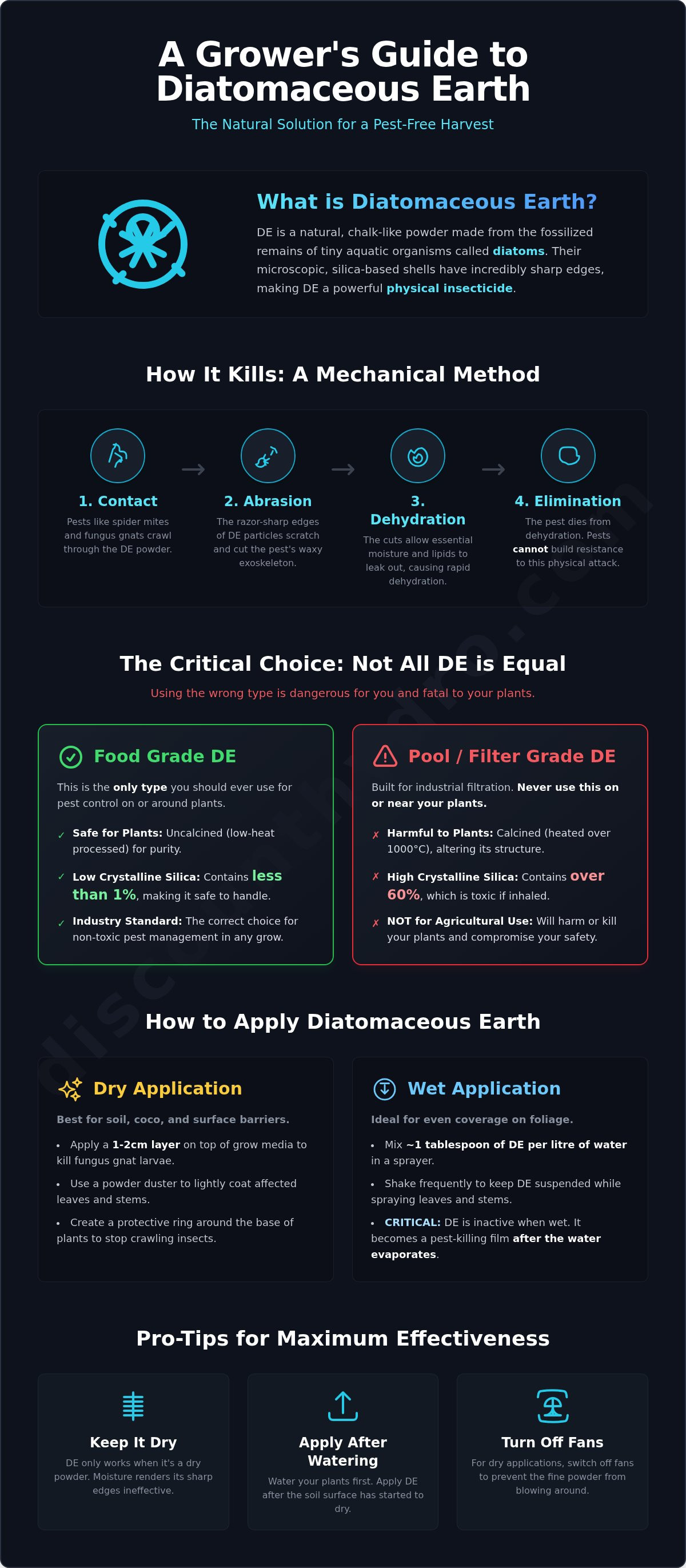
For growers, the value is simple: diatomaceous earth works as a physical insecticide, not a chemical poison. Instead of poisoning pests, its sharp particles stick to an insect's exoskeleton, scratching through the waxy outer layer. This causes the pest to rapidly lose moisture, dehydrate, and die. It's a mechanical method of control that pests cannot develop a resistance to, making it a reliable solution for your grow room or garden.
However, getting the right product is critical. Not all DE is created equal, and using the wrong type is a costly, dangerous mistake. There are two main grades, and only one is safe for your plants.
Food Grade DE: The Only Choice for Your Garden
This is the only type you should ever use for pest control on or around plants. Food Grade diatomaceous earth is uncalcined, meaning it is purified and heated at low temperatures. This process ensures the crystalline silica content remains extremely low (less than 1%), making it safe to handle and apply in your garden, pots, or hydroponic medium. It is the industry standard for effective, non-toxic pest management.
Filter Grade (Pool Grade) DE: Do Not Use On Plants
Filter Grade DE is built for industrial filtration, primarily in swimming pools. It is calcined-heated to over 1000°C-which changes its form and dramatically increases the crystalline silica content to over 60%. This type is toxic if inhaled and will harm or kill your plants. It is not designed for agricultural use and must be avoided at all costs. Always check the label to ensure you are buying Food Grade DE for your grow.
How Diatomaceous Earth Kills Pests (The Mechanical Method)
Forget chemical poisons. Diatomaceous earth works through purely physical action, making it a powerful and cost-effective tool for your grow room. It doesn't poison pests; it kills them mechanically. This method is brutally effective against insects with a waxy exoskeleton but remains safe for your plants, pets, and you when you use food-grade DE correctly. Its strength lies in its simple, reliable structure.
Dehydration: Death by a Thousand Tiny Cuts
Under a microscope, DE particles are revealed to be hollow cylinders with incredibly sharp edges. When a pest like a spider mite or fungus gnat larva crawls through the powder, these sharp edges scratch and scrape away the protective waxy outer layer of its exoskeleton. This physical abrasion is detailed in the Diatomaceous Earth General Fact Sheet from the National Pesticide Information Center. The damage allows essential moisture and lipids to leak out of the insect's body, causing it to quickly dehydrate and die. Because this is a physical attack, not a chemical one, pests cannot build up immunity. It works every time.
Common Pests Targeted by DE
This is your frontline defence against the most common crawling pests in UK grow rooms. For maximum effect, apply it as a dry powder where pests travel or live. It must remain dry to be effective.
- Fungus Gnats: Target the larvae where they live. Apply a 1-2cm layer of DE to the top of your soil or coco coir to kill larvae as they hatch and move through the medium.
- Spider Mites, Thrips, & Aphids: These pests require direct contact. Use a powder duster to apply a very light film to affected leaves and stems. The powder will shred any soft-bodied insects that walk through it.
- Ants, Slugs, & Crawling Insects: Create a protective barrier they won't cross. Sprinkle a line of DE around the base of your plants, pots, or at entry points to your grow tent to stop infestations before they start.
How to Apply Diatomaceous Earth in Your Grow Room: A Practical Guide
To get results from diatomaceous earth, remember one core principle: it must be dry. The microscopic sharp edges that kill pests are only effective when the powder is dry and loose. Applying it is straightforward, and you only need basic tools like a powder duster, shaker, or a simple spray bottle. There are two primary methods for application: dry and wet, each suited for different situations in your grow room.
Dry Application: For Soil and Surface Treatment
This is your go-to method for tackling pests in your growing media. It's highly effective against soil-dwelling insects like fungus gnat larvae and other crawling pests moving across the surface. This direct approach creates a lethal obstacle course for any insect trying to cross it.
- Use a powder duster or a shaker to apply a light, even layer across the top of your soil or coco coir.
- Create a protective barrier by making a ring of powder around the base of each plant stem.
- Lightly dust the lower leaves and stems where pests like to hide and climb.
Wet Application: For Broader Coverage on Foliage
For widespread issues on foliage, a wet application provides excellent, even coverage. While it seems counter-intuitive, this method is ideal for targeting pests like spider mites and thrips. Mix approximately one tablespoon of diatomaceous earth per litre of water in a spray bottle. As The Old Farmer's Almanac notes in their guide on Using Diatomaceous Earth in the Garden, the real power is unleashed once the water evaporates. The powder is inactive when wet, but as it dries, it leaves behind a fine, pest-killing film. Remember to shake the sprayer frequently during application to keep the DE suspended.
Pro Tips for Maximum Effectiveness
Get the most out of every application with these simple rules. Following them ensures the powder works harder for you, saving you time and product.
- Apply After Watering: Always apply DE to a dry surface. Watering or misting will wash away or deactivate the powder, so apply it after the soil has been watered and the surface has started to dry.
- Turn Off Fans: Before any dry application, switch off your oscillating fans. This prevents the fine powder from blowing around your grow room and ensures it settles exactly where you want it.
- Reapply as Needed: Since water deactivates it, you must reapply your protective layer after each watering or heavy foliar spray.
Having the right equipment makes the job faster and more precise. Find the right tools for the job in our accessories section.
Safety Precautions and Best Practices
While diatomaceous earth is a natural and effective tool, using it correctly is crucial for safety and maximum impact. Following these best practices ensures you get the pest control you need without creating new problems for your plants or yourself. Before you begin any application, always start by confirming you have 100% food-grade diatomaceous earth. Never use pool-grade DE in your garden or grow room, as it is chemically treated and toxic if inhaled or ingested.
Personal Protective Equipment (PPE)
Because DE is a very fine dust, protecting yourself during application is essential. It can cause irritation if it gets into your lungs or eyes. We strongly recommend using the following:
- Dust Mask: Always wear a mask to prevent inhaling the fine silicate particles, which can irritate the respiratory system.
- Safety Glasses: Protect your eyes from the abrasive dust, which can cause dryness and irritation.
- Gloves: While not strictly necessary, gloves are a good idea for those with sensitive skin, as DE is a desiccant and can cause dryness.
Considerations for Your Grow System
For hydroponic and soilless growers, it's vital to know where DE does not belong. Never add diatomaceous earth directly into your DWC, NFT, or other hydroponic reservoirs. The fine, abrasive particles will not dissolve and can quickly clog pumps, drippers, and airstones, leading to system failure and nutrient delivery issues. Its use should be restricted to the surface of growing media like coco coir or for dusting plant foliage.
Remember that DE is non-selective; it can harm beneficial insects like predatory mites or ladybirds just as easily as pests. This is less of a concern in a sealed indoor grow room, but for outdoor or greenhouse applications, apply it carefully to avoid areas where beneficials are active. To maintain its effectiveness, store your DE in a sealed, airtight container in a dry location. If it gets wet, it becomes inactive until it dries out completely.
Ready to add this powerful tool to your pest management arsenal? You can find top-quality growing supplies and pest control solutions at discounthydro.com.
Protect Your Harvest with Diatomaceous Earth
You now have the essential knowledge to use one of nature’s most effective pest control solutions. As we've covered, diatomaceous earth offers a powerful, non-chemical defence for your grow room. Its mechanical action physically destroys insects like spider mites, thrips, and fungus gnats on contact, ensuring they can't develop resistance. By following the simple application methods and safety guidelines outlined in this guide, you can confidently integrate this natural mineral into your pest management routine and protect your valuable plants.
Ready to add this essential defence to your toolkit? Shop Food Grade Diatomaceous Earth for fast, natural pest control. At Discount Hydro, we guarantee the best UK prices on all your essential growing supplies. Don't let pests compromise your hard work. We make it easy to get what you need with fast, discreet nationwide delivery, or you can use our convenient click and collect service available from our Durham store.
Take decisive action against pests today and keep your plants thriving.
Frequently Asked Questions About Diatomaceous Earth
Can I mix diatomaceous earth directly into my soil or coco coir?
Yes, mixing it into your growing media is highly effective. It improves the structure of soil or coco coir by increasing aeration and water retention, which helps prevent compaction and allows roots to access more oxygen. For best results, mix it in at a rate of around 1-2% of the total volume of your medium. This one-time application provides long-term benefits to your plant's root zone, boosting overall health and vigour.
How often should I reapply diatomaceous earth?
Reapplication depends entirely on your goal. For top-dressing to control surface pests like fungus gnats, you must reapply after watering or heavy rain, as moisture deactivates its insecticidal properties. A visible dry layer is necessary for it to work. If you have mixed diatomaceous earth into the soil as an amendment, you do not need to reapply; it will remain effective within the medium for the entire grow cycle.
Will diatomaceous earth affect the pH of my soil or nutrient solution?
No, food-grade diatomaceous earth will not significantly impact your pH levels. It is primarily composed of amorphous silica, which is pH neutral. This makes it a safe additive for soil, coco coir, and even hydroponic systems without the risk of causing pH fluctuations. You can add it to your setup with confidence, knowing it won't interfere with your carefully balanced nutrient solution or soil chemistry.
Is diatomaceous earth effective immediately?
It begins working immediately upon physical contact with pests. When a soft-bodied insect like a slug or aphid crawls through the powder, the sharp microscopic particles abrade its waxy exoskeleton. This causes rapid dehydration and death. While it is not an instant kill like a chemical spray, the process starts right away. You will typically see a reduction in pest populations within 24-48 hours of a proper, dry application.
How do I clean up diatomaceous earth after application?
For dry spills or indoor applications, avoid sweeping, as this can kick fine dust into the air. The safest method is to use a vacuum cleaner equipped with a HEPA filter to effectively trap the particles. For outdoor use on non-porous surfaces like patios or paths, you can simply wash it away with a hose. If applied to plant foliage, a gentle spray of water will rinse it off and into the soil below.
Can I use diatomaceous earth on seedlings and clones?
Absolutely. It is an excellent, non-chemical way to protect vulnerable young plants. A light dusting on the soil surface around seedlings and clones creates a protective barrier against pests like fungus gnats and other crawling insects. This is especially useful in propagation environments where high humidity can attract pests. It provides effective protection without stressing the delicate new growth, ensuring a healthier start for your plants.