

Deep Water Culture System: The Ultimate Guide to DWC Hydroponics
Why settle for slow growth when you can cut your vegetative cycle by 25% or more? The deep water culture system is the most efficient method for turning nutrients and electricity into plant biomass. By suspending roots in a highly oxygenated nutrient solution, you trigger explosive growth that traditional media cannot match. It is the fastest route to a high-yield harvest for any serious grower.
Managing a reservoir comes with specific technical challenges. You have likely dealt with the anxiety of root rot during summer heat or struggled with rapid pH fluctuations in smaller setups. These hurdles shouldn't stop you from achieving professional results. Mastering the oxygen-root interface is the key to simplifying your feeding schedule and protecting your root zone from pathogens like Pythium.
This guide provides a direct, technical breakdown of everything required for a successful DWC setup. You will learn how to select the right air pumps, stones, and LED grow lights to maximize your system output. We have simplified the maintenance process so you can focus on explosive results rather than constant troubleshooting.
Key Takeaways
- Understand the mechanics of a deep water culture system and how the "bubbler" concept accelerates plant development.
- Identify the science behind Dissolved Oxygen to eliminate root rot and ensure high-speed nutrient uptake.
- Determine if standard DWC or Recirculating DWC (RDWC) provides the best stability for your specific grow tent dimensions.
- Master the essential setup steps from equipment sterilisation to mixing your first half-strength nutrient solution.
- Optimize your grow room by integrating high-output air stones with LED grow lights for maximum biomass production.
Understanding Deep Water Culture (DWC) Hydroponics
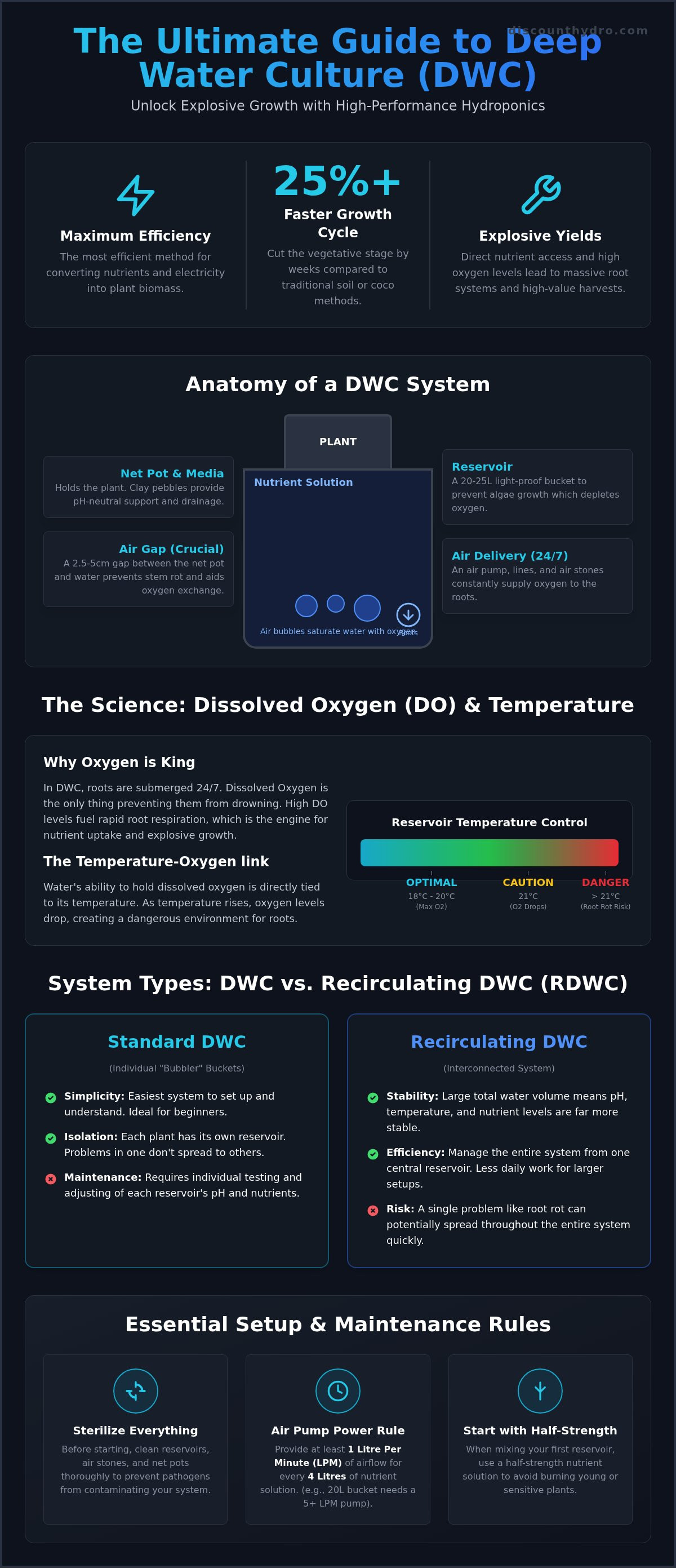
A Deep water culture (DWC) system is a hydroponic method where plant roots stay submerged in a nutrient-rich, oxygenated solution. It's often called a "bubbler" because of the constant air stream required to keep roots from drowning. Unlike traditional gardening, there is no soil to buffer nutrients or hold onto pests. The plant sits in a net pot, and its roots grow directly into the reservoir below. This design provides the most direct path for mineral uptake possible in modern horticulture.
The system relies on the "bubbler" concept to maintain root health. An air pump forces air through porous stones at the bottom of the bucket. These stones break the air into millions of tiny bubbles. As these bubbles rise, they saturate the water with dissolved oxygen. This process is vital. Without high oxygen levels, roots would quickly rot in the standing water. This high-oxygen environment is why a deep water culture system is the preferred choice for high-value indoor crops and fast-maturing leafy greens. It allows for a metabolic rate that soil simply cannot support.
The Components of a DWC Setup
Building an effective system requires specific technical components. You don't need a complex array of pipes, but each part must be high quality to avoid failure.
- Reservoir: Usually a 20-litre or 25-litre bucket. It must be light-proof. Any light entering the water will trigger algae growth, which strips oxygen and clogs air stones.
- Net Pots and Media: These plastic mesh pots hold the plant in place. Clay pebbles are the standard growing media here because they are pH neutral and provide excellent drainage.
- Air Delivery: This includes the air pump, silicone lines, and air stones. The pump must run 24/7 to ensure the roots never starve for oxygen.
The rugged nature of these industrial buckets makes them incredibly versatile for various outdoor applications. If you appreciate the efficiency of using buckets for your grow, you might also be interested in how The Hunger Hub uses a 17-litre bucket to create a portable, all-in-one camping kitchen for outdoor lovers.
Why DWC Outperforms Soil and Coco
DWC offers a level of control that substrate-based growing lacks. Because there's no soil or coco to hold onto minerals, you can change the entire nutrient profile of your plant in minutes by swapping the reservoir water. This prevents nutrient lockout and allows for precision feeding. If you're still learning the basics of soilless cultivation, read our guide on what is hydroponics? to understand the core principles.
Speed is the biggest advantage. Plants in a deep water culture system often finish their vegetative stage weeks earlier than those in soil. The lack of root resistance and the abundance of oxygen lead to massive root masses and explosive top growth. It's an efficient, direct, and highly productive way to grow.
The Science of DWC: Oxygenation and Rapid Root Growth
Dissolved Oxygen (DO) is the engine of any deep water culture system. While soil-grown plants get oxygen from air pockets in the dirt, DWC plants rely entirely on the gas dissolved in the reservoir. High DO levels allow for rapid nutrient uptake and prevent the growth of anaerobic bacteria. Without sufficient oxygen, your plants will effectively drown. Root respiration is the metabolic process where roots consume oxygen to convert stored sugars into the energy required for growth and mineral absorption.
Maintaining DO levels is a constant battle against water temperature. Cold water holds more oxygen than warm water. If your reservoir temperatures rise above 21°C, the water's capacity to hold oxygen drops significantly. This creates an environment where Pythium, or root rot, thrives. Keeping your solution between 18°C and 20°C ensures maximum oxygen saturation and keeps the root zone sterile. It's a technical balance that directly dictates the speed of your harvest.
The Role of Air Pumps and Stones
Your air pump must provide enough volume to keep the solution saturated. A standard rule is to provide 1 litre per minute (LPM) of airflow for every 4 litres of nutrient solution. For a 20-litre bucket, you need a pump rated for at least 5 LPM. Placement is also vital. Position your air stones directly under the root mass to ensure uniform distribution. If you're concerned about noise, place your pumps on a high-density foam mat or hang them from bungee cords to eliminate vibration. You can find a range of quiet, high-pressure air pumps and stones to suit any budget in our shop.
Nutrient Solution Dynamics
Plants in a deep water environment "drink" and "eat" at different rates depending on the environment. On hot days, they transpire more water, which can cause the nutrient concentration (EC) to spike. You must monitor these levels daily to avoid leaf burn. A critical part of this dynamic is the "air gap." You should maintain a space of 2.5cm to 5cm between the bottom of the net pot and the top of the water line. This gap allows the upper roots to pull oxygen directly from the humid air, providing a safety net if your air pump fails. For a deeper look at managing your reservoir chemistry, read our Hydroponic Nutrients Guide for expert mixing tips.
By mastering the oxygen-root interface, you remove the primary bottleneck found in traditional gardening. The result is a deep water culture system that delivers massive yields with a simplified maintenance routine. Success comes down to the quality of your air delivery and the stability of your water temperatures.
DWC vs. RDWC: Which System Fits Your Grow Room?
Choosing the right configuration depends on your available space and the number of plants you intend to manage. A standard deep water culture system consists of independent buckets, each with its own air stone and nutrient solution. This is the most cost-effective entry point for hobbyists. As your garden grows, managing individual reservoirs becomes labor-intensive. Recirculating Deep Water Culture (RDWC) solves this by connecting all buckets to a central reservoir, ensuring every plant receives the exact same nutrient profile.
By 2026, RDWC has become the benchmark for professional indoor setups. It offers a level of automation and stability that standalone buckets cannot provide. While the initial investment is higher, the reduction in maintenance time and the increase in crop consistency provide a clear return on value. If you're running a multi-pot setup, the ability to check pH and EC from a single point is a significant technical advantage.
When to Choose Standard DWC
Standard DWC is the best choice for growers working in compact spaces. If you're using small grow tents, such as a 1.2m x 1.2m footprint, individual buckets allow you to move plants easily. This setup is also ideal for maintaining mother plants or isolating different cultivars that require unique nutrient strengths. It's a low-risk, high-reward method for those just starting with hydroponics.
- Low Entry Cost: Requires only a bucket, net pot, air pump, and nutrients.
- Simplicity: No complex plumbing or water pumps needed.
- Isolation: If one plant develops a root issue, it won't spread to the others.
The Advantages of RDWC Systems
RDWC systems use a "brain" bucket or central reservoir to circulate water through the entire system. This constant movement keeps the nutrient solution oxygenated and prevents stagnant zones. It's the most efficient way to manage large-scale gardens without spending hours testing every individual pot. The increased water volume acts as a buffer, making the system much more stable than single buckets.
- pH and EC Stability: Large volumes of water resist rapid chemistry fluctuations.
- Centralised Control: Mix nutrients and adjust pH in the brain bucket only.
- Temperature Management: RDWC is easy to pair with water chillers to keep the entire system at the optimal 18-20°C range.
Ultimately, your choice should align with your production goals. If you want a simple, high-performance plant in a corner, go with standard DWC. If you're building a high-yield production room, RDWC is the only logical choice for long-term efficiency and stability. Both configurations rely on the same fundamental principles of oxygenation to deliver superior growth rates.
Setting Up and Maintaining Your DWC System
Setting up a deep water culture system requires technical precision to avoid the common pitfalls of soilless growing. Follow this professional workflow for every new cycle. Accuracy during the initial phase prevents metabolic stress later in the bloom stage.
- Step 1: Sterilise. Clean all buckets, lines, and air stones with a 10% bleach solution or food-grade hydrogen peroxide. Pathogens like Pythium thrive in unsterilised environments.
- Step 2: Mix Nutrients. Fill the reservoir and add nutrients at half the manufacturer's recommended strength. Plants in a DWC environment absorb minerals rapidly; full-strength doses often lead to immediate nutrient burn.
- Step 3: Set the Air Gap. Maintain a 2.5cm to 5cm space between the net pot and the water surface. This gap is vital for lateral root development and provides a failsafe for oxygenation.
- Step 4: Daily Monitoring. Check pH and EC every 24 hours. Maintain a pH range of 5.5 to 6.5. If the EC rises while the water level drops, your nutrient concentration is too high.
- Step 5: Weekly Reset. Perform a complete reservoir change every 7 days. This prevents mineral salt buildup and ensures your NPK ratios remain balanced.
Managing UK Water and pH Swings
Much of the UK deals with hard water containing high levels of calcium carbonate. This often causes significant pH instability in a deep water culture system. If your tap water has an initial EC above 0.4, you should use an RO filter or specific "Hard Water" nutrient formulations. This prevents mineral lockout and stops calcium scale from clogging your air stones.
pH drift is a normal phenomenon. As plants absorb nutrients, the chemical balance of the solution shifts. You don't need to intervene if the pH moves by 0.1 or 0.2; only adjust when it drifts outside the 5.5 to 6.5 range. When adding supplements like silicon, always mix them into the water first. Let the solution settle before adding base nutrients to prevent chemical precipitation.
Troubleshooting Common DWC Issues
Root rot is the primary threat in DWC setups. If you notice brown slime on the roots or a swampy odour, your dissolved oxygen levels are too low or your water is too warm. In summer, you must use reservoir insulation or a water chiller to maintain the 18 to 20°C sweet spot. If an air pump fails, you have roughly 4 to 6 hours before the roots begin to suffer permanent damage. Always keep a spare pump on hand for immediate replacement.
Reservoir maintenance shouldn't be a guessing game. You can find professional-grade plant nutrients and supplements at Discount Hydro to help stabilise your pH and prevent mineral deficiencies.
Finding the Best DWC Equipment at Discount Hydro
Sourcing a high-performance deep water culture system doesn't require a premium price tag. We stock the individual components needed to build or maintain your setup, from heavy-duty buckets to high-pressure air delivery systems. Buying components separately often provides better value than pre-packaged kits; it allows you to customise the airflow and reservoir size to your specific room requirements. Our inventory includes affordable air pumps and high-output air stones designed for continuous 24/7 operation.
Success in DWC depends on nutrient stability. We stock Intense Nutrients and Dutch Pro, both of which are engineered for hydroponic environments. These brands offer the pH stability required to prevent the rapid fluctuations common in smaller reservoirs. Using these high-performance mineral salts ensures your roots stay healthy and your growth rates remain high. It's the most reliable way to maintain a clean, productive root zone throughout the entire life cycle of your plants.
To maximise the efficiency of your hydro setup, you should pair it with high-output lighting. Our LED grow lights are the perfect partner for a deep water culture system. The low heat output of modern LEDs helps maintain the 18 to 20°C water temperature necessary for high dissolved oxygen levels. This integration is the standard for professional indoor gardens in 2026, combining metabolic speed with environmental control.
Essential Add-ons for DWC Success
Precision is mandatory in any water-based system. You need digital pH and EC pens to monitor your solution daily. Guessing will lead to nutrient lockout and stunted growth. We also provide light-proof tubing and blacked-out reservoir covers to block all light from the root zone. This is the only way to stop algae growth permanently. Finally, keep a supply of professional cleaning agents for sterilising your buckets and lines between every crop cycle.
Why Shop with Discount Hydro?
We operate as a direct, no-frills supplier of professional-grade hardware. Our focus is on inventory and price, ensuring you get the equipment you need without unnecessary markups. If you're based in the North East, use our click-and-collect service at our County Durham shop for immediate access to stock. For everyone else, we offer fast UK-wide delivery on all orders. Our staff understand UK water conditions and can recommend the right nutrients for your local hard or soft water.
Maximise Your Yield with Professional DWC Hardware
Implementing a deep water culture system is the fastest way to accelerate plant development and achieve professional-grade results. By focusing on the oxygen-root interface and maintaining precise pH levels, you remove the growth bottlenecks found in soil-based gardening. The transition to DWC allows for faster nutrient uptake and significantly reduced vegetative times, provided you maintain strict reservoir hygiene and temperature control.
Reliable equipment is the foundation of any high-performance hydro setup. You need air pumps that run 24/7 and light-proof reservoirs that prevent algae growth. Discount Hydro stocks everything required for a successful grow, from individual components to complete systems. We offer competitive pricing on all professional grow gear, backed by expert local support in County Durham and fast UK-wide delivery for all online orders.
Shop the best value DWC systems and components at Discount Hydro and start your next cycle with the right tools. It's time to stop guessing and start growing with precision.
Frequently Asked Questions
Is DWC better than soil for beginners?
DWC is less forgiving than soil because it lacks a substrate buffer, but it is better for beginners who prioritise rapid growth. In a soil setup, mistakes in pH or feeding take days to show; in a deep water culture system, the plant responds within hours. If you can commit to a strict daily monitoring routine, you will achieve results far superior to traditional potting methods.
How often do I need to change the water in my DWC system?
You should perform a complete reservoir change every 7 to 10 days. This prevents the accumulation of mineral salts and ensures the nutrient ratios remain balanced for optimal uptake. Between changes, top up the reservoir with plain, pH-adjusted water to replace what the plants have transpired. Never let the water level drop below half of the total volume to avoid EC spikes.
What is the ideal water temperature for a DWC reservoir?
The ideal temperature range for your nutrient solution is 18°C to 20°C. Maintaining this range ensures maximum dissolved oxygen levels while inhibiting the growth of harmful pathogens like Pythium. If your water exceeds 21°C, its oxygen-carrying capacity drops, which increases the risk of root rot. Use reservoir insulation or a dedicated water chiller during the summer months to maintain these specifications.
Can I use organic nutrients in a deep water culture setup?
Using thick organic nutrients in a deep water culture system is not recommended because they often clog air stones and promote anaerobic bacterial growth. Organic compounds break down slowly and can create a sludge that coats roots, preventing oxygen absorption. Stick to high-quality mineral-based nutrients, such as Intense Nutrients, which are designed to stay in solution and keep your equipment running efficiently.
How much air do I need for my DWC bucket?
You need approximately 1 litre per minute (LPM) of airflow for every 4 litres of nutrient solution. For a standard 20-litre bucket, a pump providing at least 5 LPM is the technical minimum. Providing more air is always beneficial, as it is impossible to over-oxygenate the water. Ensure your air stones are high-porosity to create the fine mist of bubbles necessary for optimal root respiration.
Why are my plants wilting in a DWC system even though they have plenty of water?
Wilting usually indicates that the roots cannot breathe, even though they are submerged in liquid. This happens when dissolved oxygen levels are too low or when root rot has already set in, physically blocking nutrient and water uptake. Check your air pump for failure and inspect the roots for brown slime or a swampy odour. If the roots are damaged, they cannot process water regardless of the reservoir volume.
Do I need to leave the air pump running 24/7?
Your air pump must remain operational 24 hours a day without exception. Roots in a DWC setup have no access to air pockets and rely entirely on the bubbles produced by the stones to survive. Even a few hours of downtime can cause oxygen starvation, leading to permanent root damage or total plant loss. Always keep a backup pump in your inventory to handle mechanical failures immediately.
To ensure your 24/7 systems never lose power, especially if you're looking for sustainable backup options, visit MacSell Solar Outlet for high-end solar hardware that can provide a reliable energy source for your air pumps.
What is the best pH level for DWC hydroponics?
The optimal pH range for DWC is 5.5 to 6.5, with 5.8 to 6.2 being the ideal target for most mineral uptake. Keeping the solution within this range ensures that all essential micro and macro nutrients remain chemically available to the plant. If the pH drifts outside these parameters, certain minerals will become locked out, leading to visible deficiencies and stunted growth rates.