

Diagnosing Sick Plants Chart: A Complete Indoor & Hydroponic Guide
Most "sick" plants aren't actually dying from a mysterious disease; they're suffering from basic system imbalances that are easy to fix if you know what to look for. It's frustrating to watch an indoor garden fail while you guess whether the issue is too much water or a specific nutrient deficiency. Many growers waste money on the wrong supplements because they lack a clear starting point for troubleshooting. We've developed this diagnosing sick plants chart to remove the guesswork and provide a technical solution to prevent total crop failure.
You need a fast, accurate diagnosis to protect your investment and ensure your hydroponic or soil system runs efficiently. This guide identifies exactly what's killing your plants and how to fix it using our comprehensive visual diagnosis tool. We provide a step-by-step recovery plan and the knowledge to prevent these issues from returning. The following analysis covers the critical differences between mobile and immobile nutrient symptoms, environmental stressors, and the specific actions you can take to get your grow back on track immediately.
Key Takeaways
- Identify the difference between chlorosis and necrosis to determine if your plant is lacking nutrients or suffering from permanent tissue damage.
- Apply the "Location Rule" using our diagnosing sick plants chart to see if symptoms on old or new growth indicate mobile or immobile nutrient issues.
- Distinguish between environmental stressors like light burn and actual nutrient deficiencies to stop wasting money on unnecessary additives.
- Implement a technical 5-step recovery protocol that prioritizes pH and EC testing to stabilize your hydroponic or indoor system quickly.
- Learn which precision tools and high-quality mineral supplements are required to prevent future imbalances and ensure long-term plant health.
The Visual Diagnosis: How to Read Your Plant’s Symptoms
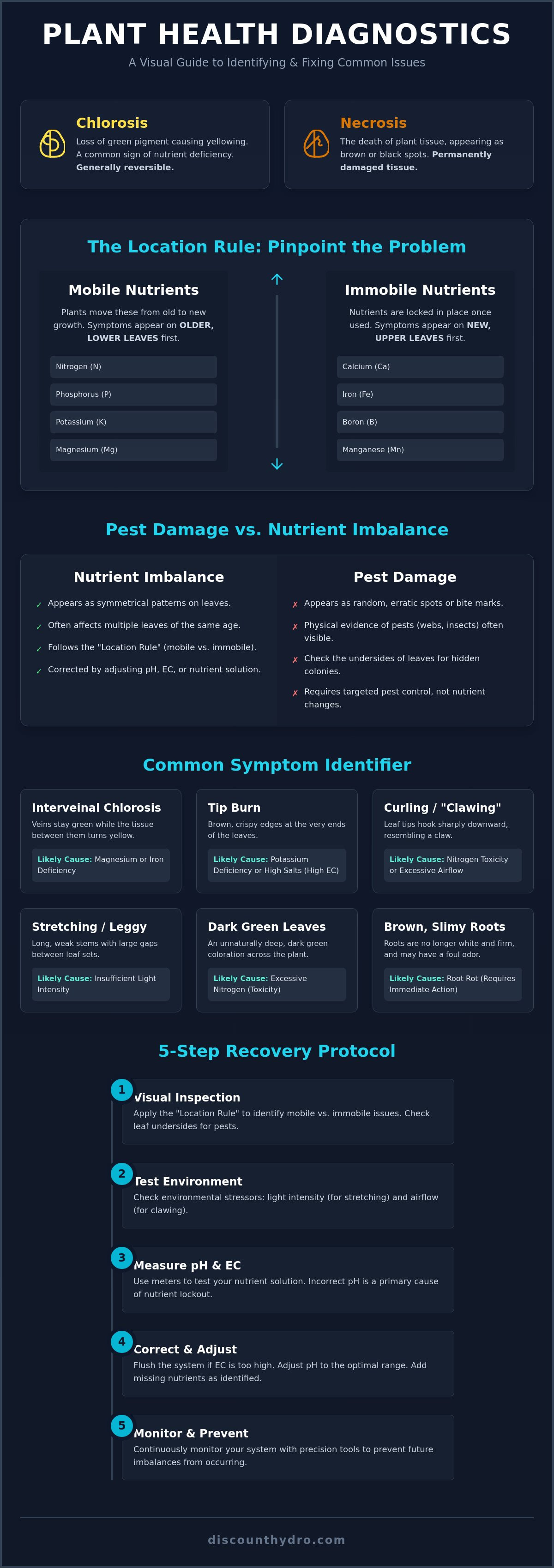
The leaves of your plants function as the primary diagnostic interface for any indoor garden. They act as "engine lights" that signal internal failures before the entire crop is lost. By utilizing a technical diagnosing sick plants chart, you can decode these signals with precision. The two most critical terms to identify are chlorosis and necrosis. Chlorosis is the loss of green pigment, often indicating that the plant's nutrient uptake is hindered. This is frequently a symptom of Physiological plant disorders rather than a biological disease. Necrosis, conversely, is the actual death of plant tissue. While chlorosis is reversible through system adjustments, necrotic tissue is permanently damaged.
Distinguishing between pest infestations and nutrient imbalances is vital for choosing the right corrective action. Nutrient issues typically present as symmetrical patterns across multiple leaves of the same age. Pest damage, such as that from spider mites or thrips, appears as random, erratic spots or bite marks. Always perform a physical inspection of the leaf undersides. Hidden colonies often thrive there long before the top of the leaf shows signs of distress. Early detection prevents a minor imbalance from escalating into a total system failure.
Leaf Discolouration Patterns and What They Mean
Interveinal chlorosis is a specific visual marker where the veins stay green but the surrounding tissue turns yellow. This is a classic indicator of Magnesium or Iron deficiency. Tip burn appears as brown, crispy edges at the very ends of the foliage. This often signals Potassium deficiency or a high salt concentration in the growing media. Stippling, which looks like tiny white or yellow dots, is frequently confused with Manganese deficiency. However, if the dots are erratic, it's likely a pest issue rather than a mineral imbalance. Use your diagnosing sick plants chart to compare these patterns against your current crop status.
Growth Habits as Diagnostic Signals
The physical structure of the plant provides additional data points. Leggy or "stretching" growth is a direct result of insufficient light intensity from your LED system. The plant is physically reaching for energy, which weakens the stem. Curling or "clawing" leaves, where the tips hook downward, are primary indicators of Nitrogen toxicity or excessive airflow from fans. In hydroponic systems, abnormal root growth is the most dangerous signal. Healthy roots are white and firm; if they appear brown, slimy, or emit an odour, you're dealing with root rot that requires immediate intervention.
Nutrient Deficiency vs. Toxicity: A Comprehensive Comparison Chart
Successful troubleshooting starts with the "Location Rule." This rule dictates that you must look at where the symptoms first appear to identify the missing element. A diagnosing sick plants chart is only effective if you understand nutrient mobility. Mobile nutrients, including Nitrogen, Phosphorus, Potassium, and Magnesium, are the plant's flexible assets. When the root zone lacks these elements, the plant scavenges them from its oldest, lowest leaves to keep the new growth alive. This is why Nitrogen deficiency always starts at the bottom. If you see yellowing at the top of the plant first, it isn't a mobile nutrient issue.
Immobile nutrients like Calcium, Iron, and Boron are fixed in place once absorbed. The plant cannot move them to new leaves. Consequently, if the nutrient solution is lacking, the new growth will emerge stunted or discoloured while the old leaves look perfectly healthy. For a deeper look at these visual markers, refer to this Illustrated Glossary of Plant Symptoms. It provides a technical breakdown of how these physiological shifts manifest across different species. Identifying the location of the damage immediately narrows your search from dozens of possibilities to just a few likely candidates.
Toxicity is the opposite problem but just as common in high-performance indoor grows. Many growers assume that adding more minerals will result in faster growth, but "more is not better" in a closed system. Excessive Nitrogen causes deep, unnaturally dark green leaves and "clawing," where the leaf tips curve downward like a bird's talon. Overfeeding leads to high salt levels in the growing media, which eventually causes "nutrient lockout." This happens when one element is so overabundant that it physically blocks the plant from absorbing others. If your plants show these signs, it's time to flush the system and reset with balanced plant nutrients and supplements.
Primary Macronutrient Deficiencies (N-P-K)
Nitrogen is the most common deficiency. It presents as a uniform fading of green to light yellow on the oldest leaves. Growth slows down as the plant lacks the building blocks for protein. Phosphorus deficiency is harder to spot; look for stunted growth and a dark, bluish-green tint on the leaves. In severe cases, the stems or leaf undersides may turn purple. Potassium deficiency shows up as "firing" or scorching on the leaf margins. The edges turn brown and crispy while the center remains green, which can be confused with light burn if you aren't careful.
Secondary and Micronutrient Imbalances
Calcium deficiency is a major concern in hydroponics. It causes the growing tips to die back and new leaves to come out twisted or crinkled. Magnesium deficiency creates a distinctive "tiger stripe" look known as interveinal chlorosis. The veins stay dark green while the rest of the leaf turns yellow, starting from the bottom of the plant. Iron and Zinc issues both cause yellowing on new growth. Iron deficiency leaves the veins green, whereas Zinc deficiency often results in "resetting," where the distance between leaf nodes becomes extremely short, creating a bunched-up appearance.
Environmental Stressors: When the Problem Isn’t Nutrients
Environmental factors often mimic nutrient deficiencies, leading many growers to add supplements that actually make the problem worse. If your climate isn't dialed in, a diagnosing sick plants chart might point to a mineral issue when the real culprit is your light height or room temperature. Unlike nutrient deficiencies, which usually follow the "Location Rule," environmental stress often affects the entire plant or specific areas closest to the stress source. For a systematic approach to ruling out these variables, consult this 10-Step Guide to Diagnosing Plant Problems. This resource helps you differentiate between pathogenic diseases and abiotic stressors like heat or wind.
Wind burn is a frequently overlooked issue in indoor tents. While airflow is necessary to prevent stagnant air, high-velocity fans pointed directly at foliage damage the leaf cuticles. This causes the leaves to curl inward or develop "claws," which many growers mistake for Nitrogen toxicity. Similarly, Vapour Pressure Deficit (VPD) dictates how your plants "breathe." If the humidity is too high or the temperature is too low, the plant's stomata close. This stops the transpiration stream, meaning the plant cannot pull water or nutrients up from the roots, regardless of how much food is in the reservoir.
Lighting and Heat Issues
High-intensity LED grow lights provide excellent yields but can cause light bleaching if placed too close to the canopy. Bleaching looks like a localized Nitrogen deficiency, where the top leaves turn white or pale yellow while the rest of the plant remains green. Heat stress often accompanies light intensity, triggering the "Taco" effect. This is where leaf edges curl upward to create a pocket of moisture and reduce surface area exposed to the heat. Use a digital thermometer and hygrometer at the canopy level, not just on the wall, to get accurate readings of the microclimate your plants actually experience.
The Role of pH and Nutrient Lockout
Nutrient lockout is the primary cause of "sickness" in hydroponics. It occurs when the pH of your nutrient solution drifts outside the optimal range, causing minerals to become chemically unavailable. Even if your reservoir is full of high-quality minerals, the plant cannot absorb them if the pH is wrong. For most hydroponic systems, the ideal range is 5.5 to 6.5. A pH swing of just 0.5 can completely lock out essential micronutrients like Manganese or Zinc. Before you spend money on more supplements, check your pH; fixing a drift is the fastest way to resolve symptoms that look like complex deficiencies on a diagnosing sick plants chart.
The 5-Step Protocol for Diagnosing and Fixing Sick Plants
A systematic approach is required to move from identifying a problem on a diagnosing sick plants chart to implementing a cure. Guesswork leads to wasted supplements and further stress. Follow this technical protocol to isolate variables and stabilize your system. Start by checking the pH of your reservoir or runoff immediately. In hydroponics, a drift outside the 5.5 to 6.5 range is the most common cause of sudden "sickness." If the pH is correct, move to a physical inspection. Use a 60x loupe or microscope to check the leaf undersides and stems for mites, thrips, or fungus gnats. Pests often create damage that mimics trace mineral deficiencies.
The third step involves evaluating your hydroponic nutrients dosage. Measure the Electrical Conductivity (EC) or Parts Per Million (PPM) of your solution. If the EC is rising while the water level drops, your plants are telling you the concentration is too high. Step four requires an environmental audit. Verify that your LED height provides the correct light intensity and that your VPD is within the target range for the current growth stage. If these steps don't reveal a clear cause, step five is the "nuclear option": flush the system. This removes salt buildup and resets the root zone chemistry.
How to Perform a Proper Flush
Flushing isn't just about watering. Use pH-balanced water at a volume three times the size of your container. For example, a 5-gallon pot requires 15 gallons of water to effectively clear the media. Monitor the EC of the runoff water as it exits the pot. You're finished when the runoff EC matches the EC of the water you're pouring in. Using a dedicated flushing agent can speed up this process by breaking down mineral salts more effectively than plain water alone.
Reintroducing Nutrients Safely
Don't return to full-strength feeding immediately after a flush. Reintroduce nutrients at half-strength to avoid osmotic shock to the roots. Many recovery plans start with a "cal-mag" supplement to stabilize the plant's internal structure before adding heavy N-P-K loads. Track the newest growth only. Old leaves won't recover from necrosis or severe chlorosis, so look for vibrant green tissue at the top of the plant to confirm your fix is working. To ensure you have the right technical equipment for these steps, browse our selection of precision pots, trays, and systems.
Essential Supplies for Preventing and Curing Plant Ailments
Once you've identified the issue using a diagnosing sick plants chart, you need the right hardware to execute a fix. Precision is the difference between a recovered harvest and a total loss. Digital pH and EC pens are the most critical investments for any indoor grower. These tools allow you to monitor the nutrient solution with laboratory accuracy, ensuring you never drift into the lockout zones described in the previous sections. High-quality hydroponic nutrients and mineral supplements provide the baseline for health, but monitoring equipment ensures those minerals actually reach the root zone. Without accurate data, you're just guessing.
Pest management requires immediate, aggressive action. Outbreaks of spider mites can destroy a canopy in days if left unchecked. Beyond chemical or biological controls, maintaining a stable environment is your best defense. Professional-grade grow tents and high-velocity fans prevent the stagnant, humid conditions that pests and fungal pathogens thrive in. A controlled climate reduces the physiological stress that makes plants vulnerable to attack. Proper light-proofing and ventilation also ensure that your LED system works at maximum efficiency without causing the heat issues discussed earlier.
Monitoring Tools for Success
Digital pH testers provide instant, numerical data that liquid test kits simply cannot match. For growers managing large reservoirs, this speed is essential for maintaining stability. An infrared thermometer is another high-value tool. It measures leaf surface temperature rather than just ambient air, which is vital for calculating VPD accurately and adjusting your LED height. A simple jeweller’s loupe is the final piece of the kit. It allows for early detection of pests like thrips or fungus gnats before they become a visible infestation that requires a full system flush.
Corrective Supplements
Cal-Mag additives are the industry standard for resolving the most common secondary nutrient deficiencies identified on your diagnosing sick plants chart. Silicon supplements are equally important for long-term resilience. Silicon strengthens cell walls, making plants more resistant to heat stress, drought, and physical damage from fans. For root health, beneficial bacteria and mycorrhizae prevent and cure root rot by outcompeting harmful pathogens in the reservoir or growing media. These supplements, combined with technical monitoring, give you a complete toolkit for managing any indoor growth issue.
Restore Your Grow Room Performance Today
Using a professional diagnosing sick plants chart provides the technical data needed to stop guessing and start fixing. Identifying whether a symptom is a mobile nutrient deficiency or an environmental stressor like light burn is the first step toward recovery. Implementing a systematic 5-step protocol ensures you address root causes rather than just masking symptoms with unnecessary additives. Precision monitoring and the right chemical balance are the only ways to guarantee a successful harvest and prevent future system failures.
Maintaining a stable indoor environment requires high-quality mineral supplements and reliable hardware. We stock expert-selected brands like Intense Nutrients and Dutch Pro to ensure your system remains balanced. We offer UK-wide fast delivery to get your recovery plan started immediately. If you're local, click-and-collect is available at our County Durham location for even faster service. Don't let a minor imbalance lead to a total crop loss.
Browse our range of professional Plant Nutrients and Supplements at Discount Hydro to secure the health of your next harvest. Your plants can recover if you act quickly with the right tools.
Frequently Asked Questions
Why are my plant leaves turning yellow at the bottom?
Yellowing at the base typically indicates a Nitrogen deficiency. Because Nitrogen is a mobile nutrient, the plant scavenges it from older, lower leaves to support new growth at the canopy. Check your diagnosing sick plants chart to confirm if this pattern matches your specific species. Increasing the concentration of your base nutrients usually resolves this issue if your reservoir pH is within the correct range.
How do I tell the difference between overwatering and underwatering?
Overwatered plants have firm, heavy-feeling leaves that droop because the roots are suffocating from a lack of oxygen. Underwatered plants have thin, limp, and papery leaves that sag because the cells have lost turgor pressure. Lift your pots to check the weight; a heavy pot suggests overwatering, while an exceptionally light pot confirms the media is too dry and needs immediate saturation.
What is nutrient lockout and how do I fix it?
Nutrient lockout occurs when the pH of your growing media or reservoir drifts outside the optimal range, making minerals chemically unavailable to the plant. Even if your solution is full of food, the plant cannot absorb it. Fix this by flushing your system with pH-balanced water to remove salt buildup and then reintroducing a balanced nutrient solution at half-strength to stabilize the root zone.
Can I save a plant that has root rot?
You can save a plant from root rot if the damage hasn't affected the entire root mass. Immediately treat the system with beneficial bacteria or a specialized root zone cleaner to kill the pathogens. Increase oxygenation in your reservoir using larger air stones and ensure your water temperature stays below 21 degrees Celsius to prevent the rot from returning and spreading to healthy tissue.
Why are the tips of my plant leaves brown and crispy?
Brown, crispy tips are usually a sign of "nutrient burn" caused by an excessively high Electrical Conductivity (EC) level in your solution. This happens when the plant pulls in more minerals than it can process, leading to salt accumulation in the leaf tips. If the browning moves along the leaf edges, it might indicate a Potassium deficiency instead. Lower your nutrient concentration immediately to stop the progression.
Does the pH of my water really matter that much?
The pH level is the most critical variable in hydroponic success because it directly controls nutrient solubility. Most minerals are only available for uptake within a narrow window of 5.5 to 6.5. If your pH is off by just 0.5, you will see symptoms on a diagnosing sick plants chart that look like deficiencies but are actually caused by the pH being too high or too low.
How do I identify spider mite damage vs. a nutrient deficiency?
Spider mite damage appears as tiny, random yellow or white dots, known as stippling, on the leaf surface. Nutrient deficiencies usually follow symmetrical patterns along the veins or leaf edges. Use a 60x loupe to inspect the underside of the leaves for moving specks or fine webbing. Nutrient issues won't show physical bite marks or debris on the foliage, allowing for a clear distinction.
What should I do if I accidentally overfed my plants?
If you accidentally overfeed, you must flush the growing media immediately with plain, pH-balanced water. Use a volume of water equal to three times the size of your pot to wash out the excess mineral salts. Monitor the EC of the runoff to ensure it drops to a safe level before you resume a regular feeding schedule at a significantly lower concentration to avoid further stress.