

Grow Room Automation Ideas: The 2026 Guide to Hands-Free Indoor Gardening
What if you could leave your garden for a week and return to a healthier crop than when you left? You already know the stress of manual watering and the fear that a sudden heat spike or humidity drop will ruin your hard work while you're away. Implementing the right grow room automation ideas is the most effective way to stop worrying about environmental swings and start focusing on high-efficiency results. Human error in nutrient dosing or equipment failure is costly, but modern technology allows you to maintain a professional setup without the constant manual grind.
This guide highlights how to transform your indoor garden into a high-efficiency system that boosts yields while reducing manual labor. You'll learn how to achieve consistent VPD levels and lower electricity bills through precision lighting and climate control. We'll show you how to gain peace of mind with remote alerts and AI-assisted monitoring. This 2026 guide ensures you can build a reliable, hands-free environment that maximizes crop quality. Discover the specific hardware needed for a professional, automated setup.
Key Takeaways
- Stabilize your environment to prevent yield-killing fluctuations while reducing energy costs through smart light and fan scheduling.
- Sync your extraction fans and LED lighting to maintain perfect VPD levels automatically without the need for manual adjustments.
- Explore practical grow room automation ideas for setting up self-regulating drip irrigation and precise nutrient dosing systems.
- Gain peace of mind with remote monitoring tools that send instant mobile alerts for temperature spikes or equipment failures.
- Prioritize your automation budget by focusing on high-impact environmental controls first to maximize immediate efficiency and crop quality.
Why Grow Room Automation is Essential for 2026 Success
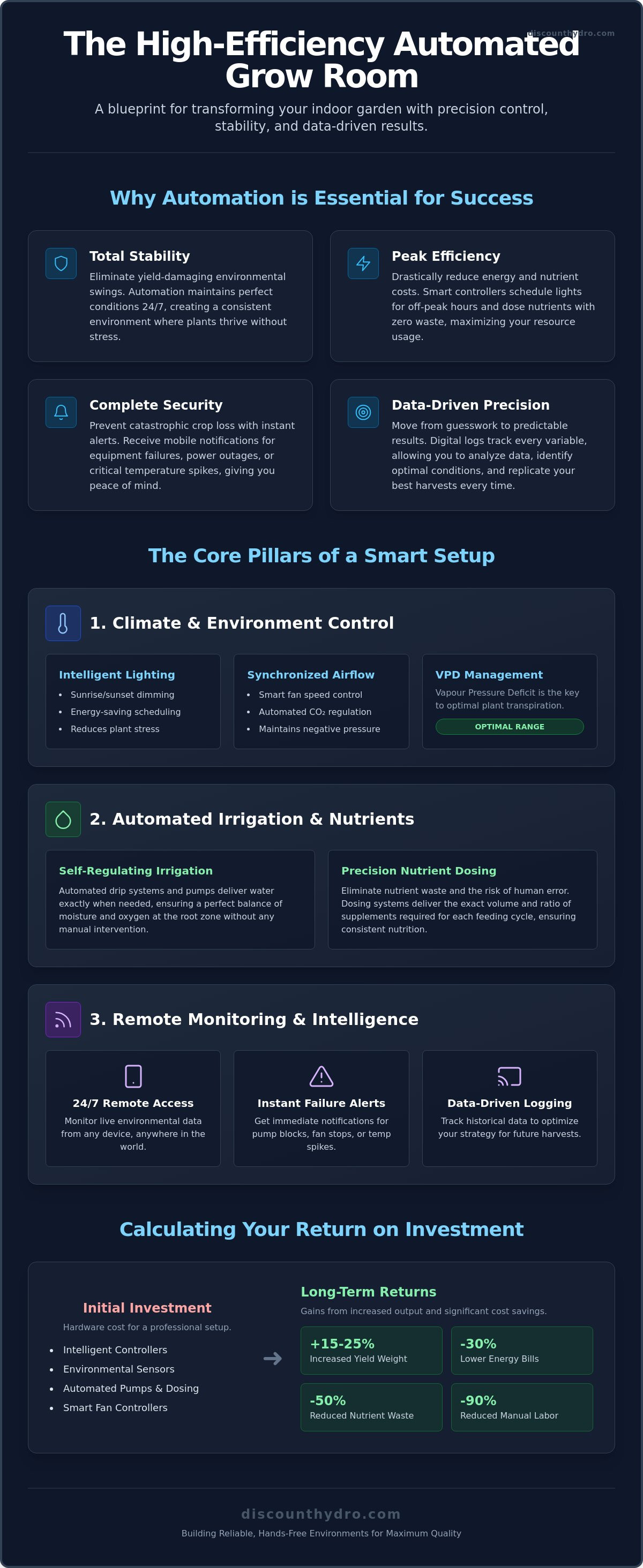
High-performance gardening in 2026 relies on precision rather than guesswork. Manual adjustments cannot compete with the 24/7 monitoring provided by modern systems. Stability is the primary driver of harvest quality. Plants thrive on consistency; even minor fluctuations in temperature or humidity can stall growth and reduce final weight. Implementing grow room automation ideas allows you to maintain a perfect environment without constant physical presence. By following the principles of Controlled-environment agriculture, you ensure that every variable is locked within the optimal range for your specific crop.
Efficiency is a major concern for UK growers facing high electricity rates. While automation manages consumption, comparing commercial energy rates through Green Compare can provide additional savings on your baseline costs. Automation allows you to manage energy consumption with surgical precision. Smart fan controllers reduce motor speed when temperatures are low, significantly cutting power usage. You can also schedule high-intensity activities to match off-peak energy tariffs. Risk mitigation is another core benefit. Fail-safes and real-time alerts prevent total crop loss from equipment failure. If a pump blocks or a fan stops, you receive a notification immediately. Finally, automation provides data-driven growth. Digital logs track every environmental change, allowing you to identify exactly what caused your most successful harvests so you can repeat those results every time.
The Shift from Timers to Intelligent Controllers
Basic mechanical timers are no longer sufficient for modern high-output setups. They are prone to failure and cannot react to changing conditions inside the room. Digital controllers manage multi-stage growth cycles by adjusting light intensity and airflow based on live sensor data. These systems are essential for managing modern LED heat signatures and humidity spikes. Specialized hydroponics systems benefit from millisecond precision in pump timing. This ensures roots receive the perfect balance of moisture and oxygen, which is impossible to achieve with manual watering or simple analog clocks.
Calculating the ROI of Your Automation Setup
The return on investment for automation comes from both savings and increased output. Precision dosing systems eliminate nutrient waste by delivering the exact volume required for each feed. This reduces your long-term spend on supplements and additives. You can also lower electricity bills by using controllers to dim led grow lights during peak tariff hours or when plants are at a younger stage. ROI in automation is the balance between hardware cost and increased yield weight. By investing in these grow room automation ideas, you reduce manual labor hours and minimize the risk of expensive human errors.
- Stability: Eliminate yield-killing environmental swings.
- Efficiency: Lower UK energy bills with smart scheduling.
- Security: Prevent crop loss with instant mobile alerts.
- Precision: Use digital logs to refine your growing strategy.
Automating the Environment: Air, Light, and VPD
Managing a grow room environment requires more than just basic timers. Advanced grow room automation ideas focus on the synergy between lighting and climate. Modern LED systems now support sunrise and sunset dimming. This feature mimics natural light transitions, which reduces plant stress and prevents sudden temperature spikes when lights switch on. Integrating these cycles with your ventilation system ensures that your plants remain in a stable state throughout the 24-hour period. It's a pragmatic way to ensure your hardware works for you rather than against you.
Effective climate control involves synchronizing your extraction fans with precise temperature and humidity sensors. For those using high-intensity lighting, CO2 injection is another critical variable to automate. In sealed rooms, automated regulators maintain gas levels to ensure plants can process the increased light energy. Odour management also benefits from automation. Smart speed controllers adjust fan output to maintain constant negative pressure. This prevents smells from escaping while ensuring a steady flow of fresh air. It's about maintaining total control over every cubic centimetre of your space.
The Importance of VPD Automation
Vapour Pressure Deficit (VPD) measures the difference between the moisture in the air and how much moisture the air can hold. It's a vital metric because it dictates how well your plants transpire. Integrated controllers use live sensor data to adjust your humidifier or dehumidifier based on current room temperatures. Maintaining the correct VPD prevents issues like spider mites and mould, which thrive in stagnant or poorly regulated environments. Research from Cornell's Controlled Environment Agriculture program highlights that precision in these variables is essential for professional-grade success.
Smart Extraction and Ventilation
Choosing the right hardware is the first step toward a hands-free setup. EC (Electronically Commutated) fans are superior to traditional AC fans for automation. EC fans allow for precise digital speed adjustments without the humming or motor wear associated with older technology. Linking your extraction system to a grow tent sensor hub allows the fans to react instantly to heat spikes. Automating your intake fans ensures optimal fresh air exchange, keeping CO2 levels naturally replenished. If you're looking to upgrade, you can find a wide range of compatible ventilation controllers and EC fans at competitive prices.
Using these grow room automation ideas helps you move beyond basic on/off schedules. You create a responsive ecosystem that protects your crop from environmental stress. This level of control is what separates standard results from high-efficiency yields.
Automated Irrigation and Nutrient Management
Watering by hand is often the most labor-intensive part of indoor gardening. Implementing smart grow room automation ideas for irrigation allows you to step away from the daily grind of manual feeding. Automated systems ensure your plants receive water and nutrients at the exact moment they need them. You can choose between a run-to-waste system, which delivers fresh solution for every feed, or a recirculating system that maximizes water efficiency. Both methods rely on a central reservoir where stability is key. Using float valves ensures your tank stays topped up automatically, while water chillers prevent the heat from your lights from raising reservoir temperatures to dangerous levels.
Moisture sensors represent the next level of irrigation control. Instead of watering based on a simple clock, these sensors trigger your pump only when the growing media reaches a specific dry-back percentage. This approach mimics natural cycles and prevents the root rot associated with overwatering. It's a pragmatic way to ensure your plants are never sitting in stagnant water or drying out completely. By automating the delivery of your hydroponic nutrients, you eliminate the risk of human error in mixing and timing.
Step-by-Step: Setting Up an Auto-Feed System
Building a reliable auto-feed system starts with selecting the right pump and manifold for your tent size. A high-quality submersible pump provides the pressure needed to clear drip emitters without clogging. You should integrate a digital timer or a smart plug to create precise feeding windows, sometimes as short as one minute. It's important to recognize that some nutrients behave differently in automated lines. Organic-based additives can often block small drippers, so using clean-running mineral formulas is usually the best choice for hands-free setups. This ensures your lines stay clear and every plant receives an equal share of the solution.
pH and EC Monitoring
The biggest risk in automated irrigation is pH drift. In a stagnant reservoir, the pH level can shift rapidly, leading to nutrient lockout and stunted growth. Automated pH controllers act as a "set and forget" tool by constantly monitoring the water and dosing small amounts of pH adjuster to keep the solution within the ideal range. This level of precision is a core component of Controlled Environment Agriculture, where every variable is managed for maximum output. EC monitoring prevents nutrient burn by ensuring the solution strength never exceeds the plants threshold. By keeping these two metrics stable, you create a perfect environment for rapid, healthy growth without needing to check your reservoir every few hours.
- Drip Irrigation: Precision delivery directly to the root zone.
- Float Valves: Automatic reservoir refills to prevent pump damage.
- Moisture Sensors: Demand-based watering for better root health.
- pH Controllers: Constant monitoring to prevent nutrient lockout.
Remote Monitoring and Smart Hubs
You don't need to be in the room to know exactly what's happening inside it. Remote monitoring is the final piece of the puzzle for many grow room automation ideas, allowing you to view live statistics from your phone anywhere in the UK. WiFi-enabled controllers connect your lights, fans, and pumps to a single digital interface. This removes the need to check multiple analog dials or manual sensors. If a heat spike occurs or a reservoir leak is detected, the system sends an immediate push notification to your device. This rapid response time is what prevents minor equipment failures from becoming total crop disasters.
Integrated hubs simplify your workflow by consolidating all controls into one app. You can adjust light intensity or fan speed with a few taps. Security is also improved through the use of smart cameras. These allow you to visually check plant health and leaf posture without opening the tent and disrupting the environment. It's a pragmatic approach to management that prioritizes your time and the safety of your investment. To get started with these systems, browse our smart hub and controller range for high-performance options at competitive prices.
Plug-and-Play vs Custom Built
Beginners usually benefit from all-in-one, plug-and-play controllers. These devices are designed to work out of the box with specific brands of fans and lights. As you gain experience, you might move to modular setups using independent sensors and smart plugs for more granular control. One practical tip is to check your WiFi signal strength before finalizing your setup. Foil-lined grow tents act as Faraday cages and can block signals. You may need a hardwired connection or a signal booster placed close to the tent to ensure your hub stays online 24/7.
Data Logging for Continuous Improvement
The real power of a smart hub lies in its ability to record history. Data logging creates weekly charts that help you identify environmental bottlenecks you might miss during a quick daily check. If you notice a consistent humidity spike every time the lights go off, you can adjust your extraction schedule to compensate. These logs are essential for troubleshooting slow growth or recurring leaf issues. Many professional growers also share this data with peers to refine their environmental "recipes." By analyzing these trends, you move away from guesswork and toward a repeatable, high-yield strategy.
- Instant Alerts: Get notified about high temps or leaks immediately.
- Visual Checks: Use smart cameras to monitor health without opening the tent.
- Unified Control: Manage lights, fans, and pumps from one app.
- Signal Reliability: Use boosters to overcome foil-tent interference.
Implementing Automation with Discount Hydro Hardware
Building an automated room shouldn't be a financial burden. Successful grow room automation ideas start with smart budget prioritization. If you're working with limited funds, automate your lighting first. Lights are the engine of your garden and require the most consistency. Ventilation is the next priority to ensure environmental stability. Finally, automate your irrigation once your air and light cycles are locked in. This hierarchy ensures you get the highest return on investment from your hardware upgrades. We stock a range of high-value LED controllers and fan speed dial-ins designed to deliver professional results without the premium price tag.
A starter automation kit is the most cost-effective way to manage small grow tents. By combining a reliable digital controller with an EC fan, you can maintain perfect negative pressure and temperature levels 24/7. This setup eliminates the need for manual monitoring and reduces the risk of human error. Our team provides expert advice on compatible components and offers UK-wide delivery on all automation hardware. You get the technology you need to scale your garden efficiently and reliably.
The "Budget Professional" Setup
You don't need the most expensive gear to achieve pro-level results. The "Budget Professional" approach involves pairing high-output, value-driven LED lights with intelligent smart controllers. This combination gives you the same dimming and scheduling capabilities as high-end commercial systems. Essential monitoring tools like digital pH pens and EC meters are also vital. These allow you to verify that your automated dosing systems are performing correctly. We focus on reliable, no-frills hardware that lasts, ensuring your investment pays off through multiple successful harvests.
Next Steps for Your Automated Garden
Testing your system is critical before leaving your room unattended. Trigger your fail-safes manually to ensure fans ramp up and alerts reach your phone. Maintenance is also a requirement for long-term success. Sensors and probes need regular attention to stay accurate. Temperature and RH probes should be calibrated every 90 days, while CO2 sensors require a check every six months. Keep your sensors clean and free from mineral build-up to prevent false readings. Visit our Chester-le-Street store or browse online for the latest 2026 grow room automation ideas and technology. We provide the pragmatic tools needed for a truly hands-free garden.
- Prioritize: Automate Lights > Air > Water for the best ROI.
- Monitor: Use pH and EC meters to verify your automated feeds.
- Maintain: Calibrate probes every 90 days to ensure accuracy.
- Test: Always verify fail-safes before leaving the system alone.
Start Growing Smarter and Faster
Automation provides the precision needed to eliminate environmental swings that threaten your crop. You've seen how syncing lighting and ventilation maintains perfect VPD levels while sensor-driven irrigation prevents the risks of manual overwatering. These systems protect your investment and maximize final yield weight by maintaining total stability 24/7. Moving to a hands-free setup isn't just a luxury; it's a pragmatic choice for any grower looking to reduce labor and lower energy costs.
Implementing these grow room automation ideas is the most effective way to scale your indoor gardening success in 2026. We've been providing expert advice since 2010 and offer competitive pricing on top-tier LED controllers, EC fans, and environmental hubs. Upgrade your garden with the latest automation hardware at Discount Hydro and take advantage of our fast UK-wide delivery. Secure your garden's future and start enjoying the benefits of a professional, automated setup today. You'll have more time and better results with the right hardware in place.
Frequently Asked Questions
Is grow room automation expensive to set up?
Automation costs vary depending on the complexity of the hardware you choose. You can start with basic digital controllers for lights and fans, which provide the best return on investment. Scaling up to full nutrient dosing and remote monitoring requires more hardware but reduces labor costs significantly. Prioritizing environmental stability first ensures you don't overspend on unnecessary gadgets before locking in your basic climate.
Can I automate my grow room using my smartphone?
Yes, modern WiFi controllers allow you to manage your entire environment via a smartphone app. These systems provide live data on temperature, humidity, and light cycles from any location with an internet connection. Remote monitoring is one of the most popular grow room automation ideas because it allows for instant adjustments without entering the room. You can receive push notifications if variables fall outside your set range.
What is the most important thing to automate first?
Lighting and extraction are the most critical components to automate first. These two variables have the biggest impact on plant health and yield. Once your light cycles and VPD levels are stable, you can move on to automating irrigation and nutrient dosing. Starting with environmental controls ensures your plants have a consistent base before you introduce complex watering schedules.
Do I still need to check my plants if the room is automated?
You must still perform regular physical inspections even with a fully automated room. Automation manages the environment, but it can't spot early signs of pests, diseases, or structural plant issues. Use smart cameras for daily visual checks. Plan for at least one or two physical walk-throughs per week to calibrate sensors and ensure your plants are responding well to the automated settings.
Just as a clean grow room is vital for preventing disease, maintaining a hygienic professional workspace is crucial for business operations; you can learn more about DLT Cleaning Services Ltd to find expert hygiene solutions for offices in the South East.
How do I prevent my automated system from leaking or flooding?
Use water leak sensors and float valves to prevent flooding in your reservoir area. Leak detectors can be programmed to cut power to your pumps immediately if moisture is detected on the floor. High-quality manifolds and secure tubing connections are also essential. These preventative measures ensure that your grow room automation ideas don't result in expensive water damage while you're away from the garden.
Will automation help me save on my electricity bills?
Automation significantly lowers electricity bills by optimizing fan speeds and light schedules. EC fans use less power when running at lower speeds during cooler periods. You can also program your lights to run during off-peak hours when UK energy tariffs are lower. These small adjustments lead to substantial long-term savings on your operational costs without sacrificing crop quality.
Is it difficult to calibrate automation sensors?
Calibrating sensors is a straightforward process that should be done on a set schedule. Temperature and RH probes usually require a quick check every 90 days to maintain accuracy. pH and EC meters need more frequent calibration, typically once every few weeks, to prevent nutrient dosing errors. Keeping your sensors clean is just as important as the calibration itself to ensure reliable readings.
Can I use smart home plugs for my grow room equipment?
Smart home plugs are suitable for low-draw equipment like small fans or pumps. However, they aren't recommended for high-wattage LED grow lights or heavy-duty extraction fans. Dedicated grow room controllers are built to handle the specific electrical loads and surge requirements of hydroponic hardware. Always check the wattage rating of any plug before connecting it to your automated system to prevent fire risks.