

Grow Room Ventilation Kit UK: The 2026 Guide to Airflow and Odour Control
What if your current fan setup is burning through 40% more electricity than necessary just to keep temperatures stable? In 2026, UK growers can't afford to waste money on inefficient airflow. You've probably felt the sting of rising energy prices while worrying if the neighbours can smell your indoor garden. It's a common stress, but finding the right grow room ventilation kit uk is the only way to lock in a perfect climate without the massive overheads or the constant noise of outdated motors.
We're here to help you master your environment with a direct look at choosing, sizing, and installing the most efficient kits available. You'll learn how to use modern EC technology to slash your running costs and ensure total odour elimination. This guide covers everything from calculating your room's exact requirements to setting up silent ducting for a discreet, professional grow space.
Key Takeaways
- Learn how a complete ventilation setup manages heat, humidity, and CO2 levels to maintain a perfect growing environment.
- Master the two-step calculation for choosing the right grow room ventilation kit uk by accounting for space volume and filter friction losses.
- Discover the performance differences between traditional AC motors and modern EC fans, plus why premium Australian virgin carbon is essential for total odour control.
- Optimise your airflow by applying the "straight line" rule and strategic extractor placement to ensure maximum efficiency from your hardware.
- Secure the UK's best prices on branded hardware with fast, discreet delivery or local collection options from our County Durham warehouse.
What is a Grow Room Ventilation Kit and Why Do You Need One?
A grow room ventilation kit uk is a bundled system designed to automate the environment inside your indoor garden. These kits typically feature four essential components: an extractor fan, a carbon filter, flexible ducting, and securing clips. Instead of guessing which parts fit together, a kit provides a pre-matched setup where the fan's airflow capacity, measured in m3/h, perfectly aligns with the filter's scrubbing potential. This ensures your system runs efficiently without straining the motor or failing to clear smells.
In the framework of Controlled-environment agriculture (CEA), ventilation serves three critical roles. It removes heat generated by high-intensity lighting, exhausts excess moisture to prevent mould, and brings in fresh air to replenish CO2 levels. For UK growers, purchasing a complete kit often saves between 15% and 25% compared to buying individual parts. It's a pragmatic choice that guarantees all flanges and diameters match up for a light-tight and airtight seal from day one.
The Problem with Stale Air
Plants consume CO2 rapidly during photosynthesis. Without constant replenishment, CO2 levels drop, and plant metabolism stalls. You'll need a system that refreshes the entire volume of air every 1 to 5 minutes to maintain peak growth rates. Stagnant air also creates a breeding ground for pests like spider mites and fungus gnats, which thrive in still, humid pockets. Air exchange rate is the frequency at which the total volume of air in your grow space is replaced with fresh, filtered air from outside.
Odour Management and Privacy
Maintaining a discreet garden is a priority in UK residential settings. Carbon filters use beds of activated charcoal to trap volatile organic compounds (VOCs) before they leave the room. To keep smells contained, your fan must create "negative pressure" within the grow tent. This means air is sucked out through the fan faster than it can naturally escape, forcing all outgoing air through the filter. This setup prevents untreated air from leaking out of zips, ports, or intake vents, ensuring your hobby remains private and professional.
A high-quality grow room ventilation kit uk also acts as the primary defence against crop-destroying pathogens. High humidity levels in the UK often lead to botrytis, commonly known as bud rot, which can ruin a harvest in 48 hours. By constantly pulling moist air out and replacing it with drier air, you keep the relative humidity within the 40% to 60% range required for healthy development.
Calculating the Correct Fan Size for Your UK Grow Space
Selecting the right grow room ventilation kit uk depends on accurate math rather than guesswork. If your fan is too small, heat and humidity will build up, stressing your plants and inviting pests. If it's too large and unregulated, you'll waste electricity and struggle to maintain consistent temperatures. Follow these four steps to determine the exact requirements for your setup.
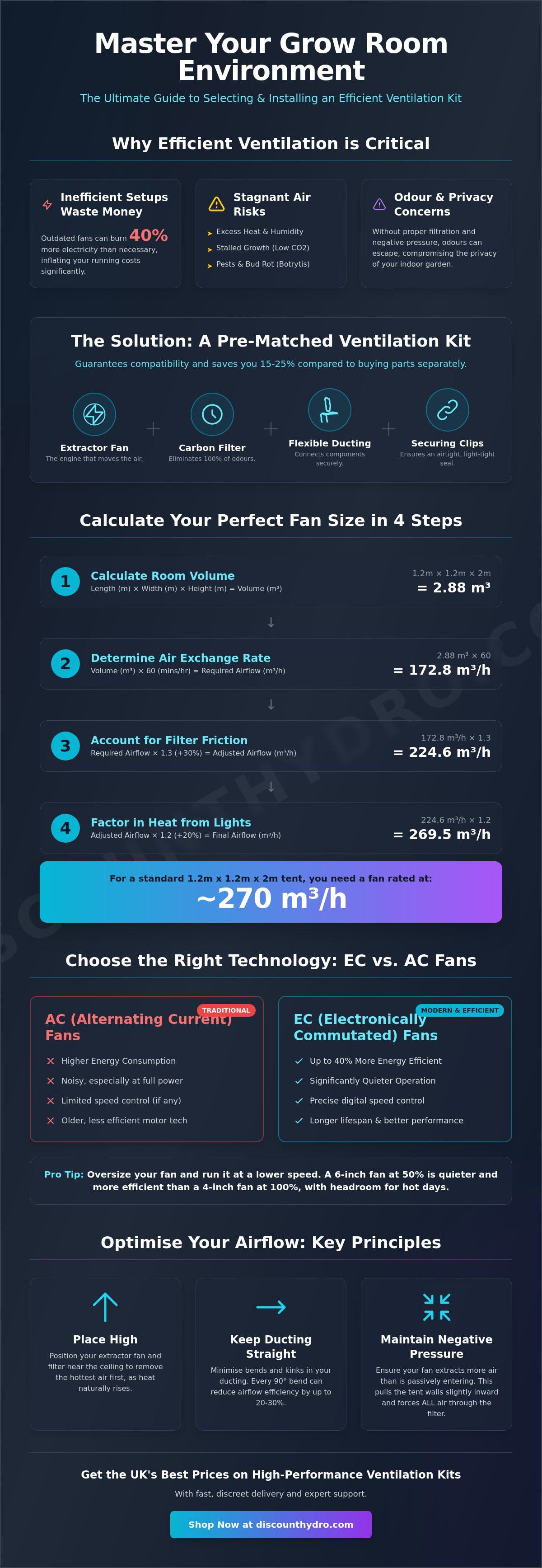
- Step 1: Calculate your room volume. Measure your space in metres. Multiply Length x Width x Height. For a standard 1.2m x 1.2m x 2m tent, the volume is 2.88 cubic metres (m3).
- Step 2: Determine the air exchange rate. You should refresh the air in your space at least once every minute to maintain CO2 levels. Multiply your volume by 60 to get the hourly requirement. For our example: 2.88 x 60 = 172.8 m3/h.
- Step 3: Account for filter friction. Attaching a carbon filter creates static pressure that slows down the air. This usually causes a 20% to 30% reduction in actual airflow. Multiply your m3/h figure by 1.3 to compensate for this loss.
- Step 4: Factor in light heat. High-intensity lighting adds thermal load. When using a high-output led grow light, add an extra 10% to 20% to your total to ensure the fan can pull enough cool air to offset the heat.
Metric Sizing for Common UK Tents
The 1.2m x 1.2m x 2m tent is the UK industry standard for hobbyists. Based on the calculations above, a fan rated at approximately 225 m3/h to 250 m3/h is the minimum requirement. Small propagation spaces with low-wattage lights require much less air movement, often suiting a 100mm (4 inch) fan. Large flowering rooms with heavy plant canopies require high-pressure fans to move air through dense foliage and large filters. We recommend "oversizing" your fan and using a digital controller. Running a 150mm (6 inch) fan at 50% capacity is significantly quieter than running a 100mm fan at 100% power, and it gives you extra headroom for hot summer weeks.
Understanding m3/h vs. CFM
Many fans manufactured for the global market use CFM (Cubic Feet per Minute), while UK and European retailers use m3/h (Cubic Metres per Hour). To convert CFM to m3/h, multiply the value by 1.699. It is a known industry standard that airflow velocity drops as soon as a carbon filter is attached because the fan must work harder to pull air through the dense carbon bed. When calculating ventilation needs, always check the manufacturer’s performance curve. This graph shows how many m3/h the fan actually moves when restricted by ducting or filters. Choosing a fan with a high "static pressure" rating ensures your grow room ventilation kit uk performs reliably under real-world conditions.
Essential Components of a High-Performance Ventilation Kit
Building a reliable indoor garden requires parts that work together under pressure. A complete grow room ventilation kit uk must handle heat, moisture, and smells without failing mid-cycle. If one part is weak, the whole system suffers. You'll find that investing in quality components upfront prevents expensive environment crashes later.
AC vs. EC Fans: Which is Best for 2026?
The choice between AC and EC motors is the most significant decision for your airflow setup. Traditional AC fans are cheap to buy but expensive to run. Modern EC (Electronically Commutated) fans use up to 50% less power when you run them at reduced speeds. This efficiency makes them the standard for 2026. EC fans also solve the noise problem. While AC fans produce a loud, low-frequency hum when dimmed, EC fans stay silent across their entire power range. You get precision control via 0-10V digital controllers, allowing for 1% increment adjustments rather than the clunky 5-step transformers used for older tech.
Choosing the Right Carbon Filter
Odour control depends entirely on the quality of the carbon inside your cylinder. Budget filters often use recycled coal pellets that settle over time, creating "bypass" gaps where air escapes untreated. Premium filters use RC412 Australian virgin carbon. This material has a higher surface area for trapping molecules. You must match your filter airflow rating to your fan. Never undersize the filter. If your fan pulls 500m3/h, your filter needs a rating of at least 500m3/h, though 600m3/h is safer to account for resistance. Keep an eye on your hygrometer. If humidity levels stay above 70% for too long, the carbon pores clog with water, and the filter stops working. Under normal UK conditions, expect to replace your carbon every 12 to 18 months.
Ducting, Clips, and Seals
The tube connecting your fan and filter matters for both noise and durability. You have three main choices:
- Standard Aluminium: The most affordable option, but it tears easily and offers no sound insulation.
- Combi-Ducting: This features a foil interior with a tough plastic outer layer. It's much harder to puncture, which prevents smelly air leaks.
- Acoustic Ducting: This contains a layer of glass wool insulation. It's essential if you need to keep your grow room ventilation kit uk quiet, as it dampens the sound of rushing air.
Don't rely on duct tape or zip ties to hold these together. High-quality steel jubilee clips are essential. They provide a mechanical, airtight seal that won't peel off when the grow room gets warm. A single loose connection can leak enough air to make your carbon filter useless, so tighten every joint until it's rock solid.
Optimising Your Environment: Placement and Installation
Getting the most out of your grow room ventilation kit uk depends entirely on how you set it up. Efficiency isn't just about fan power; it's about physics. The "Straight Line" rule is your most important guideline. Every 90-degree bend in your ducting can reduce airflow by 20% or more. Keep your ducting runs as short and straight as possible to ensure your fan doesn't work harder than it needs to. If you must have a turn, use a gradual curve rather than a sharp corner.
Heat always rises. For this reason, you must place your extractor fan and carbon filter at the highest point in your grow space. This position allows the equipment to pull out the hottest, most humid air before it settles around your plants. For intake, place your vents or fans at the bottom on the opposite side of the room. This creates a cross-flow of fresh air that reaches every leaf.
Your intake strategy depends on the size of your setup. Passive vents work well for small 1m x 1m tents, but larger rooms require active intake fans. An active intake fan helps manage the environment when you're using high-output lighting that generates significant heat. Properly integrating your ventilation with hydroponics systems is also vital. Water-based growing often leads to humidity levels spiking above 75% during the dark cycle; a well-placed extraction kit prevents this moisture from causing mould issues.
Step-by-Step Installation Guide
Start by hanging your carbon filter and fan using rope ratchets. These allow for easy height adjustment and help isolate the equipment from the tent frame. Connect your ducting and secure it tightly with metal duct clips and silver tape. Don't rely on tape alone, as heat can cause the adhesive to fail over time. Once everything is connected, perform a negative pressure test. Close the tent completely and turn the fan to full power. The walls should suck inward slightly. This proves that air is only entering through your intakes and leaving through the filter.
Managing Noise and Vibration
Noise is often the biggest hurdle for indoor growers in the UK. To quieten your setup, replace standard flexi-ducting with acoustic ducting. This uses a layer of glass wool insulation to dampen the sound of air rushing through the pipes. If fan motor hum is still an issue, add a dedicated silencer or muffler to the end of your extraction line. Never bolt your fan directly to a wooden joist or wall. This creates a drum effect that carries sound through the building. Suspend the fan using bungee cords or rubber hangers to kill 95% of the vibration at the source.
Ready to upgrade your airflow? Shop our full range of ventilation equipment for the UK's best prices.
Buy the Best Value Grow Room Ventilation Kits at Discount Hydro
Finding a reliable grow room ventilation kit uk doesn't have to be a gamble. Discount Hydro focuses on delivering the best prices on branded hardware to growers nationwide. Our County Durham warehouse stays fully stocked to ensure fast, discreet UK delivery on every order. You can also use our click-and-collect service if you need gear immediately for a new setup. We only stock components that last multiple seasons; we avoid the cheap, single-use plastics often found in budget marketplaces. Our team provides expert support to help you select a kit that fits your specific skill level and space requirements without overcomplicating the process.
Complete Kits for Every Budget
We offer entry-level kits for hobbyists setting up their first indoor garden. These kits include essential AC fans and carbon filters that provide solid performance without a high upfront cost. They're perfect for smaller tents where noise isn't the primary concern. For experienced growers, our professional EC kits are the top choice. These systems focus on efficiency and silent operation, allowing for precise environment control via digital sensors. EC motors often reduce energy consumption by 30% to 50% compared to traditional fans, which is a massive saving over a full year. We also build custom bundles. We match fans and filters to your specific room volume to ensure the static pressure remains optimal. This prevents odours from escaping and keeps your plants healthy through consistent air exchange.
Why Shop with a UK Specialist?
Shopping with a UK specialist means your equipment meets local 230V electrical standards and safety regulations. You get a local warranty and a straightforward returns process if a component fails. We understand the UK climate and how it affects indoor gardening throughout the seasons. High humidity in autumn or cold, damp winters requires specific ventilation adjustments that generic retailers might miss. Our staff offers technical advice based on years of experience in the British market, helping you avoid common mistakes like buying mismatched ducting or undersized filters.
Our County Durham team is available to walk you through the installation process if you hit a snag. We pride ourselves on being a no-frills, high-stock supplier that prioritises your results. Every grow room ventilation kit uk we sell is tested for durability before it makes it to our shelves. Our goal is to provide a functional, economical solution for every customer, from the small-scale hobbyist to the large-scale professional. You can browse our full range of grow room ventilation kits here and start your next project with confidence.
Take Control of Your Indoor Environment Today
Managing airflow isn't just about moving air; it's about protecting your investment. By 2026, precision in fan sizing and carbon filter efficiency has become the standard for successful UK growers. You've learned how to calculate the exact CFM requirements for your space and why high-performance components prevent heat stress. Choosing a high-quality grow room ventilation kit uk ensures your setup remains discreet and your environment stays stable through every stage of the cycle.
We've built our reputation on providing the industry's most reliable gear. Our County Durham team provides expert technical support to help you dial in your environment perfectly. We back every purchase with a Best Price Guarantee on all hydroponic equipment and offer fast UK-wide delivery to get your system running without delay. Don't let poor airflow limit your results when professional-grade solutions are this accessible.
Shop the UK’s best value grow room ventilation kits at Discount Hydro
Get your setup ready for peak performance and enjoy the peace of mind that comes with professional equipment.
Frequently Asked Questions
Do I need a separate intake fan for my grow tent?
You don't always need a separate intake fan if you're using a tent smaller than 1.2m x 1.2m. Passive intake vents usually suffice for small setups by allowing air to enter naturally. However, for 2.4m x 1.2m tents or larger, an active intake fan ensures fresh air reaches every plant. This setup maintains negative pressure and prevents stale air pockets from forming in the corners of your room.
How often should I change the carbon filter in my ventilation kit?
You should replace the carbon filter in your grow room ventilation kit uk every 12 to 18 months of continuous use. High humidity levels over 70% can reduce this lifespan by 50% as the carbon pores clog with moisture. Check for escaping smells daily. If you notice any odour outside the tent, it's time for a new filter to maintain total discretion and keep your environment clean.
What is the difference between a 4-inch and a 6-inch ventilation kit?
The main difference is the volume of air moved, which is measured in cubic metres per hour (m3/h). A standard 4-inch (100mm) fan typically moves 187 m3/h, while a 6-inch (150mm) fan moves between 400 m3/h and 550 m3/h. Choose the 6-inch kit for rooms larger than 1m x 1m to ensure 20 air changes per hour. Larger fans also run much quieter when dimmed down.
Can I run my grow room extraction fan 24 hours a day?
You must run your extraction fan 24 hours a day to maintain constant airflow and odour control. Stopping the fan causes humidity to spike by 20% to 30% during the dark cycle, which significantly increases the risk of mould. Continuous operation also ensures the carbon filter keeps scrubbing the air. This prevents smells from leaking out through the tent zips or seams while your lights are off.
Why is my grow tent walls sucking in so much?
Tent walls suck inward because your extraction fan is pulling out more air than the intake vents allow in. This creates negative pressure, which is essential for containing smells within the tent. If the walls bow in more than 10cm, you're losing valuable growing space. Open another passive vent or add an intake fan to balance the pressure without losing the vacuum seal required for your filter.
How do I reduce the noise of my extraction fan in a flat?
Use acoustic ducting and an EC fan controller to lower noise levels in a flat. Insulated ducting can reduce wind noise by up to 10 decibels compared to standard aluminium foil. Mounting your fan with bungee cords instead of solid brackets stops vibrations from travelling through the ceiling. These simple adjustments make your grow room ventilation kit uk run quietly enough for residential use without bothering your neighbours.
Does ducting length affect the performance of my ventilation kit?
Every metre of ducting reduces your fan's airflow by approximately 3% to 5%. Sharp 90 degree bends are even more restrictive, cutting performance by up to 20% per turn. Keep your ducting runs as short and straight as possible for maximum efficiency. Use metal jubilee clips to ensure airtight connections, as leaks will further decrease the efficiency of your extraction system and lead to heat buildup.
Is an EC fan worth the extra cost compared to an AC fan?
An EC fan is worth the investment because it uses 40% less electricity than a traditional AC fan. EC motors allow for precise speed control from 0% to 100% without the loud humming noise associated with AC dimmers. While the initial cost is higher, the energy savings usually cover the price difference within 12 months of operation. They provide better torque and reliability for long-term indoor gardening.