

Guide to Hydroponic Drip Systems: Precision Feeding
Most indoor growers lose significant harvest weight because they cannot maintain a perfect feeding schedule by hand. Manual watering is a massive time sink that often leads to uneven nutrient distribution and stunted plants. You have likely dealt with the headache of blocked dripper lines from salt buildup or noticed that plants at the back of the tent don't get the same attention as those at the front. It's a common frustration that limits your garden's potential.
A well-configured hydroponic drip system solves these issues by delivering precise, automated nutrition directly to the root zone. This guide provides a technical breakdown of system mechanics, setup procedures, and essential maintenance protocols to ensure your hardware runs at peak performance. You'll learn how to automate your feeding schedule and increase nutrient uptake efficiency for consistent growth across your entire canopy. We'll cover everything from selecting the right emitters to the "clean-line" protocol that prevents clogs. Mastering these mechanics allows you to achieve professional-grade yields with automated precision and minimal waste.
Key Takeaways
- Learn how a hydroponic drip system automates nutrient delivery to eliminate manual watering errors and ensure consistent growth across your entire canopy.
- Identify essential hardware components, including how to calculate the correct reservoir size and why inline filters are mandatory for preventing particulate blockages.
- Compare the efficiency of recirculating setups against run-to-waste systems to determine which configuration best suits your specific nutrient management strategy.
- Master professional maintenance protocols like line flushing and flow rate calibration to prevent nutrient salt buildup and ensure even distribution.
- Discover cost-effective, UK-proven hardware like the Origin (Wilma) system to upgrade your grow room with high-performance, automated feeding technology.
What is a Hydroponic Drip System and How Does It Work?
A hydroponic drip system is an active method of indoor cultivation that uses a network of tubes and emitters to deliver nutrient solution directly to the root zone. It's a specialized adaptation of drip irrigation, designed to maximize efficiency and growth rates in controlled environments. By automating the feeding process, growers eliminate the inconsistencies and human error associated with manual watering.
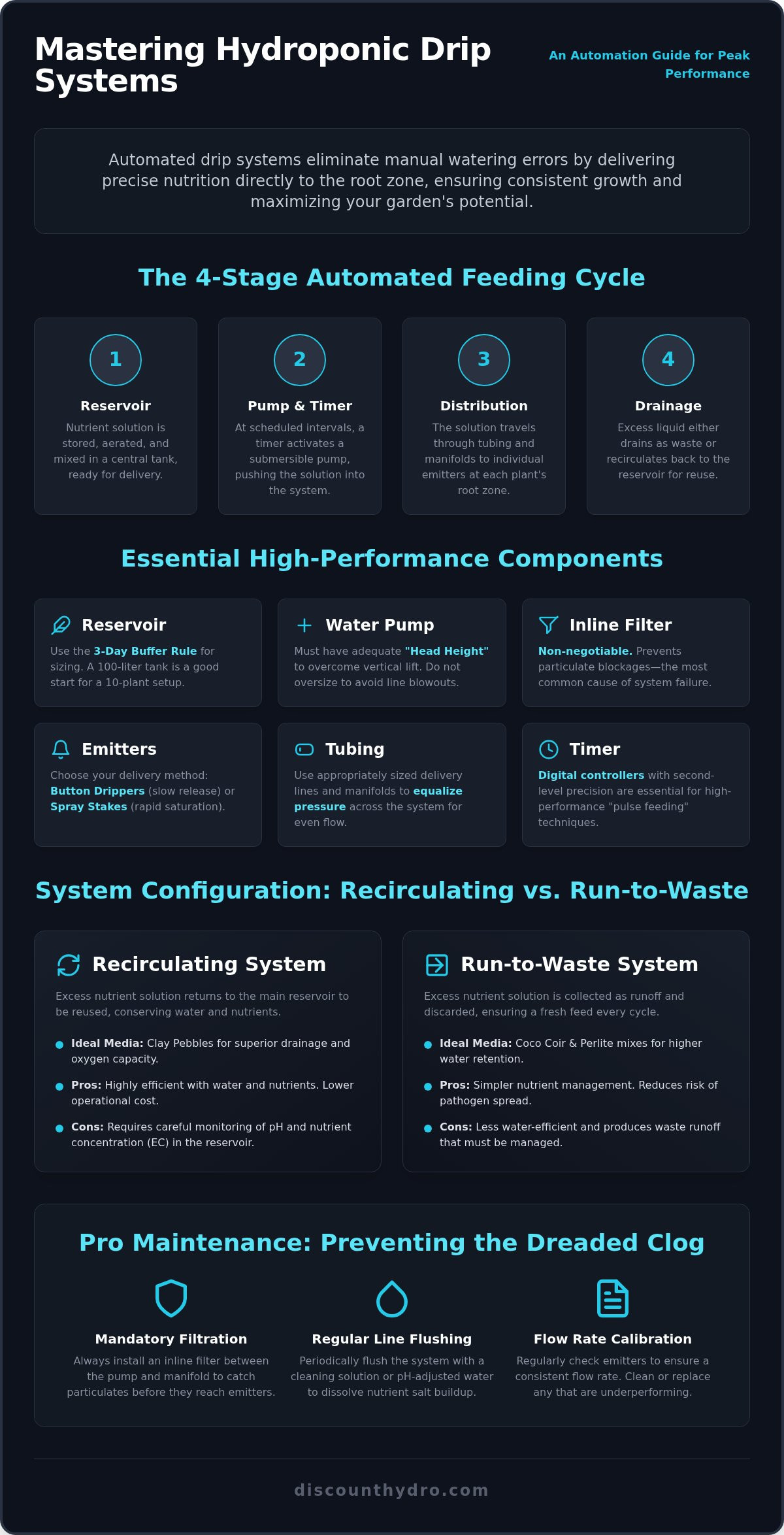
The core cycle consists of four distinct stages. Nutrient solution is stored in a reservoir where it is kept aerated and mixed. At scheduled intervals, a timer triggers a submersible pump. This pump drives the solution through distribution lines and manifolds to reach individual plants. Depending on the specific system design, the excess liquid either drains out of the grow room or recirculates back into the main tank for reuse.
Drip systems are the logical choice for growers looking to scale their operations. While hand-watering might be manageable for four plants, it becomes a logistical burden for 40 or more. These systems provide precise nutrient control and significant water conservation. They reduce labor hours and ensure that every plant in the canopy receives an identical dose of nutrients. This leads to a uniform harvest across the entire grow tent without the physical strain of carrying heavy watering cans.
The Anatomy of a Modern Drip Setup
High-performance systems rely on several critical hardware components working in unison. Submersible pumps are the primary drivers; they must provide enough pressure to overcome the resistance of the tubing and emitters. Delivery lines and manifolds are used to equalize this pressure across the room, ensuring consistent flow rates. Growers must also choose their delivery method. Button drippers offer a slow, controlled release, while spray stakes provide rapid saturation of the medium surface, which is often better for larger pots.
The Role of Growing Media in Drip Irrigation
Growing media selection is vital because it determines your pump's "on-time" cycles. Clay pebbles are the industry standard for recirculating setups due to their excellent drainage and high oxygen capacity. They don't retain excessive moisture, which prevents root rot during frequent feeding. For run-to-waste configurations, coco coir and perlite mixes are often preferred because they hold more water. Media porosity directly affects how often the pump needs to run. Highly porous materials require frequent, short bursts of irrigation to keep the root zone hydrated without causing saturation issues.
Essential Components for a High-Performance System
Building a reliable hydroponic drip system requires hardware that can handle constant pressure and nutrient salt exposure. High-quality Hydroponics equipment ensures your plants receive consistent saturation without the risk of mechanical failure. Every component must be sized correctly to maintain the balance between delivery speed and system safety.
Your reservoir is the foundation of the setup. Use the 3-day buffer rule to calculate the minimum volume needed. This means your tank should hold enough nutrient solution to feed your entire plant count for three full days without a refill. This safety margin prevents the pump from running dry and protects your plants if you are away from the grow room. For a standard 10-plant setup, a 100-liter reservoir is a practical starting point.
Filtration is non-negotiable for system longevity. An inline filter placed between the pump and the distribution manifold stops particulate matter and undissolved nutrients from reaching the drippers. This simple addition prevents the most common cause of system failure: blocked lines. You also need to decide between segmented and integrated configurations. Segmented systems use individual modular pots connected by tubing, offering flexibility in plant spacing. Integrated systems, like the Wilma, use a single tray and are more compact for tight spaces. Control these components with a high-quality timer. While mechanical pin timers work for basic setups, digital controllers with second-level precision allow for the "pulse feeding" required in high-performance environments.
Selecting the Right Water Pump
You must understand head height before purchasing a pump. This is the vertical distance the pump can push water. If your pots are elevated on a table, your pump needs a head height rating that exceeds that vertical lift to maintain flow. Don't buy an oversized pump thinking more power is always better. Excessive pressure leads to line blowouts and leaks at the fittings. Clean your submersible pump every month to prevent nutrient salts from seizing the impeller.
Piping and Tubing: 13mm vs. 19mm Mainlines
Standardize your fittings to 13mm or 19mm to ensure all your connectors and emitters fit securely. 19mm mainlines are superior for larger grow rooms because they maintain pressure more effectively over long distances. Always use black "anti-algae" tubing. Clear or translucent lines allow light to penetrate, which triggers algae growth that will eventually clog your emitters. If you are upgrading your current hardware, you can find a wide selection of compatible hydroponic pots and systems to match your tubing size. Limit the use of elbows and tees; each fitting creates resistance and reduces the final water pressure at the plant.
Recirculating vs. Run-to-Waste Drip Systems
Choosing between a recirculating and a run-to-waste (RTW) configuration is a critical decision when setting up your hydroponic drip system. These two methods differ in how they handle nutrient runoff, and your choice will dictate your weekly maintenance routine and long-term running costs. Each approach has distinct advantages depending on your choice of growing media and your goals for efficiency.
In a recirculating setup, the nutrient solution follows a continuous loop. The pump sends the liquid from the reservoir to the plants, and any excess drains back into the same tank for reuse. This method is highly efficient. It significantly reduces water and nutrient consumption, which lowers your overheads over several harvest cycles. However, it demands strict monitoring. As plants selectively absorb specific elements, the pH and EC levels in the reservoir will fluctuate. You'll need to check and adjust your tank frequently to keep the solution balanced and prevent nutrient lockout.
Run-to-waste systems operate on a linear path. Fresh nutrient solution is applied to the plants, and the runoff is collected in a separate tray or sent to a drain rather than returning to the reservoir. This ensures your plants receive a perfectly balanced, fresh dose of nutrition with every feed. While RTW uses more water and increases nutrient costs, it simplifies management by eliminating the need to adjust the reservoir mid-week. You simply mix a fresh batch and let the system run until the tank is empty.
When to Choose a Recirculating Setup
Recirculating configurations are ideal for inert media like clay pebbles or rockwool that don't break down or alter the solution's chemistry. This is the best choice for growers focused on sustainability and minimizing waste. To succeed here, you must use Hydroponic Nutrients specifically formulated for stability. Professional-grade formulas resist pH swings better than budget fertilizers, which is vital when the same solution passes through the root zone multiple times.
The Advantages of Run-to-Waste for Coco Growers
Coco coir growers often prefer run-to-waste because it eliminates the risk of root pathogens spreading through a shared reservoir. If one plant develops an issue, it won't contaminate the entire crop via the return line. RTW also handles the natural cation exchange in coco more effectively. It flushes out accumulated salts with every feed, preventing toxic buildup in the medium. This reliability is why commercial-scale indoor facilities almost exclusively use RTW; the consistency and reduced risk of crop failure outweigh the higher cost of nutrients.
Setup and Maintenance: Preventing the Dreaded Clog
Maintenance for a hydroponic drip system centers on one goal: preventing salt buildup. Mineral deposits are the primary cause of emitter failure and uneven feeding. You must follow a strict protocol to ensure your hardware lasts for multiple harvest cycles without performance drops. A proactive approach saves hours of troubleshooting mid-cycle.
Start by flushing the entire network with clean water before you introduce any plants. This removes dust or plastic shavings left over from the manufacturing process. Next, calibrate your flow rates. Run the pump for one minute and measure the output from several different emitters using a graduated jug. If the volumes aren't identical, you have a pressure imbalance or a partial blockage that needs immediate attention. Canopy uniformity depends entirely on this precision.
Implement a weekly reservoir change-out routine. Don't just top up the tank. Draining the old solution and mixing a fresh batch prevents nutrient imbalances and stabilizes your pH levels. Use specialized line cleaners and enzymes to break down mineral salts before they can crystallize. High-quality nutrients from brands like Dutch Pro are designed to stay in suspension longer, which reduces the risk of clogs in narrow delivery lines.
The "Clean Line" Protocol
Use drip-specific additives during every feed to keep the internal surfaces of your tubing slick. If an emitter becomes blocked, use a pin or scalpel to clear the opening immediately. This is a temporary fix; the line likely needs a deeper flush. Perform a deep clean at the end of every cycle. Soak all lines and manifolds in a mild citric acid solution for 24 hours. This dissolves calcium and magnesium scales that standard cleaners might miss.
Monitoring pH and EC in the Reservoir
Precision feeding requires stable water chemistry. Drip systems are sensitive to pH fluctuations. If the pH drifts too far, nutrients can precipitate and form solids in your lines. Watch for EC drift in recirculating setups. As plants transpire water, the nutrient concentration in the reservoir increases, which can lead to overfeeding. Position your LED Grow Lights to avoid direct heat transfer to your nutrient tank. Warm solution promotes algae growth and reduces dissolved oxygen levels.
Ensure your setup stays operational with our selection of system maintenance tools and spare parts.
Finding the Best Drip System at Discount Hydro
Discount Hydro provides an expertly curated selection of hardware proven in UK grow rooms. We focus on high-performance kits that deliver automated precision without the premium price tag. Buying from a specialist ensures you get equipment selected by those who understand Hydroponics inside out. Our County Durham hub serves as a central logistics point, offering local support and click-and-collect options for Chester-le-Street growers. This localized expertise means we don't just ship boxes; we supply the exact components needed for successful indoor cultivation.
We maintain a relentless focus on price and availability. Our inventory includes everything from complete professional kits to individual replacement parts. This ensures that whether you're building a new room or repairing an existing hydroponic drip system, you have access to the right parts at competitive rates. Fast UK-wide shipping is standard, so your plants never miss a scheduled feed due to a hardware delay.
Origin Wilma: The Entry-Level Standard
The Origin Wilma is the industry standard for entry-level automation. It's the perfect bridge for growers moving from hand-watering in soil to a fully automated hydroponic drip system. These systems are available in multiple configurations to fit any space, from compact 60cm tents to large 2.4m professional setups. Assembly is straightforward. The design integrates the reservoir and tray into a single unit, which minimizes the footprint and reduces the risk of external leaks. It's a reliable, no-frills choice for those who value efficiency and consistent results.
Custom Setups and Spare Parts
Not every grow room fits a standard kit. We stock a comprehensive range of individual pumps, drippers, and pipe fittings for custom manifolds. If you're looking to upgrade your current Grow Tent, a custom drip setup allows for specific pot placement and tailored flow rates. We maintain deep stock levels on all critical hardware. This includes high-pressure pumps and various emitter styles to match your specific growing media. Our focus remains on providing functional, reliable equipment that helps you achieve professional-grade yields with minimal maintenance requirements.
Scale Your Harvest with Automated Precision
Implementing a hydroponic drip system is the most effective way to eliminate the labor and inconsistency of manual watering. You've learned how to master the clean-line protocol and select the right hardware for your tent size. These steps ensure every plant in your canopy receives the exact nutrient dose needed for maximum growth. Whether you choose a recirculating setup for sustainability or a run-to-waste configuration for easier management, the shift to automation is a significant step toward professional-grade results.
We provide the hardware and specialist advice needed to keep your system running at peak efficiency. Discount Hydro offers competitive pricing on complete kits and individual spare parts to support your garden's growth. Our inventory is built for growers who prioritize value and reliability.
Shop our full range of Hydroponic Drip Systems and Components. We offer fast UK-wide shipping and click-and-collect services from our County Durham hub. Our team provides specialist advice to help you choose the right configuration for your specific space. Start automating your feeding schedule today to see the difference in your next harvest.
Frequently Asked Questions
How often should I run my hydroponic drip system?
Run your pump based on the water retention properties of your growing media. For coco coir, three to five feedings per day are standard to maintain moisture without saturation. If you use clay pebbles, you might run the pump every two hours during light hours because they drain rapidly. Always ensure the on-time is long enough to achieve slight runoff in run-to-waste setups, confirming the entire root zone is saturated.
Can I use organic nutrients in a drip system?
Using thick organic nutrients is not recommended for a hydroponic drip system because they contain suspended solids that trigger immediate blockages. These viscous liquids settle in the narrow delivery lines and emitters, leading to hardware failure. If you prefer organic-based growth, look for highly filtered, drip-clean mineral-based supplements. These provide the necessary elements while ensuring your pump and drippers remain clear of biofilm and sludge throughout the cycle.
What is the best growing medium for a drip irrigation system?
The best medium depends on your drainage strategy. Clay pebbles are the industry standard for recirculating systems due to their high aeration and rapid drainage properties. For run-to-waste configurations, a 70/30 mix of coco coir and perlite is superior. This combination retains enough nutrient solution to keep plants hydrated between feeds while allowing enough oxygen to reach the roots, preventing rot and encouraging rapid vegetative growth.
How do I prevent my drippers from clogging?
Prevent clogs by installing an inline filter and using high-quality nutrients like Dutch Pro that stay in suspension. Mineral salt buildup is the primary cause of blockages, so you should use a line-cleaning additive in every reservoir batch. Flush the entire network with a mild acid solution between harvest cycles to dissolve any remaining scale. Regularly check flow rates at individual stakes to catch partial blockages before they lead to plant wilting.
Do I need a return pump for a recirculating drip setup?
You only need a return pump if your pots are positioned lower than the reservoir or if you are using a drip and drain system on a flat floor. Most standard recirculating kits, such as the Wilma, rely on gravity to return excess solution to the tank. If your drainage tray cannot sit above the reservoir, a specialized brain pot or a small submersible pump in a catchment tank is necessary to move waste liquid back.
How many plants can I run on one drip manifold?
Most standard manifolds support between 4 and 12 plants per unit. The actual number depends on the pressure capacity of your water pump. If you split a single line too many times, the pressure drops, and the plants furthest from the pump won't receive enough solution. To maintain precision across a larger canopy, use multiple manifolds connected to a single high-flow mainline rather than overloading a single distribution point.
Is a drip system better than an Ebb and Flow system?
Drip systems offer more precision than ebb and flow because they deliver nutrients directly to the root zone without saturating the entire tray. This makes them better for larger plants and varying pot sizes. Ebb and flow is often simpler for sea of green setups with many small pots. A hydroponic drip system is generally preferred when you want to automate feeding while maintaining strict control over the volume each individual plant receives.
How do I calculate the right pump size for my drip system?
Calculate your pump size by adding the flow rate of every emitter in your system. If you have 20 drippers rated at 2 liters per hour, you need a pump that delivers at least 40 liters per hour at your specific head height. Always choose a pump with a higher rating than your minimum requirement to account for the resistance created by tubing, elbows, and filters. This ensures consistent pressure at every stake.