

How to Calibrate a pH Meter: The Complete UK Grower’s Guide for 2026
Is your digital pH pen actually lying to you? Even a 0.2 deviation in your reservoir can lock out vital nutrients, turning a high-yield crop into a stunted disappointment in less than 24 hours. Most growers in the UK struggle with drifting readings, often realizing too late that their equipment was the problem rather than their nutrient schedule.
It's frustrating to invest in expensive setups only to see your plants suffer from avoidable pH fluctuations. You want precision without the fear of cracking a delicate glass probe or guessing which buffer solution matches your local water profile. This guide teaches you exactly how to calibrate a ph meter uk growers use for peak performance in 2026. By mastering these steps, you'll ensure stable levels and faster growth while extending the life of your gear by up to 18 months.
We're going to walk through the essential two-point and three-point calibration routines, the specific storage solutions required for the UK market, and the daily habits that prevent sensor failure.
Key Takeaways
- Prevent costly nutrient lockout by mastering pH calibration techniques that ensure your plants reach their full potential.
- Learn which standard buffer solutions are required for UK hydroponics and how to maintain them for long-term accuracy.
- Follow our professional guide on how to calibrate a ph meter uk using the essential neutral-point method for flawless readings.
- Identify signs of a failing probe and learn simple maintenance tricks to fix "lazy" meters and avoid unnecessary replacement costs.
- Compare the best value pH pens and continuous monitors to find the most reliable equipment for your grow room budget.
Why pH Calibration is Critical for Hydroponic Success in the UK
pH calibration is the vital process of aligning your digital reader with known reference standards. Think of it as tuning a high-performance engine. Without it, your readings are just guesses. A pH meter works by detecting tiny electrical changes in your nutrient solution. These sensors are incredibly sensitive and lose accuracy as they age or encounter temperature swings. Mastering how to calibrate a ph meter uk growers rely on is the difference between a record harvest and a total crop failure.
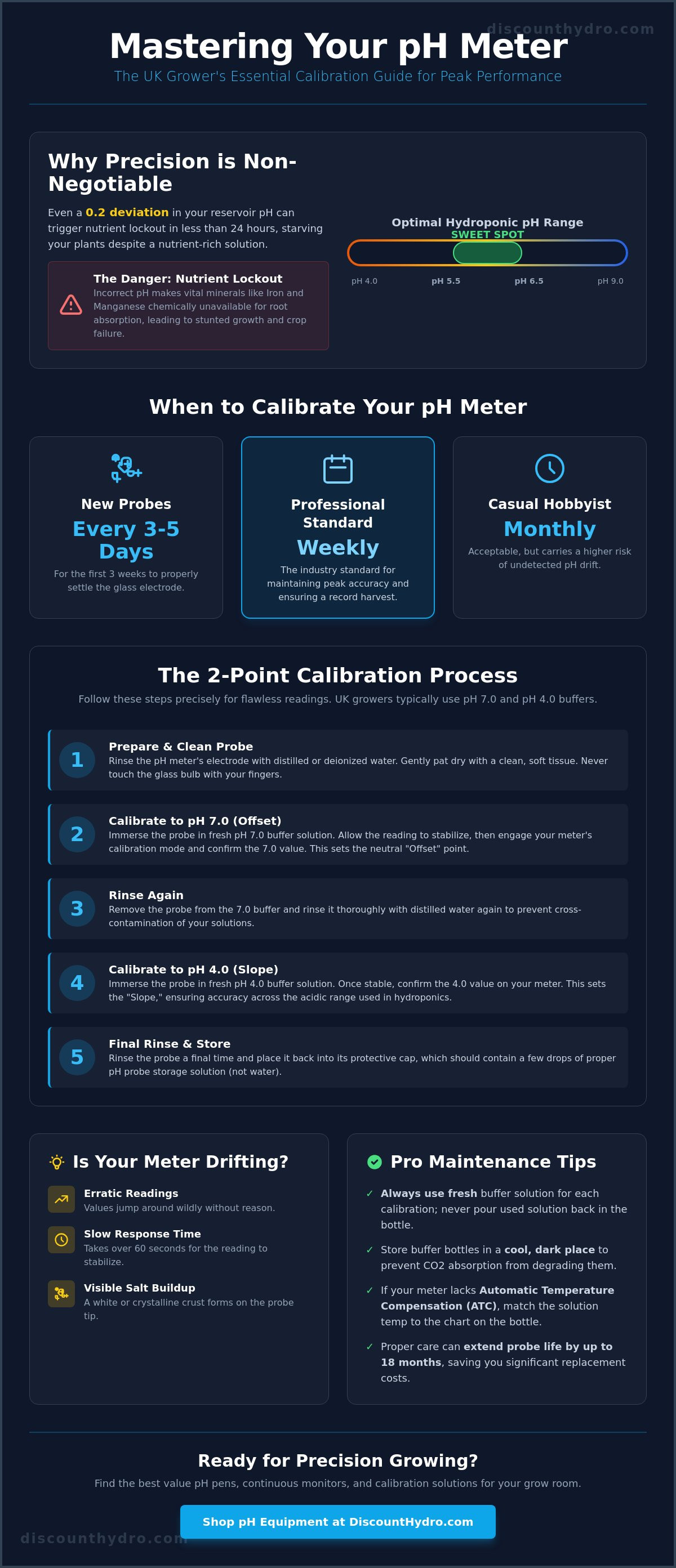
Precision gardening requires a strict pH range between 5.5 and 6.5 for most indoor crops. If your levels drift outside this window, you hit a wall called "Nutrient Lockout." This happens when the chemical environment prevents roots from absorbing minerals. You might have the best gear in Britain, but if your meter is off by just 0.5 points, your plants will starve while sitting in a pool of food. Factory calibration is never enough for serious results. High-end meters are calibrated at the factory, but transit through UK shipping networks often disrupts these delicate settings before the box reaches your door.
The Science of Nutrient Solubility
Chemical reactions in your reservoir depend entirely on acidity levels. Different minerals become physically unavailable at specific pH points. For example, iron and manganese struggle to stay soluble when pH rises above 6.5. This directly impacts the efficiency of your hydroponic nutrients. The meter detects hydrogen ions in the root zone, allowing you to adjust the balance before deficiencies appear. If these ions aren't measured correctly, your nutrient profile becomes unbalanced, leading to stunted growth.
How Often Should You Calibrate?
Weekly calibration is the industry standard for maintaining peak performance in a UK grow room. While some casual hobbyists might wait a month, professional results require more frequent checks. New probes are especially temperamental. They often require calibration every 3 to 5 days during the first three weeks of use to settle the glass electrode. Learning how to calibrate a ph meter uk standards require ensures your hardware stays reliable. You can spot a drifting meter by looking for these signs:
- Erratic readings that jump up and down without a clear reason.
- Slow response times where the meter takes over 60 seconds to stabilize.
- Visual salt buildup or "crusting" on the probe tip.
Consistent maintenance ensures your equipment stays as reliable as the day you bought it. Don't wait for your plants to show stress before you check your accuracy. Regular checks save time, money, and your harvest.
Understanding pH Buffer Solutions and Equipment Requirements
Mastering how to calibrate a ph meter uk requires understanding the chemical standards used in the process. These liquids, known as buffer solutions, act as the fixed reference points for your digital equipment. Without them, your meter has no way to verify its accuracy. Most manufacturers provide pH 4.0, 7.0, and 10.0 solutions. UK growers typically focus on the 4.0 and 7.0 options. This is because most nutrient solutions for indoor crops aim for a range between 5.5 and 6.5. Using a 10.0 buffer is usually unnecessary unless you're managing highly alkaline environments.
Temperature significantly affects chemical activity in these solutions. A buffer that is exactly pH 7.0 at 25°C might read 7.06 at 15°C. Modern digital meters feature Automatic Temperature Compensation (ATC) to account for these shifts. If your device lacks ATC, you must manually adjust your readings based on the reference chart printed on the buffer bottle. Always use fresh liquid for every calibration session. Pouring used buffer back into the original bottle contaminates the entire batch and ruins future accuracy.
Buffer 4.0 vs. 7.0: The Slope and Offset
Calibration typically starts at pH 7.0, which is known as the "Offset." This tells the meter's computer where the neutral point sits. The "Slope" is the second calibration point, usually pH 4.0. A two-point calibration is significantly more accurate than a single-point check. It ensures the sensor is linear across the specific range you use for feeding. Store your bottles in a cool, dark cupboard. Exposure to air allows CO2 absorption; this process slowly turns the liquid more acidic and invalidates the stated pH value.
The Impact of UK Tap Water on pH Stability
Water quality varies significantly across the UK. In London and the South East, hard water is the standard. This water contains high levels of calcium carbonate and high alkalinity. High alkalinity acts as a natural buffer, resisting your efforts to lower the pH with phosphoric acid. This leads to rapid pH drift in your reservoir as the plants begin to feed. Knowing how to calibrate a ph meter uk is vital in these hard water regions. Your meter will face more mineral interference, making regular checks mandatory for crop health. If you are new to hydroponics, understand that hard water requires more frequent equipment maintenance. You can find professional-grade pH calibration kits and fresh buffers to ensure your readings stay spot on.
Step-by-Step Guide: How to Calibrate a pH Meter Correctly
Precision is everything in a high-performance hydroponic system. If your readings are off by even a small margin, you'll likely see yellowing leaves or stunted growth without ever knowing the true cause. Following a strict, repeatable routine is the only way to maintain the accuracy required for professional results. This guide breaks down the process to ensure your equipment remains a reliable asset in your grow room.
Preparing Your Calibration Station
Use small, clean containers like shot glasses or dedicated beakers for your buffers. You should never dip your probe directly into the large manufacturer bottles. This introduces microscopic contaminants that ruin the entire batch of solution. Ensure your environment is stable before you begin. All buffers must be at room temperature, ideally between 20°C and 25°C. Cold or hot liquids cause a "drift" in the electrical response, which makes your final readings useless. Keep a bottle of deionised water nearby to rinse the probe thoroughly after every single dip to maintain the purity of your testing station.
Executing the Two-Point Calibration
Start with the pH 7.0 neutral buffer. This acts as the "zero point" for the meter's internal logic. Submerge the probe and wait. Don't rush this part; wait until the numbers on the screen stop moving completely. Once the reading is stable, adjust your meter using the digital interface or the manual trimmer until it matches the 7.0 value exactly.
Rinse the probe in deionised water and move to the pH 4.0 buffer. This second point is critical for growers because it establishes the "voltage slope" for the acidic range where most nutrient solutions sit. Wait for the reading to settle before confirming the adjustment. This two-point method creates a linear scale that covers the 5.5 to 6.5 range where plants absorb nutrients most efficiently. This is the most reliable way to learn how to calibrate a ph meter uk professionals depend on for consistent crop cycles. Finish by testing the 7.0 buffer one last time to verify the settings held.
Post-Calibration Storage
Proper storage determines how many seasons your equipment will last. A dry probe is a dead probe. You must never store a pH probe in distilled or deionised water. These liquids lack ions and will actually leach the internal chemistry out of the glass membrane, destroying the sensor. Use a dedicated KCI storage solution instead. Fill the protective cap halfway and slide it onto the probe, ensuring the seal is airtight. If you notice white salt crystals around the cap, simply wipe them away and refill the solution. Keeping the glass bulb hydrated ensures the meter is ready for immediate use the next time you mix a reservoir.
Troubleshooting Common Calibration Issues and Probe Maintenance
Digital meters often display "Error" or "Out of Range" messages when the sensor can't find a stable reading. This usually happens if the probe has dried out or the buffer solution is contaminated. If your meter takes longer than 60 seconds to stabilize during the process of how to calibrate a ph meter uk, you likely have a "lazy" probe. Most pH electrodes have a functional lifespan of 12 to 18 months in a standard UK hydroponic environment. Once the internal electrolytes deplete, the glass membrane loses its sensitivity and the unit requires replacement.
White crusty deposits around the probe cap are simply dried potassium chloride salt. While this looks like a defect, it's actually a sign of a healthy, leaking reference junction. However, excessive salt build-up can clog this junction. If the junction is blocked, the meter cannot complete the electrical circuit with your nutrient solution. This leads to erratic readings that jump by 0.5 pH or more without warning. Regular rinsing with deionised water after every use prevents this specific failure.
Cleaning Stubborn Probes
Don't discard a glitchy pen without trying a deep clean first. Use a specialized pH cleaning solution to dissolve stubborn nutrient salts from the glass. You can use a very soft brush to gently clear the reference junction, but you must never touch the round glass bulb with your bare fingers. Skin oils create a permanent film that blocks ion exchange. For unresponsive sensors, an overnight soak in KCl storage solution often restores the probe's speed. Never store probes in RO or distilled water; this leaches ions from the glass and kills the sensor 50% faster.
Dealing with Temperature Fluctuations
Temperature impacts the chemical activity of ions in your reservoir. High heat levels from a powerful LED grow light can shift your water temperature and skew readings. Most modern digital meters include Automatic Temperature Compensation (ATC) to handle these shifts. If you use a budget model without ATC, you must manually adjust your readings using the reference chart on your buffer bottle. A shift of 10 degrees Celsius can alter pH readings by approximately 0.1. While that seems small, it's enough to trigger nutrient lockout in sensitive varieties. Always calibrate your equipment at the same temperature as your nutrient tank to ensure 100% accuracy.
Get the best prices on replacement pH probes and calibration kits to keep your grow on track.
Pro-Level Tools: Selecting the Best pH Meters for Your Grow Room
Choosing the right equipment is a commercial decision. A precision pH meter prevents nutrient lockout, which can ruin a crop in 48 hours. High-quality tools reduce waste. You'll stop overusing pH Down and expensive boosters when your readings are 100% accurate. If you want to know how to calibrate a ph meter uk professionals trust, you first need a device that holds its calibration under pressure. Cheap, unbranded pens often drift within days, leading to false readings and burnt plants.
Look for these three non-negotiable features when browsing our stock:
- Replaceable Probes: Don't bin the whole unit when the sensor dies. Probes typically last 12 to 18 months with heavy use.
- IP67 Waterproofing: Accidents happen in wet environments. Your meter should survive a 30-minute submersion in the reservoir.
- Backlit Displays: These are essential for checking levels when your high-intensity lights are off during the dark cycle.
Handheld Pens for Small Setups
Handheld pens offer maximum portability. They're perfect if you're managing three or four separate reservoirs in different areas. The Essentials pH Meter is a top entry-level choice for tight budgets, while the Bluelab pH Pen is the industry standard for 2026. These units require regular care to stay accurate. Always store the probe in KCI storage solution. Never let the glass bulb dry out. Dry sensors lead to "drifting" readings, making it significantly harder to learn how to calibrate a ph meter uk standards require for high-yield results.
Continuous Monitors for Serious Growers
Continuous monitors provide 24/7 data. You can see pH shifts the moment they happen without dipping a pen. This is vital for recirculating hydroponic systems where pH can swing rapidly as plants consume specific ions. Integrating these monitors with your grow tent setup ensures you aren't guessing between manual tests. Brands like Milwaukee and Bluelab dominate this space. The Bluelab Guardian monitor is a popular pick because it tracks pH, conductivity, and temperature on one screen.
Install probes away from air stones to avoid "bubble interference" on the sensor. Position them in a high-flow area of the tank. This prevents nutrient film build-up on the glass. Investing £150 to £280 in a wall-mounted monitor saves hundreds of pounds in lost yield over a single 12-week cycle. It's the most efficient way to maintain a stable environment for your root zone.
Get Precise Results for Your 2026 Grow
Maintaining accurate readings is the only way to prevent nutrient lockout and maximize your hydroponic yields. You've learned that using 4.0 and 7.0 buffer solutions every 30 days keeps your equipment reliable. Understanding how to calibrate a ph meter uk prevents costly mistakes and ensures your plants get exactly what they need. Industry standards suggest that regular probe maintenance can extend the life of your sensors by up to 12 months.
Don't let drifting levels ruin your hard work. We provide a best price guarantee on leading brands like BlueLab and Essentials to keep your costs low. Our Durham-based team offers expert technical support for all customers; we provide UK-wide delivery on all pH equipment. Whether you're a commercial grower or a hobbyist, having the right tools makes the difference between a failed crop and a record harvest.
Browse our full range of pH meters and calibration fluids at Discount Hydro to find the best deals in the UK. Grab your supplies now and keep your system running perfectly.
Frequently Asked Questions
Can I use tap water instead of buffer solution to calibrate my meter?
No, you can't use tap water because its pH level is inconsistent and fluctuates between 6.5 and 8.5 depending on your UK postcode. Calibration requires a certified reference point with a fixed value like 4.01 or 7.01. Using tap water results in a 100% failure rate for accuracy. Always use professional buffer solutions to ensure your equipment provides the precision needed for high-yield hydroponic systems.
How long do pH buffer solutions last once the bottle is opened?
Most pH buffer solutions remain accurate for 90 days after you break the seal. While pH 7.01 is relatively stable, pH 10.01 solutions degrade quickly because they absorb CO2 from the air. You should check the manufacturer's expiry date on the bottle. Using expired fluid can lead to errors of 0.5 pH or more. Store your bottles in a dark cupboard at 15 to 20°C to maintain their chemical integrity.
Why does my pH meter reading keep changing after I calibrate it?
Fluctuating readings often indicate a dirty junction or a dehydrated glass electrode. If your probe is older than 12 months, the internal reference solution might be depleted. It's also vital to know how to calibrate a ph meter uk standards require by checking for air bubbles trapped around the sensor. A 1°C change in temperature can shift readings by 0.03 pH, so give the meter 30 seconds to stabilize.
Is it better to calibrate with pH 7 and 4, or pH 7 and 10?
You should use pH 7 and 4 because most hydroponic crops thrive in an acidic range between 5.5 and 6.5. Calibrating with points that bracket your target value ensures the best linear accuracy for your specific setup. Use pH 10 only if you're testing highly alkaline solutions. For 95% of UK indoor growers, a two-point calibration using 4.01 and 7.01 fluids provides the most reliable data for nutrient management.
Do I need to calibrate my pH meter every time I use it?
You don't need to calibrate daily, but doing it once every 7 days is the industry standard for maintaining accuracy. High-quality digital meters might hold their slope for 30 days, but budget-friendly pens can drift within 48 hours. If the device has been sitting in storage for more than 14 days, you must recalibrate it before use. Regular maintenance prevents nutrient lockout and protects your investment in expensive liquid feeds.
What is the best way to clean a pH probe that has dried out?
Soak the dried probe in a dedicated pH electrode storage solution (KCL) for a minimum of 24 hours to rehydrate the glass bulb. Don't use deionised or distilled water for soaking, as these fluids leach ions from the glass and will ruin the sensor permanently. If the probe doesn't respond after a 24-hour soak, it's time to buy a replacement. Keeping the storage cap filled with 5ml of solution prevents this problem.
Does the temperature of the nutrient solution affect the pH reading?
Yes, temperature significantly changes the chemical activity of your nutrients. A solution measured at 25°C will provide a different reading than the same liquid at 10°C. Most modern meters sold in the UK feature Automatic Temperature Compensation (ATC) to fix this. If your device doesn't have ATC, you'll need to manually adjust your readings using a reference chart to avoid inaccuracies of 0.2 to 0.5 pH in cold water.
Can I reuse the buffer solution I poured out for calibration?
Never pour used buffer solution back into the main bottle or reuse it for another calibration session. Once the fluid is exposed to air or a used probe, the pH value shifts due to contamination. Learning how to calibrate a ph meter uk style means using a fresh 20ml sample for every test. This small habit ensures your £500 nutrient reservoir isn't ruined by a false reading from a contaminated sample.