

How to Increase Terpenes in Plants: The Ultimate 2026 Grower Guide
Why does a record-breaking harvest feel like a failure when the final product smells like a bale of dry hay? It's a common frustration for growers who hit their weight targets but miss the mark on the pungent, complex aromas that define high-value crops. You've likely invested in expensive setups only to be met with low resin production and a dull scent profile that fails to impress. Learning how to increase terpenes in plants isn't about magic additives; it's about triggering a biological defense response through specific environmental and nutritional hacks.
This guide provides a clear roadmap to mastering these techniques for maximum aroma and flavor. You'll learn how to utilize the latest 2026 LED technology, including dedicated UV and IR channels, to stimulate oil production without risking light burn. We'll also cover the precise nutrient timing and stress-based methods needed to elevate your harvest's market value. From optimizing your grow tent environment to selecting the right supplements, you're about to transform your cultivation process into a terpene-producing powerhouse that delivers professional-grade results every time.
Key Takeaways
- Control harvest temperature and utilize full-spectrum LED lighting with UV/IR channels to maximize trichome development and prevent oil evaporation.
- Balance nutrient profiles by prioritizing Potassium and Magnesium while avoiding excessive Nitrogen that can suppress secondary metabolites.
- Master how to increase terpenes in plants by applying controlled environmental stress and LST techniques to trigger natural defense mechanisms.
- Protect crop value with the "60/60" drying rule to prevent the rapid loss of volatile organic compounds in the first 48 hours post-harvest.
Understanding Terpenes: Why Aroma and Flavour Matter for Quality
Harvest quality is often judged by the intensity of the aroma before the weight is even measured. These aromatic profiles come from volatile organic compounds (VOCs) known as terpenes. Understanding What are Terpenes? is the first step for any grower looking to maximize the market value of their crop. These compounds are produced within the plant's trichomes; the same resinous glands that house other essential oils. While yield is important, the complexity of the terpene profile dictates the "bag appeal" and overall desirability of the finished product. Many growers prioritize bulk, but the most successful operations focus on how to increase terpenes in plants to ensure a premium result.
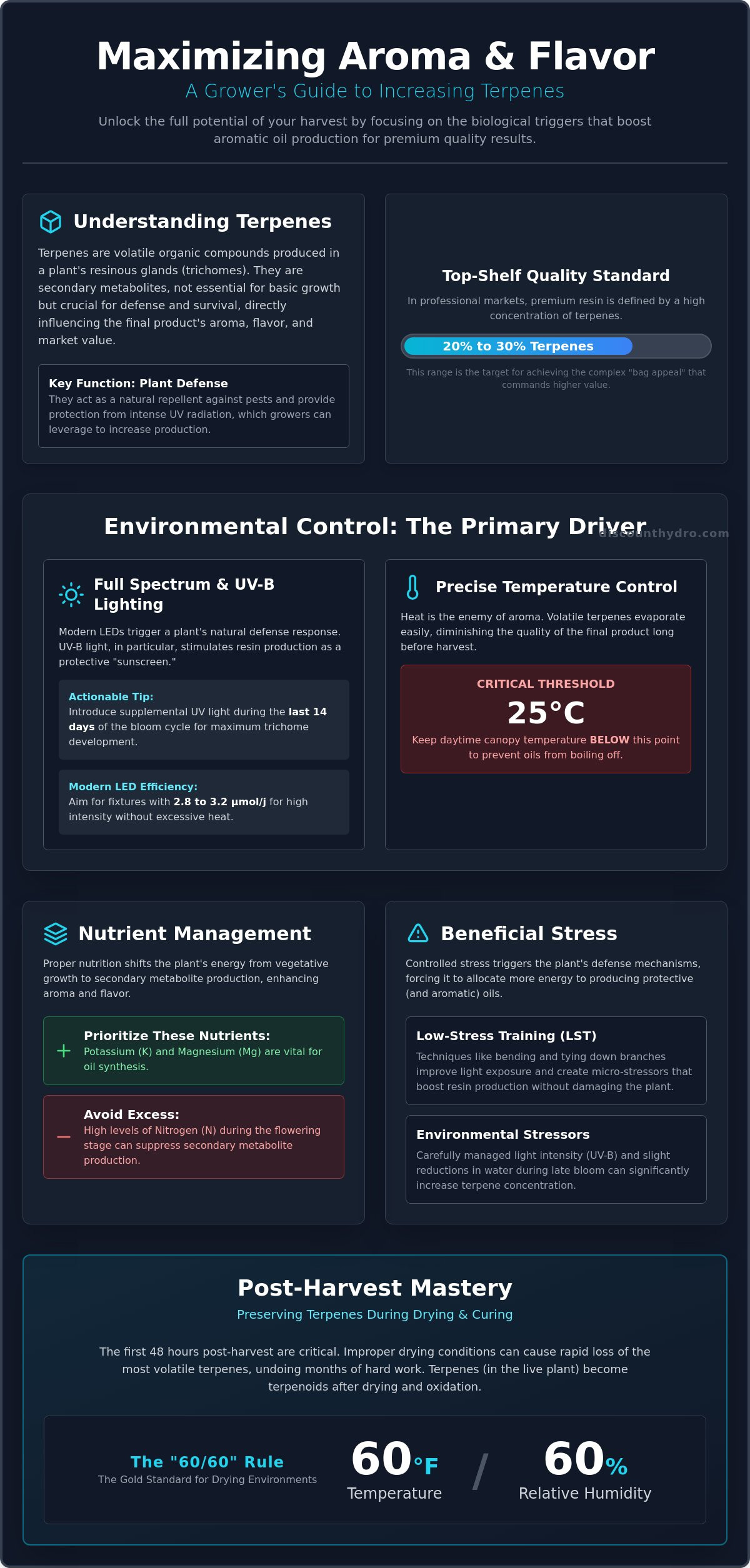
Terpenes serve as a sophisticated defense system. They act as a natural repellent against predatory insects and provide a layer of protection against intense UV radiation. This biological function is exactly why specific lighting and environmental triggers can be used to boost production. The "Entourage Effect" describes how these aromatic compounds interact with other plant metabolites to enhance the overall characteristics of the crop. Without a robust terpene profile, the final harvest often feels flat and lacks the depth required for high-end distribution. In professional markets, resin that comprises 20% to 30% terpenes is the standard for top-shelf quality.
To see how these high-terpene extracts are used in professional-grade hemp topicals and balms, check out Try The CBD.
The Biology of Secondary Metabolites
Terpenes are classified as secondary metabolites. This means they aren't required for the plant's basic growth or reproduction but are essential for survival in competitive environments. The plant uses carbon to construct five-carbon building blocks called isoprene units. Terpene synthesis is a defense-driven response to external environmental stimuli. By manipulating these stimuli, growers can force the plant to allocate more energy toward aromatic production rather than just vegetative biomass.
Terpenoids vs. Terpenes: What is the Difference?
The chemical structure of these compounds changes once the plant is harvested. Terpenes are the live, hydrocarbon-based versions found in the growing plant. Once the drying and oxidation process begins, they become terpenoids. Preserving these delicate oils is just as critical as knowing how to increase terpenes in plants during the flowering stage. Key profiles include:
- Myrcene: Provides earthy, musky notes and is the most common terpene found in high-value crops.
- Limonene: Delivers a sharp citrus scent and is highly sought after for its uplifting aromatic qualities.
- Caryophyllene: Offers a spicy, peppery aroma and is unique for its ability to interact with specific biological receptors.
Each profile requires specific temperature and humidity controls to remain intact. If your grow room is too hot, these volatile oils evaporate long before you reach the drying room.
Optimising Your Grow Room Environment for Maximum Resin
Environmental control is the primary driver for resin quality. If you ignore atmospheric variables, even the best genetics will produce a dull harvest. Learning how to increase terpenes in plants starts with understanding that these oils are highly volatile. They evaporate easily under heat and light stress. You need a system that balances intense light output with precise temperature management to prevent degradation. Stagnant air and improper humidity levels can quickly ruin the complex aromatic profiles you've spent weeks developing.
The Power of UV-B and Full Spectrum Lighting
Modern LED grow lights now include specific channels for UV-B and Infrared. This is crucial for anyone researching how to increase terpenes in plants because UV-B light triggers a natural protective response. The plant produces more resin and trichomes to act as a "sunscreen" against radiation damage. According to a scientific review of terpene synthesis, environmental stressors like light spectrum significantly regulate secondary metabolite production. Top-tier fixtures now reach efficiency standards of 2.8 to 3.2 µmol/j, providing the intensity needed for trichome development without excessive heat. For the best results, introduce supplemental UV during the last 14 days of the bloom cycle.
Temperature Control and the VPD Sweet Spot
Heat is the enemy of aroma. Delicate oils like Myrcene and Limonene begin to dissipate when temperatures climb too high. Keep your daytime canopy temperature below 25°C. Anything higher risks boiling off the very compounds that provide flavor. Transpiration must be managed using a VPD chart to ensure the plant doesn't dry out or stop growing. During the final weeks, drop your night-time temperatures to 15-18°C. This mimics autumn air and signals the plant to finish strong with maximum resin production. This temperature differential is a proven professional technique for deepening scent profiles.
Humidity and CO2 play supporting roles in this process. Keep humidity between 40% and 50% in late flower. This prevents mold while keeping the resin sticky and intact. High CO2 levels are great for yield, but they can raise leaf surface temperature. You must compensate with extra cooling to protect the volatile VOCs. Fresh air exchange is also vital to remove metabolic byproducts and maintain a healthy environment. If you want a professional finish, you need to control every cubic inch of your grow space.
If you're ready to upgrade your environment, explore our selection of LED grow lights designed for precision spectrum control.
The Role of Nutrients and Supplements in Terpene Synthesis
Nutrient management during the bloom phase is a precise balancing act. While Nitrogen is essential for vegetative growth, high levels in late flower can actually suppress the production of secondary metabolites. If you want to know how to increase terpenes in plants, you must reduce Nitrogen and prioritize Potassium and Magnesium. These minerals act as vital catalysts for the enzymatic processes that create resinous oils. A plant focused on building green biomass won't have the metabolic bandwidth to produce a complex aromatic profile.
Potassium (K) is responsible for regulating water movement and enzyme activation within the plant tissue. Magnesium (Mg) serves as the central atom of chlorophyll but also supports the specific metabolic pathways needed for volatile oil production. Without these elements, your crop will lack the energy to produce dense trichomes. High-value crops require these minerals in specific ratios to reach their genetic potential for aroma and flavor. Maintaining these levels ensures the plant doesn't stall during the critical middle weeks of flowering.
Carbohydrates and Molasses: Feeding the Microbes
Resin production is an energy-intensive biological process. Simple and complex sugars provide the immediate fuel required for the plant's "terpene engine." Carbohydrates don't just feed the plant directly; they also support the beneficial microbes in the root zone. A healthy rhizosphere creates a symbiotic environment that significantly boosts aromatic output. Utilizing professional hydroponic nutrients during the bloom stage ensures your crop has the sugar levels required for a pungent finish. Many growers use unsulphured molasses or specialized carbohydrate boosters to maintain this energy supply.
Amino Acids and Precursors
Amino acids serve as the fundamental building blocks for complex terpenoid structures. Applying specific boosters between weeks 3 and 6 of bloom provides the precursors needed for rapid resin development. This is a key strategy for anyone learning how to increase terpenes in plants effectively. Sulfur is another critical element often overlooked. It helps create the pungent, "skunky" profiles that define premium harvests. Industry-standard additives like Rhizoflora Terpinator are formulated to facilitate these specific chemical pathways by providing the necessary building blocks for oil synthesis.
The flushing debate remains a point of contention among professional growers. Some experts argue that a 10 to 14 day flush with plain water improves flavor by forcing the plant to consume stored nutrients. Others suggest that it simply removes excess salts from the growing media to prevent a harsh finish. Regardless of your method, the primary goal is to ensure the final product reflects the plant's natural genetic profile. Proper nutrient timing ensures that your harvest is defined by its aroma rather than its fertilizer schedule.
Using Beneficial Stress (LST & HST) to Trigger Production
Stress isn't always a negative factor in the grow room. In professional cultivation, "eustress" is the strategic application of controlled pressure to trigger a biological defense response. This is a primary method for anyone learning how to increase terpenes in plants. By simulating a threat, you force the plant to produce more resin as a protective shield. Techniques like Low Stress Training (LST) involve bending and tying stems to ensure every floral site receives maximum light from your LED fixtures. High Stress Training (HST) goes further by physically manipulating the plant's structure to change its internal chemistry. Avoid unverified myths like "ice flushes" or "stem splitting." These methods lack scientific backing and often lead to root rot or infection rather than improved aroma.
Defoliation and Light Penetration
Removing lower fan leaves directs the plant's energy toward the top canopy where light intensity is highest. This isn't just about light; it's about managing the microclimate. Stale air trapped around trichomes can lead to moisture buildup and oil degradation. Proper defoliation increases airflow, ensuring your high-value floral sites remain dry and potent. Don't remove more than 20% of the foliage in a single session. Stripping too many leaves at once can shock the plant, causing it to stall and stop terpene synthesis entirely.
Supercropping: The Hormonal Boost
Supercropping involves crushing the inner hurd of a stem without breaking the outer skin. This physical "wound" triggers a systemic defense response and a significant hormonal shift. The plant produces Jasmonic acid, a key hormone that regulates the production of secondary metabolites. It sends extra nutrients to the damaged area to repair the tissue, resulting in a thick "knuckle" that supports heavier, more aromatic growth. Stop all HST by the third week of the bloom cycle. Applying high stress too late can cause the plant to produce male flowers, a process known as hermaphroditism, which ruins the market value of your crop.
Effective training requires the right tools to prevent permanent damage to your stems. For professional training ties and support systems, browse our full range of propagation supplies and grow accessories.
Post-Harvest Mastery: Preserving Terpenes During Drying
Most growers focus entirely on the bloom cycle and forget that the first 48 hours after harvest are the most volatile. Research indicates you can lose up to 50% of your total terpene content in this short window if the environment isn't perfect. While previous sections focused on how to increase terpenes in plants through light and nutrients, this stage is purely about preservation. If your drying room is too warm or too dry, the aromatic compounds you've spent months developing will simply evaporate into the air. You've done the hard work to build the resin; now you must protect it.
Professional standards for high-value crops rely on the "60/60" rule. This requires maintaining a consistent 60°F (15.5°C) and 60% relative humidity. These specific conditions slow down the evaporation of volatile organic compounds while ensuring the plant doesn't dry out so fast that it becomes brittle. Total darkness is also a requirement. Light is the primary enemy of harvested resin. It breaks down trichomes and oxidizes the delicate oils, turning a pungent, premium harvest into a bland, low-value product. Keeping your drying space pitch black is the easiest way to maintain bag appeal.
The Drying Environment
Dedicated space is essential for a professional finish. Setting up a specific grow tent for drying allows for total control over light, temperature, and airflow. You'll need high-quality carbon filters to manage the intense aroma, which is most potent during the initial moisture loss phase. Don't rush the process with heaters or fans pointed directly at the plants. You'll know they're ready for the jar when the smaller stems snap cleanly instead of bending. This "snap test" usually happens between day 7 and day 14 under 60/60 conditions.
Curing for Complexity
Curing is the final step in developing a complex aromatic "bouquet." This process involves storing the dried material in airtight jars and "burping" them daily to release excess moisture and gases. This allows for the slow breakdown of chlorophyll, which otherwise creates a harsh, grassy taste that masks the terpene profile. A long-term cure of 4 to 8 weeks is the industry standard for top-shelf quality. Preserving the results of how to increase terpenes in plants requires this patience to ensure the flavor is smooth and the scent is stable.
To ensure your next harvest meets these professional standards, stock up on the necessary propagation supplies and tools from our inventory.
Maximize Your Harvest Value
Mastering how to increase terpenes in plants requires a combination of precise environmental triggers and specific nutrient precursors. You've learned that using UV-B lighting and managing the VPD sweet spot creates the biological defense response needed for heavy resin. Reducing Nitrogen in late bloom while prioritizing Potassium and Magnesium ensures the plant has the metabolic energy for aromatic production. Protecting those volatile oils with the 60/60 drying rule prevents the loss of quality after all your hard work. Consistency in these areas separates hobbyist results from professional-grade harvests.
Get the professional results your crop deserves. Shop Discount Hydro for the best prices on Nutrients and LED Lighting. We offer expert-selected inventory from top brands like Intense Nutrients with UK-wide fast delivery. If you're local, take advantage of click and collect from our Chester-le-Street location. Our inventory is built for growers who prioritize quality and value. Start optimizing your grow space today and see the difference in your next harvest.
Frequently Asked Questions
Do LED grow lights increase terpenes more than HPS?
Modern LED grow lights are more effective than HPS for aromatic production because they offer spectral precision and lower heat output. HPS fixtures generate significant infrared heat that often evaporates volatile oils before harvest. High-efficiency LEDs with dedicated UV and IR channels allow you to trigger resin production without risking the high canopy temperatures that destroy delicate scents.
Can I add terpenes directly to my plants during the grow?
No, applying external terpenes to your plants won't change their internal genetic expression or oil synthesis. Instead, you should use nutrient additives that provide the building blocks, such as sulfur and specific amino acids, to support the plant's natural metabolic processes. Focus on how to increase terpenes in plants by providing these precursors during the peak flowering weeks.
How does temperature affect the smell of my plants?
Excessive heat is the primary cause of aroma loss in the grow room. When daytime temperatures exceed 25°C, the most volatile organic compounds begin to boil off the plant. Maintaining cooler temperatures, especially during the final two weeks of bloom, ensures these oils remain trapped within the trichome heads rather than dissipating into your carbon filter.
Does molasses actually make the fruit taste sweeter?
Molasses doesn't directly sweeten the final harvest through sugar translocation. It works by feeding the beneficial microbes in the root zone and providing an easily accessible carbon source for the plant's energy-intensive resin production. This metabolic boost results in a more complex and intense flavor profile, but it won't make the fruit taste like sugar.
What is the best humidity level for terpene production?
Keep your relative humidity between 40% and 50% during the final stages of flowering. This range is low enough to prevent botrytis and other fungal issues that thrive in dense, resinous growth. Maintaining this specific window also prevents the "stale" moisture buildup that can lead to the degradation of the most delicate aromatic compounds before you reach the drying stage.
Is flushing necessary for a better-tasting harvest?
Flushing with plain water for 10 to 14 days helps remove excess mineral salts from the growing media. While it doesn't technically increase the terpene count, it prevents stored nutrients from causing a harsh or chemical taste in the finished product. A proper flush ensures the natural aromatic "bouquet" of your crop is the dominant characteristic during consumption.
Can I increase terpenes in the last week of flowering?
You can maximize the final resin push in the last week, but you can't compensate for poor growth earlier in the cycle. This is the ideal time to implement a 10°C temperature drop at night and use supplemental UV lighting. These late-stage stressors act as a final trigger for the plant to protect its floral sites with a dense layer of aromatic oil.
Do UV lights really work for resin production?
UV-B lighting is a proven method for those looking at how to increase terpenes in plants through environmental stress. The plant perceives UV radiation as a threat and produces more trichomes and resin to act as a protective sunscreen. This biological defense mechanism results in a significantly more potent and pungent harvest compared to plants grown under standard light spectrums alone.