

How to Reduce Your Grow Room Electricity Bill: The 2026 UK Grower’s Guide
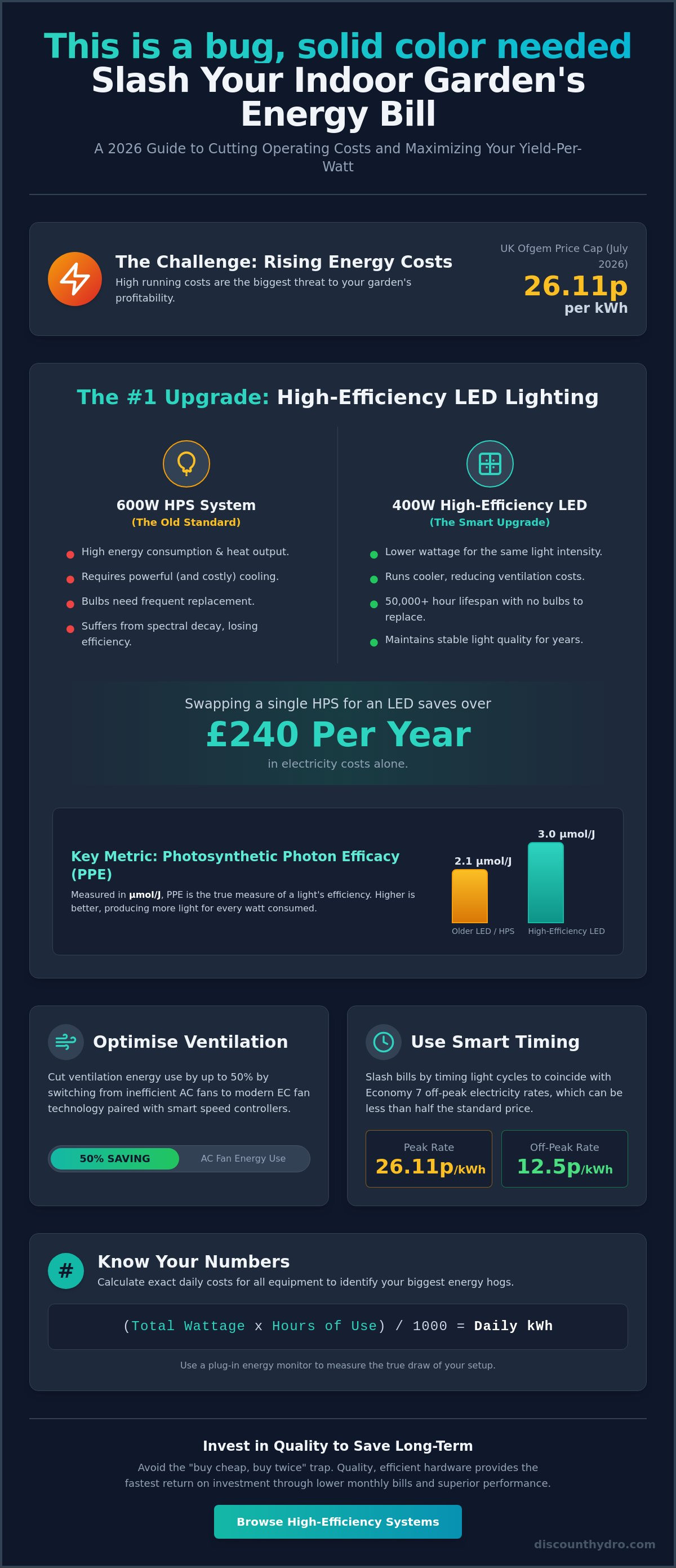
Swapping a single 600W HPS for a high-efficiency 400W LED saves over £240 a year on electricity while maintaining the same light intensity. With the Ofgem price cap rising to 26.11 pence per kWh in July 2026, high running costs are currently the biggest threat to your indoor garden's profitability. You need a way to reduce electricity bill grow room expenses without sacrificing the health of your plants or the final weight of your harvest. It's a common struggle for UK growers facing record-high energy rates and inefficient older lighting systems.
We've compiled the most effective, high-impact strategies to slash your monthly overheads using current UK market data. You'll learn how to leverage Economy 7 tariffs to access off-peak rates as low as 12.5p/kWh and why upgrading to fixtures with a 3.0 µmol/J rating is now a financial necessity. This guide provides a direct breakdown of thermal insulation, high-efficiency ventilation, and hardware migration. Follow these steps to maximize your yield-per-watt ratio and keep your operational costs under control throughout 2026.
Key Takeaways
- Calculate exact daily costs using the standard UK kWh formula for all equipment.
- Reduce electricity bill grow room expenses by migrating from HPS to high-PPE LED lighting.
- Cut ventilation energy use by 50% with EC fan technology and smart speed controllers.
- Slash bills by timing light cycles to coincide with Economy 7 off-peak electricity rates.
- Avoid the "buy cheap, buy twice" trap with quality hardware that prevents spectral decay.
Calculating Your Grow Room Energy Consumption
The first step to manage your overheads is mastering the kilowatt-hour (kWh). This is the unit your UK energy supplier uses to generate your bill. One kWh equals 1,000 watts of power used for one hour. You can find your daily usage with a simple formula: (Total Wattage x Hours of Use) / 1000 = Daily kWh. If you want to reduce electricity bill grow room totals, you must apply this math to every piece of kit in your tent. For instance, a 600W light running for 12 hours a day consumes 7.2 kWh. At current high rates, that single light can cost over £50 per month to operate.
Many growers overlook "constant load" equipment. Extraction fans and circulation pumps might have lower wattages than lights, but they run 24 hours a day. A 50W fan running 24/7 uses 1.2 kWh daily, which adds up significantly over a full cycle. It's best to use a plug-in energy monitor to see the true draw of your setup. These devices show real-time consumption, revealing if an old ballast or pump is drawing more than its rated wattage. Relying on manufacturer labels alone often leads to underestimating your actual energy spend.
The Impact of the UK Energy Price Cap
The Ofgem price cap for July to September 2026 is 26.11 pence per kWh. This rate, combined with a daily standing charge of 57.19 pence, makes indoor gardening more expensive than in previous years. If you're on a standard variable tariff, your monthly costs will change every three months based on these caps. Monitoring your usage is especially critical during the winter months when heaters might trigger to keep temperatures stable. Knowing your exact unit rate helps you find ways to reduce electricity bill grow room costs, such as switching to a fixed-rate tariff or a time-of-use tariff like Economy 7.
Identifying Your Biggest Energy Hogs
Not all hardware is created equal. High-intensity discharge lighting is usually the largest expense, but you should also look at different types of grow lights to see how spectral efficiency impacts your wallet. Extraction systems are the second biggest draw. Inefficient AC fans consume significantly more power than modern EC versions. Look for "phantom drain" in older equipment; old magnetic ballasts often lose energy as heat rather than light. Prioritising upgrades for these high-consumption items ensures the fastest return on your investment through lower monthly bills.
Migrating to High-Efficiency LED Lighting
Upgrading your lighting system is the fastest way to reduce electricity bill grow room costs. While High-Pressure Sodium (HPS) and Metal Halide (MH) lamps were once the standard, their high heat output and energy waste make them obsolete in 2026. LEDs convert a much higher percentage of electricity into usable light for plants. You should measure success by yield-per-watt. This metric proves that a more efficient light produces more biomass for every pound spent on power. According to NYSERDA's Best Practices Guidebook, switching to high-efficiency lighting is a primary strategy for horticultural energy reduction. It's about maximizing output while minimizing input.
Don't just look at wattage. Look at Photosynthetic Photon Efficacy (PPE), measured in micromoles per joule (µmol/j). A light with a 3.0 µmol/j rating produces significantly more light than a 2.1 µmol/j fixture using the same power. This efficiency reduces the "Heat Factor" in your garden. HID lamps act like space heaters, forcing your extraction fans to run at max speed to maintain a 25°C environment. LEDs run cooler, meaning your ventilation system consumes less power. It's a double saving that directly impacts your monthly overheads.
LED vs. HPS: The Real Cost Comparison
The initial price of an LED fixture is higher than an HPS kit. However, the long-term savings are undeniable. You'll see a return on investment within 12 to 24 months through lower bills alone. You also save on maintenance costs. LED diodes are rated for 50,000+ hours. That's over a decade of use without buying replacement bulbs. HPS bulbs suffer from spectral decay, losing efficiency after every harvest. LEDs maintain their light quality for years. Removing HID lamps also slashes your cooling requirements, allowing for smaller, cheaper ventilation setups.
Choosing the Right Wattage for Your Space
Match your light's footprint to your grow area. Excess light hitting tent walls is wasted money. Modern LED grow lights are the industry standard for 2026 because they offer precision control. Use dimmable LEDs to save power during the early growth stages when plants need less intensity. There's no need to blast seedlings with 100% power. If you are ready to upgrade, you can browse high-efficiency lighting systems designed for maximum ROI. Proper placement and dimming ensure every watt you pay for goes directly into plant development.
Optimising Ventilation and Climate Control
Ventilation is the second largest energy expense in most indoor gardens. Many growers over-ventilate, which wastes power and forces heaters to work harder. You can reduce electricity bill grow room costs by moving away from old-school AC fans. These older motors are inefficient when dimmed. Modern EC (Electronically Commutated) fans use digital technology to scale power consumption precisely with speed. If you run an EC fan at 50% speed, it uses significantly less than half its maximum power. This creates a more stable environment while slashing your monthly overheads.
Using oversized fans is a counter-intuitive but effective strategy. A larger fan running at a lower RPM is more efficient and quieter than a smaller fan running at full tilt. This setup lasts longer and provides better control over your Vapor Pressure Deficit (VPD). To further cut costs, use passive intake. High-quality extraction creates enough negative pressure to pull in fresh air through tent vents. This removes the need for a secondary intake fan, saving you both the hardware cost and the daily electricity draw.
EC Motor Technology vs. Traditional AC Fans
EC motors represent a 50% energy saving over traditional AC models. Digital controllers allow these fans to react to temperature and humidity in real-time. This prevents the fan from running faster than necessary. Over a single growing season, the savings on your UK energy bill can often cover the price difference of the fan itself. You also benefit from a massive reduction in noise, which is vital for discreet indoor setups. It's a pragmatic choice for any grower concerned with long-term value.
Thermal Management and Insulation
Your environment is an ecosystem. High-quality grow tents with thick, reflective lining are essential for trapping heat during the lights-off period. In the UK, many gardens are located in cold lofts or garages. Cold floors are a major issue. Placing your pots directly on concrete causes cold-shock and forces you to use expensive water or space heaters. Use foam insulation boards or raised platforms to keep the root zone warm.
During the winter, consider venting your filtered exhaust air into the rest of your home. This repurposes the heat generated by your lights to help warm your living space. It's a practical way to offset your domestic heating bills. By combining insulation with smart fan control, you minimize the "on-time" of high-draw heaters. These heaters are often the hidden cause of skyrocketing energy bills. Focus on sealing leaks and maintaining a consistent thermal mass to keep your equipment from working overtime.
Operational Strategies: Timing and Tariffs
Operational timing is often the most overlooked method to reduce electricity bill grow room costs. In the UK, electricity prices vary significantly depending on the time of day. If you run your high-draw equipment during peak hours, you pay the maximum rate possible. Shifting your "lights-on" period to the night allows you to take advantage of cooler ambient temperatures and cheaper energy windows. This strategy also helps manage the thermal swings common in UK lofts and outbuildings. It keeps the environment stable without relying on power-hungry heaters during the coldest parts of the night.
Choosing the right light cycle for the vegetative stage is another quick win. While some growers prefer a 24/0 cycle, switching to 18/6 provides a 25% saving on lighting costs immediately. Plants require a rest period for optimal health, and the extra six hours of light often yield diminishing returns. Using smart timers and automation ensures your equipment never accidentally runs into peak-time pricing. It removes human error and guarantees your garden operates at the highest possible efficiency.
Economy 7 and EV Tariffs for Growers
Many UK energy providers offer Economy 7 or specific EV tariffs with a 7-hour window of cheap electricity. Off-peak rates can be as low as 12.5p/kWh, compared to the standard 26.11p/kWh. Aligning your 12/12 flowering cycle with this window can cut your lighting bill in half. You must ensure your extraction system can handle the daytime "lights-off" period. In summer, daytime heat can cause spikes in humidity when the lights are off. Proper insulation and fan control are essential to prevent these environmental issues while you save money.
Reducing Humidity to Lower Dehumidifier Costs
Dehumidifiers are energy hogs that can ruin your efficiency. Your watering schedule and choice of hydroponic nutrients directly impact the moisture levels in your tent. Heavy feeding often leads to higher transpiration rates. You can manage this by defoliating excess fan leaves to improve airflow and reduce the moisture released into the air. This lowers the load on your dehumidifier. Using larger pots or mulch also slows evaporation from the growing media. These small adjustments are a proven way to reduce electricity bill grow room expenses while maintaining plant health. If you need to upgrade your setup, buy high-efficiency grow room equipment to maximize your savings.
Investing in Value: Why Quality Hardware Saves Money
Cheap equipment often draws more power than advertised or loses efficiency within months. To reduce electricity bill grow room costs long-term, you must avoid the "buy cheap, buy twice" trap. High-quality digital ballasts and LED drivers maintain a consistent power factor. This ensures they convert electricity into usable light with minimal waste as heat. Low-grade alternatives often suffer from spectral decay. This is where the light output drops significantly while the power draw remains the same. You end up paying full price for light that no longer fuels plant growth.
ROI of Professional Grow Systems
Upgrading to a professional LED system has a quantifiable payback period. If a high-efficiency fixture saves you £20 per month on energy, the unit can pay for itself through bill reductions alone within 24 months. Beyond lighting, hydroponics setups often prove more energy-efficient than traditional soil. These systems facilitate faster growth cycles, which means your lights and fans run for fewer total weeks per year. We offer click-and-collect and fast UK delivery to help you upgrade your setup without any downtime between harvests.
Maintenance for Maximum Efficiency
Even the best hardware loses its edge if neglected. Dust on LED diodes or reflectors can reduce light intensity by 10% or more without lowering your bill. Clean your equipment between every cycle to ensure maximum light transmission. Your extraction system is another area for potential savings. A clogged carbon filter forces the fan motor to work harder, which increases the electrical draw. Replace filters regularly to keep airflow smooth and consumption low.
Check the zips and seals on your grow tent frequently. A perfect thermal envelope prevents your heaters from triggering unnecessarily during the lights-off period. This is a vital step to reduce electricity bill grow room totals during the colder UK months. Consistent maintenance ensures every watt you pay for is used effectively, protecting your margins and your plant health.
Maximise Your ROI with Efficiency Upgrades
You now have a clear roadmap to reduce electricity bill grow room expenses through hardware migration and strategic timing. The data for 2026 is certain; high UK energy rates make efficiency a requirement for every indoor garden. Shifting to modern LED systems and leveraging Economy 7 off-peak windows are the most effective ways to protect your margins. Don't let inefficient HID lamps or outdated AC fans drain your profits. By combining trade-grade hardware with smart climate control, you can maintain peak plant health while slashing your monthly overheads.
Discount Hydro is here to help you scale effectively. We offer competitive pricing on top-tier brands like Omega and Dutch Pro, ensuring you get professional performance at the best possible value. Our County Durham warehouse provides expert technical support to help you choose the right kit for your specific space. With UK-wide fast delivery, you can start upgrading your system immediately and see the impact on your next billing cycle.
Browse our range of high-efficiency LED Grow Lights and start saving today. Take control of your overheads and build a more sustainable, cost-effective growing environment.
Frequently Asked Questions
How much does it cost to run a 600w light for 12 hours in the UK?
It costs approximately £1.88 per day to run a 600W light for 12 hours. This calculation is based on the July 2026 Ofgem price cap of 26.11 pence per kWh. Over a full month, this adds roughly £56.40 to your energy bill. You can lower this cost by switching to a lower-wattage LED that provides the same light intensity.
Is it cheaper to grow plants in a tent or a spare room?
Growing in a tent is significantly cheaper due to better thermal efficiency and light reflection. Tents create a contained micro-environment that is easier to heat and ventilate than a full room. The reflective Mylar walls ensure no light is wasted on dark surfaces. This allows you to use smaller, more efficient fans and heaters to maintain your climate.
Does turning my grow lights off for 6 hours really save money?
Yes, moving from a 24/0 light cycle to an 18/6 cycle reduces your lighting electricity consumption by 25%. Most plants benefit from a dark period to process energy, and the extra six hours of light often yield diminishing returns. This is a simple, no-cost strategy to reduce electricity bill grow room expenses while protecting the health of your plants.
What is the most energy-efficient way to heat a grow room in winter?
The most efficient method is using floor insulation combined with low-wattage tube heaters. Concrete floors in the UK pull heat away from your pots, forcing your equipment to work harder. Elevating your pots and using foam insulation boards keeps the root zone warm for pennies. You should also run your lights at night to use their heat during the coldest hours.
Can I use a smart meter to track my grow room electricity usage?
You can use a smart meter to see your total household draw, but a plug-in energy monitor is more effective for specific equipment. These monitors sit between the wall and your plug, showing the exact live wattage of your lights or fans. This helps you identify "energy hogs" or old ballasts that are drawing more power than they should. It's a pragmatic tool for auditing your setup.
Will an LED grow light actually lower my electricity bill compared to HPS?
Yes, upgrading to LED is a primary way to reduce electricity bill grow room costs. A 400W LED can replace a 600W HPS while providing better light quality and 33% lower power consumption. You also save on cooling costs because LEDs produce far less heat. This reduces the load on your extraction fans, leading to lower monthly bills across your entire setup.
Are EC fans worth the extra cost for a small grow setup?
EC fans are worth the investment because they use up to 50% less electricity than traditional AC fans when dimmed. Digital EC motors maintain high efficiency even at low speeds, whereas AC fans waste energy as heat when you slow them down. The savings on your UK energy bill will typically cover the price difference of the fan within a few harvests. They also run much quieter.