

How to Start Seeds in a Grow Tent: The 2026 Beginner’s Guide
What if your grow tent isn't just a storage space for mature plants, but actually the most precise laboratory for starting seeds you'll ever own? Many growers face the frustration of seeds that refuse to sprout or seedlings that turn into tall, spindly sticks overnight. It's a common struggle when you're first learning how to start seeds in a grow tent while trying to balance humidity and light intensity. You want a high success rate and stocky, healthy seedlings that are ready for transplant without wasting money on failed attempts or unnecessary equipment.
This 2026 beginner's guide provides a direct, pragmatic approach to mastering seed propagation using your existing setup. We'll show you how to use your grow room equipment efficiently to achieve professional-grade germination rates every time. You'll learn the exact steps to manage your environment, from selecting the right LED grow lights to maintaining perfect humidity levels to prevent damping off. We're cutting through the technical jargon to give you a clear roadmap for turning your grow room into a high-output propagation hub that produces consistent, healthy results for every tray you start.
Key Takeaways
- Total environmental control in an enclosed space beats windowsills for consistent germination consistency and speed.
- Master how to start seeds in a grow tent by using heat mats to maintain precise root zone temperatures.
- Choose between direct sowing and high-efficiency propagation plugs like Rockwool for the best start in your setup.
- Set correct LED light clearance and 18/6 photoperiod timers to prevent weak, leggy seedlings.
- Identify true leaves to time your transplants perfectly for uninterrupted growth within your grow room.
Why Start Seeds in a Grow Tent?
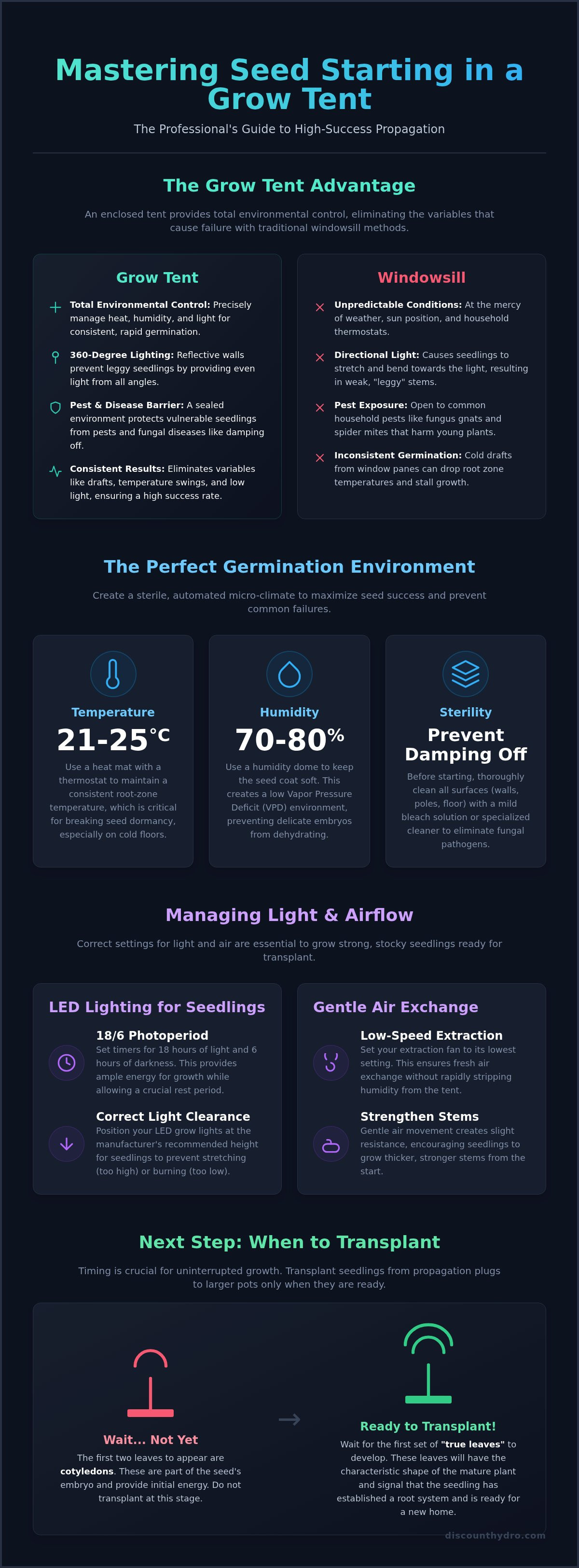
Starting seeds in a grow tent means using a dedicated, enclosed space to manage heat, light, and humidity levels with absolute precision. While some growers view a tent as simple storage, it's actually a high-performance environment for the biological process of seed germination. When you learn how to start seeds in a grow tent, you eliminate the variables that cause failure on windowsills. You aren't at the mercy of the sun or the house thermostat. Instead, you create a micro-climate where every factor is optimized for rapid root development.
Windowsills are notoriously unreliable. They provide directional light that causes seedlings to bend and stretch, resulting in weak stems. A grow tent uses reflective Mylar walls to bounce light from every angle. This ensures 360-degree coverage, keeping your plants upright and stocky. UK growers face particularly short days and freezing temperatures during the peak starting season. A tent bypasses these seasonal limits entirely. You can start heat-loving crops in the middle of a County Durham winter without worrying about frost or low light levels. It's a pragmatic solution for year-round production.
Pest management is another critical factor. Young seedlings are vulnerable to house flies, spider mites, and fungus gnats. These pests often hitchhike on household items or enter through open windows. The sealed design of a professional tent acts as a physical barrier. When combined with proper intake filters, it keeps your propagation area sterile. This reduces the risk of damping off and minimizes the need for interventions later in the plant's life cycle. You're effectively building a clean room for your genetics.
The Tent Advantage vs. Traditional Methods
Consistency is the primary benefit. You avoid the "cold draught" of a window pane that often drops root zone temperatures below the functional threshold. Tents allow you to use extraction fans to maintain steady airflow and manage Vapor Pressure Deficit (VPD). This movement strengthens the seedling through gentle resistance. If you're selecting your first setup, our grow tent guide covers the technical requirements for different plant counts. Tents also offer incredible space efficiency, allowing you to stack propagation trays vertically to maximize your footprint.
What You Can Grow
Tents are ideal for starting high-value vegetables and ornamental flowers that require a long growing season. You can get an eight-week head start on peppers or aubergines before the last frost. They are also perfect for specialised projects. For example, you can learn How to Grow Ginger at Home by using the tent to maintain the high humidity and consistent warmth this tropical plant demands. Whether you're starting tomatoes or exotic tubers, the tent provides the laboratory-grade conditions needed for a high success rate.
Preparing the Perfect Germination Environment
A successful harvest starts with a sterile environment. Before you begin, clean every surface of your tent with a mild bleach solution or a specialized grow room cleaner. Wipe down the Mylar walls, the support poles, and the floor tray to eliminate pathogens. This step is vital to prevent damping off, a fungal disease that causes new stems to rot at the soil line. If you're following a step-by-step guide to starting seeds, you'll recognize that warm, humid environments are breeding grounds for mold. A clean tent ensures your expensive genetics have a fighting chance from day one.
Once the space is sterile, organize your equipment to automate the climate. Place your heat mat on a flat surface and position your propagation trays directly on top. Use humidity domes to seal in moisture during the critical first 48 hours. This setup mimics the tropical conditions required to break seed dormancy. You also need to configure your extraction fan for minimal air exchange. In a small space, a high-powered fan can strip away humidity faster than a heat mat can generate it. Set the fan to its lowest speed to keep air fresh without drying out your growing media. Learning how to start seeds in a grow tent is about balancing these competing forces.
Temperature and Humidity (VPD) Basics
Most seeds thrive in a "Goldilocks zone" between 21°C and 25°C. Aim for a relative humidity of 70% to 80% to ensure the seed coat stays soft enough for the sprout to break through. In 2026, successful growers use Vapor Pressure Deficit (VPD) to monitor plant stress. Vapor Pressure Deficit (VPD) is the measurement of the difference between the amount of moisture in the air and how much moisture the air can hold when saturated, which dictates how effectively a seedling can transpire. Keeping your VPD low during germination prevents the delicate embryos from dehydrating before they establish a root system.
Using Heat Mats and Thermostats
UK grow rooms, often located in unheated lofts or garages, suffer from cold floors. Bottom heat is the most effective way to trigger germination because it warms the root zone directly. Don't plug a heat mat directly into the wall; always use a thermostat. Setting the temperature too high can cook the seeds, while too low will stall growth. Position the thermostat sensor inside the propagation tray, pressed into the media, to get an accurate reading of what the seeds actually feel. Investing in quality propagation supplies like digital thermostats ensures you maintain these precise levels without constant manual adjustments.
Seed Germination Methods for Your Grow Tent
Selecting the right technique for how to start seeds in a grow tent depends on your final growing system and the sensitivity of your plants. Direct sowing is the most straightforward method for plants with delicate taproots that don't tolerate handling. By planting directly into coco coir or soil, you eliminate the risk of transplant shock. However, many high-efficiency setups rely on propagation plugs like Rapid Rooters or Rockwool. These plugs provide a consistent air-to-water ratio that accelerates early root development. According to this university guide to starting seeds, choosing the right container and media is the first step toward a healthy crop. Whether you choose Hydroponics vs Soil, the goal remains the same: provide a stable foundation for the first root to anchor.
The paper towel method is a classic technique often used to test the viability of older seeds. You place seeds between damp paper towels inside a plastic bag to check for sprouts. While it's useful for seeing if seeds will "pop," it's less practical for large-scale tent growing. Moving a germinated seed with a visible root into a tray is risky. The tiny root hairs can easily snap or dry out in seconds. For most growers, starting directly in the final media or a dedicated plug is the more reliable choice for consistent results.
Direct Sowing into Growing Media
When sowing directly, depth is critical. A reliable rule is to plant the seed at a depth roughly twice its width. Planting too deep will exhaust the seed's energy before it reaches the light; too shallow, and it may dry out. Keep the media damp but never waterlogged. Excessive moisture at this stage leads to oxygen deprivation and rot. During these early stages, you don't need heavy feeding. If you're using inert media, introduce diluted hydroponic nutrients once the first set of leaves appears. This provides the essential minerals needed for cell division without burning the young roots.
Using Propagation Kits and Plugs
Propagation plugs are the industry standard for a reason. They fit perfectly into standard trays and keep the root zone contained, which makes the eventual transplant much easier. If you're using Rockwool, you must pre-soak the cubes in pH-adjusted water (around 5.5) to neutralize the natural alkalinity of the stone wool. Rapid Rooters are often pre-moistened and ready to use out of the bag. When you organize your tray, leave a small gap between the plugs or use a mesh-bottom tray to encourage airflow. This prevents the bottom of the plugs from becoming stagnant and helps maintain the high oxygen levels that new roots require to thrive.
Managing Light and Airflow for Seedlings
Once your seeds have successfully sprouted, the focus shifts to preventing leggy growth. Proper lighting is the most critical factor in how to start seeds in a grow tent without causing them to fail. Modern LED grow lights are significantly more efficient than older HID or fluorescent bulbs, meaning they produce higher intensity with less radiant heat. If you follow outdated advice to "keep the light as close as possible," you risk bleaching or stunting your young plants. Start with a conservative clearance and adjust based on your manufacturer's specs. Set your timer for a photoperiod of 18 hours of light and 6 hours of darkness to give the seedlings enough energy to build cell structures while allowing for a necessary rest period.
Monitoring for "stretch" is a daily task. If your seedlings look thin, tall, and struggle to stand up, they're searching for more light. This usually happens because the light is too high or the intensity is too low. Conversely, if leaves look curled or have brown tips, they're likely getting hit with too much light. Balance is key. You also need a small clip-on fan to provide gentle air movement. This movement creates micro-stresses on the stem, which forces the plant to produce more cellulose and grow thicker. Without this, your plants will be too weak to support their own weight once they begin producing larger leaves.
Setting Your LED Grow Light Intensity
Understanding PAR and PPFD is essential for precision growing in 2026. Seedlings only require a fraction of the light intensity that mature, flowering plants need. Aim for a lower PPFD range during the first week to avoid overwhelming the delicate tissue. Use the built-in dimmers on your lights to achieve this; it saves on electricity and prevents light burn. To check for heat, use the simple hand test: place your hand at the canopy level for 30 seconds; if it feels uncomfortably warm to you, it is definitely too hot for the plants.
Strengthening Stems with Air Movement
An oscillating breeze is the best way to build structural integrity. Don't point the fan directly at the tray, as constant high-speed air can cause windburn and dry out the media too quickly. Instead, aim the fan to bounce air off the tent walls. This prevents stagnant air pockets where pests like spider mites thrive. Keep your extraction fan running at a low setting to ensure a constant supply of fresh CO2, which is the primary building block for plant tissue. For high-performance equipment at warehouse prices, check our full range of LED grow lights today.
Next Steps: Transplanting and Beyond
The final phase of learning how to start seeds in a grow tent is knowing exactly when to move your plants into their permanent homes. You'll know they're ready when the first "true leaves" appear. These are the jagged or shaped leaves that grow after the initial smooth seed leaves. Once you see these, the plant's metabolic needs increase. Unlike moving plants outdoors, a tent-to-tent transplant doesn't require a long "hardening off" period. Since you're maintaining a controlled environment in both spaces, the transition is almost immediate. This efficiency is why indoor setups are superior for rapid growth cycles.
Before moving, prepare your larger pots or hydroponic systems. Ensure your growing media is pre-buffered or moistened to match the seedling's current tray. A final checklist for success includes:
- Sterilise all large pots and reservoir tanks.
- Check that your main grow light is set to a safe height for young transplants.
- Verify that your nutrient solution is at the correct pH and EC levels.
- Ensure your extraction system is ready for the increased humidity of larger plants.
Following these steps ensures your plants don't stall during the move. Mastering how to start seeds in a grow tent allows you to maintain a perpetual harvest cycle by having new seedlings ready as soon as your main tent is harvested.
When to Move Your Seedlings
Check the bottom of your propagation plugs or starter pots daily. You want to see healthy, white root tips beginning to emerge. If you wait too long, the seedlings become root-bound. This is where roots circle the container and eventually choke the plant, stalling growth for weeks. Once transplanted, it's time for the first real dose of plant nutrients. Start with a quarter-strength solution to avoid nutrient burn while the roots establish themselves in the new media.
Discount Hydro Propagation Essentials
We provide professional-grade propagation kits designed for UK growers who value performance and price. Our kits include everything from sterile trays to precision heat mats, providing a one-stop start for your season. Our LED grow lights are specifically selected for the 2026 season to provide the exact spectrum needed for early vegetative growth. We offer fast nationwide delivery across the UK, or you can use our click-and-collect service at our County Durham warehouse. Order your propagation gear today to get your grow room running at peak efficiency.
Achieve Professional Germination Results Today
Mastering the technical aspects of how to start seeds in a grow tent transforms your propagation from a guessing game into a repeatable science. You've learned the importance of maintaining precise root zone temperatures with heat mats and managing modern LED intensity to prevent leggy seedlings. By focusing on sanitation and moisture control, you eliminate the common causes of early plant failure. This pragmatic approach ensures every seed you plant has the best possible foundation for a high-yield harvest. Consistency in your environment leads directly to consistency in your results.
We provide the professional tools you need to succeed without the high markup. Shop our professional Propagation Supplies for the best start! Our inventory includes competitive pricing on top-tier brands and we provide expert advice for every customer. With fast UK-wide delivery and click-and-collect options at our County Durham warehouse, you can start your 2026 season immediately. Your journey to a more productive grow room begins with the right equipment. Get your trays ready and start growing with confidence.
Frequently Asked Questions
Do I need to leave my grow light on 24 hours a day for seeds?
No. Most growers use an 18/6 light cycle for optimal results. Seedlings need a dark period to focus on root development and cellular respiration. A 24-hour cycle can stress young plants and increase electricity costs without providing a proportional growth benefit. Stick to an 18-hour photoperiod to maintain plant health and efficiency in your grow room.
How far should my LED grow light be from my seedlings?
Distance depends on your specific LED model and intensity. Keep modern LEDs between 24 and 36 inches away during the early seedling stage. If your light has a dimmer, set it to 20% or 30% power. This prevents light burn while providing enough energy to stop stretching. Always check the manufacturer's PPFD charts for precise 2026 equipment settings.
Can I start seeds in a grow tent without a heat mat?
Yes, but your germination rates will likely drop in cold environments. A heat mat is essential for maintaining a consistent 21-25°C root zone temperature in unheated UK grow rooms. Without one, seeds may rot before they sprout or take significantly longer to germinate. Using a heat mat is a pragmatic way to ensure professional results when learning how to start seeds in a grow tent.
Why are my seedlings falling over and dying at the base?
This is likely "damping off," caused by soil-borne fungi. It happens when the environment is too wet or lacks proper airflow. The stem shrivels at the soil line and the plant collapses. To prevent this, ensure your tent is sterile, use fresh growing media, and avoid overwatering. Proper extraction fan settings help keep the air fresh and the media surface dry.
What is the best humidity level for seed germination in a tent?
Aim for 70% to 80% relative humidity during the initial germination phase. High humidity keeps the seed coat soft, allowing the sprout to break through easily. Use a humidity dome to trap moisture around the trays. Once the first true leaves appear, gradually lower the humidity to 60% to prevent fungal issues and encourage healthy transpiration rates.
Can I use regular garden soil to start seeds in my grow tent?
No. Garden soil is too heavy and often contains pests, pathogens, or weed seeds. It can easily compact in a container, suffocating young roots. Use a sterile seed-starting mix, coco coir, or propagation plugs. These options provide the high aeration and drainage required for successful seed starting in a grow tent. Stick to professional media for consistent results.
How often should I water my seeds in a grow tent?
Water only when the surface of your media feels dry to the touch. Overwatering is a common beginner mistake that leads to root rot and oxygen deprivation. Use a spray bottle to mist the media gently during the first few days. Once roots are established, water from the bottom of the tray to encourage the root system to grow downwards.
What is the best temperature for starting vegetable seeds indoors?
Most vegetable seeds germinate best between 21°C and 25°C. Maintaining this "Goldilocks zone" ensures rapid cell division and healthy root development. If your grow room drops below 18°C, germination will stall or fail entirely. Use a digital thermostat with your heat mat to lock in these precise temperatures. Consistent warmth is the most effective way to achieve professional germination rates.