

Hydroponic Nutrients UK: The 2026 Buyer’s Guide to Plant Feed
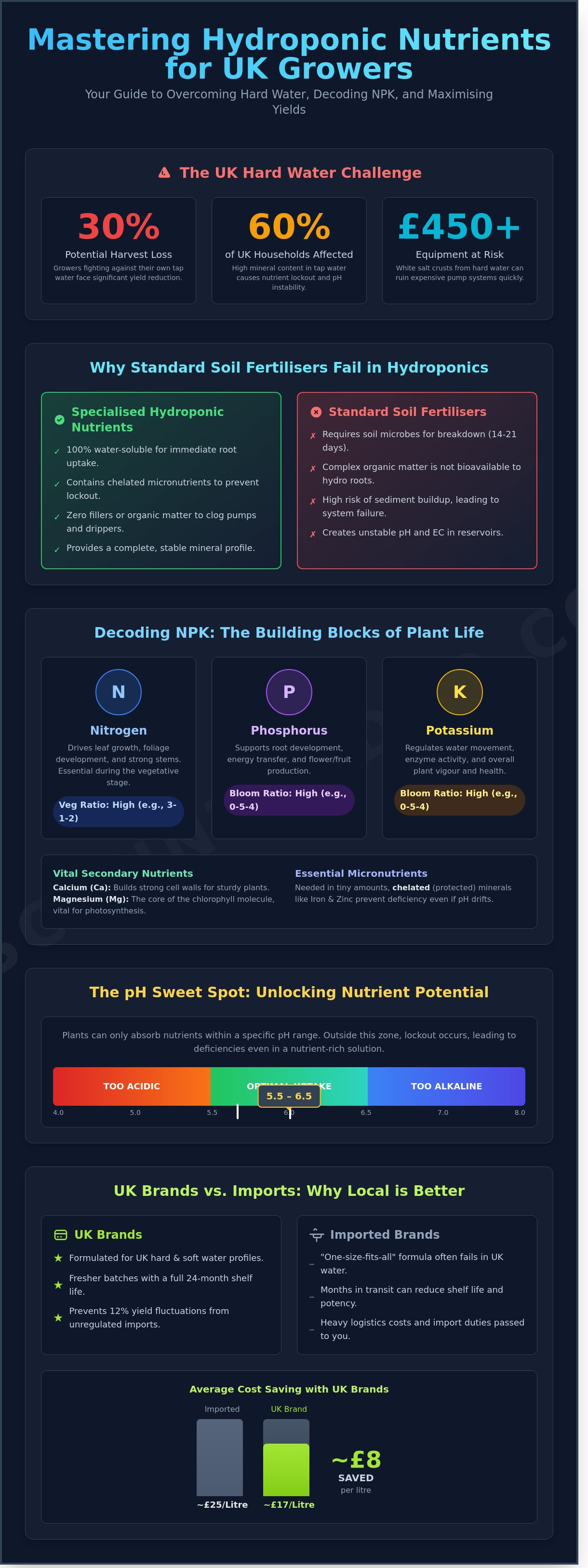
Most UK growers lose up to 30% of their potential harvest weight simply because they are fighting against their own tap water. While premium imported brands promise miracles, they often fail to account for the high mineral content found in 60% of British households. It's frustrating to watch your pH levels swing or see white salt crusts ruin a £450 pump system before the first flowering cycle even finishes. You need the right hydroponic nutrients to handle these local conditions without overpaying for fancy labels that don't solve the hard water lockout problem. It's time for a better approach.
We agree that feeding your plants shouldn't feel like a high-level chemistry experiment or a drain on your savings. This guide helps you master plant nutrition by identifying the best feed for your specific system and local water profile. We're breaking down the top 5 UK-specific nutrient ranges, explaining NPK ratios in plain English, and providing a simplified 2026 feeding schedule that delivers professional results for the best possible price.
Key Takeaways
- Understand why specialised mineral solutions are essential for soilless systems and why standard soil fertilisers fail in UK indoor setups.
- Decode NPK ratios and the vital roles of Calcium and Magnesium to maintain a perfect nutritional balance in your reservoir.
- Compare mineral nutrients for immediate uptake against organic options for enhanced crop quality and root health.
- Learn how to select the best hydroponic nutrients uk brands for your specific medium, including coco, pebbles, and DWC.
- Find out how to secure the UK’s best prices on leading feeds like Canna and BioBizz with expert advice for every experience level.
Understanding Hydroponic Nutrients in the UK Market
Successful growing starts with the right chemistry. Hydroponic nutrients UK aren't just liquid versions of garden centre fertilisers; they're precise, 100% water-soluble mineral solutions. In a soilless environment, your plants rely entirely on what you put in the tank. Standard soil fertilisers fail here because they often contain complex organic matter that requires soil microbes to break down over 14 to 21 days. In inert media like clay pebbles or rockwool, your plants don't have that time. They need minerals in a bioavailable form that's ready for immediate root uptake.
Bioavailability is the difference between a thriving crop and a total loss. In closed-loop or run-to-waste systems, the pH and mineral balance must remain stable to prevent nutrient lockout. UK manufacturing standards, specifically the Fertiliser Regulations 1991 and subsequent updates, ensure that professional feeds maintain high-quality consistency. This regulation means that a bottle of A&B bought in London will have the exact same elemental breakdown as one bought in Manchester, preventing the 12% yield fluctuations often seen with unregulated imports.
- Complete Mineral Profiles: Essential macro and micro-elements including Nitrogen, Phosphorus, Potassium, Calcium, and Magnesium.
- Chelated Micronutrients: Iron and Zinc are often chelated to remain available to the plant even if pH levels drift slightly.
- Zero Fillers: Pure mineral salts ensure your pumps and drippers don't clog with sediment.
The Role of Liquid vs Powder Nutrients
Liquid concentrates are the UK industry standard for ease of use. They mix instantly and suit the 85% of hobbyist growers using small to mid-sized reservoirs. Powdered nutrients offer a different advantage, providing a 25% cost saving for large-scale commercial operations. However, powders require high-shear mixing to ensure they don't settle at the bottom of the tank. Storage is a vital factor in the British climate. You must keep your nutrients above 5°C; otherwise, the concentrated salts can crystallise and fall out of solution, ruining the balance of the feed.
Why Local UK Brands are Often Superior
Choosing local hydroponic nutrients uk brands is a smart move for your wallet and your plants. Local batches don't sit in shipping containers for months, meaning they arrive fresher with a full 24-month shelf life. British brands also formulate specifically for our local water chemistry. For instance, London and the South East often deal with hard water exceeding 280ppm of calcium carbonate. UK-based manufacturers offer specific "Hard Water" versions of their feeds to account for this, whereas US imports often use a "one size fits all" approach. You'll also save roughly £8 per litre by avoiding the heavy logistics costs and import duties attached to overseas products.
Essential Components: Decoding NPK and Micronutrients
NPK stands for Nitrogen, Phosphorus, and Potassium. These are the primary building blocks for any crop. Nitrogen drives leaf growth. Phosphorus supports root development. Potassium regulates water movement and enzyme activity. Getting the right hydroponic nutrients uk means checking these ratios on every bottle to match your plant's life cycle.
Secondary macronutrients like Calcium and Magnesium are just as vital. Calcium builds cell walls. Magnesium is the core of the chlorophyll molecule. Without them, your plants won't reach their full genetic potential. Micronutrients like Iron, Zinc, and Manganese are needed in smaller amounts but must be chelated. Chelated minerals are wrapped in organic molecules so they stay available to roots even if the pH fluctuates. Most premium UK feeds use EDTA or DTPA chelates to prevent nutrient lockout.
pH stability is the final piece. Most hydroponic systems require a pH between 5.5 and 6.5. If your pH drifts outside this range, your plants can't absorb specific elements, regardless of how much you feed them. In the UK, many growers deal with hard water containing high levels of Calcium Carbonate. This affects how you dose your hydroponic nutrients uk. Standard feeds might lead to a mineral buildup if you don't account for your local water profile. Many professional nutrient lines now offer "Hard Water" and "Soft Water" versions to maintain a balanced EC (Electrical Conductivity) level.
Vegetative vs Flowering Requirements
Plants have different needs at different stages. During the vegetative phase, use "Grow" formulas with high Nitrogen ratios, such as 3-1-2. This supports lush foliage and strong stems. Once you switch to the flowering cycle, move to "Bloom" feeds. These have higher Phosphorus and Potassium levels, often seen as 0-5-4 or similar ratios. Transitioning your feeding schedule over a 7 day period prevents shock and helps optimise fruit production.
The Importance of Cal-Mag in Hydroponics
Coco coir users often face specific challenges. This medium naturally binds to Calcium and Magnesium, making them unavailable to the plant. You'll need to supplement with a dedicated Cal-Mag additive to compensate. Look for yellowing between leaf veins or small brown spots. These deficiencies can reduce final yields by 15% if ignored. Using synthetic secondary minerals provides immediate relief, while organic sources take longer to break down. You can find high-quality hydroponic feed additives at trade prices to keep your leaves green and healthy.
Choosing Between Mineral, Organic, and Water-Specific Formulas
Selecting the right hydroponic nutrients uk depends on your specific system and your desired end result. Most commercial UK growers opt for mineral-based nutrients because they offer 100% solubility. This prevents blocked drippers and pump failures. Mineral salts provide immediate ion uptake, giving you total control over the EC (Electrical Conductivity) levels. It's the most efficient way to ensure your plants get exactly what they need at every growth stage.
Organic nutrients focus on complex carbon chains and beneficial microbes. While these improve the final terpene and flavour profiles, they can be difficult to manage in recirculating systems like NFT or DWC. Many modern growers now use a hybrid programme. This uses a clean mineral base for the primary NPK requirements and adds organic stimulants to enhance the root zone. This method reduces system maintenance by 25% compared to pure organic runs while maintaining high crop quality.
Hard Water vs Soft Water Formulations
UK tap water varies significantly by region. If you're in London or the South East, your water likely contains high levels of Calcium and Bicarbonates, often exceeding 300ppm. Using a hard water formulation prevents nutrient lockout by adjusting the Calcium-to-Magnesium ratio. In contrast, soft water in Scotland or the North West lacks these minerals. Soft water feeds include extra buffers to prevent the pH from crashing. To eliminate variables entirely, many professional setups use a Reverse Osmosis system to standardise their starting water at 0.0 EC.
Base Nutrients vs Additives and Boosters
Standard hydroponic feeds use an A&B system. Concentrated Calcium and Phosphates react to form solids if mixed directly; they must be kept in separate bottles until diluted in your tank. Once your base is set, PK boosters become the engine room of the late flowering phase. A typical 9/18 or 13/14 PK ratio provides the extra Phosphorus and Potassium needed for heavy yields during the final 3 to 4 weeks.
- A&B Base: Provides the essential NPK and micronutrients for daily growth.
- PK Boosters: Concentrated minerals used to increase flower density and weight.
- Enzymes: These break down dead root matter into usable sugars, keeping roots white and oxygenated.
- Root Stimulants: Using a high-quality stimulant during the first 14 days can increase root mass by up to 50%.
Don't skip the cleaning additives. Enzymes are vital for maintaining a sterile environment, especially in systems where water temperatures might fluctuate. Keeping your root zone clean is the easiest way to prevent pythium and other common pathogens that thrive in hydroponic nutrients uk setups.
How to Select the Right Nutrient Brand for Your Setup
Your choice of hydroponic nutrients uk depends on your growing medium. Soil growers require organic-based feeds that support microbial life. Coco coir users must choose specific formulations with elevated Calcium and Magnesium levels to prevent mineral lockout. For pure hydroponic setups like Deep Water Culture (DWC) or Nutrient Film Technique (NFT), you need highly soluble mineral salts that won't clog pumps or biofilm your reservoir. A 2025 survey of UK indoor growers found that 68% of crop failures resulted from using medium-inappropriate feed.
Brand complexity should match your available time. If you're a beginner, a simple two-part A&B system is more reliable than a 10-bottle professional range. Consistency is vital; high-quality brands offer pH stability, meaning your nutrient solution won't swing wildly in acidity after mixing. Always calculate the cost-per-litre of finished feed rather than the bottle price. A £25 bottle of concentrated feed at a 2ml per litre dilution rate is better value than a £15 bottle requiring 5ml per litre.
Top UK Favourites: Intense Nutrients and Dutch Pro
Intense Nutrients is a UK-based brand that has gained a 15% market share in local grow shops since 2022. Their Foundation A&B range is designed for British tap water, which often contains specific mineral profiles that imported brands overlook. Dutch Pro remains a staple for those focusing on auto-flowering varieties. They've spent over 30 years perfecting "Take With Me" packs that simplify the process for small-scale hobbyists. These brands dominate because they offer professional-grade mineral purity without the premium price tag of North American imports.
Creating a Custom Feeding Schedule
A feed chart is a guide, not a rule. Most manufacturers suggest dosages for ideal laboratory conditions. In a standard UK spare room or tent, start at 50% strength and increase as the plant reacts. Monitoring Electrical Conductivity (EC) is the only way to track nutrient strength accurately. Aim for an EC of 0.8 for seedlings, rising to 2.0 or 2.4 for heavy-feeding plants in peak bloom. You should read this Hydroponic Nutrients guide to understand the fundamental chemistry behind these numbers.
Keep a physical or digital log of every feed. Note the date, the EC level, and the pH of the runoff. This data allows you to repeat a successful harvest or troubleshoot a yellowing leaf within 24 hours. Successful growers treat their feed schedule like a scientific experiment, adjusting variables one at a time to find the sweet spot for their specific environment.
Why Shop Discount Hydro for Your Plant Supplements and Feed
Discount Hydro is the primary destination for hydroponic nutrients uk growers. We focus on delivering the UK’s best prices on essential brands like Canna, BioBizz, and Shogun Fertilisers. Our inventory includes everything from 1L hobbyist bottles to 20L commercial drums. We understand that profit margins matter for large-scale operations. That's why we offer aggressive bulk buy discounts for commercial facilities and serious growers buying in volume.
Our team brings years of experience dealing with UK-specific growing conditions. We know how local water quality affects your EC levels. Whether you're dealing with the heavy limescale of London or the soft water of the North, we have the right feed adjustments for you. Shipping is fast and discreet. We use plain packaging to ensure your privacy. For those in the North East, our County Durham click-and-collect point offers a convenient way to skip delivery fees and get your supplies immediately.
Our Commitment to Quality and Value
We only stock nutrient lines that deliver consistent yields and pH stability. Every brand on our shelves has undergone rigorous testing in real-world environments. You'll find regular "Hot Deals" on complete nutrient starter kits, which are perfect for setting up a new cycle without overspending. These kits often save customers up to 20% compared to buying components individually. Technical support is a core part of our service. Nutrient lockouts can ruin a harvest in days. Our staff can help you identify deficiencies or toxicities based on leaf symptoms and runoff readings. We provide actionable advice to get your plants back on track quickly.
Completing Your Grow Room Setup
Feeding your plants is just one step. To maximise your return on investment, you must pair your hydroponic nutrients uk with the right hardware. High nutrient concentrations require intense light to be processed effectively. Check out our range of LED Grow Lights to find a fixture that matches your feed schedule's potential.
Your environment also dictates how much your plants drink. A well-ventilated Grow Tent ensures that humidity stays within the optimal range for transpiration. If the air is too stagnant, your plants won't pull nutrients from the root zone efficiently. Browse our full range of discounted nutrients today and upgrade your grow.
Maximise Your 2026 Harvest with Professional Feed
Securing the right hydroponic nutrients uk stands as the most critical factor for your grow room success in 2026. You've learned how to decode NPK ratios and why matching mineral or organic formulas to your specific water profile prevents costly nutrient lockout. Don't risk your crop with unverified supplements. We're an authorised stockist of industry leaders like Intense Nutrients and Dutch Pro, providing 100% genuine products for every growth stage. Our warehouse team processes orders for UK-wide fast delivery so your plants never miss a feeding. If you're near County Durham, take advantage of our Click & Collect service to pick up your essentials directly from our trade counter. We've built our reputation on providing the UK's best prices on professional-grade plant food. It's time to upgrade your feeding schedule and see the results in your final yield. Grab the supplies you need to keep your system running at peak efficiency all year round.
Shop our full range of Hydroponic Nutrients at the UK’s best prices
Frequently Asked Questions
How often should I change the nutrient solution in my hydroponic reservoir?
Change your nutrient solution every 7 to 14 days. This routine prevents toxic salt buildup and ensures the mineral profile stays balanced. If you don't refresh the tank, certain elements get depleted while others reach dangerous levels. Most UK growers find a full reservoir change every 10 days provides the most consistent growth rates and prevents expensive plant deficiencies.
Can I mix different brands of hydroponic nutrients together?
Don't mix different nutrient brands in the same tank. Manufacturers design their ranges to work as a complete chemical system. Mixing brands often leads to nutrient lockout, where minerals react and become unavailable to the plant. It's more cost-effective to buy a full kit from one brand to ensure your plants get a balanced diet without any chemical conflicts.
What is the ideal pH level for hydroponic nutrient solutions in the UK?
The ideal pH range for most systems is 5.5 to 6.5. Aim for a target of 5.8 to allow for maximum mineral uptake. You should check these levels daily using a calibrated digital meter. In the UK, tap water pH can fluctuate by 0.5 points depending on local treatment, so regular monitoring is vital to prevent your plants from stalling.
Why are my plant leaves turning yellow despite using premium nutrients?
Yellow leaves usually signal a pH imbalance or a nitrogen deficiency. If your pH isn't between 5.5 and 6.5, your plants can't absorb the hydroponic nutrients uk shops sell. Check your reservoir temperature as well. If the water exceeds 22°C, oxygen levels drop by 20%, leading to root stress and yellowing foliage. Always fix the environment before adding more feed.
Do I really need to use a "Bloom" nutrient, or can I use "Grow" all the way through?
You must switch to a Bloom nutrient during the flowering stage. Grow feeds are high in nitrogen for leaf production, but flowering plants require 40% more phosphorus and potassium. Using a Grow feed all the way through will result in thin, airy flowers and a 30% reduction in total harvest weight. Investing in a specific Bloom formula is essential for high-quality results.
What happens if I use too much nutrient in my hydroponic system?
Using too much nutrient causes nutrient burn and root dehydration. You'll notice the tips of your leaves turning brown and crispy within 48 hours. Excessive salt levels in the water create osmotic pressure that actually sucks water out of the plant roots. This stress can stunt growth by 25% or even kill the plant if you don't flush the system immediately.
Is it necessary to use a PK booster for indoor plants?
While not strictly mandatory, a PK booster is the most effective way to increase harvest weight. These supplements provide a concentrated dose of phosphorus and potassium during the heaviest weeks of flowering. Most UK professional growers report a 15% increase in flower density when using a PK 13/14 booster. It's a small investment that delivers a significant return on your final yield.
How do I know if I have hard or soft water for my plants?
Use an EC meter to test your tap water's mineral content. If your reading is above 0.5 EC, you have hard water; if it's below 0.3 EC, you have soft water. About 60% of the UK has hard water, particularly in the South and East. Knowing your water type is crucial because using the wrong formula can lead to calcium or magnesium issues.