

Improving Plant Quality with Full Spectrum Light: The 2026 Indoor Grower’s Guide
What if the raw power of your grow lights is actually the least important factor in determining your harvest's final value? Most indoor growers focus solely on wattage, yet they still struggle with poor plant structure and disappointing essential oil production. True professional results come from improving plant quality with full spectrum light by mimicking the sun’s specific spectral fingerprint to trigger better chemical responses.
It's a common problem to see high electricity bills while your flowers remain airy and terpene profiles stay flat. You want denser yields and lower running costs, but the confusion between traditional PAR and the new ePAR standards often leads to expensive mistakes. This guide explains how 2026 LED technology uses the extended 400-750nm range to maximize plant health and secondary metabolites. We'll show you how to understand the latest DLC V4.0 efficiency requirements and why modern fixtures hitting 2.9 µmol/J are the most pragmatic choice for any serious indoor grow room.
Key Takeaways
- Learn how mimicking the sun's natural spectral fingerprint reduces plant stress and enhances overall health throughout the growth cycle.
- Discover why the 700-750nm Far-Red range is essential for improving plant quality with full spectrum light beyond traditional PAR limits.
- Compare LED performance against HPS and CMH systems to see how lower operating temperatures preserve delicate terpene profiles.
- Master PPFD calculations and hanging heights to maximize light penetration without risking heat stress or light burn.
- Identify the right fixture for your specific footprint, including high-performance options like the Omega Black 720W LED for professional results.
What is Full Spectrum Light and How Does It Improve Plant Quality?
Full spectrum light covers the entire electromagnetic spectrum from Ultraviolet (UV) to Far-Red. It's the closest indoor equivalent to natural sunlight. Understanding What is Full Spectrum Light? is essential for any grower moving away from outdated HID systems. It provides the full range of wavelengths that plants have evolved to use over millions of years. This spectral balance is the key to improving plant quality with full spectrum light. It reduces plant stress and ensures balanced development from the roots to the canopy.
The industry has shifted away from "Blurple" LEDs that only provided red and blue light. While those early lights could grow plants, they often resulted in poor structural integrity and lower chemical complexity. Modern white full spectrum LEDs provide a more natural light that is easier on the plants and the grower's eyes. They provide the necessary "spectral fingerprint" to trigger specific chemical responses. This results in plants that are sturdier, healthier, and more resistant to common environmental stressors.
The Evolution of Grow Room Lighting
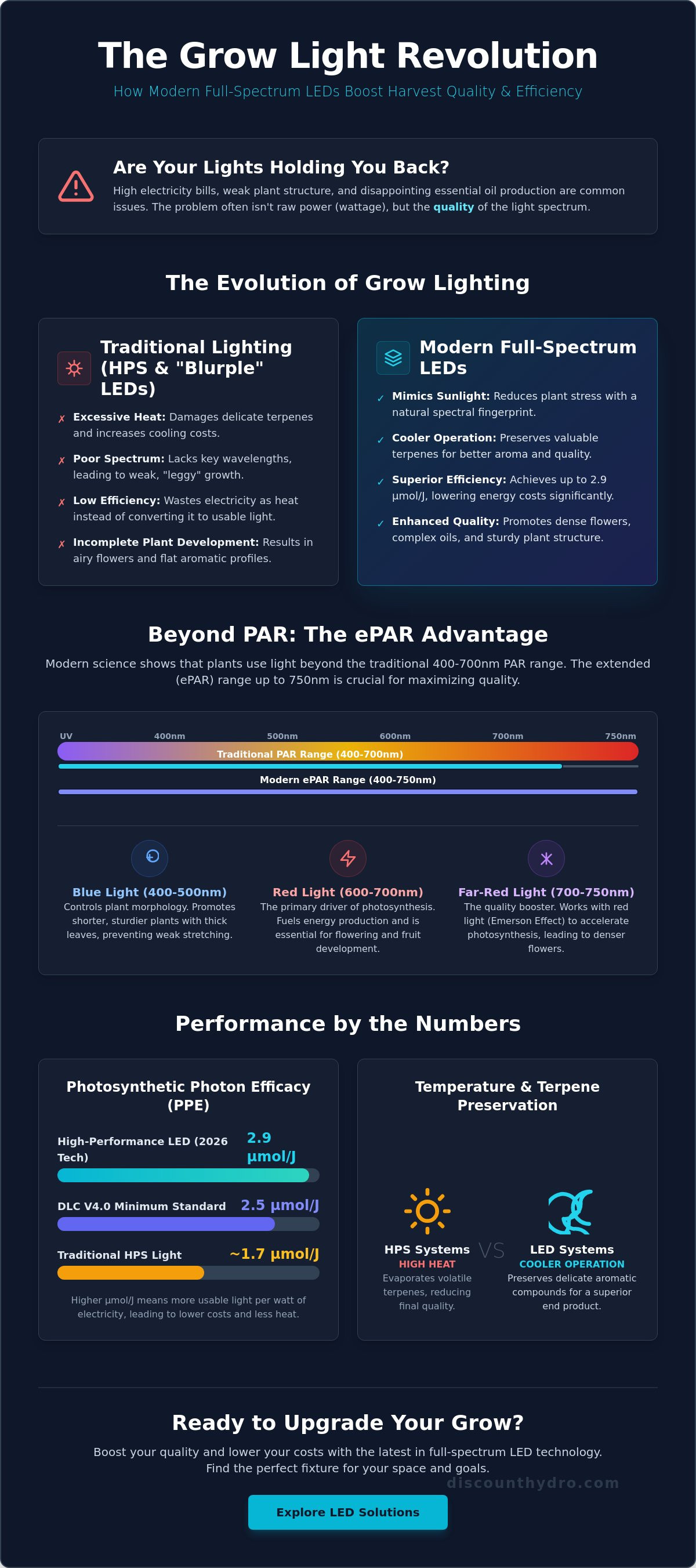
Lighting technology has moved rapidly from High-Pressure Sodium (HPS) to advanced 2026 LED diodes. HPS lamps were the industry standard for decades, but they had major drawbacks. They produced excessive heat and lacked the blue and UV light needed to prevent "leggy" growth. Plants often stretched too much, leading to weak stems and airy flowers. Modern LED fixtures solve this with superior efficiency. New 2026 models often reach a Photosynthetic Photon Efficacy (PPE) of 2.9 µmol/J. This far exceeds the DLC V4.0 minimum standard of 2.5 µmol/J. You get more usable light for every watt of electricity consumed. This efficiency doesn't just save money; it creates a more controlled growing environment.
Quality vs. Quantity: The Spectral Difference
Intensity is only one part of the equation. The quality of the light spectrum determines the final value of your harvest. Full spectrum light is directly responsible for "bag appeal" and fruit density. It encourages the production of secondary metabolites and essential oils. These are the compounds that create complex aromatic profiles and high-quality results. When plants receive the full range of light, including the 700-750nm Far-Red range (ePAR), they produce more resin and denser structures. Lower operating temperatures also play a role. Because LEDs run cooler than HPS, they preserve delicate terpenes that would otherwise evaporate under high heat. Improving plant quality with full spectrum light ensures you end up with a harvest that looks, smells, and performs better.
The Science of ePAR and PAR: How Wavelengths Dictate Plant Growth
PAR (Photosynthetically Active Radiation) has traditionally focused on the 400-700nm range. This has been the industry engine of growth for decades. However, 2026 research confirms that the ePAR (400-750nm) range is more effective for improving plant quality with full spectrum light. This extended range includes Far-Red photons that were previously ignored but are now known to drive significant photosynthetic activity. Balancing these specific wavelengths is more important than simply increasing raw light intensity. While blue light (400-500nm) prevents stretching and improves leaf thickness, red light (600-700nm) drives the bulk of energy production and flower development.
The Importance of Blue Light for Morphology
Blue light controls how a plant occupies space in your grow room. High levels of blue light result in shorter internodal spacing, creating bushier and sturdier plants that can support heavier harvests. It also triggers stomatal opening. This allows the plant to breathe more effectively and take in more CO2 for processing. Cryptochromes are the specific blue-light photoreceptors that mediate these morphological changes and regulate the plant's internal clock.
Far-Red and the Emerson Effect
The Emerson Effect occurs when plants are exposed to both deep red and far-red light simultaneously. This combination creates a synergistic boost in photosynthetic rate that exceeds what either wavelength could achieve alone. It's a critical factor for maximizing flower density. This technology was heavily influenced by NASA's research on LED plant growth, which highlighted how targeted spectra optimize energy conversion. Using Far-Red at the end of the light cycle also helps plants transition into their "sleep" state faster. This improves metabolic efficiency during the dark period.
UV Light: Triggering Defensive Quality
UV light is a powerful tool for increasing essential oils and aromatic complexity. While it doesn't drive biomass growth, it triggers a defensive response. Plants produce secondary metabolites to protect their tissues from UV radiation. This "sunscreen" effect results in significantly higher resin production and more pungent profiles. Many 2026 LED models now include dedicated UV-A chips specifically for this purpose. If you're looking to upgrade your setup, browse the professional range of LED grow lights to find a fixture with the right spectral balance for your specific needs.
Full Spectrum LEDs vs. Traditional Lighting: A Performance Comparison
Traditional High-Pressure Sodium (HPS) and Ceramic Metal Halide (CMH) systems were the standard for indoor cultivation for decades. HPS lights are notorious for their heavy orange and red output, which drives bulk but lacks the spectral complexity required for improving plant quality with full spectrum light. CMH offered a broader range but still struggled with massive heat output and rapid bulb degradation. In contrast, 2026 LED technology provides a consistent, sun-mimicking spectrum that doesn't shift over time. While HPS bulbs need replacing every 6 to 12 months due to spectrum decay, professional LEDs maintain their performance for 50,000 hours or more. This makes them the only pragmatic, long-term investment for serious growers who value consistency.
The spectral output of a modern LED is fundamentally different from HID lighting. HPS lacks the blue and UV wavelengths that prevent stretching and stimulate resin production. LEDs integrate these into a single fixture. You no longer need to swap bulbs between the vegetative and flowering stages. This streamlined approach reduces labor and equipment costs. It also ensures the plants receive exactly what they need at every stage of their life cycle without the shock of a spectrum shift. By using a single, high-quality light source, you simplify your workflow and reduce the risk of environmental fluctuations.
Terpene Retention and Heat Stress
HPS lights act like giant heaters in your grow room. This radiant heat often "cooks off" the delicate aromatic compounds that define high-value botanical crops. When the canopy temperature exceeds 28°C, you lose the very oils that provide flavor and bag appeal. LEDs run significantly cooler. This lower operating temperature makes it easier to maintain a perfect Vapour Pressure Deficit (VPD). You keep more essential oils on the plant rather than losing them to the extraction fans. Improving plant quality with full spectrum light means preserving the final product's chemical profile, not just producing raw biomass. Cool-running lights allow for tighter environmental control, which is the foundation of expert-level growing.
Energy Efficiency and the UK Power Grid
With UK electricity prices remaining a primary concern in 2026, efficiency is no longer optional. Modern LEDs are designed to convert every watt into usable photons rather than wasted heat. The current industry standard for high-performance fixtures is at least 2.7 µmol/j, with many models now reaching 2.9 µmol/j. This efficiency allows you to run higher light intensities without the massive utility bills associated with 1000W HPS units. To get the most out of this efficiency, ensure you are choosing a grow tent that complements your light’s specific footprint. A well-matched tent and light combination ensures maximum photon reflection and prevents wasted energy on the walls. This combination is the most cost-effective way to maximize your yields in the current economic climate.
Practical Strategies for Optimising Light Delivery in Your Grow Room
Precision in the grow room is the difference between a mediocre harvest and a professional-grade result. Maximising your yields requires more than just high wattage; it requires a strategic approach to light placement and intensity. Improving plant quality with full spectrum light involves calculating the exact Photosynthetic Photon Flux Density (PPFD) your canopy needs at each stage of development. Seedlings generally thrive at 100-300 µmol/m²/s, whereas the flowering stage requires 600-900 µmol/m²/s to reach full potential. Managing hanging heights is essential to balance light penetration with the risk of light burn. If the fixture is too close, the intense photon density can cause bleaching or heat stress. If it is too far away, the lower canopy won't receive enough energy to develop dense fruits.
Light uniformity is another pillar of a successful indoor grow. Use reflective grow tent walls to ensure photons aren't wasted on dark surfaces. This reflection helps eliminate "dead zones" in the corners of your space, ensuring every plant develops at the same rate. Photoperiod management also plays a role in quality. Consistent 18/6 or 12/12 cycles, timed with the precise spectral output of a 2026 LED, ensure the plant’s internal clock stays synchronised for peak metabolic performance. Consistency leads to predictability, which is the hallmark of an expert grower.
Measuring What Matters: Lux vs. PAR
A standard Lux meter or a basic phone app is insufficient for modern LED technology. Lux measures light as perceived by the human eye, which is most sensitive to green and yellow wavelengths. Plants rely on the full PAR and ePAR range, which these meters often ignore. Investing in a dedicated PAR meter allows you to map your grow area and identify hot spots. This data-driven approach ensures you are getting the full value from your investment in high-performance lighting. Mapping your tent ensures that every square centimetre of your canopy is working at maximum efficiency.
Feeding Your Lights: Nutrient Adjustments
Higher light intensity directly increases a plant's metabolic demands. When you transition to 2026 LED models with efficacies of 2.9 µmol/J, your plants will process water and minerals at an accelerated rate. Many growers find that their plants require additional Calcium and Magnesium to prevent deficiencies under these intense conditions. Adjust your hydroponic nutrients to account for this increased uptake. Monitor your EC levels closely to avoid salt buildup, as the high transpiration rate can lead to nutrient lockout if the reservoir is not balanced. Improving plant quality with full spectrum light is only possible when your feeding schedule matches the energy provided by your lights. Browse our full range of high-efficiency LED grow lights to find the perfect fixture for your space.
Finding the Right Full Spectrum LED Solution at Discount Hydro
Selecting the correct wattage for your specific grow space is the first step toward improving plant quality with full spectrum light. A standard 1.2m x 1.2m tent requires a fixture that provides uniform coverage across the entire canopy to avoid underdeveloped edges. For professional-grade results, the Omega Black 720W LED is a top-tier choice. It provides the spectral complexity needed for dense fruit and high essential oil production while maintaining industry-leading efficiency. Buying from a local UK specialist ensures you get equipment built for our power grid and environmental conditions. We provide local support from our Chester-le-Street shop, offering a level of reliability that anonymous international sellers simply can't match. Every lighting system we sell includes fast UK-wide delivery and discreet packaging as standard.
Pragmatic growers know that price and availability are just as important as technical specs. We maintain a huge inventory of LED systems, nutrients, and grow tents to ensure you aren't waiting for backorders. Our focus is on providing the best value for money without compromising on the light quality your plants require. By choosing a 2026 model LED, you're investing in a fixture that will maintain its spectral integrity for years. This consistency is vital for maintaining a predictable harvest cycle and high-quality output. Newer models hitting 2.9 µmol/J ensure you're getting the most photons for every penny spent on electricity.
Professional Grade Lighting for Home Growers
Our inventory focuses on high-performance hardware that delivers measurable results. You can find detailed comparisons of our top-rated led grow light options on our blog. We prioritise "plug and play" systems because they eliminate technical barriers for beginners. These systems are ready to go out of the box, ensuring you spend less time on wiring and more time on cultivation. As a specialist UK hydroponics retailer, we only stock fixtures that meet or exceed current efficiency standards. This ensures your indoor grow room remains cost-effective despite rising energy prices. Improving plant quality with full spectrum light is easier when you use equipment designed for professional-grade reliability.
Visit Us in County Durham
If you prefer a hands-on approach, visit our physical store at Drum Industrial Estate. We offer convenient click and collect options for all our lighting systems and growing media. Our team provides expert advice on setting up your first full spectrum grow, ensuring your equipment matches your tent footprint and ventilation capacity. We have the stock on hand for immediate collection, allowing you to get your grow started without delay. Browse our full range of LED Grow Lights today and secure the best prices on professional-grade hardware. Our Chester-le-Street location is open for those who want to see the latest 2026 lighting technology in person before they buy.
Maximize Your Harvest Potential with 2026 LED Technology
Transitioning to modern lighting is the most effective way to secure professional-grade results in your indoor grow room. By focusing on the ePAR range and maintaining precise environmental control, you ensure your plants produce the aromatic profiles and density you need. Improving plant quality with full spectrum light isn't just about intensity; it's about providing the specific wavelengths that drive essential oil production and structural integrity. You've learned how to map your PPFD, adjust your nutrients for higher metabolic rates, and choose fixtures that hit the latest DLC V4.0 efficiency standards.
Discount Hydro is your trusted UK Specialist Retailer and an Omega Black 720W Authorized Dealer. We provide the technical hardware and expertise required to transition your setup to the next generation of horticultural lighting. With fast nationwide delivery and a massive inventory of ready-to-ship systems, it's never been easier to optimize your production. Our team is ready to help you select the most pragmatic solution for your specific space and budget. Upgrade your grow with the latest Full Spectrum LED Lights and see the difference that high-efficiency spectral control makes in your next harvest.
Frequently Asked Questions
Is full spectrum light better than red and blue light for plants?
Full spectrum light is superior because it provides a complete spectral range that mimics natural sunlight. While older "blurple" lights only focus on two wavelengths, full spectrum LEDs include green, yellow, and far-red light. This balance is essential for improving plant quality with full spectrum light, as it prevents the weak, leggy growth often associated with limited spectrum fixtures. It ensures better structural integrity and more complex chemical development.
What is the best hanging height for a full spectrum LED grow light?
The ideal hanging height typically ranges from 30cm to 60cm depending on your plant's growth stage. Seedlings require the light to be further away, around 60cm, to prevent intensity stress. During the flowering stage, you can move the fixture closer, to about 30cm or 45cm, to maximize photon penetration. Always consult your specific fixture's PPFD map to identify the most efficient height for your canopy.
Does full spectrum light increase the potency of indoor plants?
Yes, full spectrum light increases potency by triggering the production of secondary metabolites and essential oils. The inclusion of UV and Far-Red wavelengths acts as a catalyst for these chemical responses. Plants produce these compounds as a natural defense mechanism against specific light stresses. This results in a final harvest with significantly higher aromatic complexity and a more robust chemical profile compared to plants grown under limited spectra.
How many watts of full spectrum LED light do I need for a 1m x 1m tent?
You need approximately 300W to 480W of high-efficiency LED power for a 1m x 1m space. This wattage range ensures you hit the target of 600 to 900 µmol/m²/s required for dense fruit and flower production. Using a bar-style LED fixture within this power range provides the most uniform coverage. It eliminates the dark corners and hot spots that can occur with lower-wattage or poorly distributed light sources.
Can full spectrum LEDs cause light burn on my plants?
Full spectrum LEDs can cause light burn if the intensity is too high or the light is too close to the canopy. Light burn happens when the plant receives more photons than it can process through photosynthesis. You'll notice yellowing or bleaching on the top leaves while the lower leaves remain green. To avoid this, monitor your plants closely and use a dimmer to adjust intensity during the early growth stages.
Do I need to wear eye protection under full spectrum grow lights?
Yes, you must wear eye protection specifically designed for grow rooms. High-intensity LEDs emit concentrated light that can cause significant eye strain and long-term damage. Because full spectrum lights often include UV and Infrared wavelengths, the risk is higher than with standard household lighting. Specialized grow room glasses balance the spectrum, allowing you to inspect your plants clearly while protecting your vision from harmful radiation.
What is the difference between PAR and ePAR in 2026?
PAR refers to the traditional 400-700nm range, while ePAR extends this measurement to 750nm. The inclusion of the 700-750nm Far-Red range is the current 2026 industry standard for improving plant quality with full spectrum light. Research has confirmed that these Far-Red photons are vital for driving the Emerson Effect, which increases overall photosynthetic efficiency. Most professional-grade 2026 LED models are now rated using ePAR to provide a more accurate measure of usable light.