

Inline Fan Speed Controller UK: The 2026 Guide to Grow Room Climate
Running your extractor fan at full power 24/7 is the most expensive mistake you can make in a modern indoor garden. It is not just about the noise; it is about the wasted electricity and the constant battle against temperature swings that stunt your harvest. You likely know the frustration of a budget dimmer switch making your motor buzz like a hornet nest. Finding the right inline fan speed controller uk is the only way to achieve a professional, whisper-quiet environment while keeping your running costs under control.
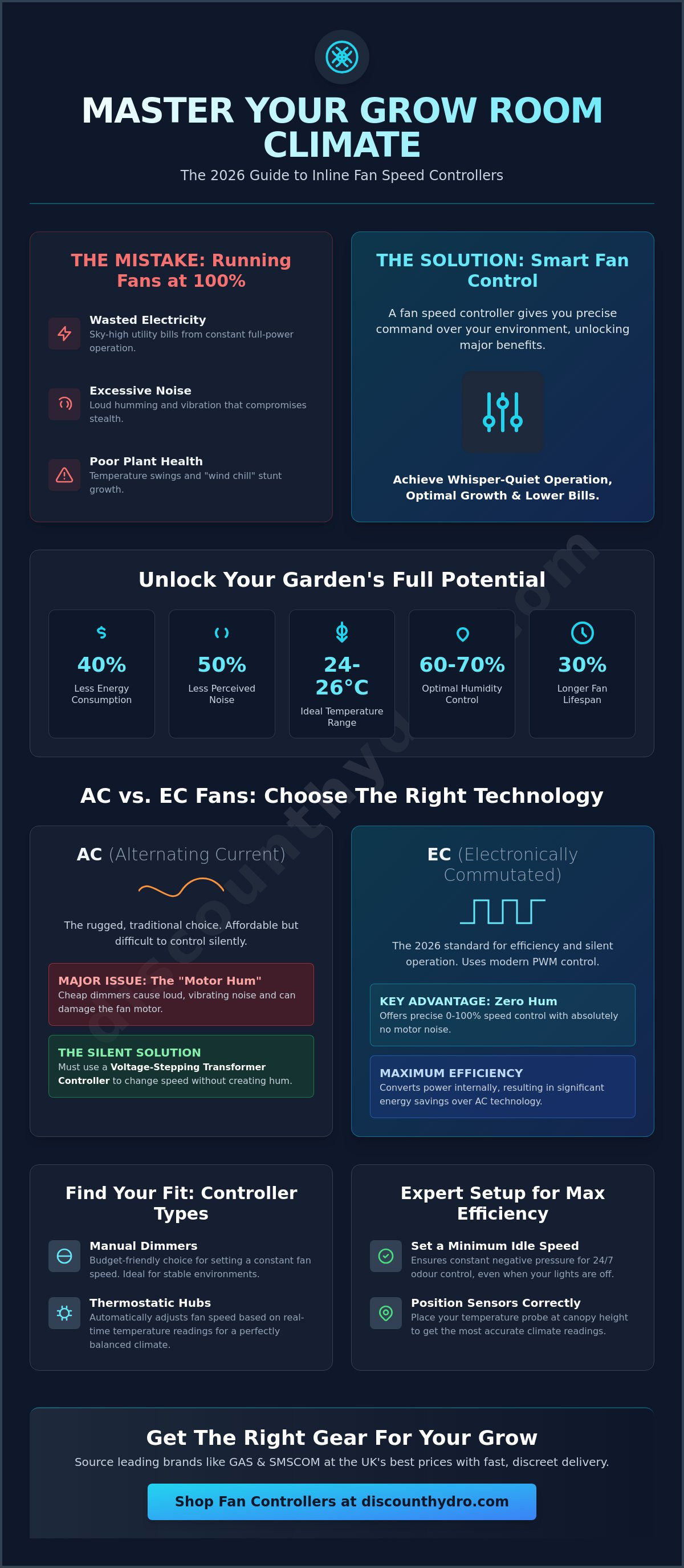
In this 2026 guide, you'll learn how to master your climate and stop the hum for good. We'll show you how to maintain a steady 24°C to 26°C year-round and reduce your ventilation energy consumption by up to 40%. From silent digital controllers to heavy-duty transformers, we are breaking down the best tech to ensure your plants thrive in total silence while you save money on every utility bill.
Key Takeaways
- Learn how to maintain the ideal 24-26°C temperature range to ensure your indoor crops reach their full potential.
- Discover the differences between AC and EC technology to choose an inline fan speed controller uk that eliminates motor hum and boosts energy efficiency.
- Identify whether a budget-friendly manual dimmer or an automated thermostatic hub is the best fit for your ventilation setup.
- Master expert calibration techniques, including setting minimum idle speeds for odour control and positioning sensors at canopy height.
- Find out how to source leading brands like GAS and SMSCOM at the UK's best prices with fast, discreet delivery.
Why Every UK Indoor Garden Needs an Inline Fan Speed Controller
An inline fan speed controller uk is a fundamental tool for managing the internal environment of any high-performance grow room. It works by regulating the RPM (revolutions per minute) of your extraction system, allowing you to fine-tune the volume of air moved through your filters and ducting. Without this control, your fans run at 100% capacity regardless of the actual climate needs, which often leads to inefficient growing conditions and higher overheads. Effective airflow management ensures your crops remain in the vital 24-26°C temperature range required for optimal metabolic activity.
Operating fans at full tilt during the colder UK months is a common mistake that leads to the "wind chill" effect. This rapid movement of cold air can shock plants, causing stunted growth or nutrient lockout. By dialling back the fan speed, you maintain a stable thermal mass within the tent. This precision also has a direct impact on your bottom line. Reducing fan speed lowers electricity consumption and significantly extends the lifespan of your extraction motor by reducing mechanical wear. Most high-quality motors are rated for thousands of hours, but running them at 80% capacity instead of 100% can increase their operational life by up to 30%.
The Link Between Airflow and Humidity
Controlling your extraction rate is the most effective way to manage humidity levels. During the early growth stages, plants require higher relative humidity, often between 60% and 70%. If your fan is pulling air too quickly, it strips moisture from the environment before the plants can use it. Slowing the fan creates a pocket of moist, warm air that encourages rapid leaf development. You should never turn your fans off completely, however, as stagnant air leads to CO2 depletion and increases the risk of fungal pathogens. The goal is to maintain a constant but gentle exchange of air that preserves negative pressure, ensuring all odours pass through your carbon filter before exiting the space.
Noise Reduction: The Stealth Factor
Stealth is a primary concern for indoor gardeners in residential areas. A fan running at 100% speed creates significant air turbulence and vibration that can be heard through walls and floors. Most growers find that maximum speed is rarely necessary to maintain the correct climate. Reducing your fan speed by just 20% can lead to a 50% reduction in perceived noise levels, making your setup much more discreet. This is achieved by utilising advanced motor controller technology to adjust the power delivery to the fan without causing the humming or buzzing sounds associated with cheap, low-quality dimmers. Investing in a dedicated inline fan speed controller uk allows you to keep your hobby private while ensuring your equipment runs at peak efficiency.
AC vs. EC Fans: Choosing the Right Controller for Your Technology
Selecting an inline fan speed controller uk requires knowing exactly what motor technology is spinning inside your ducting. Most UK growers use either AC (Alternating Current) or EC (Electronically Commutated) fans. Getting this wrong doesn't just result in a noisy room; it can burn out your motor in weeks. AC fans are the traditional choice, known for being rugged and affordable upfront. However, they rely on induction motors that are notoriously difficult to slow down without causing a loud, vibrating hum.
Matching your controller to your fan's wattage is vital for safety. In the UK, domestic power is single-phase 230V. If you're running a high-powered 10-inch or 12-inch AC fan, a basic speed plug will likely overheat. Always ensure the controller's amp rating is higher than the fan's maximum draw to prevent fuse failures or fire risks.
Understanding AC Fan Control Challenges
Cheap resistive dimmers often fail with AC fans because they "clip" the electrical sine wave. This creates a mechanical vibration in the motor housing known as the "motor hum" issue. To reduce fan speed silently on an AC system, you must use a voltage-stepping transformer controller. These units change the voltage in clean steps, such as 100V, 150V, or 230V, keeping the motor cool and quiet. We recommend switching to LED grow lights to lower the overall heat load in your room. This allows your AC fan to run at lower, quieter voltages more often without struggling against the heat of old HPS lamps.
The Rise of EC Technology
EC fans represent the 2026 standard for efficiency. These motors convert AC power to DC internally, allowing for Pulse Width Modulation (PWM) control. This technology offers 0 to 100% dimming with zero motor hum. While an EC fan might cost £40 to £60 more than an AC model, the controllers are significantly cheaper. You don't need a heavy, expensive transformer. Instead, EC fans use small digital controllers or plug directly into smart climate hubs via RJ11 or 3.5mm cables.
Digital integration allows for precise environment tracking. If you're building a new setup, the lower cost of EC controllers usually offsets the higher price of the fan itself. You can find the latest ventilation deals on our store to help balance your budget. Most UK domestic setups run on 50Hz single-phase power; ensure your EC kit is rated for this standard to avoid compatibility issues.
Types of Fan Controllers: From Manual Dimmers to Thermostatic Hubs
Choosing an inline fan speed controller uk depends on your budget and the complexity of your ventilation setup. Manual plug-in dimmers are the entry-level choice. They work like a light switch, reducing voltage to slow down small intake fans. These are best for budget-conscious growers using 4-inch or 5-inch fans. They don't respond to environmental changes, so you'll have to adjust them by hand as the day gets warmer. This makes them less suitable for extraction fans where constant airflow is required to manage humidity.
Thermostatic controllers represent a significant upgrade for serious indoor gardens. These units use a remote probe to monitor air temperature in real-time. When the room gets too hot, the controller automatically ramps up the fan speed. This follows Demand Controlled Ventilation (DCV) principles to ensure your extraction system only works as hard as necessary. It saves electricity and extends the life of your fan motor by avoiding constant 100% operation.
Thermostatic Control: Set and Forget
Probe placement is critical for accurate climate readings. Place the sensor at canopy height, away from direct light or heat sources. If you're using grow tents in uninsulated UK lofts, temperatures can swing by 15°C in just a few hours. Setting minimum and maximum speeds prevents temperature crashes during the night cycle. It ensures the fan clears stale air even when it's cold, preventing stagnant pockets where mould can form.
Hybrid and Transformer Controllers
Hybrid controllers are the gold standard for AC fans. Standard digital dimmers often cause a loud 50Hz hum when slowed down. Hybrid units use transformer technology to "step" the voltage up or down in distinct stages. This mechanism removes the buzz entirely, making the fan run silently at any speed. Professional UK setups often rely on SMSCOM or GAS-branded hybrid units for this reason. Finding the right inline fan speed controller uk for your specific fan size ensures peak efficiency.
Large-scale indoor gardening requires silence and precise pressure management. Mechanical transformers are the only way to run powerful AC fans at low speeds without acoustic interference. These units are heavy and carry a higher price tag, but they're essential for discreet operations. Twin fan controllers go a step further by managing both intake and outtake fans simultaneously. This maintains negative room pressure, ensuring all air passes through your carbon filter before exiting the building. This setup is mandatory for 100% odour control in residential areas.
How to Set Up Your Fan Controller for Maximum Efficiency
Setting up an inline fan speed controller uk involves more than just plugging it into the wall. You must dial in specific parameters to protect your plants and keep your equipment running for years. Start by calibrating your idle speed. This is the minimum RPM required to maintain negative pressure in your tent. If the fan drops below this level, odours will leak out. Your carbon filter needs a constant pull of air to scrub smells effectively, so never set your minimum speed to zero percent.
Position the temperature sensor at canopy height. This is where the heat affects your plants the most. Don't place it directly under high-intensity discharge lamps or powerful LEDs. Direct light radiation creates false readings, which causes the fan to ramp up when the ambient air is actually cool. Use a small piece of card to shade the sensor for the most accurate data.
Set your target temperature 2 degrees below your absolute maximum limit. If your room should not exceed 28°C, set the controller to 26°C. This gap allows the fan enough time to ramp up its speed before the heat hits a critical level. It creates a smoother transition and prevents the fan from constantly pulsing between low and high speeds.
Your airflow requirements change throughout the grow. Sync your fan settings with your hydroponic nutrients schedule. Plants in the peak of their bloom cycle transpire significantly more water than seedlings. This increased transpiration raises humidity levels fast. You'll need higher minimum fan speeds during these heavy feeding weeks to prevent stagnant air and mould issues.
Always test the fail-safe. Simulate a heat spike by holding a warm (not hot) object near the sensor. Watch the display to ensure the fan hits 100% power as it crosses your threshold. If it doesn't, your settings are wrong and your crop is at risk during a summer heatwave.
Seasonal Adjustments for the UK Climate
UK growers face unique challenges. During winter, keep your minimum fan speed at the lowest possible setting that still manages odours. This helps you retain expensive heat. In summer, increase the controller bandwidth. This ensures the fan reacts aggressively to 30°C outdoor temperatures. Always monitor the transition between day and night cycles. Humidity often spikes 15% when lights go off, so keep your extraction running high for at least 30 minutes after the dark cycle starts.
Safety and Maintenance
Never exceed the maximum amp rating of your inline fan speed controller uk. If your fan draws 6 amps and your controller is rated for 5, you risk a fire. Check the controller unit for heat buildup periodically. If the casing feels hot to the touch, it's likely overloaded. Avoid using cheap household light dimmers for heavy-duty extraction. These aren't designed for inductive motor loads; they will cause your fan to hum and eventually burn out the motor coils.
Why Buy Your Ventilation Gear from Discount Hydro?
Discount Hydro is the UK's go-to source for high-performance ventilation. We've built our reputation on providing the UK's best prices on leading brands like GAS, SMSCOM, and Rhino. You won't find unnecessary markups here. We focus on high-volume, low-margin sales to keep your costs down. Whether you need a simple plug-and-play unit or a sophisticated inline fan speed controller uk for a multi-fan setup, we have the stock ready to go. We don't just sell boxes; we provide the tools you need to maintain a perfect environment year-round.
Shipping is fast and reliable. We understand that environment issues need immediate solutions, so we prioritize rapid nationwide delivery. Privacy is a major concern for our customers. That's why every single order is sent in discreet packaging. There are no logos, no brand names, and no hints about what's inside the box. For those based in the North East, our Click and Collect service from our County Durham warehouse allows you to bypass shipping times entirely. Just place your order online and pick it up at a time that suits you.
The Discount Hydro Value Promise
We don't stock filler. Every item in our warehouse is chosen because it survives the humid, demanding environment of a busy grow room. Our massive inventory includes HPS systems, the latest LED technology, and complete ventilation kits. Everything you see online is ready for immediate dispatch. We keep our pricing transparent at all times. Our 'Hot Product' deals feature regular rotations of top-tier controllers and fans at clearance rates. You get professional-grade hardware without the professional-grade price tag.
Support for the UK Growing Community
Managing a garden in the UK presents unique challenges. Our team has local knowledge on handling everything from winter cold snaps to high summer humidity levels. We understand hydroponics from the ground up and can advise on the right inline fan speed controller uk for your specific tent or room size. If something goes wrong, we make it right. We offer easy returns and full manufacturer warranty support on all electronic gear. Our goal is to keep your garden running smoothly without breaking the bank. Browse our full range of Fan Controllers here to find the best deal for your setup today.
Master Your Environment with Precise Fan Control
Effective climate management in 2026 requires more than just high-powered extraction. It's about precision. Upgrading to an EC fan setup can cut your energy usage by 30% compared to traditional AC motors. Whether you choose a manual dimmer for a small tent or a thermostatic hub for a multi-light room, your choice of inline fan speed controller uk determines your final yield quality. Automated controllers from GAS and SMSCOM manage fluctuations 24/7, so you don't have to worry about temperature spikes while you're away.
Discount Hydro is your source for the industry's most reliable ventilation gear. We stock leading brands like Rhino, GAS, and SMSCOM at the UK's best prices. You can take advantage of our fast UK delivery or choose click and collect from our County Durham location for immediate pickup. It's time to stop guessing and start controlling your indoor environment with professional-grade hardware. We have the stock ready to ship so you can get your setup running at peak efficiency immediately.
Shop the UK's Best Prices on Fan Speed Controllers
Get your ventilation dialed in today and watch your garden thrive.
Frequently Asked Questions
Can I use a standard light dimmer as a fan speed controller?
No, you cannot use a standard light dimmer for your ventilation setup. Dimmers are built for resistive loads like halogen bulbs, while fans are inductive loads. Using a light switch causes the motor to overheat and can lead to a fire or permanent motor failure within 48 hours of use. Always buy a dedicated inline fan speed controller uk to ensure the voltage is managed safely without damaging your equipment.
Why does my fan make a buzzing noise when I turn the speed down?
Buzzing occurs because cheap triac controllers "chop" the AC sine wave, which causes the motor coils to vibrate at 50Hz. This noise is often louder than the actual air movement when the fan runs below 50% power. To stop this, you should upgrade to a transformer-based controller or an EC fan. These options provide a smooth power flow and reduce noise levels by 15 decibels in most grow environments.
What is the difference between an AC fan and an EC fan?
AC fans run on alternating current and are cheaper upfront but lose efficiency when you dim them. EC (Electronically Commutated) fans use permanent magnets and digital controllers to maintain high torque at low speeds. An EC fan consumes 50% less energy on average compared to an AC fan when running at half speed. They are the industry standard for 2026 due to their precise 0-100% control range and silent operation.
Do I need a separate controller for my intake and extraction fans?
You need separate control or a dual-channel unit to maintain negative pressure in your room. If your intake and extraction run at the same speed, smells will leak out of the tent. Setting your extraction fan 20% higher than your intake ensures the tent walls suck inward, forcing all air through the carbon filter. Most UK growers use a twin controller to automate this balance based on real-time temperature fluctuations.
Where should I place the temperature probe for my fan controller?
Place your temperature probe at the top of the plant canopy where the heat is most intense. Don't put it directly under a grow light or against a cold wall, as this causes false readings. A 2-degree deviation in probe placement can lead to your fan running at the wrong speed. Secure the sensor in a shaded spot or use a small plastic cover to protect it from direct light radiation.
Will a fan controller reduce the effectiveness of my carbon filter?
A controller only reduces filter effectiveness if the airflow drops below 20% of the filter's rated capacity. Carbon filters require a minimum "contact time" to scrub odors from the air. If you turn an inline fan speed controller uk down too low, air moves too slowly and smells might bypass the carbon. Keep your fan running at a minimum of 25% power to ensure 100% odor removal in your space.
What happens if my fan controller fails during the night?
If a controller fails at night, your fans will either stop or jump to 100% power depending on the unit. Without extraction, humidity levels can rise from 50% to 90% in less than 30 minutes, which risks mold growth. High-end controllers include a "fail-safe" mode that defaults to full speed if the sensor or unit malfunctions. It's a smart move to check your controller's manual for its specific 24-hour emergency protocols.
How much electricity can I save by using a fan speed controller?
You can save up to 60% on fan-related electricity costs by using a controller. Running a fan at 100% when the room is cool wastes power and increases mechanical wear. By dropping fan speed by just 20%, you reduce energy consumption by roughly 30% due to the laws of fan physics. In a typical UK indoor garden, this efficiency helps lower your monthly utility bills while extending the lifespan of your extraction motor.