
LED Grow Light Spectrum for Vegetative Growth: The 2026 Indoor Guide
Your plants don't care about the colour of your grow light. They care about specific wavelengths, and getting that wrong during veg means stretched, spindly stems and wasted electricity bills. If you've been staring at product listings wondering whether a blurple LED is a bargain or a gimmick, you're not alone.
Most UK growers already know that light drives growth. What's less obvious is exactly which part of the led grow light spectrum for vegetative growth actually does the heavy lifting, and whether a cheap full-spectrum white LED can genuinely outperform a pricier dedicated blue unit. With UK energy costs still a real concern for indoor growers, choosing the wrong light doesn't just slow your plants down; it quietly drains your wallet every single day.
This guide cuts through the noise. You'll learn which nanometer ranges build thick stems and dense canopies, why full-spectrum efficiency is the smarter play in 2026, and how to match the right LED to your veg stage without overspending. By the end, you'll have a clear, practical framework for faster growth, tighter internodal spacing, and lower running costs.
Key Takeaways
- Understanding the led grow light spectrum for vegetative growth comes down to specific nanometer ranges — get these right and you'll see noticeably thicker stems and tighter internodal spacing.
- Blue wavelengths (400–500nm) are the engine of vegetative development, directly influencing chlorophyll production and keeping plants compact rather than tall and spindly.
- Blurple LEDs are largely outdated — modern full-spectrum white LEDs with a built-in blue bias deliver better efficiency and lower running costs, which matters when UK electricity bills are a real overhead.
- Hanging height and PPFD targets are just as important as the light itself — a PAR or LUX meter takes the guesswork out of dialling in your veg room correctly.
- Not all 2026 LED units are equal — diode quality, driver reliability, and warranty terms separate a genuine long-term investment from a short-term saving that costs more later.
Understanding the Grow Light Spectrum for Vegetative Success
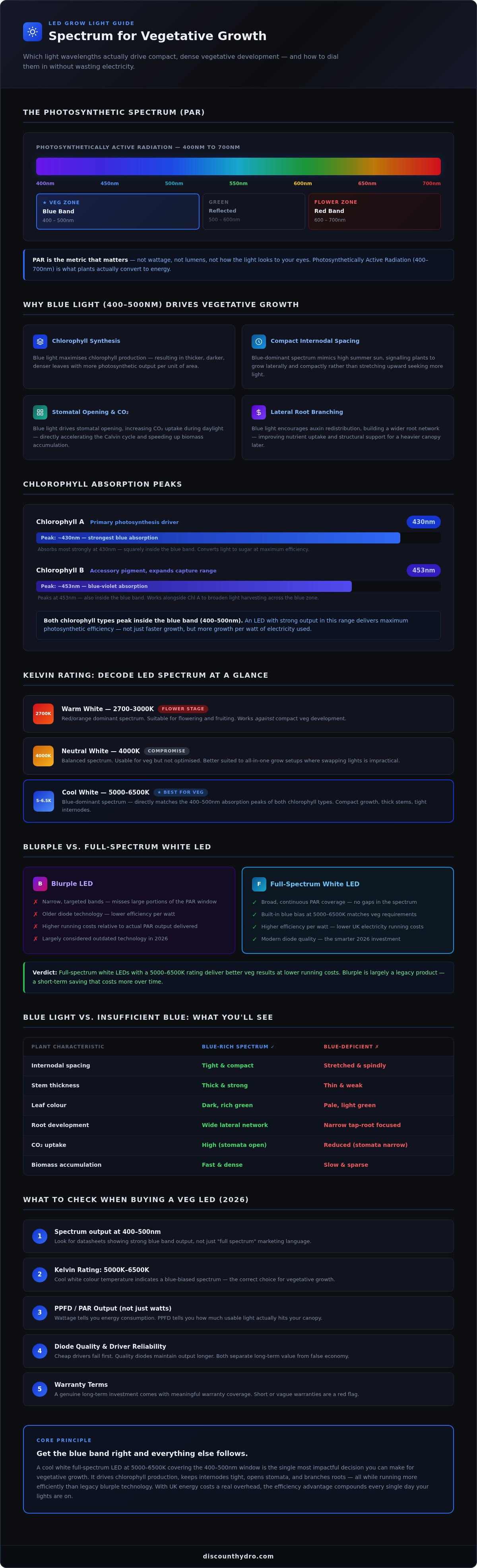
Light isn't just light. It's a spectrum of electromagnetic wavelengths, each measured in nanometres (nm), and plants respond to different wavelengths in fundamentally different ways. The portion that drives photosynthesis falls between roughly 400nm and 700nm, a range known as Photosynthetically Active Radiation (PAR). PAR is the real metric that matters for indoor growing, not brightness, not wattage, and certainly not how the light looks to your eyes.
Within that PAR window, the led grow light spectrum for vegetative growth has a clear priority: the blue band, sitting between 400nm and 500nm. This is the range that directly activates the photoreceptors responsible for compact, structured plant development. Get enough of it, and your plants build dense canopies with tight internodal spacing. Fall short, and they stretch upward searching for it, wasting energy on stem length instead of leaf mass.
Light spectrum also shapes plant morphology from day one. The ratio of blue to red wavelengths signals to the plant whether it's growing under open sky or being shaded by a canopy above. A blue-dominant spectrum mimics high summer sun, triggering compact, lateral growth. A red-heavy spectrum mimics the lower light angle of autumn, pushing the plant toward flowering. During veg, you want the plant firmly in the first mode.
The Transition from Seedling to Vegetative Phase
A seedling becomes a vegetative plant when it develops its first true leaves and begins active photosynthesis beyond cotyledon level. At this point, light demand increases sharply. More leaf surface area means more photosynthetic capacity, but only if the light intensity and spectrum can keep pace. Under-lighting a plant that's ready to grow is one of the most common reasons growers see excessive stretching, where internodes elongate and stems become weak and spindly. It's not always a nutrient problem. Often, it's simply a spectrum or intensity problem arriving at the wrong moment.
Nanometres and Kelvins: Decoding the Labels
Colour temperature, measured in Kelvins (K), is a shorthand for spectrum composition. A Cool White LED rated at 5000K to 6500K contains a higher proportion of blue wavelengths, which is exactly what vegetative growth requires. The "crisp" or slightly blue-white appearance you see from these bulbs isn't just aesthetic; it reflects a genuine shift in the spectral output toward that 400nm to 500nm range. A warm white at 2700K to 3000K skews toward red and orange, which suits flowering but works against compact veg development. When you're reading LED product specs, Kelvin rating gives you a fast, practical indicator of whether a unit is built for veg or not.
Why Blue Light is Essential for Vegetative Growth
Blue wavelengths don't just support vegetative growth; they actively engineer it. In the 400nm to 500nm range, photons trigger specific photoreceptors called cryptochromes and phototropins, which regulate how a plant builds itself from the ground up. More blue light means more chlorophyll synthesis, wider leaf expansion, and a plant that's structurally prepared to handle the demands of the flowering stage. Cut that blue input short and you get a plant that's visually alive but structurally compromised.
There's also a less-discussed benefit: blue light drives stomatal opening. When stomata open wider, CO2 uptake increases during daylight hours, feeding the Calvin cycle more efficiently. That translates directly into faster biomass accumulation. It's a chain reaction that starts with the right spectrum and ends with noticeably denser growth in less time.
Root development is part of this picture too. Blue-dominant spectrums encourage auxin redistribution, which supports lateral root branching rather than just downward tap root extension. A broader root network means better nutrient uptake, stronger anchorage, and a plant that can actually support heavier canopy weight later in the cycle.
Chlorophyll Absorption and Energy Conversion
Chlorophyll a absorbs most strongly at around 430nm, while chlorophyll b peaks at approximately 453nm, both sitting squarely inside the blue band. When the led grow light spectrum for vegetative growth delivers strong output in this range, plants convert light energy into sugars with maximum efficiency. The practical result is thicker, darker, more leathery leaves. That's not just an aesthetic indicator; it signals higher chlorophyll density per unit of leaf area, which compounds photosynthetic output across the entire canopy.
Preventing the Stretch: Structural Integrity
Internodal stretching is one of the most common and costly problems in indoor veg rooms. It happens when plants don't receive enough blue light and respond by elongating stems in search of a better spectrum. Inside a grow tent, this creates an immediate space problem and a longer-term yield problem, because weak, stretched stems struggle to support heavy flower sites later on.
Blue light keeps internodal spacing tight by suppressing the elongation response. Pair that with consistent airflow from an oscillating fan and stems thicken further through mechanical stimulation, a process called thigmomorphogenesis. The two work together. Neither replaces the other. Strong stems built during veg are the structural foundation for everything that follows, and getting the spectrum right from the start is the most direct way to build them.
If you're currently running a warm-white or blurple setup and seeing excessive stretch, switching to a blue-biased full-spectrum LED is the fastest single fix available. It's worth checking current LED grow light options built specifically around veg-stage spectral output before your next grow cycle begins.
Full Spectrum vs. Targeted Blue LEDs: The Efficiency Debate
The blurple era is effectively over. Those distinctive purple-pink lights, built from discrete red and blue diodes, dominated the early LED market because the technology was simple and cheap to manufacture. The logic was straightforward: plants use red and blue, so strip everything else out. In practice, the results were mixed. Targeted blurple units often delivered inconsistent canopy coverage, ran hot relative to their actual output, and made it nearly impossible to spot early signs of deficiency or pest damage under that distorted light.
Modern full-spectrum white LEDs changed the equation entirely. By using phosphor-coated diodes that produce a broad, balanced output, these units deliver the led grow light spectrum for vegetative growth without sacrificing efficiency. Critically, most quality full-spectrum fixtures include a deliberate blue bias in their spectral design, a "blue bump" around 450nm to 470nm that gives veg-stage plants exactly the wavelength density they need without requiring a dedicated single-purpose unit.
While purple-spectrum lighting is being phased out for plant growth in favor of these full-spectrum options, it remains a specialized choice for architectural and decorative environments; for a look at how professional manufacturers utilize these specific wavelengths, visit Prescot.
The "Blurple" Legacy vs. Modern White LEDs
Early LED diodes were genuinely inefficient. Modern Samsung LM301B and LM301H diodes, along with comparable chips from other tier-one manufacturers, produce significantly more photons per watt than the diodes used in blurple fixtures from even five years ago. The practical upshot for UK growers is real: lower wattage for equivalent PPFD output, which directly reduces running costs. With UK electricity prices remaining a genuine overhead for indoor growers, that efficiency gap compounds across every grow cycle. Working under white light also has a practical benefit that's easy to underestimate: you can actually see your plants accurately, spotting yellowing leaves, early pest activity, or overwatering symptoms without removing plants from the tent.
Stage-Specific Lighting vs. All-in-One Solutions
The choice between a dedicated veg light and a dimmable full-spectrum fixture comes down to how you run your space. If you're operating separate veg and flowering rooms, a purpose-built blue-biased unit makes sense. But for most UK home growers running a single tent through both stages, a dimmable full-spectrum LED with adjustable spectrum output is the more practical and cost-effective solution. You dial in the blue-heavy profile during veg, then shift toward red-dominant output when you flip to flower, all from one fixture.
Green wavelengths, often dismissed as irrelevant, are actually a meaningful part of a full-spectrum array. Green light penetrates deeper into the canopy than blue or red, reaching lower leaves that would otherwise contribute little to overall photosynthesis. That lower canopy contribution matters for yield, particularly in denser grows.
One factor that's often overlooked: high-intensity LED growth increases nutrient demand sharply. Plants under strong, efficient LEDs process inputs faster, which means your feeding schedule needs to keep pace. Pairing your LED upgrade with a properly structured nutrient programme is essential; a solid starting point is this hydroponic nutrients guide covering the fundamentals of feeding plants under intensive light conditions.
Optimising Your Grow Room for Vegetative Growth
Getting the right led grow light spectrum for vegetative growth is only half the equation. Where you hang that light, how intensely it fires, and whether your environment can handle the output all determine whether your plants actually perform. A premium LED running at the wrong height or in a poorly ventilated tent will underdeliver every time.
Hanging height isn't one-size-fits-all. Broad guidance like "keep lights 12 to 24 inches away" doesn't account for the actual intensity of your specific fixture. A compact 200W bar-style LED behaves very differently from a high-output 600W or 720W unit. At those higher wattages, running the light at 12 inches above your canopy risks light bleaching and heat stress, even with efficient diodes. The practical approach is to start higher, around 24 to 30 inches for high-output fixtures during early veg, then lower incrementally as plants establish and canopy density increases. Watch the plants, not just the ruler.
A PAR or LUX meter removes the guesswork entirely. Take readings at canopy level across multiple points in your tent to identify hot spots and low-coverage edges. Uneven PPFD distribution means some plants are working harder than others, and that inconsistency shows up in uneven growth rates across your canopy. Repositioning the light or using a light mover can solve distribution problems that adjusting height alone won't fix.
Light Intensity (PPFD) for Vegetative Plants
PPFD measures the actual number of photons hitting your canopy per second, expressed as micromoles per square metre per second (µmol/m²/s). Wattage tells you how much electricity the fixture consumes; PPFD tells you how much usable light your plants actually receive. They are not the same metric. For early veg, target PPFD values of around 200 to 400 µmol/m²/s. As plants mature into mid-to-late veg, push toward 400 to 600 µmol/m²/s. Most quality dimmable LEDs let you run at 40 to 50 percent power during seedling and early veg stages, which cuts running costs significantly during the weeks when plants can't yet use full intensity.
Environmental Synergy: Vents, Fans, and Humidity
Higher light intensity drives faster transpiration. As PPFD increases, plants pull more water through their leaves, raising humidity inside the tent quickly. Vegetative plants perform best at a Vapour Pressure Deficit (VPD) of roughly 0.8 to 1.2 kPa. If your extraction system can't keep pace with the moisture load from a canopy under strong LED output, humidity climbs beyond that range and creates conditions where pathogens thrive. Extraction capacity needs to match your light intensity, not just your tent volume.
Fast-growing vegetative plants also demand a consistent, well-managed root environment. Hydroponics is particularly effective here because it gives you direct control over nutrient delivery and oxygenation, which supports the rapid uptake rates that high-intensity LED lighting demands. Soil buffers those inputs; hydroponic systems let you respond faster when plants accelerate under strong light.
Oscillating fans serve double duty: they manage heat distribution across the canopy and strengthen stems through gentle mechanical movement. Don't treat airflow as an afterthought once the lights are dialled in. It's a core part of the system.
If you're building or upgrading a veg room and want fixtures matched to the PPFD targets above, browse LED grow lights at Discount Hydro for high-efficiency options suited to UK growing conditions.
Best LED Grow Lights for Vegetative Growth in 2026
Knowing the right led grow light spectrum for vegetative growth is only useful if the fixture you buy can actually deliver it. The UK market has matured significantly, and the gap between a genuine high-performance unit and a budget import that looks similar on paper has never been wider. For UK growers, three factors separate a smart purchase from an expensive mistake: diode quality, driver reliability, and whether you can actually get support when something goes wrong.
Diode quality is the foundation. Tier-one chips from established manufacturers deliver more photons per watt and maintain output stability across the fixture's lifespan. Cheap diodes degrade faster, meaning the PPFD your plants receive in month one isn't what they're getting by month twelve. Driver reliability matters just as much. A premium LED panel running on an underpowered or poorly regulated driver will underperform and fail early. Check that the driver is rated to handle the fixture's full wattage with headroom to spare.
For UK growers specifically, two practical factors are easy to overlook. First, buy from a supplier stocking UK-plug units. Adapters on high-wattage fixtures are a fire risk and void most warranties. Second, local support matters. If a driver fails mid-cycle, a UK-based supplier with actual stock can resolve it. An overseas seller cannot.
The Omega Black 720W: A Strong UK Option
The Omega Black 720W is one of the fixtures Discount Hydro stocks that's built specifically around the UK market. Its foldable bar design fits cleanly into standard tent dimensions without the awkward overhang you get from rigid panel designs, and setup takes minutes rather than an afternoon. Performance across both veg and bloom stages makes it a practical all-in-one solution for growers running a single tent through the full cycle. It's the kind of fixture that reflects the Discount Hydro approach: high-efficiency output at a price point that doesn't require justifying to yourself every time the electricity bill arrives.
Choosing the Right Fixture for Your Space
Matching light footprint to tent size is non-negotiable. A 1.2m x 1.2m tent needs a fixture with a coverage specification that matches that footprint at the hanging height you're actually using, not the optimistic figure quoted for maximum spread. A dimmable driver is essential for early vegetative stages; running a 720W unit at full power over seedlings wastes electricity and risks stress. Start at 40 to 50 percent output and scale up as the canopy develops.
- Tent size match: Confirm the fixture's stated coverage at your target hanging height, not just the maximum spread
- Dimmable driver: Required for cost-effective early veg; non-dimmable units waste energy when plants can't use full intensity
- UK plug and warranty: Verify both before purchasing; local support from a UK-based supplier like Discount Hydro removes the risk of being stranded mid-grow
- Diode and driver pairing: A quality diode on a weak driver is still a weak light; both components need to be rated correctly
If you're ready to match a fixture to your specific tent and grow stage, browse our full range of LED Grow Lights with fast UK delivery for current stock, specifications, and pricing across high-efficiency options suited to UK conditions.
Get Your Veg Stage Right From the First Day
The led grow light spectrum for vegetative growth isn't complicated once you know what to look for. Blue wavelengths between 400nm and 500nm drive compact structure, chlorophyll production, and tight internodal spacing. Modern full-spectrum white LEDs deliver that output more efficiently than outdated blurple units, and a dimmable driver means you're not burning unnecessary electricity during early veg when plants can't use full intensity.
Environment backs up the light. Match your extraction to your intensity, dial in your PPFD at canopy level, and your plants will reward you with the structural foundation that makes every subsequent stage easier.
Discount Hydro stocks high-efficiency LED grow lights with fast UK-wide delivery, competitive trade pricing, and expert advice from specialists based in County Durham. Whether you're upgrading a single tent or building out a dedicated veg room, the right fixture is available now.
Shop High-Efficiency LED Grow Lights at Discount Hydro and give your next grow the spectral foundation it actually needs.
Frequently Asked Questions
What is the best light spectrum for vegetative growth?
The blue band between 400nm and 500nm is the core of the led grow light spectrum for vegetative growth. Chlorophyll a absorbs most strongly at around 430nm, and this range directly triggers the photoreceptors that keep plants compact and structurally dense. A cool white LED rated between 5000K and 6500K delivers this naturally, making it a reliable baseline for any veg setup.
That said, a complete spectrum outperforms a narrow blue-only output. Green wavelengths penetrate deeper into the canopy, and small amounts of red support overall photosynthetic efficiency. The priority is blue dominance, not blue exclusivity.
Do I need a different LED light for the vegetative and flowering stages?
Not necessarily. A quality dimmable full-spectrum LED with adjustable output covers both stages from a single fixture. You run it at lower intensity with a blue-biased profile during veg, then increase power and shift toward red-dominant output when you move to flower. Dedicated stage-specific lights only make practical sense if you're running separate rooms simultaneously.
For most home growers operating a single tent, a versatile full-spectrum unit is the more cost-effective and space-efficient choice. Two fixtures for one tent rarely justifies the extra outlay.
Can I use a "Full Spectrum" LED for the entire growth cycle?
Yes, provided the fixture includes a meaningful blue bias rather than just a flat white output. Reputable full-spectrum LEDs are designed with a deliberate blue bump around 450nm to 470nm that supports veg development, alongside the broader red output plants need at flower. Check the spectral output chart in the product spec sheet, not just the label.
The key is buying a unit with a dimmable driver. Running a high-output fixture at reduced power during early veg cuts running costs significantly during the weeks when plants don't yet need full intensity.
How many hours of light do plants need during the vegetative stage?
Most plants in vegetative growth perform well on an 18-hours-on, 6-hours-off schedule. This mimics long summer days and keeps plants in active vegetative mode without triggering the flowering response. Some growers run 20/4 or even 24 hours of continuous light, though continuous light can cause stress in certain species and the marginal gains over 18/6 are modest.
Consistency matters more than the exact split. Irregular photoperiods confuse plant hormone cycles and can cause uneven growth or premature flowering. Set a timer and don't deviate from it.
What is the ideal hanging height for an LED grow light during veg?
There's no single correct answer because it depends entirely on your fixture's output. For high-output units above 600W, starting at 24 to 30 inches above the canopy during early veg is a sensible baseline. Lower-wattage units can sit closer, typically 18 to 24 inches. The fixture's own documentation should give you a PPFD map at various heights; use that rather than generic advice.
Take actual readings at canopy level with a PAR meter. Adjust height until you're hitting 200 to 400 µmol/m²/s for early veg, scaling toward 400 to 600 µmol/m²/s as plants mature. The meter removes guesswork entirely.
Why are my plants stretching even though I have an LED light?
Stretching under an LED almost always points to one of three problems: insufficient blue output, too little intensity at canopy level, or the light hanging too high. Not all LEDs deliver strong blue wavelengths. A warm-white or red-heavy fixture won't suppress the elongation response regardless of its wattage rating. Check your fixture's Kelvin rating and spectral output chart first.
If the spectrum looks right but stretch persists, measure your actual PPFD at canopy level. You may be hitting the right wavelengths but at too low an intensity to trigger the compact growth response. Lower the light incrementally and monitor internodal spacing over the following days.
Is blue light better than red light for growing leaves?
For the vegetative stage specifically, yes. Blue light drives the photoreceptor activity that produces compact structure, wider leaf expansion, and stronger stems. Red light is more efficient at driving raw photosynthesis by volume, but without adequate blue input, plants stretch and produce weaker, more open growth that's harder to manage later in the cycle.
The practical takeaway is that blue and red serve different functions rather than competing directly. During veg, blue takes priority. During flower, the balance shifts toward red. A full-spectrum LED with a dimmable driver lets you work with that shift rather than against it.
How much will running a 720W LED cost me in the UK?
The actual running cost depends on the current unit rate from your energy supplier, which varies by tariff and region. As a working calculation: a 720W fixture running 18 hours per day consumes 12.96 kWh daily. Multiply that by your pence-per-kWh rate to get your daily cost. Check your latest bill for your exact rate rather than relying on any average figure, since UK tariffs have shifted considerably and vary by supplier.
The efficiency of the fixture itself matters here. A high-quality 720W LED delivering strong PPFD output uses that wattage far more productively than a cheap unit drawing the same power. Over a full grow cycle, the difference in output per watt compounds into a real cost-per-gram advantage worth calculating before you buy.