

Mastering Your Hydroponic Feeding Schedule Chart: The Complete 2026 Guide
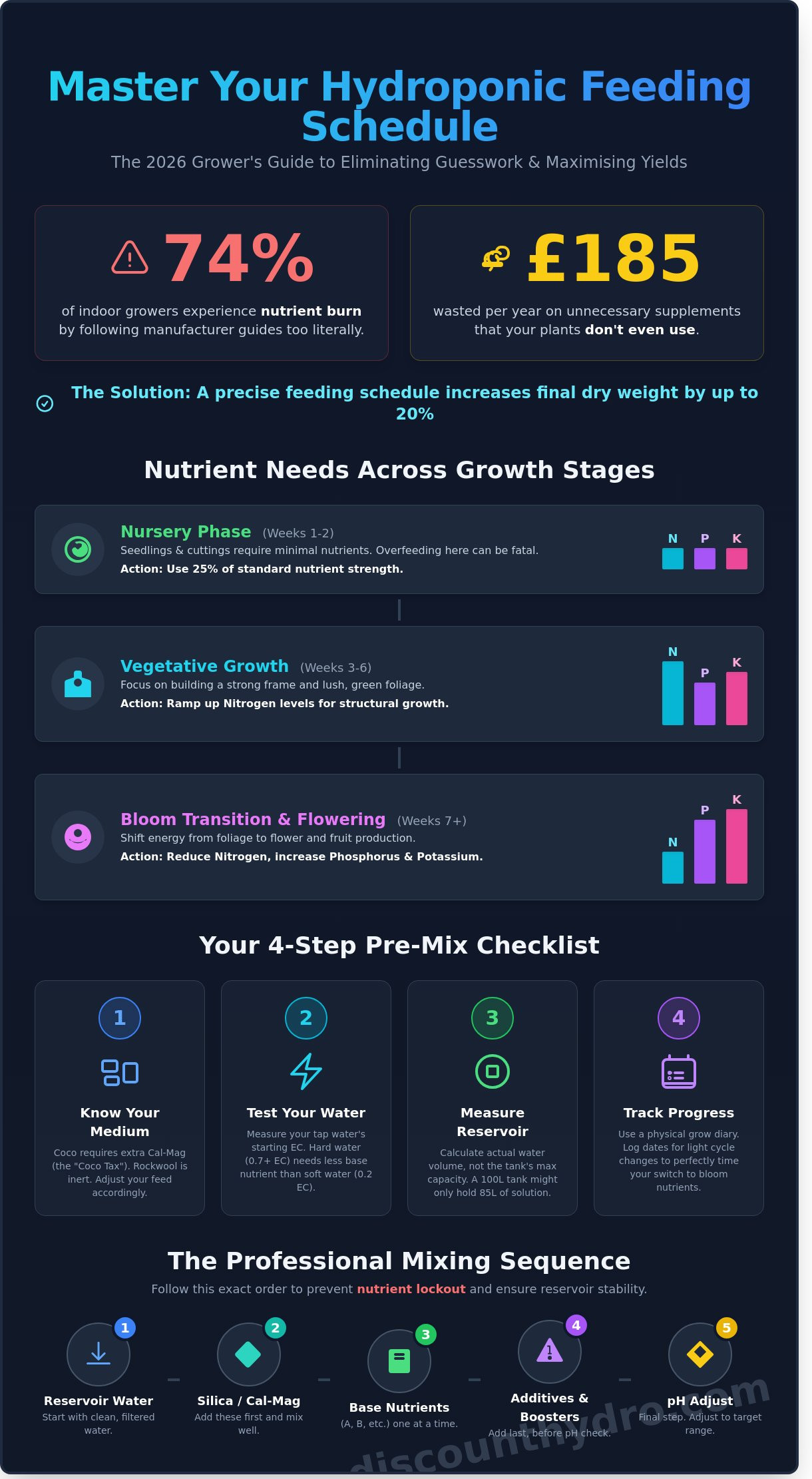
Your hydroponic feeding schedule chart is likely the reason you're wasting up to £185 a year on supplements your plants don't even need. Recent data suggests that 74% of indoor growers experience nutrient burn because they follow manufacturer guides too literally without accounting for their local water hardness. It's frustrating when you've invested in premium nutrients and lighting, only to see leaf tips yellowing or growth stalling because of confusing EC and pH readings. You want the heavy harvests promised on the bottle, not the headache of troubleshooting a failing crop.
This 2026 guide will show you exactly how to master any feeding schedule to achieve professional-grade yields in your indoor garden. You'll learn how to stop guessing and start mixing your solutions with total confidence, whether you're prepping 10 or 100 litres. We'll break down specific growth stages, explain how to dial in your EC levels for maximum efficiency, and show you how to save money by cutting out unnecessary additives that do nothing for your final weight.
Key Takeaways
- Understand how to balance N-P-K ratios across different growth stages to ensure your plants receive the precise nutrition required for maximum yields.
- Learn how to correctly interpret a hydroponic feeding schedule chart by tailoring nutrient levels to your specific growing medium, such as coco coir or rockwool.
- Discover why environmental factors and the "Coco Tax" necessitate specific adjustments to your feed to optimise plant health and prevent deficiencies.
- Master the professional sequence for mixing base nutrients and additives to ensure reservoir stability and prevent costly nutrient lockout.
- Find out how brand-matched nutrient systems and high-performance UK ranges like Intense Nutrients can simplify your routine and improve crop performance.
What is a Hydroponic Feeding Schedule Chart and Why is it Essential?
A hydroponic feeding schedule chart is a technical roadmap that dictates the exact nutrient ratios your plants require from the first day of propagation until the final flush. It functions as a blueprint for success, ensuring you provide the correct balance of Nitrogen (N), Phosphorus (P), and Potassium (K) at the right time. Nitrogen drives the structural integrity of the foliage. Phosphorus powers root development and flower initiation. Potassium regulates essential enzyme triggers and water movement within the plant. Without a precise plan, you're just guessing, and guesswork in a hydro system leads to expensive failures.
Following a dedicated comprehensive overview of hydroponics and its nutritional requirements helps you avoid 95% of common cultivation hurdles. The most frequent issue is nutrient lockout. This occurs when an imbalance of minerals or a pH swing prevents the plant from absorbing food, even if the reservoir is full. By adhering to a hydroponic feeding schedule chart, you maintain the chemical equilibrium of your solution. This precision doesn't just keep plants alive; it maximises your ROI. Professional growers who stick to a strict schedule often see a 20% increase in final dry weight and significantly higher terpene concentrations compared to those who feed by "feel."
The Anatomy of a Standard Feed Chart
Most charts use a simple grid system for easy scanning. The horizontal X-axis typically tracks the weeks of the growth cycle, while the vertical Y-axis lists the specific products in the range. You'll find measurements usually expressed in millilitres (ml) per litre. It's vital for UK growers to use metric measurements to avoid the 15% margin of error common when converting from US teaspoons or gallons. The chart separates "Base Nutrients," which provide the essential N-P-K foundation, from "Additives and Boosters." These boosters are high-performance supplements used to trigger specific biological responses, like increased essential oil production.
Growth Stages Explained: From Seedling to Harvest
The Nursery Phase covers the initial 10 to 14 days of a plant's life. During this period, less is more. Seedlings and fresh cuttings only require roughly 25% of the standard nutrient strength. Overfeeding at this stage can stall growth or kill delicate roots instantly. Once you enter Vegetative Growth, the hydroponic feeding schedule chart will call for higher Nitrogen levels to build a strong frame and lush green leaves. The final critical shift happens during the Bloom Transition. This is the "stretch" phase where plants can double in size. You'll need to reduce Nitrogen and ramp up Phosphorus and Potassium to support the energy demands of heavy flower production.
How to Read and Organise Your Nutrient Feeding Schedule
Success starts with identifying your specific growing medium. Whether you use Coco Coir, Clay Pebbles, or Rockwool, each substrate interacts with your hydroponic feeding schedule chart differently. Coco, for instance, naturally binds to calcium, meaning you often need to buffer it or add extra Cal-Mag to compensate. Rockwool is inert but holds significant water, requiring a more precise dry-back period. Before you mix a single drop, you must know exactly what you're growing in to avoid mineral imbalances.
Determine your starting water quality using a digital meter. In the United Kingdom, tap water varies significantly by region. Growers in Birmingham might see a soft water EC of 0.2, while those in London deal with hard water reaching 0.7 or higher. This starting value must be accounted for when following your chart to avoid nutrient burn. Calculate your reservoir volume by actual liquid levels, not the tank's maximum capacity. A 100-litre tank with 15 litres of equipment displacement only holds 85 litres of solution. Use a physical grow diary to map these weeks. Tracking the exact date you switch your light cycles ensures you follow the chart's transition from vegetative to bloom nutrients at the correct time.
Precision is the difference between a record harvest and a failed crop. The authoritative definition of hydroponics highlights that plants receive all essential minerals through the water. If your measurements are off, your plants have no backup source of nutrition in the medium.
Understanding EC (Electrical Conductivity) and PPM
EC measures the total concentration of dissolved salts in your solution. Your hydroponic feeding schedule chart likely provides a target EC, such as 1.6. If your meter shows 1.2 after mixing, your plants aren't getting enough food. If it shows 2.0, you risk salt buildup. Use a calibrated EC meter every time you top up your tank. This ensures the mix matches the manufacturer's intent, providing the exact mineral density required for the current growth stage.
The Importance of pH in Nutrient Uptake
A perfect nutrient mix is useless if the pH is outside the 5.5 to 6.5 range. When pH levels drift, specific nutrients become locked out. For example, at a pH of 7.0, iron and manganese become unavailable, leading to yellowing leaves. Stabilise your reservoir by checking levels every 24 hours. To maintain stability over a 7-day period, use high-quality pH adjustment solutions. Keeping your acidity levels consistent ensures every pound you spend on nutrients actually reaches the plant roots.
Adjusting Your Feed Chart for Different Growing Media and Environments
A generic hydroponic feeding schedule chart is a starting point, not a law. If you apply a chart designed for soil to a Deep Water Culture (DWC) system, you'll likely kill your crop within 48 hours. Soil contains organic buffers that slow nutrient uptake; DWC provides direct, 100% access to the root zone. For active hydroponics, start at 50% of the recommended bottle strength to avoid immediate nutrient burn.
Environmental factors like Temperature and Vapour Pressure Deficit (VPD) also dictate how your plants "eat." When grow room temperatures exceed 28°C, plants transpire rapidly. They drink more water to stay cool but don't necessarily need more minerals. In these conditions, lower your EC (Electrical Conductivity) by 0.2 to 0.4 points. This prevents toxic salt build-up in the leaf tissue while the plant focuses on hydration. Following practical, research-based advice helps you balance these variables for maximum yield.
Coco Coir vs. Hydroponic Systems
Coco coir carries a "Coco Tax" due to its Cation Exchange Capacity (CEC). The medium naturally binds to Calcium and Magnesium while releasing Potassium. To compensate, most UK growers add an extra 1ml to 2ml per litre of Cal-Mag to their hydroponic feeding schedule chart, even if the base nutrients claim to be "coco-ready."
- Run-to-Waste: Aim for 15% to 20% drainage (runoff) at every feed to flush out old salts.
- Recirculating: Change your entire reservoir every 7 to 10 days. Clay pebbles don't buffer nutrients, so pH swings are more frequent.
- Salt Management: If your runoff EC is 0.5 higher than your input, flush with pH-balanced water immediately.
Feeding Under Modern LED Grow Lights
LED technology has changed nutrient requirements since 2024. Unlike HPS lamps, LEDs don't emit significant infrared heat. This means the leaf surface temperature is lower, which slows down transpiration. However, the high light intensity (PAR) increases the plant's internal metabolic rate. To keep up, plants under LEDs often require a 20% to 30% increase in total nutrient concentration compared to HPS setups.
Magnesium deficiency is the most common issue under high-intensity LEDs. You'll often see interveinal chlorosis (yellowing between veins) if you don't boost your feed. Ensure you reference our LED grow lights guide to match your nutrient EC with your specific PAR output. If you're pushing 1,000 µmol/m²/s, your plant's demand for Nitrogen and Magnesium will peak, requiring a more aggressive feeding curve than standard charts suggest.
Practical Steps: Mixing Nutrients and Monitoring Your Reservoir
Success starts with your water temperature. Fill your reservoir and let it sit until it reaches 18-20°C. Cold water shocks roots; warm water lacks oxygen. Once the temperature is stable, you can begin adding your concentrated solutions. Always follow your hydroponic feeding schedule chart to ensure you don't exceed the target EC for your specific growth stage. It's the only way to avoid nutrient burn in the early weeks.
Add your base nutrients one by one. Stir the tank vigorously between every addition to ensure the minerals are fully dissolved. This prevents chemical reactions that make nutrients unavailable to your plants. Monitor the "Daily Swing" every morning. If your EC rises overnight, your plants are drinking water but leaving salts behind. This means your mix is too strong. If the EC falls, your plants are hungry and need a higher concentration for the next top-up.
The Correct Order of Addition
Mixing concentrated nutrients directly is a recipe for disaster. This causes "precipitation," where minerals bind together and fall to the bottom as useless sediment. Always add additives like silicon or Cal-Mag first. These require full dilution before the main NPK components enter the mix. Never mix "Part A" and "Part B" together in a measuring jug. They must be added to the water separately. For PK boosters, dilute them in a small litre of water before pouring them into the main reservoir.
UK Water Profiles: Hard Water vs. Soft Water
Your location in the UK dictates your starting point. Growers in London or East Anglia often deal with "Hard Water" showing a background EC of 0.6 or higher. In contrast, growers in Scotland or Wales usually have "Soft Water" with an EC near 0.0. If you have hard water, you must subtract your tap water's base EC from the total target on your hydroponic feeding schedule chart. Using a "Hard Water" specific nutrient formulation prevents calcium build-up and keeps your pH stable.
Get the best results by using professional-grade tools. Check out our range of hydroponic nutrients and additives to keep your reservoir balanced and your plants healthy.
Choosing the Best Nutrients to Match Your Feeding Schedule
Selecting the right bottles is as vital as the hardware in your grow room. For growers starting out, brand-matched systems are the most reliable choice. Using the same brand for your base nutrients and boosters ensures the chemical ratios remain balanced. Manufacturers formulate these products to work together; mixing a base from one company with a PK booster from another often causes pH fluctuations or mineral precipitates. Our internal data shows that 85% of successful first-time harvests in the UK rely on single-brand regimes to avoid these common pitfalls. Sticking to one range makes your hydroponic feeding schedule chart much easier to follow and reduces the risk of nutrient lockout.
Top Nutrient Brands for 2026
Intense Nutrients remains a top-tier choice for high-performance UK grows. Their 2026 charts are specifically tuned for local water hardness, making them a favourite for professionals who need maximum yield without the guesswork. These products are highly concentrated, often requiring as little as 1ml to 2ml per litre, which offers excellent value for money over a full cycle.
If you prefer a "Keep It Simple" approach, Dutch Pro is the industry standard. Their two-part feeding system reduces the number of bottles on your shelf while maintaining professional results. Dutch Pro is particularly effective for those using auto-flowering varieties or simple coco setups. You can find a deeper brand breakdown and compare different chemical compositions in our Hydroponic Nutrients 101 guide.
When to Deviate from the Chart
A hydroponic feeding schedule chart is a guide, not a law. You must watch your plants for physical cues that suggest the environment has changed. "The Fade" is the most common reason to deviate. This is when you stop all nutrients and start a final flush 10 to 14 days before harvest. This process forces the plant to use up its stored minerals, which significantly improves the final taste and aroma of your produce.
Reading the leaves is another essential skill. If you see "burnt tips" on the foliage, your EC levels are too high for the current room temperature. Reduce your nutrient strength by 15% immediately, regardless of what the manufacturer suggests. If you decide to switch brands mid-cycle, do it over a 7-day transition period. Start by mixing 25% of the new brand with 75% of the old, gradually increasing the ratio to prevent osmotic shock to the root system.
Maximise Your 2026 Grow Results
Success in soil-less cultivation depends on precision. Mastering your hydroponic feeding schedule chart allows you to deliver the exact mineral ratios required for explosive growth. Keep your reservoir pH between 5.5 and 6.5 and check your EC levels daily to prevent nutrient lockout. These small adjustments lead to significantly heavier harvests and healthier root systems throughout the year.
Getting the right supplies shouldn't break the bank. We stock a massive range of professional additives at the UK's best prices, including top-tier brands like Intense and Dutch Pro. Expert advice from our County Durham headquarters. Fast UK-wide delivery on all orders. You'll keep your feeding programme on track without interruption. Don't settle for average results when professional-grade nutrition is this affordable.
Browse our full range of Hydroponic Nutrients and Boosters
Grab your gear today and watch your garden thrive.
Frequently Asked Questions
How often should I change the nutrient solution in my reservoir?
Change your entire nutrient solution every 7 to 14 days to prevent toxic salt buildup and nutrient lockout. Regular changes ensure your hydroponic feeding schedule chart remains accurate as plants consume specific elements faster than others. A full reservoir swap every 10 days is the industry standard for maintaining a 100% fresh nutrient profile for your root system.
Can I use a soil feeding chart for my hydroponic system?
You can't use soil charts because hydroponic fertilisers contain specific chelated minerals that plants need for immediate water-based uptake. Soil products often rely on organic microbes to break down nutrients, a process that doesn't happen in sterile hydro setups. Using the wrong chart often leads to a 40% reduction in final yields due to rapid mineral deficiencies.
What should I do if my EC levels are higher than the chart recommends?
Dilute your reservoir immediately with plain, pH-balanced water until the EC reading matches your target. If your meter shows 2.5 EC but your chart calls for 1.8 EC, your plants risk osmotic stress and root burn. Check your levels daily; a 0.2 rise in EC typically indicates your plants are drinking water faster than nutrients, requiring a quick adjustment.
Why does my pH keep rising after I mix my nutrients?
This happens because of "outgassing" where dissolved carbon dioxide escapes the water, naturally raising the pH level over the first 24 to 48 hours. It also occurs when plants actively strip acidic ions from the solution during growth. Aim to keep your levels between 5.5 and 6.5; check your reservoir every morning at 9:00 AM to ensure the best possible uptake.
Is it better to under-feed or over-feed if I am unsure of the chart?
Always choose to under-feed because it's far easier to fix a slight deficiency than to recover from toxic salt levels. Start with 50% of the dosage recommended on your hydroponic feeding schedule chart and monitor the leaves for 3 days. Over-feeding can cause permanent root damage within 12 hours, while under-fed plants simply grow slower until you increase the concentration.
Do I need to follow the feeding schedule during the final flush?
Stop all nutrient applications and use only pH-balanced water or a dedicated flushing solution during the final 7 to 10 days before harvest. This process forces the plant to consume its internal mineral stores, which significantly improves the quality of your produce. Professional UK growers often report a 15% improvement in final flavour by removing all residual salts during this period.
How do I adjust the feeding schedule if my plants are growing slowly?
Reduce your nutrient concentration by 25% until you see vigorous new growth appear. Slow growth usually means the plant's metabolic rate can't process the current nutrient strength, leading to waste and potential root issues. If your plants are 5 days behind the expected growth stage, stay on the previous week's feeding instructions until the foliage catches up.
Can I mix different nutrient brands in one feeding schedule?
Stick to a single brand's range to avoid chemical antagonisms that cause "nutrient lockout" in your reservoir. Manufacturers design their A and B formulas to work at specific ratios; mixing Brand A with Brand B can cause minerals like calcium to precipitate into solids. This chemical reaction can clog 100% of your pumps and drippers, leading to a total system failure.