

Pest Control for Indoor Plants UK: The Ultimate Grower’s Guide 2026
The UK pest control market is projected to reach £618.90 million in 2026. This data reflects a harsh reality for indoor growers: pests are an expensive and growing problem. If you've ever lost a high-value crop to spider mites or found fungus gnats destroying root systems in your coco or soil, you know the financial cost of a compromised environment. Finding reliable pest control for indoor plants uk is often confusing due to shifting regulations and an overwhelming range of products. You need a direct approach that focuses on technical results and monetary value.
We agree that your time and money should be spent on growth, not fighting off avoidable infestations. This guide provides the professional knowledge required to identify, eliminate, and prevent common pests using professional-grade UK solutions. You'll get a clear breakdown of the most effective products currently available for purchase. We cover everything from setting up a daily preventative routine to selecting the right treatments for immediate outbreaks. Stop wasting your budget on failing crops and start using an integrated pest management strategy that keeps your grow room clean and productive.
Identify common UK indoor pests like spider mites, thrips, and fungus gnats before they destroy your crop. Indoor environments like grow tents accelerate pest lifecycles, making early detection vital for success. Use intake filtration and fine mesh filters to block flying insects from entering your space. This clean room philosophy is the most cost-effective way to manage your grow room and protect your investment.
Deploy yellow and blue sticky traps to monitor pest levels and kill adult flies. Use Diatomaceous Earth to mechanically shred soft-bodied insects in your coco or soil media. Master the art of pest control for indoor plants uk with a tiered Integrated Pest Management (IPM) strategy. This involves using UK-approved contact killers for immediate knockdown followed by biological controls for long-term protection.
Access professional-grade invigorators and mechanical controls at competitive warehouse prices. Our County Durham facility stocks everything from sticky traps to advanced sprays for serious growers. Focus on value and efficiency by choosing products that deliver results without unnecessary costs. Maintain a biosecure environment to stop future outbreaks and ensure a pest-free harvest every time.
Common Indoor Plant Pests in the UK: Identification and Risks
High-value indoor crops are vulnerable to rapid infestation. A single pest outbreak can wipe out an entire yield, leading to significant financial losses for the grower. Effective pest control for indoor plants uk starts with immediate identification. Unlike outdoor gardens, indoor grow tents provide a climate-controlled sanctuary where pests reproduce at an accelerated rate. Constant temperatures and high humidity levels mean lifecycles that take weeks outdoors can complete in days inside. This environment creates a vacuum where natural predators are absent, allowing populations to explode without warning.
Early detection is the difference between a minor setback and a total crop failure. You must look for subtle changes in leaf colour or texture daily. Pests often hide on the underside of leaves or within the growing media. Implementing Physical Pest Control Methods, such as inspecting plants with a high-powered loupe, is the first step in a professional IPM strategy. If you wait until you see visible damage from across the room, the infestation is already critical.
Spider Mites and Thrips: The Silent Yield Killers
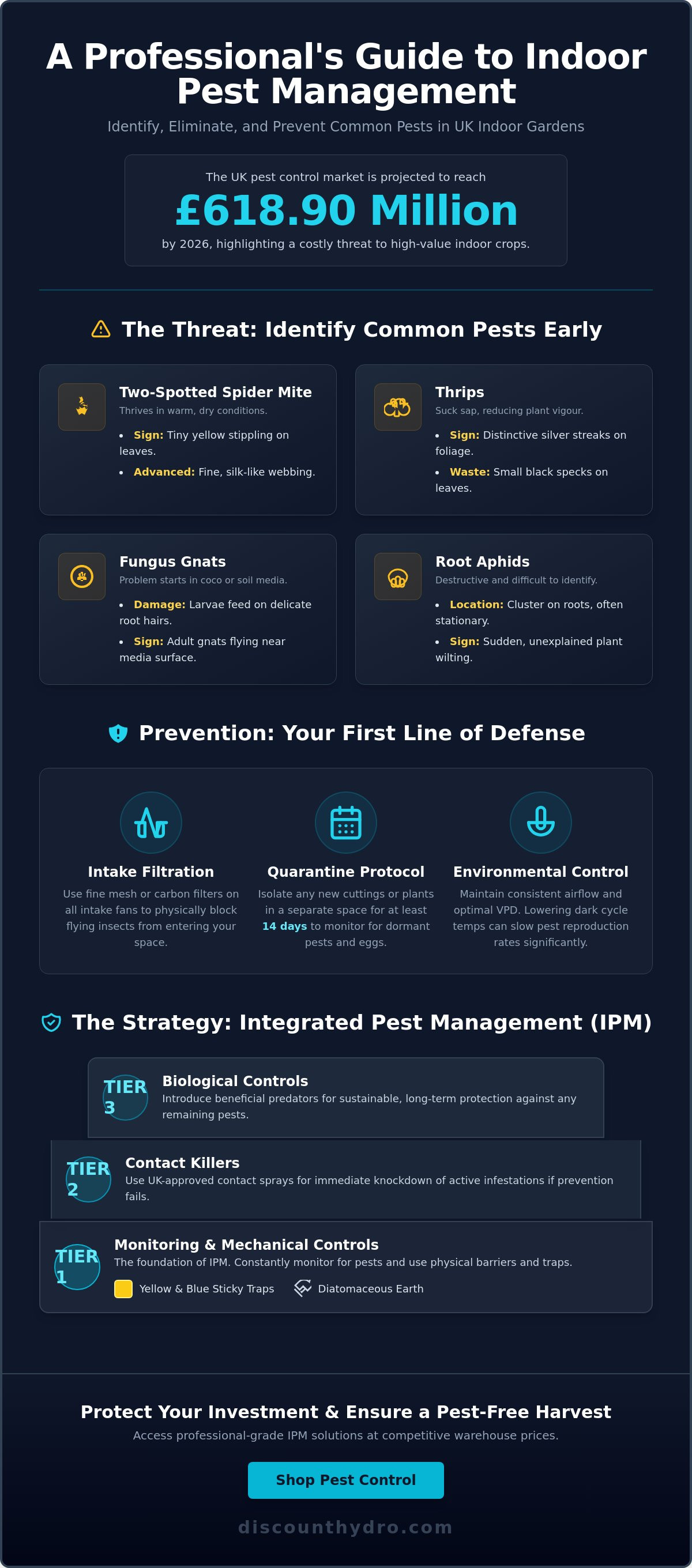
The Two-Spotted Spider Mite is a major threat in UK grow rooms. These microscopic arachnids thrive in warm, dry conditions often found under high-intensity LED grow lights. You'll spot fine webbing between leaf stems in advanced stages, but early signs include tiny yellow stippling on leaf surfaces. Thrips leave different markers. Look for distinctive silver streaks and small black specks of waste on foliage. Both pests suck the sap from your plants, rapidly reducing vigour and final harvest quality.
Fungus Gnats and Root Aphids: Below the Surface
Problems in coco coir or soil media often start with the Fungus Gnat. Their larvae feed on organic matter and delicate root hairs, compromising nutrient uptake and plant health. You'll see adult gnats crawling on the media surface or flying near your pots. Root Aphids are far more destructive and harder to identify. They cluster on roots and are often mistaken for harmless soil organisms like springtails. However, root aphids are stationary and cause sudden, unexplained wilting. Protecting your investment requires the right professional-grade tools. We stock a full range of pest control for indoor plants uk to handle these specific threats before they escalate.
Building a Biosecure Grow Room: Prevention Strategies
Prevention is the foundation of high-performance indoor growing. Adopting a "Clean Room" philosophy ensures you spend less on reactive treatments and more on plant development. Every insect you block at the intake vent saves you money on expensive sprays later. This proactive approach to pest control for indoor plants uk is the only way to maintain a professional facility. Physical barriers are your first line of defense. Use fine mesh or carbon filters on all intake fans to stop flying pests like thrips and fungus gnats from entering. According to the RHS guide to indoor plant pests, many infestations start with small oversights in basic biosecurity.
Quarantine protocols are mandatory for any serious grower. Never introduce a new cutting or plant directly into your main room. Keep new arrivals isolated in a separate space for at least 14 days. This window allows you to monitor for dormant eggs or larvae that aren't visible to the naked eye. Environmental factors also play a critical role in pest management. Lowering temperatures slightly during the dark cycle can significantly slow down the reproduction rate of spider mites. While pests thrive in stagnant, warm air, a well-ventilated room with consistent airflow makes it harder for them to settle and breed.
Environmental Control and Biosecurity
Maintaining a specific Vapour Pressure Deficit (VPD) keeps plants resilient. Healthy, unstressed plants have stronger cell walls that are harder for sucking insects to pierce. Using high-quality grow tents creates a sealed, controllable environment that is far easier to secure than an open room. Biosecurity also extends to the grower. Always change your clothes and wash your hands before entering your clean space. Pests like spider mites often hitchhike on clothing after you've been outdoors or in a garden centre.
Hygiene and Sterilisation Routines
Deep cleaning between cycles is a technical requirement. Use professional-grade sterilisers to wipe down every surface, including tent walls, light reflectors, and floor trays. Remove all dead plant matter and standing water immediately. These are prime breeding grounds for fungus gnats and pathogens. Sterilise all tools, pots, and trays with a dedicated horticultural cleaner to prevent cross-contamination between crops. For the best value on essential supplies, browse our range of pots, trays, and systems to ensure your setup remains sterile and efficient.
Mechanical Controls: Sticky Traps and Physical Barriers
Mechanical controls provide a chemical-free layer of protection. These methods rely on physical interaction to kill or trap insects. Integrating sticky traps and physical barriers is a standard part of professional pest control for indoor plants uk. These tools are low-cost and highly effective when used correctly. They don't rely on toxic chemistry, making them safe for use throughout the growth cycle. Physical methods are essential for preventing pests from establishing a foothold in your grow room.
Yellow traps attract fungus gnats, whiteflies, and winged aphids. Blue traps are specifically designed to catch thrips. Pests are drawn to these specific wavelengths of light. For maximum effectiveness, place yellow traps directly on the surface of your growing media. Position blue traps at canopy height where thrips are most active. This targeted placement ensures you catch adults before they can reproduce. It's a simple, transactional solution to a complex biological problem.
Diatomaceous Earth (DE) is a natural powder made from fossilised algae. It works mechanically by shredding the exoskeletons of soft-bodied insects. It's highly effective against crawling pests. Apply it as a dry dust to the surface of your coco or soil. DE loses its effectiveness when wet. Keep the top layer of your media dry to maintain its lethal properties. It's a no-frills, physical barrier that stops larvae in their tracks.
Monitoring with Sticky Traps
Sticky traps are early warning systems. They tell you exactly what has entered your grow room before damage becomes visible. Reading trap data helps you determine the infestation size. If a trap is covered in days, your population is peaking. Replace these traps weekly. Dust and debris from circulation fans reduce stickiness, making old traps useless. Monitoring is the only way to track if your other treatments are working. Use these as a data collection tool to adjust your strategy.
Physical Barriers in the Growing Medium
A 1-2cm top-dress of sharp sand or perlite prevents adults from laying eggs in the damp media below. This is a proven method for controlling fungus gnats effectively. Combine this with Diatomaceous Earth for a lethal barrier. For heavy spider mite infestations, mechanical leaf-washing with horticultural oils is essential. These oils coat leaf surfaces and suffocate eggs and larvae. Ensure you cover the undersides of leaves where most pests hide. Use these oils during the dark cycle to avoid leaf burn under intense LED grow lights. This physical approach ensures pests can't develop chemical resistance over time.
Integrated Pest Management (IPM): Chemical and Biological Solutions
Professional pest control for indoor plants uk requires a tiered Integrated Pest Management (IPM) strategy. You can't rely on a single spray to fix a major infestation. A successful IPM plan uses a "Knockdown" phase to clear adult populations instantly using UK-approved contact killers. Once you've reduced the initial numbers, you introduce biological controls to maintain the environment. This technical approach ensures your crops remain healthy without the constant need for heavy chemical application. It's about efficiency and protecting your financial investment in your grow room.
Resistance management is a critical part of long-term success. Pests like thrips and mites reproduce so quickly they can develop immunity to specific active ingredients within a few generations. You must rotate your treatment types to stay ahead. Switch between physical suffocants, growth stimulants, and biological predators to keep pest populations off balance. This variety prevents the survival of resistant strains that could ruin future cycles. Professional growers don't wait for an outbreak. They use a rotation as a standard preventative measure.
Effective UK Sprays and Invigorators
SB Plant Invigorator is a staple for UK indoor growers. It acts as a growth stimulant while physically controlling pests through a non-toxic foaming action that suffocates insects on contact. SMC (Spider Mite Control) offers a more specialized solution for stubborn spider mites. For maximum results, you must spray the undersides of every leaf. Timing is vital. Always apply these treatments during "lights-off" periods. This prevents leaf scorch from high-intensity LED grow lights and allows the product to stay wet for longer, increasing its effectiveness. You can find these essential treatments in our plant nutrients and supplements category at warehouse prices.
Biological Predators in the Grow Room
Introducing biological predators like Persimilis or Nematodes requires specific environmental management. Persimilis mites are highly effective against spider mites but need high humidity to survive and hunt. In a dry grow tent, these predators will perish before they can clear your infestation. Nematodes are the standard choice for fungus gnat larvae living in your media. Be aware that you cannot use certain chemical sprays alongside biologicals. Strong contact killers will destroy your beneficial insects as easily as the pests. Plan your IPM schedule to allow a safety window between spraying and releasing your predators. Coordination is the key to a pest-free harvest.
Professional Pest Control Supplies at Discount Hydro
Maintaining a biosecure environment requires immediate access to the right tools. Discount Hydro is committed to providing the UK’s best value inventory for serious growers. We understand that an infestation doesn't wait for a convenient time. That's why we maintain a massive stock of pest control for indoor plants uk at our County Durham warehouse. From basic sticky traps to professional-grade invigorators, we supply everything needed to execute a successful IPM strategy. Our focus remains entirely on technical performance and monetary value.
Urgency is the priority when crops are at risk. We offer fast UK-wide delivery to ensure your treatments arrive before the damage becomes irreversible. If you're local to the North East, our click-and-collect service provides even faster access to essential supplies. Our team provides pragmatic, cost-effective solutions based on what actually works in a high-intensity grow room. We don't deal in hobbyist narratives; we provide the professional equipment required to protect your financial investment. Our Chester-le-Street facility serves as a hub for growers across the region who need reliable inventory without the high markup found at boutique shops. This no-frills approach is why professional operations choose us as their primary supplier for pest control for indoor plants uk.
Essential Pest Control Kit for UK Growers
Every professional setup needs a ready-to-use kit. This includes high-pressure sprayers for total leaf coverage and specific traps for monitoring. Using premium hydroponic nutrients is also a key part of your defense. Well-fed plants have higher immunity and can withstand pest pressure more effectively than nutrient-deficient crops. Buying these IPM supplies in bulk is the smartest way to save. Professional growers trust us because we prioritise inventory availability and competitive pricing over narrative branding. We stock the technical products that deliver results.
Get Started Today
Browse our full range of pest control and plant health products through our digital catalogue. You can compare prices and technical specifications to find the right fit for your specific tent size. If you need items immediately, visit our Chester-le-Street store for direct collection. We keep the process simple and efficient so you can get back to managing your grow. Don't wait for spider mites or thrips to compromise your yield. Protect your crop with professional pest control from Discount Hydro and ensure your harvest reaches its full potential.
Secure Your Harvest with Professional Pest Management
Maintaining a high-performance grow room requires a technical, no-nonsense approach to biosecurity. You've seen that effective pest control for indoor plants uk relies on early detection via sticky traps and a tiered IPM strategy. Combining physical barriers with professional-grade contact killers ensures that pests like fungus gnats and spider mites never gain a foothold. Prevention is always cheaper than a cure; keeping your environment sterile is the only way to protect your financial investment and yield quality.
We're here to provide the essential tools for a clean facility. Our inventory includes professional brands at competitive prices, backed by UK-based expert support. If you're facing an immediate threat, next-day nationwide delivery ensures you can start your knockdown phase without delay. Don't wait for visible damage to ruin your crop cycle. Take control of your environment today and keep your plants healthy throughout every stage of growth.
Shop the UK’s Most Effective Indoor Pest Control Range
Frequently Asked Questions
What is the best pest control for indoor plants in the UK?
The most effective pest control for indoor plants uk is a combined strategy of physical biosecurity and targeted contact killers. Use fine mesh filters on all intake fans to block entry. Apply professional-grade products like SB Plant Invigorator or SMC for immediate knockdown of existing populations. This transactional approach ensures you don't waste your budget on ineffective home remedies.
How do I get rid of fungus gnats in my hydroponic system?
Eliminate fungus gnats by targeting both adults and larvae simultaneously. Place yellow sticky traps on the surface of your growing media to catch flying adults. Introduce Steinernema feltiae Nematodes into your hydroponic reservoir or coco media to destroy larvae. Keep the top layer of your media dry between watering cycles to prevent new eggs from being laid.
Are sticky traps enough to stop a spider mite infestation?
Sticky traps are monitoring devices and won't stop a spider mite infestation on their own. They help you track population levels but cannot reach eggs or larvae hidden on the undersides of leaves. You must use a specialized contact killer or predatory mites like Persimilis for total elimination. Relying on traps alone often leads to total crop failure.
Is SB Plant Invigorator safe to use on all indoor plants?
SB Plant Invigorator is safe for most indoor crops because it works mechanically as a suffocant rather than a chemical poison. It also acts as a growth stimulant to help plants recover. Always apply the spray during the dark cycle to avoid leaf scorch under intense LED grow lights. Perform a small patch test on a single leaf before treating your entire room.
Can I use biological pest control inside a grow tent?
Biological controls work well in grow tents if you maintain the correct environment for the predators. Predatory mites like Persimilis require humidity levels above 60% to hunt effectively. If your tent is too dry, the beneficial insects will die before they can clear the pests. Coordination between your ventilation settings and biological releases is essential for technical success.
How often should I spray my plants for pest prevention?
Spray your plants once per week for a standard preventative routine. If you identify an active infestation, increase the frequency to every three days for a 10 day period. This schedule ensures you kill new hatchlings before they reach reproductive age. Always follow the specific instructions on the product label to ensure maximum value and safety during the knockdown phase.
What attracts bugs to my indoor plants in the first place?
Pests are attracted to damp growing media, high humidity, and stagnant air. Fungus gnats specifically seek out wet coco or soil to lay eggs. Sucking insects like thrips are often brought in on contaminated clothing or through unfiltered air intakes. Maintaining a clean room and using carbon filters on intakes significantly reduces these risks by creating a biosecure barrier.
Where can I buy professional-grade pest control for plants in the UK?
Professional-grade pest control for indoor plants uk is available at Discount Hydro. We stock a full range of IPM supplies at our Chester-le-Street warehouse. You can purchase online for fast nationwide delivery or use our click-and-collect service for urgent infestations. We focus on providing technical products that deliver results for serious growers at competitive warehouse prices.