

The Ultimate Hydroponics Supplies List: Everything You Need for 2026
The global hydroponics market is projected to reach USD 30.79 billion by 2034, driving a surge in high-efficiency indoor cultivation across the UK. Despite this growth, many growers still struggle with failed harvests caused by forgetting one vital component. It's easy to get confused by LED wattages or overwhelmed by the vast array of nutrient brands available. You need a setup that maximizes yield for the lowest possible price without missing critical parts like pH adjusters or specific fittings. This guide provides a definitive, no-nonsense hydroponics supplies list to ensure your indoor garden is fully equipped from day one.
We've compiled a verified checklist of every essential item, from full-spectrum LED grow lights to specialized nutrients and environmental controllers. You'll see exactly what each component does and why it's required for a professional-grade system. This overview covers the hardware, the plumbing, and the chemistry necessary for a successful harvest in 2026. Get the facts on what you actually need for a streamlined, cost-effective grow room today.
Key Takeaways
- Identify the essential hardware required to build a climate-controlled grow space using high-efficiency LED lighting and durable grow tents.
- Compare popular cultivation methods like Deep Water Culture and Nutrient Film Technique to find the system that matches your skill level.
- Access a complete hydroponics supplies list to prevent missing vital components like pH up/down solutions or EC meters.
- Learn how to manage air quality and neutralize odours through professional-grade extraction fans and carbon filtration systems.
- Understand the science behind base nutrients and growing media to ensure your plants receive the optimal N-P-K balance for high yields.
Core Hardware: Setting Up Your Controlled Environment
Setting up a high-yielding indoor garden starts with a solid foundation. You can't compromise on the environment. If your hardware is weak, your yield will suffer regardless of the nutrients you use. This hydroponics supplies list begins with the structures that house and power your grow. Every component must work together to maintain stable temperatures and optimal light levels.
Selecting Your Grow Tent
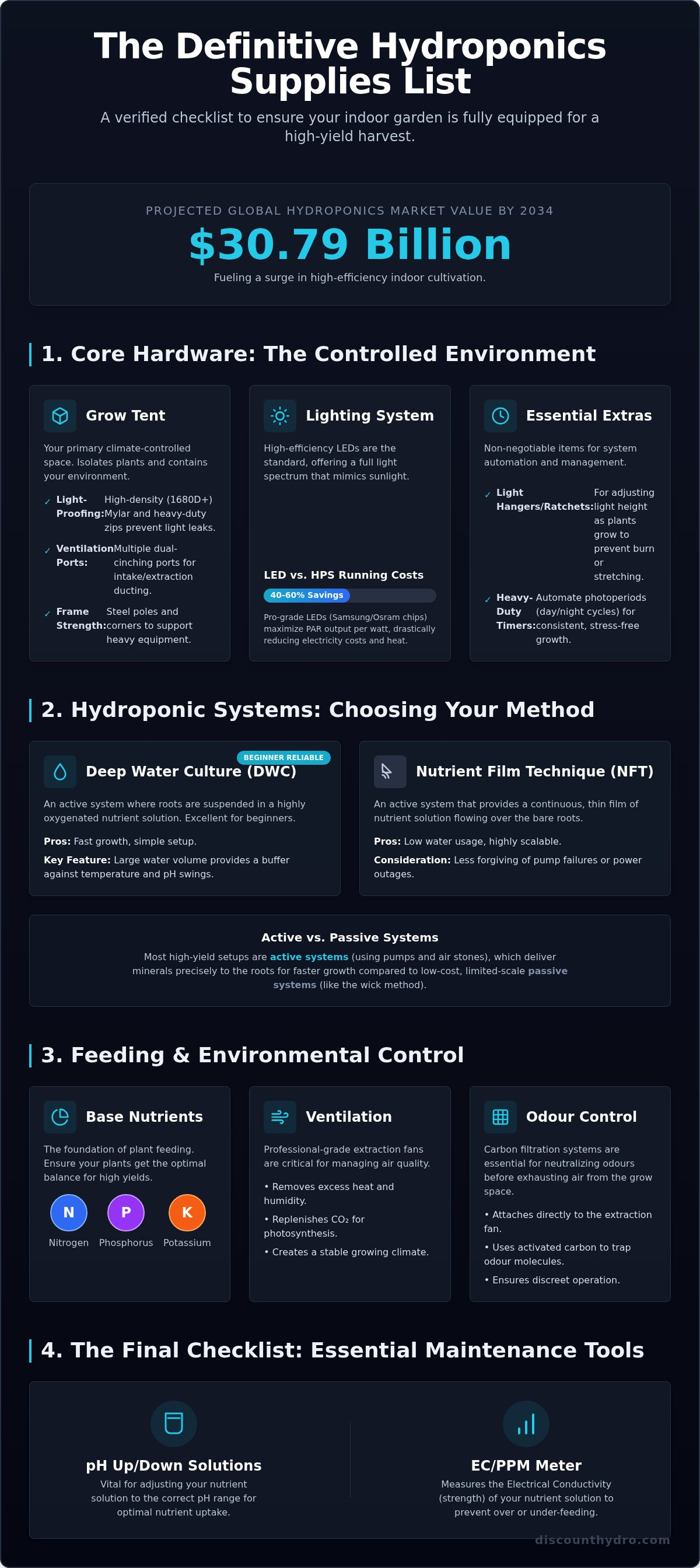
Your grow tent is your primary climate-controlled space. It isolates your plants from external pests and light leaks while containing your environment. For a budget setup, a standard 600D Mylar tent provides adequate reflection. Professional setups often utilize thicker 1680D canvas for superior heat insulation and sound dampening. Key features to look for include:
- Light-proofing: High-density Mylar with heavy-duty zips prevents light leaks that stress plants.
- Ventilation ports: Multiple dual-cinching ports are required for extraction and intake ducting.
- Frame strength: Steel poles and corners prevent the tent from collapsing under the weight of heavy fans and filters.
Size selection is critical. You must match your floor space to your yield goals. If you choose a tent that's too small, heat management becomes difficult. If it's too large, you'll waste electricity lighting empty corners. Check our buyer’s guide to grow tents for specific dimensions and footprint calculations.
The Lighting System
Lighting is your biggest investment. Modern growers have moved away from HPS (High-Pressure Sodium) because of excessive heat and high running costs. High-efficiency LEDs are the current standard for 2026. They offer full-spectrum light that mimics natural sunlight. This is essential for all stages of development. Understanding these systems is part of any comprehensive guide to hydroponics and its modern applications.
Budget LEDs often use lower-quality diodes that lose intensity quickly. Pro-grade LED systems use Samsung or Osram chips to maximize PAR output per watt. This efficiency can reduce electricity costs by 40-60% compared to traditional lighting. While the upfront cost is higher, the long-term savings and lower heat output make them the pragmatic choice. For a detailed breakdown of wattage requirements for your specific tent size, see our LED grow light guide.
Essential Hardware Extras
Don't forget the small items that keep the system running. Light hangers and ratchets are necessary for adjusting the height of your LEDs. As plants grow, you must maintain the optimal distance to avoid light burn or stretching. Heavy-duty timers are also a non-negotiable part of your hydroponics supplies list. They manage photoperiods without manual intervention. This ensures your plants get the exact "day" and "night" cycles they need for consistent growth. Use digital timers for precision or heavy-duty mechanical ones for high-draw lighting arrays.
Hydroponic Systems: Choosing Your Cultivation Method
Your choice of system is the most critical decision in your cultivation strategy. It determines the complexity of your daily routine and the specific hardware required for your hydroponics supplies list. While some retailers suggest Nutrient Film Technique (NFT) for all beginners, Deep Water Culture (DWC) is often more reliable for first-time growers due to its larger water volume and buffer against temperature swings. Selecting the right method ensures you don't waste money on incompatible components.
Active vs. Passive Systems
Most high-yield setups are active systems. They use pumps to move nutrient solution and air stones to oxygenate the root zone. Passive systems, like the wick method, are low-cost but limited in scale and growth speed. According to the USDA hydroponics overview, these soilless methods rely on precise delivery of minerals directly to the roots. Understanding these soil-free growing basics helps you choose between a simple bucket setup or a complex multi-tray array.
For those managing larger setups, auto-feeding systems like Ebb and Flow or drip irrigation reduce daily maintenance. These systems use a central reservoir to feed multiple plant sites simultaneously. This scalability is essential if you plan to expand your garden in the future. You can browse our complete hydroponic systems to see how these components integrate into a single kit.
Essential Irrigation Components
Every active system requires a specific set of plumbing and aeration tools. If these fail, your plants can decline rapidly. Ensure your hydroponics supplies list includes these verified essentials:
- Water Pumps: Submersible pumps designed for continuous or timed operation.
- Air Pumps and Stones: These prevent root rot by keeping the nutrient solution highly oxygenated.
- Delivery Tubing: Standard 13mm or 19mm black flexi-pipe to prevent algae growth inside the lines.
- Pots and Net Cups: Heavy-duty plastic containers that secure your plants within the system.
- Reservoirs and Trays: UV-stable tanks that hold your main nutrient solution without leaching chemicals.
Irrigation efficiency depends on the quality of your fittings. Cheap plastic connectors often crack under pressure or degrade when exposed to nutrients. Use professional-grade barbs, tees, and elbows to prevent leaks. A secure system allows you to focus on plant health rather than mopping up spills. High-quality reservoirs are the foundation of any water-based garden; they must be large enough to prevent rapid pH fluctuations while fitting comfortably inside your grow space.
Nutrients and Growing Media: The Science of Feeding
Feeding your plants is where many beginners fail by using standard garden fertilizers. These lack the specific mineral profile required for soilless systems. Your hydroponics supplies list must prioritize high-quality, water-soluble nutrients that won't clog your pumps. Using a university guide to hydroponics helps clarify how plants absorb these minerals without soil as a buffer. Precision in your feeding schedule directly impacts your final yield and harvest quality.
Choosing Your Growing Medium
Budget growers often start with perlite or vermiculite. These are cheap and effective for aeration but lack the structural stability for larger plants. Professional cultivators prefer coco coir or clay pebbles. Your choice depends on your system type:
- Coco Coir: This provides the perfect balance of aeration and water retention. It's an inert medium, giving you total control over the feeding schedule.
- Clay Pebbles: These are the standard for DWC and NFT systems. They are reusable, pH neutral, and provide maximum drainage for root health.
- Perlite and Vermiculite: These are essential additives for custom mixes, helping to increase oxygen levels around the roots in pot-based systems.
The Nutrient Starter Kit
Most professional nutrient lines, including UK-engineered brands like Intense Nutrients or Dutch Pro, use an A/B formula. These concentrated minerals are kept separate until mixing to prevent them from reacting and forming solids. You'll also need Cal-Mag to prevent common deficiencies, especially if you use filtered water or coco coir. Intense Nutrients and Dutch Pro offer excellent value for money. They provide professional-tier results without the premium price tag of international competitors. Refer to our beginner’s guide to nutrients for specific mixing schedules and dosage charts.
Precision is everything. You must keep your solution between pH 5.5 and 6.5. Outside this range, plants experience nutrient lockout and cannot absorb food. This leads to stunted growth and yellowing leaves. Include pH Up and pH Down solutions in your hydroponics supplies list to make these adjustments daily. Supplements and boosters can also be added to enhance root health and final yields. These products are not essential for a basic grow, but they are the difference between a standard harvest and a high-yielding professional result. Stick to established brands to ensure the chemistry is stable and effective.
Environmental Control: Ventilation and Odour Management
Ventilation is the lungs of your grow room. Many budget-focused guides treat extraction as an optional extra for heat management, but this is a mistake that leads to stunted growth. Plants require a constant supply of fresh CO2 to perform photosynthesis. Without proper airflow, CO2 levels drop rapidly, and growth grinds to a halt. Your hydroponics supplies list must include a robust extraction circuit to ensure air is fully exchanged every 1 to 3 minutes.
The Extraction Circuit
An effective extraction system consists of an inline fan, a carbon filter, and ducting. You must match your fan's power, measured in Cubic Feet per Minute (CFM), to the volume of your grow tent. Calculate this by multiplying the length, width, and height of your space. If your fan is too weak, heat and humidity will build up; if it's too strong, you'll waste electricity. Key technical considerations include:
- Matched Carbon Filters: Your filter must have a CFM rating equal to or slightly higher than your fan. This ensures the air passes through the activated carbon at the correct speed to neutralize all organic odours.
- Acoustic Ducting: Standard aluminium ducting can be noisy. Use insulated acoustic ducting to dampen the sound of moving air for a more discreet operation.
- Heavy-Duty Clips: Use metal worm-drive clips rather than tape to secure your ducting. Leaks in the extraction line bypass the carbon filter and allow odours to escape.
Climate Monitoring Tools
In 2026, smart automation is becoming the industry standard. High-efficiency setups now use digital fan controllers that adjust airflow based on real-time temperature and humidity triggers. This prevents the system from running at 100% when it's not needed, saving on energy costs and extending the life of your hardware. A basic hygrometer is the bare minimum required to track these metrics, but automated controllers offer much better precision.
Monitoring these levels allows you to manage Vapour Pressure Deficit (VPD). This technical metric determines how effectively your plants can transpire and move nutrients from the roots to the leaves. If the air is too humid or too dry, transpiration stops. Circulation fans are also essential to prevent stagnant air pockets where mould can develop. These fans move the air within the tent, mimicking a natural breeze to strengthen plant stems. For professional-grade hardware that keeps your environment stable, shop high-performance ventilation kits and controllers today.
Managing your environment is about more than just cooling. It is about creating a consistent, repeatable ecosystem. By investing in a quality extraction fan and a reliable carbon filter, you protect your garden from heat stress and keep your hobby private. Every item on your hydroponics supplies list should serve a functional purpose in maintaining this balance. High-quality ventilation components are a one-time investment that pays for itself in improved plant health and higher final yields.
The Final Checklist: Essential Maintenance Tools
A successful grow requires more than just the large components like tents and lights. Many growers fail because they overlook the small, practical items that keep the environment stable and the plants healthy. Your hydroponics supplies list must include the maintenance tools required for daily monitoring and system hygiene. These items are the difference between a high-yielding harvest and a system failure caused by nutrient lockout or root rot.
Water Chemistry Tools
Precision is the only way to ensure your plants can actually absorb the nutrients you provide. Digital pH pens are the industry standard for 2026. While liquid test kits are cheaper, they lack the accuracy needed for high-performance systems. You also need an EC (Electrical Conductivity) meter. This tool measures the concentration of salts in your water, allowing you to prevent nutrient burn by ensuring your solution isn't too strong. Key items for your water chemistry kit include:
- Digital pH Pens: For rapid, accurate readings of your solution's acidity.
- EC Meters: To monitor nutrient strength and avoid overfeeding.
- Calibration Fluids: Digital meters drift over time. You must have pH 4.0, pH 7.0, and EC calibration solutions to keep your sensors accurate.
Plant Care and Hygiene
Cleanliness is non-negotiable in a hydroponic environment. Because there is no soil to act as a buffer, pathogens can spread through a water-based system in hours. Sterile scalpels and pruning shears are required for making clean cuts that heal quickly. Between crops, you must use specialized cleaning solutions to disinfect reservoirs and tubing. This removes mineral scale and biofilm that harbor bacteria. Don't forget personal protective equipment. High-intensity LED lights can strain your eyes, and concentrated pH adjusters can irritate the skin. Keep gloves and grow-room glasses on hand at all times.
Practical Logistical Hardware
Most competitors fail to mention the logistical accessories that actually hold a grow room together. You cannot run a professional setup without high-quality extension leads and cable management. LED lights and extraction fans have a high power draw; use heavy-duty, surge-protected extension leads to prevent electrical fires. Your hydroponics supplies list should also include:
- Cable Ties: To keep power leads away from water and nutrient reservoirs.
- Duct Tape: For emergency repairs and securing light-proofing materials.
- Syringes and Pipettes: For precise measurement of concentrated nutrients and boosters.
- Measuring Jugs: Use dedicated, graduated jugs for mixing your A/B nutrients.
Having these practical tools ready prevents the "forgotten component" panic that often leads to lost yields. A well-organized grow room is easier to maintain and much safer to operate. By checking off every item on this list, you ensure your setup is a complete, modular ecosystem designed for maximum efficiency. Stock these essentials now to maintain total control over your indoor garden throughout 2026.
Launch Your High-Yield Indoor Garden Today
You now have a verified hydroponics supplies list to build a professional-grade setup for 2026. Success in soilless cultivation depends on a balanced ecosystem where your LED lighting footprint perfectly matches your extraction power. Don't let a missing pH pen or an undersized carbon filter compromise your harvest. By prioritizing high-efficiency hardware and professional-grade minerals, you eliminate the common errors that lead to nutrient lockout and stunted growth.
We provide the best prices on industry-leading brands like Intense Nutrients, Dutch Pro, and Omega Lighting. If you're based near Chester-le-Street, expert technical advice is available through our click-and-collect service in County Durham. For growers across the country, we offer fast UK-wide delivery to ensure your equipment arrives exactly when you need it. Our inventory is built for pragmatic cultivators who demand high performance at a competitive price point.
Browse our complete range of Hydroponics Supplies and Kits to secure your equipment today. Start your grow with the right tools and achieve the professional yields your garden is capable of producing.
Frequently Asked Questions
What is the most essential piece of hydroponics equipment for a beginner?
A reliable pH meter is the most essential tool for any new grower. Without it, you cannot monitor the acidity of your solution, which leads to nutrient lockout. Even with the best lights and nutrients, your plants will fail if the pH is outside the 5.5 to 6.5 range. It's the one item that prevents the most common cultivation errors.
How much does a basic hydroponics setup cost in the UK?
Costs for a basic setup depend on the scale of your grow and the quality of the lighting. Small, entry-level kits including a tent, basic LED, and a single-pot system are the most budget-friendly options. Professional-grade setups with high-efficiency LEDs and automated controllers require a higher upfront investment but offer significantly lower running costs and higher yields over time.
Do I really need a grow tent for hydroponics?
Yes, a grow tent is required for total environmental control and light-proofing. It provides a reflective internal surface that maximizes light efficiency and contains odours through integrated ventilation ports. Tents also offer a secure framework for hanging heavy extraction fans and carbon filters, which is difficult to achieve in an open room without causing damage.
Which is better for beginners: Coco Coir or Clay Pebbles?
Coco coir is the superior choice for beginners because it provides a familiar planting experience with a built-in safety buffer. It retains water better than pebbles, meaning plants won't die instantly if a pump fails. Clay pebbles are better for active systems like DWC where maximum drainage and aeration are the primary technical requirements for the root zone.
How often do I need to change the nutrient solution in my reservoir?
You should change your nutrient solution every 7 to 14 days to prevent mineral imbalances. As plants drink, they absorb specific minerals faster than others, which causes the pH and EC levels to drift. Regular changes ensure your hydroponics supplies list of base nutrients remains balanced and accessible for the plants to maintain rapid growth cycles.
Can I use regular tap water for my hydroponic system?
Tap water is acceptable if you let it sit for 24 hours to allow chlorine to dissipate. However, you must check the initial EC level of your water before adding nutrients. If you have "hard" water with high mineral content, use a specialized hard-water nutrient line like those from Dutch Pro to avoid over-concentrating the solution and causing nutrient burn.
What is the difference between a grow lamp and a regular LED light?
Grow lamps are engineered with high PAR (Photosynthetically Active Radiation) output to drive photosynthesis. Regular household LEDs lack the intensity and the full-spectrum wavelengths required for plant development. A professional grow lamp provides the specific blue and red spectrums needed for both the vegetative and flowering stages, ensuring dense growth that household bulbs cannot support.
Is it cheaper to buy a complete grow kit or individual components?
Buying a complete grow kit is typically more cost-effective and ensures all components are technically compatible. Kits remove the guesswork by matching the fan's extraction power to the tent volume and the light's footprint. If you are an experienced grower, selecting individual items from a hydroponics supplies list allows for more precise customization, though it often costs more than a bundled deal.