

Water Pump for Hydroponic Setup: The 2026 UK Grower’s Guide
Your pump's maximum flow rate is likely a misleading figure that doesn't reflect real-world performance in a vertical or multi-tray system. Choosing a water pump for hydroponic setup based solely on the box's LPH rating often leads to nutrient imbalances and unexpected equipment failure. Most UK growers have felt the sting of a silent system that's actually just a broken one, leading to wilted crops and wasted time. It's a common frustration to find that a nutrient solution isn't reaching the furthest plants because the pressure isn't high enough to overcome the lift.
A quiet, reliable system is essential for any indoor environment, especially when the goal is consistent nutrient delivery without the noise of a failing motor. This guide provides the technical clarity required to master nutrient delivery and secure a cost-effective pump tailored to your specific grow space. You'll learn how to calculate "Head Height" accurately, identify energy-efficient models that meet current UK standards, and implement a maintenance routine that prevents clogs. We'll examine the best submersible options and the specific flow rates needed to keep your plants healthy and your reservoir balanced.
Key Takeaways
- Learn the technical specs of a water pump for hydroponic setup to ensure consistent nutrient delivery and prevent system failure.
- Use the 3x Reservoir Volume rule and calculate vertical Head Height to select a pump capable of reaching your highest plant trays.
- Match pump pressure and flow rates to your specific method, from low-pressure NFT systems to high-pressure top-feed drip setups.
- Implement maintenance best practices, including pre-filter use and secure placement, to maximize pump lifespan and minimize operating noise.
- Access professional-grade equipment at value-driven prices with reliable UK shipping and expert-curated selection.
What is a Water Pump for Hydroponic Setups?
The water pump is the mechanical heart of any active hydroponic system. It provides the pressure and flow required to move nutrient-rich water from your reservoir directly to the plant root zone. Without a reliable water pump for hydroponic setup, your plants lose access to hydration and essential minerals, leading to rapid wilting or crop failure. To fully understand What is Hydroponics?, one must look at how these mechanical components replace natural soil processes by delivering nutrients directly to the roots.
You generally choose between two primary types of pumps: submersible and inline. Submersible pumps sit directly in the nutrient solution. They're typically easier to install and run quieter because the water dampens the motor vibrations. Inline pumps sit outside the reservoir. These are the preferred choice for commercial growers using large-scale systems where temperature control is tight and high-pressure delivery is required for extensive pipe networks. Because inline pumps are external, they don't transfer motor heat into your nutrient solution.
Reliability is paramount, especially in systems like the Nutrient Film Technique (NFT). In these setups, a thin film of water flows over the roots constantly. If the pump stops for even an hour, the roots dry out and the crop can be lost. Professional setups rely on 24/7 operation to maintain the life support of the plants.
The Role of Oxygenation and Circulation
Stagnant water is a breeding ground for pathogens like Pythium, often called root rot. A pump ensures constant movement, which is critical for maintaining high levels of dissolved oxygen. When water is in motion, it breaks the surface tension, allowing oxygen to enter the solution. This is vital for root respiration and prevents the anaerobic conditions that allow harmful bacteria to thrive. Circulation also ensures even nutrient distribution throughout the reservoir, preventing minerals from settling at the bottom of the tank.
Active vs. Passive Hydroponics: When is a Pump Essential?
Active systems require a pump to function. These include NFT, Drip systems, and Aeroponics. In these methods, the grower has total control over the delivery timing and volume of the nutrient solution. Passive systems, like the Kratky method, rely on a stagnant reservoir and don't use mechanical parts. While passive setups are simple, they lack the scalability and growth speed of active ones. For professional UK grow rooms, an active system with a high-quality water pump for hydroponic setup is non-negotiable. It allows for larger plant counts and more efficient use of space. For a deeper look at different setups, check our guide on What is Hydroponics?.
How to Choose the Right Water Pump for Your System
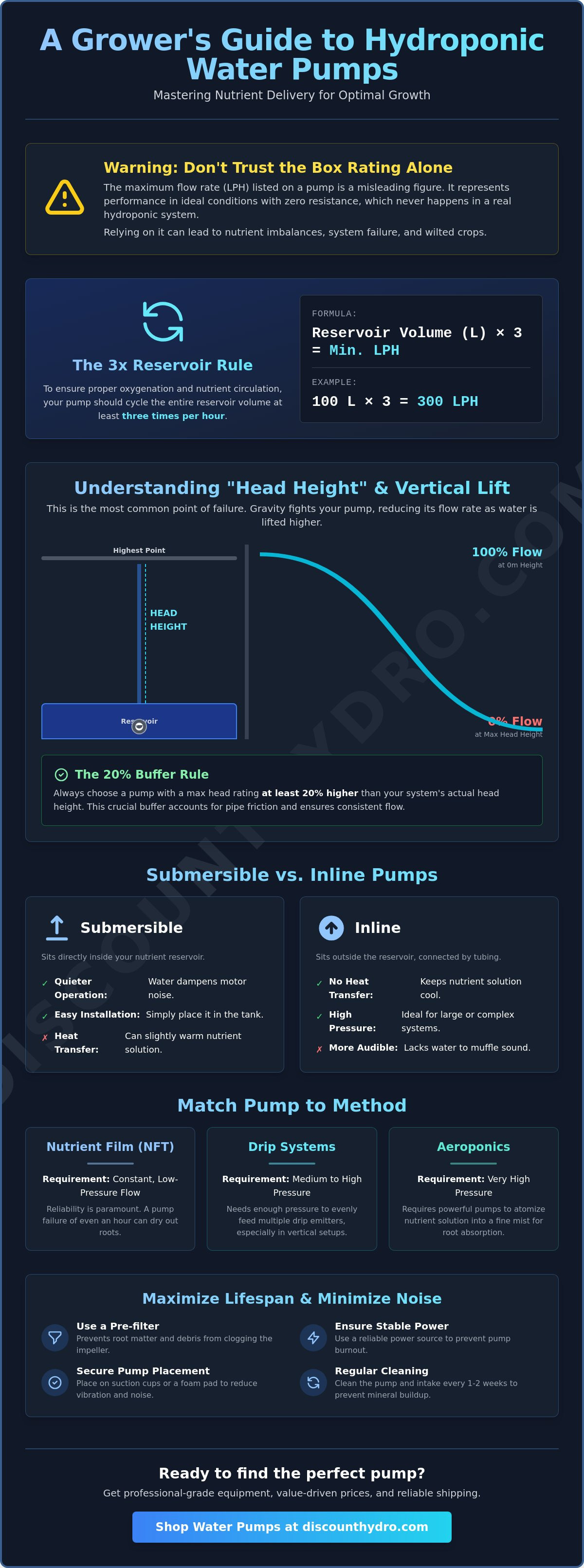
Choosing a water pump for hydroponic setup requires more than just picking the highest number on the box. You need a specific balance between volume and pressure. The industry standard is the 3x Reservoir Volume rule. This ensures your entire nutrient solution cycles through the system three times every hour. If you have a 100 litre reservoir, your pump must deliver at least 300 litres per hour (LPH) to maintain optimal oxygenation and nutrient consistency.
Calculating Your Litres Per Hour (LPH) Requirements
To find your minimum requirement, use the formula: Reservoir Volume x 3 = Minimum LPH. While this works for standard hydroponic systems for home growers, certain methods demand more. Aeroponic systems, for instance, need significantly higher pressure to create a fine mist, often requiring pumps with much higher ratings than the base calculation suggests. LPH is the volume of water moved without any resistance or vertical lift.
Understanding Head Height and Vertical Lift
Head height is the vertical distance from the pump's position in the reservoir to the highest point of the delivery tube. This is where most growers make mistakes. As the water travels upward, gravity creates resistance that slows the flow. Every pump has a Max Head rating. At this height, the flow rate drops to exactly zero. If your system needs to lift water 1.5 metres, don't buy a pump with a 1.5-metre max head. It won't move a drop.
Always choose a pump with at least 20% more head capacity than your setup actually requires. This buffer accounts for friction within the pipes and ensures consistent delivery even as the pump ages. For reliable performance, check our professional range of Pots, Trays, and Systems to find compatible hardware.
Pipe diameter also plays a massive role in actual performance. Narrow tubing increases friction, which forces the motor to work harder and reduces the effective LPH. A wider pipe allows for smoother flow but may require more power to fill the line. There is a direct trade-off between power consumption and LPH output. Higher wattage pumps move more water and handle more resistance but will increase your monthly electricity costs. Balancing these technical specs ensures your nutrient delivery remains stable without overspending on energy.
Matching Water Pumps to Specific Hydroponic Methods
Every active hydroponic method interacts with nutrient solution differently. A pump that works perfectly for a shallow NFT tray will likely fail in a high-pressure aeroponic system. Selecting the correct water pump for hydroponic setup depends entirely on your delivery mechanism. As outlined in the USDA guide to hydroponics, these systems rely on precise mechanical delivery to maintain plant health without soil. If your pump doesn't match the system's resistance or timing requirements, you risk nutrient lockout or root death.
Top-Feed Drip systems require high-pressure pumps. These systems use small emitters or stakes that easily clog if the water pressure isn't high enough to push through mineral build-up. Unlike low-pressure systems, drip setups need a pump that maintains its flow rate even when facing the resistance of narrow microtubing. Deep Water Culture (DWC) setups use pumps primarily for circulation and preventing nutrient stagnation. While air pumps provide the majority of oxygen in DWC, a small submersible water pump helps maintain a uniform temperature and EC level throughout the reservoir.
NFT and Continuous Flow Requirements
Nutrient Film Technique (NFT) requires the pump to run 24/7. Because the motor never stops, you must choose a low-wattage, cool-running model. High-wattage pumps often transfer excess heat into the water, which lowers dissolved oxygen levels and stresses the roots. Reliability is the most important factor here. Brands like Hailea and MAXIJET are popular in the UK market for their long-term durability. Always keep a secondary backup pump on-site. If your primary pump fails in an NFT system, your plants can reach a permanent wilting point in less than two hours.
Flood and Drain: Speed and Volume
Ebb and Flow systems, also known as Flood and Drain, have different priorities. You need a high-volume pump that can fill the entire grow tray quickly, usually within 10 to 15 minutes. This rapid flooding forces old air out of the root zone and pulls fresh oxygen in as the tray drains. If the pump is too weak, the flooding process takes too long, and the roots don't receive the necessary oxygenation cycles. Sizing is based on the total volume of the tray, not just the reservoir. For advice on timing these cycles with your feeding regime, see our guide on Hydroponic Nutrients. Matching your pump's LPH to the tray's capacity ensures your water pump for hydroponic setup performs efficiently during every feed cycle.
Installation, Maintenance, and Noise Reduction
Secure placement is the first step to ensuring your water pump for hydroponic setup operates efficiently. Most failures occur because the pump isn't properly secured or becomes clogged with debris. Start by cleaning the reservoir floor to allow suction cups to grip firmly. Position the pump in the centre of the tank, away from the walls. This prevents the motor's natural vibration from echoing against the plastic, which is the primary cause of noise in small grow rooms. Always submerge a submersible pump completely before turning it on. Running these units dry will melt the internal seals and void your warranty.
A pre-filter is essential for protecting the impeller. This simple foam or mesh guard stops root mass and particles from entering the motor housing. Without it, the motor works harder, draws more current, and eventually burns out. Nutrient salt buildup is another silent killer. Over time, mineral deposits crystallize inside the pump. This abrasive buildup acts like sandpaper on the moving parts, reducing LPH and increasing heat. Regular inspection is the only way to prevent this hardware degradation.
Silencing Your Setup: Vibration and Noise Control
Noise is a major pain point for indoor growers. The "humming" sound is usually kinetic energy transferring from the pump to the reservoir. Use silicone mats or specialized suction cups to decouple the unit from the tank floor. Switch from rigid PVC pipe to flexible tubing. Flexible lines absorb the staccato pulses of water movement, whereas rigid pipes act as a megaphone for motor noise. Regularly check the impeller shaft for alignment. A misaligned shaft creates a rattling sound that indicates imminent mechanical failure. Buy the right Growing Media to prevent loose particles from entering your reservoir and causing these mechanical rattles.
Routine Cleaning and Troubleshooting
Maintenance must be a monthly task for any serious grower. Soak the disassembled pump in a weak citric acid solution to dissolve mineral scale. This keeps the flow rate at factory standards and lowers operating temperatures. Common failure signs include reduced flow, increased heat, or rattling noises. If you notice a drop in pressure, check the intake immediately. To clear a blocked intake, use a soft brush or compressed air. Never poke sharp metal objects into the intake as this can score the motor housing and lead to permanent damage. A hot pump is a sign of a blocked intake. Clean it before the motor burns out.
Why Buy Your Water Pump from Discount Hydro?
Our business model is built on value. We offer warehouse pricing on individual units and bulk orders. This direct approach allows us to pass savings onto the consumer without sacrificing product quality. Beyond the pumps themselves, we stock all necessary compatible fittings, pipes, and accessories. You can find everything from standard 13mm piping to specialized connectors in one transaction. If you're building a custom system, our team provides technical support to ensure your pump matches your specific flow requirements.
Quality Brands at Warehouse Prices
Buying from a specialist UK hydroponics retailer means you get equipment designed for the local market. We prioritize stock availability and fast nationwide delivery. Most orders are processed and shipped directly from our North East facility. For local growers, we offer a convenient click-and-collect option at our County Durham store. This service allows you to bypass shipping costs and get your equipment the same day. We maintain a no-frills, efficient operation to keep our prices the most competitive in the industry. Reliability and cost-effectiveness are our core priorities.
Complete Your System with Expert Tools
A high-performance pump is only one part of a successful grow room. To achieve optimal results, you should pair your irrigation hardware with high-output LED Grow Lights. We also supply essential accessories like digital timers and precision pipe cutters to ensure your installation is professional and leak-free. Proper timing and clean cuts prevent the mechanical stress on your water pump for hydroponic setup that we mentioned in the maintenance section. Our inventory covers the full spectrum of cultivation needs, from seed to harvest.
Browse our full range of Hydroponic Water Pumps and secure the best prices for your setup today. Our direct shipping and warehouse-first approach ensure you get the hardware you need at the price you want.
Secure Your Nutrient Delivery Today
Success in active hydroponics depends on the mechanical reliability of your irrigation hardware. Mastering the balance of LPH and vertical lift is the difference between a thriving crop and total system failure. You now have the technical framework to match your pump to your specific method, whether you're running a high-pressure drip line or a 24/7 NFT tray. Investing in the correct water pump for hydroponic setup ensures consistent oxygenation and uniform nutrient distribution across your entire grow room.
We stock professional brands like Hailea and AquaKing at competitive warehouse rates to keep your overheads low. Our team provides expert advice directly from our County Durham facility, ensuring you get the right fittings for your specific tank. We offer fast UK-wide delivery on all stock items to get your system running without delay. Find the perfect water pump for your setup at Discount Hydro and build a reliable foundation for your next harvest. Get your irrigation right and watch your plants reach their full potential.
Frequently Asked Questions
How do I know what size water pump I need for my hydroponic system?
You calculate the required size by multiplying your total reservoir volume by three. This provides the minimum Litres Per Hour (LPH) rating needed for a standard water pump for hydroponic setup. For example, a 200 litre tank requires a pump rated for at least 600 LPH. Always check the manufacturer's flow chart to ensure the pump maintains this volume at your specific vertical lift height.
Can I use a standard pond pump for my hydroponics setup?
Standard pond pumps are compatible with hydroponic systems if they use oil-free motors and food-grade plastics. You must ensure the unit doesn't leach harmful chemicals into your nutrient solution. Many pond pumps are designed for continuous use, making them durable enough for irrigation. However, dedicated hydroponic pumps usually offer better fittings for standard 13mm or 19mm pipework found in UK grow rooms.
Should I leave my hydroponic water pump running all the time?
Whether you run your pump 24/7 depends on your specific growing method. Nutrient Film Technique (NFT) systems require constant flow to keep roots moist and oxygenated at all times. In contrast, Flood and Drain or Drip systems use timers to deliver water in specific cycles. Running a pump constantly in a system designed for cycles can lead to root rot and nutrient lockout from over-saturation.
What is the difference between a submersible and an inline water pump?
Submersible pumps operate while fully underwater inside the reservoir, while inline pumps sit outside the tank. Submersibles are easier to set up for beginners and run quieter because the water dampens motor noise. Inline pumps are better for larger setups because they don't transfer motor heat into the nutrient solution. Choose a submersible model for small grow tents to save space and simplify your plumbing.
How often should I clean my hydroponic water pump?
You should disassemble and clean your water pump for hydroponic setup at least once every four weeks. Mineral salts from nutrients build up on the impeller and internal housing, which reduces flow and causes the motor to overheat. If you use organic supplements, you might need to clean the pre-filter weekly. Regular maintenance prevents the motor from seizing and ensures consistent nutrient delivery to your plants.
Why is my water pump making a loud humming noise?
A loud humming noise usually indicates that the pump is vibrating against the reservoir walls or floor. Ensure the suction cups are firmly attached or place the pump on a silicone mat to dampen the kinetic energy. If the noise is a grinding sound, it likely means mineral deposits have crystallized around the impeller. Clean the unit immediately to prevent permanent mechanical damage to the motor shaft.
Does the height of my grow tray affect which pump I should buy?
Vertical lift significantly impacts pump performance because gravity creates resistance against the water flow. As the height between the pump and the tray increases, the actual LPH delivered decreases. You must check the "Max Head" rating on the pump's technical specifications before purchasing. If your tray is 1.2 metres high, select a pump with a max head of at least 1.5 metres to ensure adequate pressure.
What happens to my plants if the water pump fails?
Pump failure stops the delivery of oxygen and nutrients, leading to rapid wilting and potential crop loss. In active systems like NFT or aeroponics, plants can reach a permanent wilting point in less than two hours. Without water movement, the solution in the reservoir also becomes stagnant, which lowers dissolved oxygen levels and encourages pathogen growth. Keep a spare pump on hand to swap out immediately if your primary unit fails.