

Carbon Filter for Grow Tent: The 2026 Guide to Odour Control
Most growers believe a carbon filter is just a smell stopper, but it is actually the lungs of your entire ventilation system. If you get the math wrong, you risk more than just a lingering scent; you risk killing your airflow and burning out your expensive extractor fan. Finding the right carbon filter for grow tent environments in 2026 requires understanding that odour control is a precise balancing act between volume and pressure.
We know the stress of checking for leaks every time someone walks past your door. It is frustrating to stare at technical m3/h specs and wonder if they actually match your CFM fan ratings. This guide promises to clear that confusion and help you master the science of grow room ventilation. You will learn how to achieve total odour elimination while keeping your setup quiet and efficient.
We are going to cover everything from the benefits of premium Australian virgin charcoal to the latest refillable filter designs that save money over time. We will also explain how to size your hardware so it lasts multiple growth cycles without restriction. By the end, you will have a professional setup that keeps your indoor garden completely discreet and fresh.
Key Takeaways
- Understand the science of molecular adsorption to ensure your ventilation system effectively traps every scent particle.
- Apply the golden rule of airflow by choosing a carbon filter for grow tent use that exceeds your fan's m3/h output.
- Look for specific hardware features like a 50mm carbon bed and aluminium flanges to balance performance and weight.
- Maximise efficiency by installing your filter at the highest point of the tent using a 'pull' air configuration.
- Save on essential odour control kits with competitive UK price matching and fast shipping from Discount Hydro.
What is a Carbon Filter for Grow Tents and How Does it Work?
A carbon filter for grow tent environments is a high performance air purification device. It is designed to trap volatile organic compounds (VOCs) before they leave the growing area. While it looks like a simple metal cylinder, it is the primary line of defence against strong plant odours. This hardware ensures that the air exiting your ventilation system is clean and scent-free.
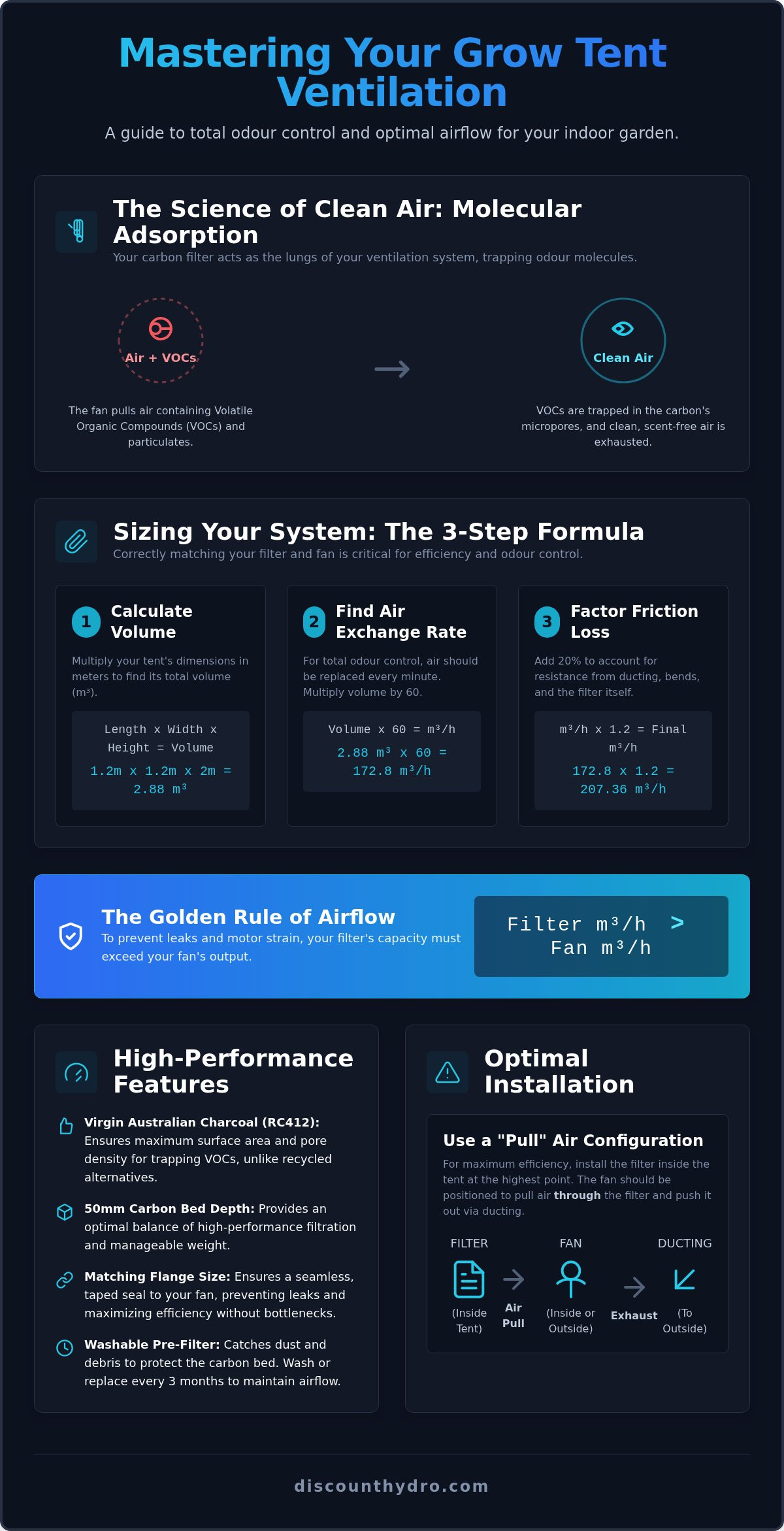
The mechanism relies on the scientific principle of adsorption. Unlike absorption where a sponge soaks up liquid, adsorption causes gas molecules to stick to the surface of the carbon. Understanding how carbon filtering works at a molecular level is key to choosing the right gear. The activated charcoal contains millions of microscopic pores. These pores create a massive surface area that physically traps odour molecules as air passes through the bed.
For this to work, your extraction fan and filter must operate in tandem. The fan creates the static pressure needed to pull air through the dense carbon bed. Without a high quality filter, the fan just moves smelly air around. With one, you get total odour removal, dust filtration, and a sterile environment. This combination is essential for maintaining a discreet indoor garden.
Virgin Activated Carbon vs. Recycled Charcoal
Professional growers prioritise virgin Australian charcoal when selecting a carbon filter for grow tent applications. Specifically, RC412 grade is the industry standard for indoor gardening because of its high pore density. Virgin carbon is fresh and hasn't been used or "reactivated" previously. This ensures the maximum possible surface area for trapping VOCs. Cheaper, recycled charcoal filters often have clogged pores from previous industrial use. These budget options frequently fail mid-cycle, leading to odour leaks when your plants are at their most fragrant.
The Role of the Pre-Filter Sleeve
Every professional carbon filter includes a white cloth pre-filter sleeve. This outer layer serves a critical purpose: it blocks large particles like dust, hair, and soil debris. If these particles reach the internal carbon bed, they clog the pores and reduce the filter's lifespan. A clean pre-filter ensures air flows freely and the carbon remains effective. Maintenance is simple. You should wash or replace your pre-filter every 3 months to maintain optimal airflow and protect your investment.
How to Size a Carbon Filter for Your Grow Tent
Sizing is the most critical step in setting up your ventilation. If your filter is too small, it won't scrub the air effectively; if it is too large, you are overspending on hardware. To get the best results from a carbon filter for grow tent environments, you need a specific mathematical approach. While these systems are designed for gardening, they also help improve your indoor air by removing particulates and VOCs from the immediate environment.
Follow these three steps to calculate your requirements:
- Step 1: Calculate tent volume. Multiply Length x Width x Height in metres. For example, a 1.2m x 1.2m x 2m tent has a volume of 2.88m³.
- Step 2: Account for air changes. For total odour control, you should replace the air once every minute. Multiply your tent volume by 60 to find the hourly requirement. (2.88 x 60 = 172.8 m³/h).
- Step 3: Factor in friction loss. Ducting, bends, and the carbon bed itself create resistance. Add 20% to your total to ensure your fan can handle the pressure. (172.8 x 1.2 = 207.36 m³/h).
The Golden Rule of ventilation is that your filter's m3/h rating must always be higher than your fan's m3/h rating. If the fan pulls 400 m3/h but the filter is only rated for 300 m3/h, the air passes through the carbon too quickly to be cleaned. This leads to immediate odour leaks and places unnecessary strain on your extractor motor.
Matching Flange Size to Your Extraction Fan
UK standard sizes include 100mm (4"), 125mm (5"), 150mm (6"), and 200mm (8"). Always match your filter flange diameter directly to your fan. Using reducers or expanders forces air through a bottleneck, which increases noise and reduces ventilation efficiency. A seamless, taped seal between the fan and the carbon filter for grow tent use is essential to prevent unfiltered air from leaking into the room. You can find correctly sized components by browsing the ventilation supplies at Discount Hydro to ensure a perfect fit.
Understanding m3/h (Metres Cubed per Hour)
UK growers should ignore US-based CFM (Cubic Feet per Minute) ratings to avoid conversion errors. Metres cubed per hour (m3/h) represents the total volume of air a fan can displace within a sixty-minute period. When you read a fan's performance curve, remember that the airflow drops significantly once a filter is attached. Always check the "under load" rating if the manufacturer provides it. Choosing a filter with a slightly higher m3/h capacity than your calculated minimum provides a safety margin for high humidity days.
Key Features of a High-Performance Grow Room Filter
A high performance carbon filter for grow tent setups isn't just about the charcoal inside. The physical construction determines how well it handles the static pressure of your fan. A key metric is bed depth. You should look for a minimum of 50mm of packed carbon. This thickness ensures that air stays in contact with the charcoal long enough for adsorption to occur. If the bed is too thin, 'breakthrough' happens, and odours leak out before they are scrubbed.
Flange material also matters for your tent's structural integrity. Aluminium flanges are preferred because they are lightweight and don't rust. Steel is more durable but adds significant weight to your roof bars. When calculating ventilation needs, you must also consider the mesh open area of the filter casing. A high quality casing has over 50% open area to prevent airflow restriction. This reduces the strain on your motor and helps with vibration dampening, making your entire system quieter.
The Impact of Humidity on Carbon Performance
Humidity is the silent killer of carbon filters. When relative humidity (RH) exceeds 70%, water molecules begin to compete with odour molecules for space in the carbon pores. Effectively, the water 'clogs' the filter. This leads to immediate odour leaks even if your filter is brand new. You must use dehumidifiers or adjust your ventilation to keep RH below this threshold. Protecting your carbon filter for grow tent use means keeping the air dry enough for the charcoal to do its job.
Professional vs. Hobbyist Filter Ranges
Choosing between a 'Pro' and a 'Hobby' range depends on your growth cycle. Professional models, like the Rhino Pro, use higher grade RC412 carbon and offer a lifespan of 18-24 months. These are the best value for long term use. Hobbyist ranges are cheaper upfront but typically last only 6-12 months. If you are running a short, low odour cycle, a hobbyist filter works fine. However, for continuous operation, pro filters offer a lower cost per month because they don't need frequent replacement. Always check the bed depth and carbon weight before buying to ensure you aren't just paying for a brand name.
Installation and Maintenance: Ensuring 100% Odour Control
Correct placement is just as important as buying the right hardware. You should always position your carbon filter for grow tent setups at the highest point inside the enclosure. Heat and odours naturally rise to the top of the grow tent. By extracting from the peak, you remove the most problematic air first. This also keeps your floor space clear for pots and trays.
You must decide between a 'Pull' or 'Push' configuration. Pulling air through the filter into the ducting is the industry standard for a reason. It is more efficient and ensures that the entire surface area of the carbon bed is utilised. To secure the unit, use heavy-duty ratchet straps or hangers rated for the filter's weight. A falling filter can destroy your plants and break your LED lights in seconds. Once installed, check for negative pressure. If the tent walls suck inward slightly when the fan is on, you have a sealed system where no air escapes through the zips.
Connecting Ducting Without Air Leaks
Air leaks often happen at the connection points rather than through the filter itself. Use metal duct clamps for a mechanical lock and follow up with high quality silver tape to create an airtight seal. Avoid long, winding ducting runs. Every 90 degree bend reduces your fan's efficiency by approximately 15% to 20%. Keep the ducting as short and straight as possible to prevent backpressure. Inspect your ducting regularly for pinhole leaks. Cheap, single-ply ducting is prone to small tears that allow smelly air to bypass the filtration system entirely.
When to Replace Your Carbon Filter
A carbon filter for grow tent use will eventually reach its saturation point. The first sign of failure is a faint odour in the exhaust air, especially during high humidity periods. You might also notice reduced airflow as the carbon pores become clogged with dust and moisture. Use the 'Weight Test' to check its status. If the filter feels significantly heavier than when it was new, it has likely absorbed too much moisture and lost its effectiveness. Never wait for total failure before ordering a replacement. Keep a spare filter in your storage area so you can swap it out instantly before the flowering stage begins. You can buy replacement carbon filters at Discount Hydro for fast UK delivery when you need them most.
Why Buy Your Ventilation Gear from Discount Hydro?
Discount Hydro is a UK specialist in hydroponic supplies. We focus on two things: competitive pricing and fast delivery. Buying a carbon filter for grow tent use shouldn't be a guessing game or a financial burden. We provide direct access to the UK's best value hardware, ensuring you get professional grade filtration without the retail markup. Our team has the technical knowledge to help you match fans and filters with the latest LED grow lights for a perfectly balanced environment.
Privacy is a priority for every grower. We use discreet packaging for all UK-wide deliveries to ensure your business remains your own. If you need gear urgently to solve an odour leak, our fast shipping options get hardware to your door without delay. For those living near County Durham, we offer a convenient click-and-collect service. This allows you to pick up your ventilation supplies directly from our warehouse, saving on shipping costs and time.
Complete Ventilation Kits for Beginners
Sizing extraction systems is often the most confusing part of setting up a new room. Our pre-matched ventilation kits take the guesswork out of the equation. We've already done the math to ensure the fan's pressure matches the filter's resistance. Each kit includes everything you need in one box:
- High-performance carbon filter with virgin charcoal.
- Compatible inline duct fan.
- Flexible aluminium ducting.
- Heavy-duty duct clamps for airtight seals.
Buying a bundle is significantly more cost-effective than purchasing individual components. It ensures 100% compatibility and saves you money on your initial setup costs.
Dedicated Support for UK Growers
We don't just move boxes; we understand the science of plant growth. Achieving the best yields requires more than just good airflow. It also demands the right hydroponic nutrients and environmental stability. Our team is available to provide bespoke advice on your specific grow room requirements. We maintain reliable stock levels across all major flange sizes, from standard 100mm hobbyist units to 315mm industrial grade filters. Whether you're starting your first garden or upgrading a professional facility, we have the inventory and the expertise to support your success. You can rely on us for consistent availability and the best prices in the UK hydroponics market.
Optimise Your Ventilation System Today
Achieving total odour control depends on two critical factors: accurate m3/h calculations and humidity management. Matching your fan's pressure to a high-quality carbon bed prevents scent leaks and protects your equipment. Choosing a premium carbon filter for grow tent use is the most effective way to maintain a discreet indoor garden throughout every growth cycle. By keeping your relative humidity below 70%, you ensure your charcoal remains active and efficient for its full lifespan.
Discount Hydro provides the essential hardware you need to succeed. We offer fast UK-wide shipping and competitive prices on all ventilation kits, backed by expert technical support for indoor growers. Whether you're starting a new setup or replacing a saturated filter, our inventory is ready for immediate dispatch and click-and-collect in County Durham.
Shop our range of high-performance Carbon Filters for UK delivery and take full control of your environment. Your garden deserves professional-grade protection that lasts.
Frequently Asked Questions
How long does a carbon filter last in a grow tent?
A standard carbon filter for grow tent use typically lasts between 12 and 24 months. High-performance models like the Rhino Pro are specifically designed to reach the two-year mark under optimal conditions. Your filter's lifespan depends on environmental factors like dust and relative humidity. If your grow room stays consistently above 70% humidity, the carbon will saturate much faster. Replace your filter immediately if you notice faint odours or a significant drop in airflow.
Can I wash and reuse my carbon filter?
You can't wash or reuse the internal activated carbon. Submerging the charcoal in water destroys its microscopic pore structure and renders the adsorption process useless. However, you should regularly wash the white cloth pre-filter sleeve. Cleaning this outer layer every three months removes dust and hair that would otherwise clog the carbon bed. Once the internal carbon is saturated with odour molecules, you must purchase a replacement unit to ensure your privacy is protected.
What size carbon filter do I need for a 1.2m x 1.2m grow tent?
For a standard 1.2m x 1.2m x 2m tent, you require a filter rated for at least 210 m3/h to achieve one air change per minute. Most UK growers choose a 150mm (6 inch) setup for this space. A Rhino Pro 150/300 model, which handles 600 m3/h, is a common choice. This provides a significant safety margin for heat management and high-odour periods. Always ensure your fan's output does not exceed the filter's maximum rating.
Why does my grow tent still smell even with a carbon filter?
Odour leaks usually occur due to air bypassing the filter or high humidity levels. Check your ducting for pinhole tears and ensure all connections are sealed with metal clamps and silver tape. If your relative humidity exceeds 70%, the carbon pores will clog with water molecules instead of odours. Finally, ensure your fan is strong enough to create negative pressure. If the tent walls aren't sucking inward slightly, air is likely escaping through zips or seams.
Do I need a carbon filter if I'm using an intake fan?
You don't need a filter on your intake fan. The intake fan's only job is to pull fresh, CO2-rich air into the bottom of the tent. Odour control happens exclusively on the extraction side. Your extraction fan must pull air through a carbon filter before it leaves the tent. Using a filter on the intake would actually restrict fresh airflow and place unnecessary strain on the motor without providing any benefit to odour management.
Can I use a carbon filter without an extraction fan?
A carbon filter cannot function without an extraction fan to provide static pressure. It is a passive device that relies on a fan to force or pull air through the dense bed of activated charcoal. Without a fan, the air will simply sit inside the tent and odours will leak out through the fabric and zips. You must match the m3/h rating of your fan to the filter to ensure the air is cleaned effectively.
How do I know if my carbon filter is high quality?
High-quality filters use virgin Australian RC412 activated carbon rather than recycled charcoal. Check technical specifications for a bed depth of at least 50mm to ensure sufficient contact time for air scrubbing. Professional units also feature lightweight aluminium flanges and a casing with over 50% open area. If a filter feels unusually light for its size, it likely contains less carbon and will fail much sooner than a premium, heavily packed model.
Does a carbon filter reduce the airflow of my fan?
Adding a carbon filter for grow tent ventilation will always reduce your fan's airflow by approximately 20% to 30%. This is due to the resistance created by the packed charcoal bed. You must account for this pressure drop when sizing your system. If the fan's already struggling to manage heat, adding a filter will make the problem worse. Always choose a fan with a higher m3/h rating than your calculated minimum to compensate for this loss.