

Carbon Filter Guide: Best Odour Control for Grow Rooms
Odour control is a mathematical certainty, not a guessing game. You already know that a single leak compromises your entire grow area. Poor airflow leads to heat buildup and wasted energy. These issues are usually caused by a mismatch between your fan and your filter. Investing in the right carbon filters ensures total odour neutralisation and maintains peak extraction efficiency without the guesswork.
You don't have to waste money on low-quality filters that clog quickly or struggle with complex CFM calculations. This guide provides a direct path to a perfectly balanced extraction system. We cover how to select professional-grade gear that offers the best value for money. You'll learn about the role of virgin carbon, currently a high-demand commodity valued for its superior absorption. We also break down how to match filter ratings to fan specs for a setup that can last up to two years. Get the technical facts on hardware that works as hard as you do.
Key Takeaways
- Understand how activated carbon neutralises organic odours to keep your indoor garden discreet and professional.
- Learn to match carbon filters to your fan's CFM and flange size to prevent heat buildup and airflow restrictions.
- Follow a simple step-by-step formula to calculate your grow room volume and required air changes per minute.
- Discover why RC-412 Australian Virgin Carbon outperforms recycled alternatives in longevity and odour capture.
- Identify the best hardware for your specific setup, from hobbyist tents to high-capacity professional grow rooms.
Why Every Grow Room Ventilation System Needs a Carbon Filter
Ventilation systems do more than just swap old air for new. They're your primary tool for environmental control and security. Every indoor garden produces organic odours that can become a liability if left unmanaged. Professional carbon filters act as the final gatekeeper in your extraction setup. They ensure that every cubic metre of air leaving the room is scrubbed clean of telltale scents. This isn't just about convenience; it's about maintaining a functional, discreet workspace.
A ventilation system without filtration is incomplete. Heat buildup and humidity are constant threats to plant health. You need high-capacity fans to pull this air out, but you can't vent it directly into the atmosphere without treatment. High-quality filters allow for maximum airflow while providing total odour neutralisation. Choosing a "budget" option often leads to restricted airflow or, worse, total system failure when the carbon bed saturates too quickly.
Odour Control and Privacy
Plants release Volatile Organic Compounds (VOCs) that create strong, distinct smells. These particles are microscopic. To stop them, you need a material with an immense surface area. Understanding what activated carbon is reveals why it's the industry standard. It features millions of tiny pores that trap VOCs through a process called adsorption. In residential settings, 100% air scrubbing is non-negotiable. Even a small leak can compromise your privacy. Browse the Discount Hydro carbon filter collection for hardware designed to handle high-intensity environments without failing.
Protecting Your Extraction Fan
Filtration provides a mechanical benefit by acting as a shield for your extraction fan. Fans are precision instruments. Dust, plant debris, and airborne resins can coat the internal blades over time. This buildup causes the motor to work harder, leading to noise, heat, and eventual burnout. Most carbon filters come equipped with a pre-filter sleeve. This outer layer catches large particles before they reach the carbon or the fan. It's a simple, cost-effective way to protect your investment and keep your extraction system running at peak efficiency for years.
Reliability is the core of a good grow room. Cheap filters with loosely packed carbon create "dead zones" where air passes through without being cleaned. This creates a false sense of security until the smell becomes undeniable. Professional-grade filters use densely packed, high-quality carbon to ensure no air escapes untreated. It's a one-time investment that prevents the high cost of unwanted attention and equipment replacement.
Understanding Technical Specs: CFM, Flange Size, and Airflow
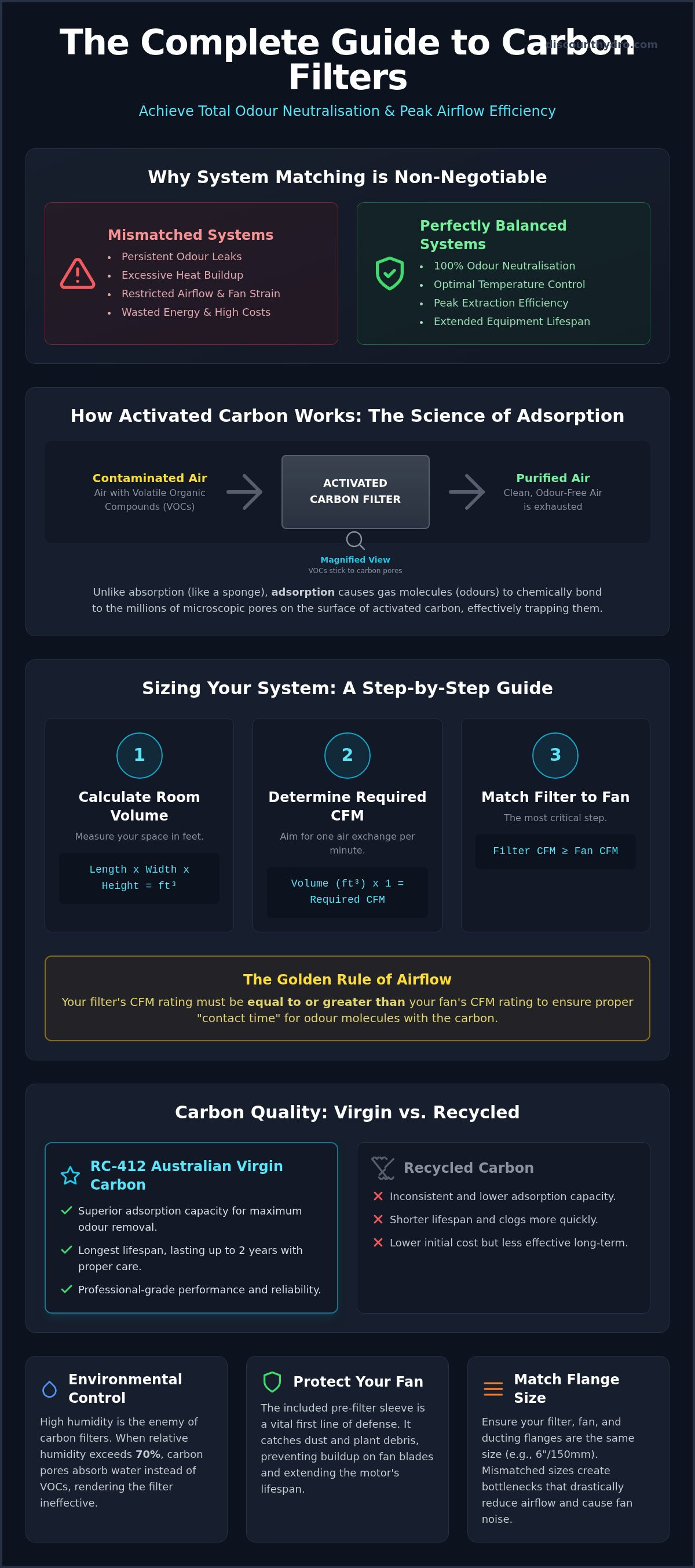
Matching your fan to your filter requires looking at two main metrics: CFM (Cubic Feet per Minute) and m3/h (Cubic Metres per Hour). Most UK fans use m3/h for their ratings, while many carbon filters are labelled in CFM. To convert between them, multiply CFM by 1.69 to get the m3/h equivalent. If your fan pulls more air than the filter is rated to handle, the air passes through the carbon bed too quickly. This reduces "contact time," meaning the carbon doesn't have long enough to trap the odour particles effectively. A deeper carbon bed increases this contact time, ensuring total neutralisation even at higher speeds.
Environmental factors also dictate hardware performance. High humidity is a common killer of filter efficiency. When relative humidity exceeds 70%, the carbon pores begin to absorb water molecules instead of volatile compounds. This physically blocks the filter and can lead to immediate odour leakage. Keeping your grow room within optimal humidity ranges is essential for the longevity of your hardware. If you notice a sudden drop in extraction power, check your humidity levels before assuming the carbon is spent.
What is a Carbon Filter?
A grow room carbon filter is a high-density cylinder filled with activated charcoal. Its primary job is removing gases and odors through a process called adsorption. Unlike absorption, where a substance is soaked up like a sponge, adsorption causes gas molecules to stick to the internal surface area of the carbon pores. Discount Hydro stocks a wide range of these units, from 4-inch hobbyist models to 12-inch professional-grade hardware, ensuring a fit for any ventilation system.
Flange Size and Compatibility
Standard UK ventilation sizes include 100mm (4"), 125mm (5"), 150mm (6"), and 200mm (8"). Your filter flange must match your fan and ducting diameter for a secure seal. Using a filter with a smaller flange than your fan creates a significant bottleneck. This increases static pressure, makes your fan louder, and reduces its operational lifespan. While you can use reducers or expanders to connect different sizes, it's always best to maintain a consistent diameter throughout the extraction line to ensure peak airflow.
Getting the right fit is the only way to guarantee a discreet environment. You can check our full inventory of professional extraction gear to find the exact match for your fan's output and flange diameter.
How to Size Your Carbon Filter: A Step-by-Step Guide
Sizing your extraction hardware correctly is the difference between a successful harvest and a compromised environment. Most growers struggle with the math, but it's a straightforward process once you know the variables. You must account for the physical space, the heat load from your equipment, and the resistance created by your ducting. If you get this wrong, you'll end up with heat issues or lingering odours that could have been avoided with a simple calculation.
Calculating Room Volume
Start by finding the total volume of your room or tent. The formula is Length x Width x Height. For a standard 1.2m x 1.2m x 2m grow tent, the calculation is 1.2 x 1.2 x 2 = 2.88 cubic metres. To clear the air once every minute, you'd need a fan and filter combo capable of moving 172.8 m3/h. However, this is just a baseline. If you run powerful LED grow lights, the heat output requires faster air exchange. During peak summer months, you'll likely need to cycle that volume three times per minute to maintain stable temperatures.
The Fan-to-Filter Ratio
Once you have your required airflow, you need to match your fan to your filter. This is where the "20% Rule" applies. Your filter must be rated higher than your fan. If a fan pulls air through carbon filters faster than their rated capacity, the odour particles don't have enough time to stick to the carbon surface. This is known as insufficient dwell time. The EPA guide to air cleaners explains that the effectiveness of gas-phase filtration depends heavily on the speed at which air passes through the media.
Static pressure also plays a role. Every bend in your ducting and the resistance of the carbon bed itself reduces your fan's actual performance. A fan rated at 500 m3/h might only move 400 m3/h once connected to a filter and three metres of ducting. By choosing a filter rated for 600 m3/h, you ensure the air always moves slow enough for total odour removal. This also keeps the fan motor from overheating by reducing the workload. It's always better to have extra capacity you don't use than to push a small filter past its physical limit. This protects your motor health and ensures your garden remains discreet.
Virgin Carbon vs. Recycled Carbon: Which Should You Buy?
Performance in carbon filters depends entirely on the quality of the raw material used inside the cylinder. You'll generally choose between virgin carbon and recycled carbon. Virgin carbon is brand new and has never been used for air or water treatment. Recycled carbon is "regenerated" from used industrial filters by heating it to burn off impurities. This process often damages the carbon's internal structure and leaves many pores permanently blocked. RC-412 Australian Virgin Carbon is the industry gold standard. It features a specific pore size that is perfectly matched to the volatile organic compounds found in indoor gardens.
Weight is a common misconception in the world of filtration. A heavier filter doesn't necessarily mean better performance. Often, a heavy unit simply contains lower-quality, coal-based carbon that is dense but lacks surface area. Premium Australian charcoal is lightweight yet has a massive internal network of pores. Density matters more than mass. You should look for machine-packed carbon beds. Machines use high-frequency vibration to settle the carbon pellets, eliminating air gaps. In hand-packed filters, the carbon can settle during shipping, creating "bypass" zones where air flows through without being scrubbed.
The Benefits of Virgin Activated Carbon
Virgin carbon offers a much higher iodine rating, which is a technical measurement of the carbon's adsorption capacity. High iodine ratings mean more odour particles are trapped per gram of media. It also contains significantly less dust. This is vital for your hardware. Excessive carbon dust can escape the filter and coat your extraction fan motor, leading to friction and premature failure. You can expect a professional virgin carbon bed to last between 12 and 24 months, whereas recycled alternatives frequently fail within a single season.
When to Choose a Budget Filter
Budget filters have a specific role in a ventilation strategy. If you're setting up a dedicated drying room that only runs for two weeks at a time, a cheaper recycled unit is a cost-effective choice. Hobbyist growers on a strict initial budget might also start here. However, for a full-cycle grow room, the long-term value is lower. You'll likely buy three budget filters in the time one professional unit lasts. Compare price points and technical specs in our Carbon Filters collection to see which grade fits your current project.
Investing in quality materials upfront prevents the stress of mid-cycle odour leaks. You can find all our value-for-money extraction gear in stock and ready for fast UK delivery.
Top Carbon Filter Recommendations from Discount Hydro
Extraction efficiency starts with the right hardware. Discount Hydro maintains a diverse inventory of 22 specific carbon filters to support every stage of plant development. Choosing the correct unit depends on your fan's m3/h rating and the physical dimensions of your space. We prioritize professional-grade gear that delivers consistent results without the high markup of boutique brands. Fast UK delivery and click-and-collect options in County Durham make it easy to get the hardware you need exactly when you need it.
Selecting the right size prevents the common issues of heat buildup and restricted airflow. If your filter is too small, your fan motor will struggle and eventually fail. If it is too large without a powerful enough fan, you won't clear the air effectively. Our range covers everything from small hobbyist tents to large industrial rooms. We focus on high-performance products that ensure your environment stays controlled and your garden remains discreet.
Best for Small Tents (0.6m - 1m)
Small tents between 0.6m and 1m require streamlined solutions. Our 100mm (4") hobbyist filters are engineered for these compact footprints. Most residential growers prefer these units for their low-noise performance and lightweight aluminium casings. You can hang these easily using standard straps or hangers without worrying about tent frame stability. They provide a high surface area for adsorption while taking up minimal vertical space. This leaves more room for your lighting and plants to thrive.
Best for Large Scale Setups (1.2m+)
Large scale setups of 1.2m and beyond need higher airflow capacities. Our 150mm (6") and 200mm (8") professional filters are the go-to choice for serious growers. These units feature deeper, high-density carbon beds designed to handle heavy odour loads over long cycles. For those managing massive air volumes, our 250mm (10") and 315mm (12") industrial solutions offer the highest extraction efficiency available. These larger filters are built for sealed rooms where maintaining a specific environment is critical to success. They ensure that even at high fan speeds, the air remains in contact with the carbon long enough for total neutralisation.
The "Best Value" pick for the average UK grower is often a 150mm professional unit. It strikes the perfect balance between price and performance. While budget filters might seem cheaper upfront, a professional unit with virgin carbon lasts twice as long. This reduces the frequency of system teardowns and filter swaps. Investing in high-capacity hardware protects your fan motor and ensures your garden stays discreet. You get professional-grade results at a price that fits your budget.
Your ventilation system is only as strong as its weakest link. A high-quality filter is a small price to pay for total peace of mind and peak extraction performance. Whether you're upgrading an existing tent or building a new room from scratch, we have the hardware to help. You can shop the full range of 22 carbon filters at Discount Hydro and secure your grow room today.
Secure Your Grow Room Environment Today
Odour control is a matter of correct technical specifications. You now have the framework to match your fan output to the right hardware. Remember that matching your CFM and choosing virgin carbon over recycled alternatives ensures your extraction system remains efficient for up to 24 months. Sizing your filter slightly higher than your fan's rated capacity is the most effective way to protect your motor and guarantee total air scrubbing.
Discount Hydro provides the professional gear you need to maintain a discreet and climate-controlled garden. We offer UK-based expert support to help you calculate your requirements and ensure a perfect fit. With fast nationwide delivery and the best prices on professional brands, we make it easy to upgrade your ventilation setup. Our inventory of 22 specific products ensures you find the exact match for your tent or room size. Once your air is clean and filtered, you might also enjoy the artisanal home fragrances, such as handmade scented candles, available at hhsenseandcreativity.nl.
Don't leave your air quality to chance. Browse the full Carbon Filter collection at Discount Hydro to find high-performance carbon filters at warehouse prices. Get your extraction system running at peak efficiency today.
Frequently Asked Questions
How long does a grow room carbon filter actually last?
Professional virgin carbon filters typically last between 12 and 24 months in a standard indoor environment. The exact lifespan depends on your humidity levels and the amount of dust in the air. Once the internal carbon pores are completely saturated with organic compounds, the unit will no longer neutralise odours and requires a full replacement.
Can I wash or clean my carbon filter to make it last longer?
You cannot wash the internal carbon bed. Water or cleaning agents will permanently block the microscopic pores and destroy the unit's adsorption capacity. You should, however, wash the white fabric pre-filter sleeve every 8 to 12 weeks. Keeping the pre-filter clean maintains airflow and prevents dust from clogging the main carbon bed prematurely.
Why is my carbon filter not removing odours anymore?
Odour leakage usually happens because the carbon is saturated or the humidity is too high. If your grow room exceeds 70% relative humidity, the carbon absorbs water molecules instead of volatile compounds. Check for air leaks in your ducting or around the flange, as even a small gap allows untreated air to bypass the filtration system entirely.
What is the difference between a pre-filter and a carbon filter?
Can I use a carbon filter without an extraction fan?
No, these are passive devices that require a fan to function. You need the static pressure generated by an extraction fan to pull or push air through the dense carbon bed. Without a fan to move the air, the filter cannot scrub the environment, and odours will simply linger in your grow space.
What size carbon filter do I need for a 1.2m x 1.2m grow tent?
A 150mm (6 inch) filter is the standard recommendation for a 1.2m x 1.2m x 2m space. This size matches the air volume of 2.88 cubic metres and handles the necessary air exchange rates effectively. Always verify that the filter's m3/h rating is approximately 20% higher than your fan's maximum output to ensure total odour removal.
Does high humidity affect my carbon filter performance?
High humidity is the primary cause of sudden filter failure. When levels rise above 70%, the activated carbon becomes waterlogged and loses its ability to trap odours. This is a common issue in poorly ventilated rooms. Maintaining a consistent environment is vital for keeping your carbon filters working at peak efficiency throughout the year.
Should I pull air through the filter or push air into it?
Pulling air through the filter is the most efficient configuration for most grow rooms. It allows the pre-filter to catch dust on the outside before the air reaches the carbon bed and the fan. Pushing air into the filter is possible but forces dust into the internal carbon, which can lead to clogging and increased strain on your extraction fan motor.