

Grow Room Ventilation Setup: The Ultimate 2026 UK Grower’s Guide
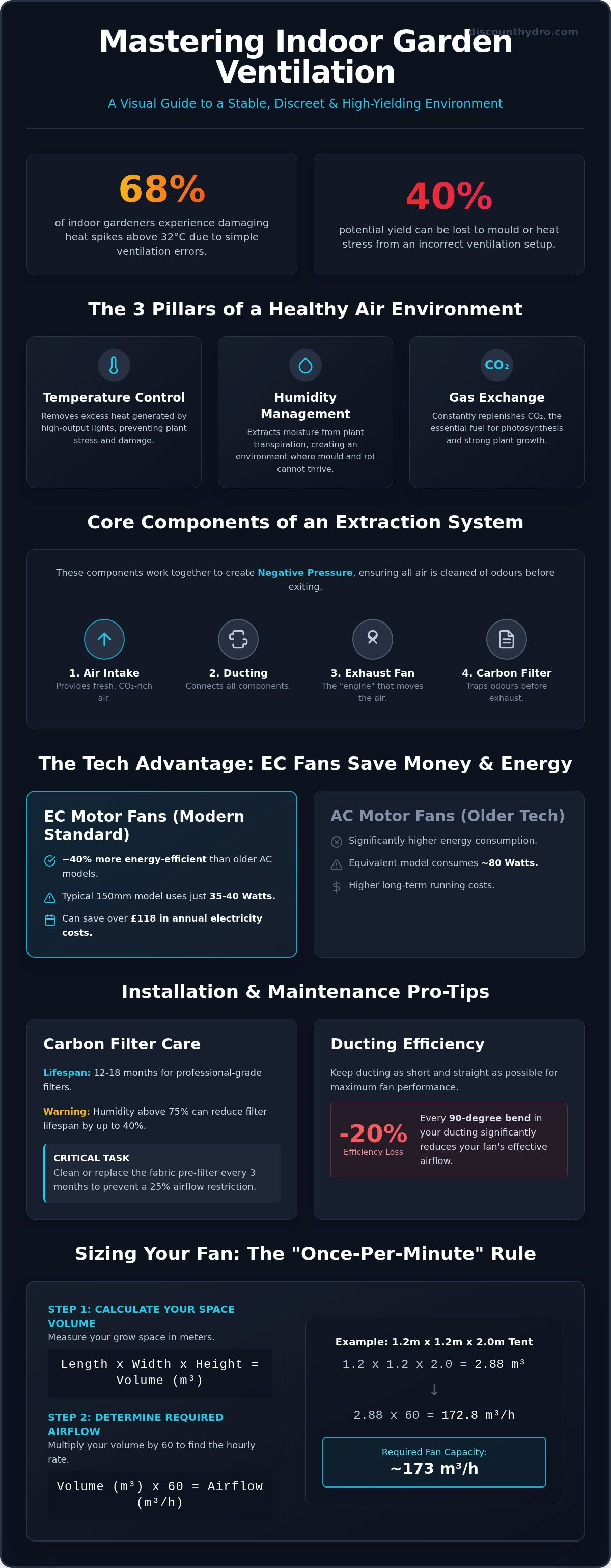
68% of UK indoor gardeners experience heat spikes above 32°C because of simple errors in converting CFM to m³/h. An incorrect grow room ventilation setup is the primary reason why many hobbyists lose up to 40% of their potential yield to mould or heat stress. You understand that managing excess heat from high-output LED lights and controlling humidity are non-negotiable for a successful harvest. Without a professional extraction system, stagnant air and lingering odours will quickly become a liability in your home.
This guide teaches you how to master airflow to maintain a stable, discreet, and high-yielding environment. You'll learn how to calculate fan sizing for standard UK tents and why upgrading to EC motor fans can save you over £100 in annual energy costs. We'll preview the essential components for odour control, including carbon filter maintenance schedules and the latest 2026 ventilation standards. Follow these steps to build a reliable system that protects your plants and your pocket.
Key Takeaways
- Learn why constant air exchange is vital for CO2 replenishment and fuels photosynthesis for stronger indoor plant growth.
- Identify the essential components for a professional grow room ventilation setup, including high-performance exhaust fans and carbon filters for odour control.
- Master the "Once-Per-Minute" rule to accurately calculate the required fan capacity based on your specific grow space volume.
- Discover the most effective installation techniques for mounting extraction gear to remove heat efficiently and maintain airtight seals.
- Understand how to match your ventilation system with high-output LED lighting to maximise yields while keeping energy costs low.
Why Ventilation is Critical for Indoor Plant Health
Ventilation is the respiratory system for your indoor garden. Without a professional grow room ventilation setup, your plants will eventually suffocate. The principles of air exchange follow the same logic as the Core Components of a Grow Room Ventilation system, ensuring stale air is removed and replaced with fresh, nutrient-rich air. This process is vital for three main reasons:
- Temperature Control: Modern LED grow lights are efficient but still produce thermal energy that can bake your plants if left unmanaged.
- Humidity Management: Plants release water vapour through transpiration. Without extraction, this moisture builds up and creates a swamp-like environment where rot thrives.
- Gas Exchange: Plants need a steady stream of Carbon Dioxide (CO2) to fuel photosynthesis and structural growth.
Stagnant air is the enemy of a high-yielding garden. It leads to nutrient lockout because the plant stops pulling water through its roots when the surrounding air is too humid. Effective ventilation keeps the transpiration stream moving. This ensures nutrients reach the top of the plant where they're needed most for flower production.
The Role of CO2 in Photosynthesis
Plants breathe CO2 to fuel photosynthesis. In a sealed environment, they can deplete available CO2 in less than 30 minutes. Once CO2 levels drop, growth stops entirely, regardless of how much light or fertiliser you provide. A fresh air intake ensures a constant supply of this essential growth fuel. Gas exchange occurs through microscopic pores on the leaf surface called stomata, which open to absorb CO2 while releasing oxygen and water vapour into the room.
Preventing Pests and Pathogens
Consistent airflow strengthens plant stems through a process called thigmomorphogenesis. Moving air simulates natural wind, which triggers the plant to develop thicker, more resilient stalks to support heavy yields. This physical movement also makes life difficult for common pests. Moving air disrupts the breeding and feeding cycles of spider mites and fungus gnats. These insects thrive in still, humid conditions. By keeping air in motion, you lower leaf-surface humidity and prevent Botrytis, also known as bud rot, from taking hold. It's much easier to prevent mould with a fan than it is to treat an infected crop later.
Core Components of a Grow Room Ventilation Setup
A high-performing grow room ventilation setup relies on four primary components: the exhaust fan, the carbon filter, ducting, and an intake method. These parts work together to create negative pressure. This ensures all air leaving the space passes through a filter, preventing untreated odours from escaping into your home. While basic setups use passive intake holes, larger rooms often require active intake fans to bring in fresh, cool air from a secondary location.
Inline Fans and Extraction Power
The exhaust fan is the engine of your environment. In 2026, the industry has shifted almost entirely toward EC (Electronically Commutated) motors. These fans are approximately 40% more energy-efficient than older AC models. For example, a 150mm EC fan typically consumes 35 to 40 watts, whereas an equivalent AC fan uses 80 watts. This efficiency can save you roughly £118 in annual electricity costs. Using an EC fan with a smart controller allows you to automate fan speeds based on live temperature and humidity data. This reduces noise during dark cycles and ensures your grow tent stays within optimal parameters without constant manual adjustment.
Carbon Filters and Odour Control
Carbon filters are your primary defence against lingering odours. They contain a bed of activated carbon that traps volatile organic compounds (VOCs) through adsorption. To work efficiently, the filter's airflow rating must match or slightly exceed your fan's output. If the fan is too powerful, the air moves through the carbon too quickly to be scrubbed. When Calculating CFM for Your Grow Space, always account for the resistance the filter adds to the system. Professional-grade filters like the Rhino Pro have a lifespan of 12 to 18 months, though high humidity above 75% can reduce this by 40%. You must wash or replace the fabric pre-filter every 3 months. This prevents dust from clogging the carbon and avoids a 25% restriction in total airflow.
Ducting connects these components and must be kept as straight as possible. Every 90-degree bend in your ducting can reduce fan efficiency by about 20%. Use heavy-duty foil tape or duct clamps to ensure every connection is airtight. If noise is a concern, acoustic-insulated ducting significantly dampens the sound of rushing air. You can find a wide range of quiet, high-efficiency ventilation components at Discount Hydro to suit any budget or room size.
Passive intake is often sufficient for small tents. Just ensure the intake port is at least double the size of the exhaust outlet. This prevents the exhaust fan from working too hard against the vacuum. For larger setups, an active intake fan helps maintain a consistent supply of CO2 and keeps temperatures lower during the summer months.
Calculating CFM: Sizing Your Fan for UK Grow Spaces
Calculating the correct airflow is the most technical part of a grow room ventilation setup. If the fan is too weak, heat and humidity will build up and stall plant growth. If it is too powerful, you waste electricity and struggle to maintain warmth during cold UK winters. The goal is a complete air exchange every 60 seconds. This ensures fresh CO2 is always available, which is Why Ventilation is Critical for maintaining a healthy transpiration stream.
You must account for "drag" when sizing your system. A carbon filter typically adds 20% to 30% resistance to your airflow. Every 90 degree bend in your ducting adds another 20% loss in efficiency. In the UK, high ambient humidity often makes it harder for air to carry moisture away from leaf surfaces. To compensate, savvy growers select a fan with roughly 50% more capacity than the raw room volume requires. This allows the fan to run at lower, quieter speeds while still maintaining total environmental control.
The Ventilation Math Simplified
To find your required capacity, multiply the length, width, and height of your space to get the total volume. For a standard 1.2m x 1.2m x 2m tent, the volume is 2.88 cubic metres. To exchange this air once per minute, you multiply by 60, resulting in a base requirement of 172.8 m³/h. After adding 50% for the resistance of a carbon filter and ducting, you need a fan capable of at least 260 m³/h. While many US guides use CFM (Cubic Feet per Minute), UK retailers use m³/h (Cubic Metres per Hour). Static pressure is the resistance your fan must overcome to pull air through the thick bed of carbon in your filter and the friction within the ducting walls.
Managing Negative Pressure
Negative pressure occurs when you extract more air than you let in. This creates a partial vacuum that prevents untreated air from leaking out of zips or seams, ensuring all odours pass through your carbon filter. You can identify negative pressure by the slight "sucking in" of your tent walls when the fan is running. If the walls are bulging out, your exhaust is too weak or your intake is too strong. Balancing this vacuum is essential for discreet growing. Use a fan speed controller to fine tune your extraction until the tent walls pull in slightly. This ensures a perfect seal and total odour neutralisation throughout the flowering cycle.
Step-by-Step Ventilation Installation Guide
A professional grow room ventilation setup requires precise placement to manage heat effectively. Heat rises. Mount your carbon filter at the highest point of the space. Position the intake port at the opposite bottom corner. This creates a diagonal cross-flow that pulls fresh air through the entire plant canopy before it's exhausted. Ensure all connections are airtight. Use heavy-duty duct clamps or foil tape to seal the joints between the fan, filter, and ducting. Small leaks allow untreated air to escape, compromising your odour control system.
Hanging and Securing Equipment
Vibration causes noise. Use rope ratchets or bungee cords to hang your inline fan and filter. This decouples the equipment from the tent frame and prevents mechanical humming from vibrating through the poles. Always check the airflow arrow on the fan housing before tightening clamps. Orient the fan to pull air from the filter and push it out through the ducting. Pulling air through the filter is more efficient than pushing. It ensures the entire surface area of the carbon bed is utilised, extending the life of the media. Keep ducting runs as short and straight as possible. Every 90-degree bend can reduce airflow by 20%. Avoid sagging ducting as it creates turbulence and increases static pressure.
Optimising Airflow and Light-Proofing
Airtight seals are mandatory for total odour control. Use a "double-bagging" technique for ducting connections. Slide the inner liner over the fan flange and secure it firmly with a metal worm-drive clamp. Then, pull the outer insulation layer over the connection and seal it with foil tape. This creates a redundant barrier against leaks. Light-proofing is equally important for plant health. Create a light-trap for passive intakes using a U-bend of black ducting. This protects your plants' dark cycle from external light pollution while allowing fresh air entry. Place oscillating fans at different heights to eliminate stagnant microclimates within the foliage. These fans don't replace your exhaust system. They work with it to ensure even CO2 distribution and prevent pockets of high humidity where mould might start. A balanced system keeps the environment stable and the air clean.
Looking for professional-grade extraction gear? You can find a wide range of ventilation kits and components at Discount Hydro with fast UK-wide delivery.
Optimising Your Setup with Discount Hydro Solutions
A reliable grow room ventilation setup is the foundation of any high-yielding indoor garden. Discount Hydro is the go-to UK source for professional-grade extraction gear that prioritises value. We understand that hobbyists and professional growers alike need equipment that performs without the inflated price tags of high-end boutique brands. Our inventory focuses on durable, high-efficiency components designed to handle the specific challenges of the UK climate, such as fluctuating ambient humidity and temperature spikes.
Success in the grow room requires a holistic approach. While air exchange manages the environment, your plants also need the right fuel to thrive. Pairing your optimised ventilation with high-performance hydroponic nutrients ensures your garden has everything it needs for heavy flower production. We stock a wide range of supplements and base feeds to match the increased metabolic rates of plants growing in a perfectly ventilated space.
Value-Driven Ventilation Kits
Matched kits eliminate the technical guesswork of component compatibility. Our ventilation sets include pre-configured fan and filter combinations that ensure the extraction power perfectly matches the carbon scrubbing capacity. This prevents the common mistake of using a fan that is too powerful for its filter, which leads to untreated odours escaping the room. We prioritise durability and competitive pricing. Our kits feature energy-efficient EC motors that offer significant long-term savings on electricity. We provide flexible logistics for all customers. You can choose fast, discreet nationwide shipping or use our click-and-collect service at our County Durham warehouse.
Expert Support for Your Indoor Garden
Experience matters when building a complex environment. We leverage over a decade of hydroponics expertise to help you select the right gear for your specific needs. If you're struggling with heat management or odour leaks, visit our physical showroom in Chester-le-Street for expert face-to-face advice. We provide custom solutions for every scale, from small domestic cupboards to large-scale professional rooms. Our team can help you with bespoke ventilation calculations to ensure your grow room ventilation setup is perfectly sized for your space. Contact us directly to discuss your requirements and get your environment dialled in for maximum yields.
Master Your Growing Environment Today
A professional grow room ventilation setup is the most effective way to ensure your plants have the CO2 and climate stability they need to hit their full yield potential. By correctly calculating your m³/h requirements and installing your extraction gear at the highest point of the room, you eliminate the risks of heat stress and stagnant humidity. Using modern EC fans and matched carbon filters allows you to manage odours with maximum energy efficiency, saving you significant annual electricity costs compared to older AC models. These technical adjustments create a consistent, discreet, and high-performing workspace for any indoor gardener.
Shop Professional Grow Room Ventilation at Discount Hydro for competitive pricing on top brands like Omega and Rhino Pro. We provide fast UK-wide delivery and expert advice from our County Durham specialists in Chester-le-Street. Whether you're setting up a small cupboard or a large-scale room, we have the inventory and the expertise to help you succeed. Start building a more reliable, high-yielding indoor garden with components that are built to last and designed for results.
Frequently Asked Questions
How much airflow does my grow room actually need?
You need enough airflow to exchange the entire volume of air every 60 seconds while overcoming static pressure. While base volume calculations are a starting point, you must also account for the heat output of your lighting. If you use high-wattage HID lights instead of LEDs, you typically need to increase your extraction by 25%. A correctly sized grow room ventilation setup prevents heat from building up to dangerous levels during the warmer summer months.
Do I really need a carbon filter for my ventilation setup?
A carbon filter is essential for any indoor grower who needs to neutralise volatile organic compounds and odours. Without one, the scent of your garden will travel through vents and under doors. It also helps create the necessary resistance for negative pressure. This ensures that untreated air is never pushed out of the tent's zips or seams. It's your primary line of defence for a discreet and professional operation.
Should I run my extraction fan 24 hours a day?
Yes, you must run your extraction fan 24 hours a day to maintain a healthy environment. Plants continue to breathe and release moisture during the dark cycle. If you turn the fans off at night, humidity will spike rapidly as temperatures drop; this leads to bud rot and powdery mildew. Continuous airflow also ensures a constant supply of fresh CO2 is available the moment your lights turn back on for the day.
What is the difference between an intake fan and an exhaust fan?
An exhaust fan is the primary engine that pulls hot, stale air out of the room through a filter. An intake fan is a secondary component used to pull fresh, cool air into the space from an external source. While small tents can rely on passive intake holes, larger rooms require an active intake fan to maintain balance. This prevents the exhaust fan from straining against a vacuum and helps regulate temperature more effectively.
How do I make my grow room ventilation quieter?
You can reduce noise by using acoustic-insulated ducting and oversized fans running at lower speeds via a controller. Standard flexi-ducting vibrates and lets sound through. Insulated versions use a layer of glass wool to dampen the noise of rushing air. Adding a silencer or muffler to the end of your extraction line can further reduce decibel levels. Mounting your fan with rubberised hangers or bungee cords also stops mechanical vibrations from travelling.
Can I vent my grow room air into the same room?
You should never vent exhausted air back into the same room where your intake is located. This creates a heat loop where the system pulls in the same hot, humid air it just removed. This leads to a rapid increase in temperature and humidity that your equipment cannot overcome. Always route your ducting to a different room, a chimney, or directly outside to ensure the intake pulls in truly fresh air for your plants.
How often should I replace my grow room carbon filter?
Most professional-grade carbon filters last between 12 and 18 months under normal conditions. You'll know it needs replacing when you can detect faint odours outside the grow space or when airflow drops significantly due to carbon compaction. High humidity levels above 70% can cause the carbon to clump; this ruins the filter's effectiveness. Regularly washing the fabric pre-filter every 3 months helps extend the life of the internal carbon bed significantly.
What happens if my grow room has poor ventilation?
Poor ventilation leads to heat stress, stunted growth, and the total loss of your crop to mould. Without air exchange, plants deplete the available CO2 and stop photosynthesising. Stagnant air pockets also allow moisture to settle on leaf surfaces, which invites pathogens like Botrytis. A faulty grow room ventilation setup is the most common cause of crop failure. It results in weak stems and significantly lower yields compared to a well-ventilated environment.