

Hydroponic Nutrient Lockout: How to Diagnose, Fix, and Prevent It (2026)
Adding more nutrients to a struggling plant is often the fastest way to kill it. When you see yellowing leaves or stunted growth, your first instinct is to pour in more expensive feed, but this frequently triggers a severe case of hydroponic nutrient lockout. It's incredibly frustrating to watch a potential harvest wither while your EC levels look perfect on paper. You've invested in quality LED grow lights and premium supplements, yet your plants act like they're starving.
We understand the fear of losing an entire crop to confusing symptoms that mimic simple deficiencies. This guide provides a clear diagnosis of your plant's health and the professional protocol needed to break the chemical wall blocking nutrient uptake. You'll master the step-by-step recovery plan to reset your system and restore rapid growth. We'll cover everything from precision pH monitoring and emergency flushing techniques to long-term prevention strategies. By the end, you'll have the tools to protect your investment and ensure your reservoir stays balanced for a successful, high-yield grow.
Key Takeaways
- Identify the 'invisible wall' of hydroponic nutrient lockout where minerals are present in the solution but remain chemically inaccessible to your plants.
- Learn to differentiate between lockout symptoms and simple deficiencies to prevent accidental overfeeding that can destroy an entire harvest.
- Master the 4-step professional flush protocol to remove mineral salt buildup and reset your system’s chemical balance for immediate recovery.
- Understand how pH levels and nutrient antagonism dictate mineral solubility and how to manage these factors for optimal uptake.
- Discover the essential monitoring tools and environmental controls needed to prevent future blockades and protect your investment in expensive nutrients.
What is Hydroponic Nutrient Lockout?
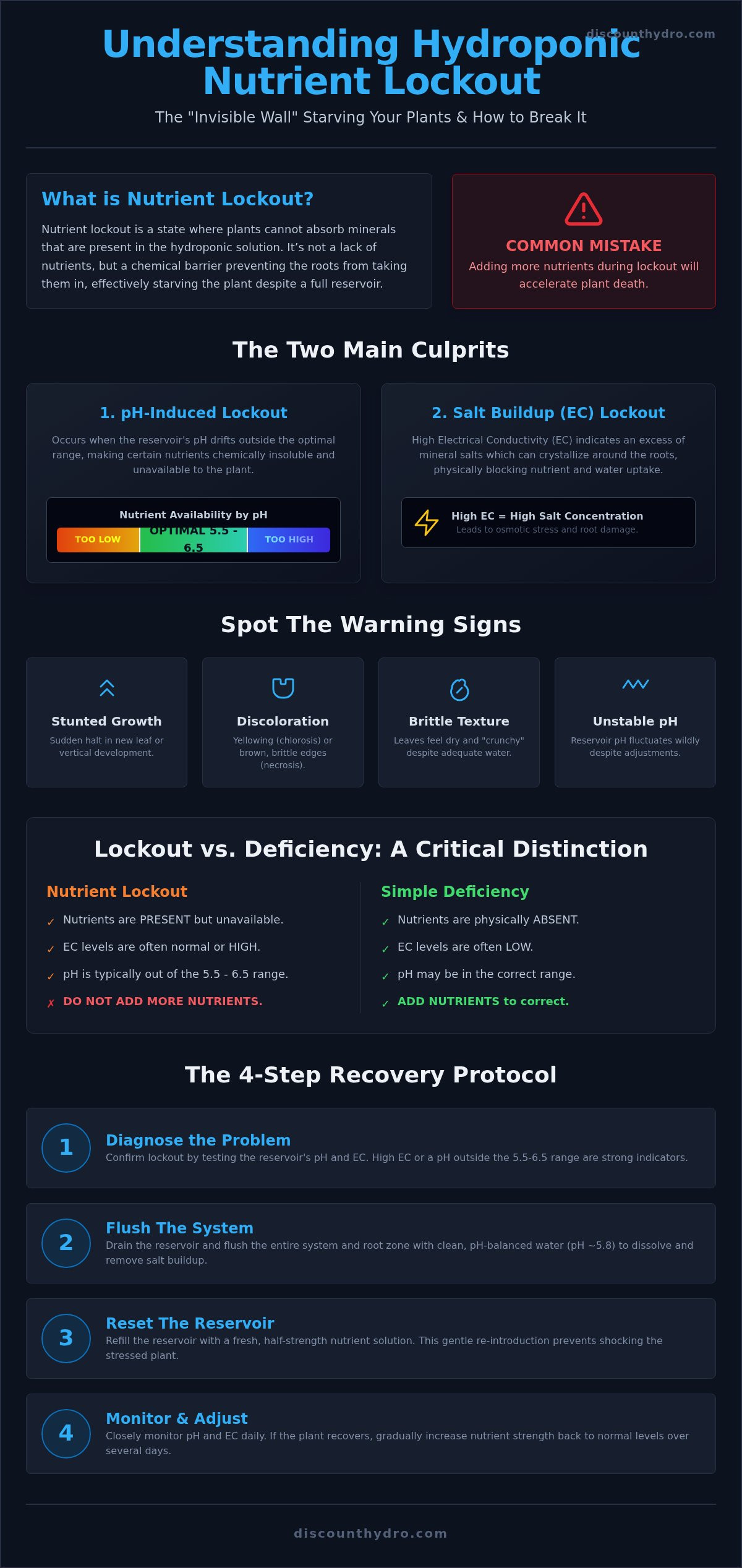
Hydroponic nutrient lockout is a physiological state where your plants lose the ability to absorb minerals from the solution. Even when you provide all the essential plant nutrients, a chemical "invisible wall" blocks the roots from taking them in. This is not a lack of food; it's a total breakdown in the plant's ability to process what's already available in the reservoir.
Adding more fertiliser during a lockout is the most common and fatal error in UK grow rooms. Growers see pale leaves and assume they need a stronger feed. This actually accelerates plant death. Increasing the nutrient concentration in an already locked-out system raises the salt levels, making it even harder for the plant to pull in water and minerals. You end up wasting expensive nutrients while actively killing your crop through osmotic stress.
There are two primary ways this blockade occurs:
- pH-Induced Lockout: This occurs when the reservoir pH drifts outside the optimal 5.5 to 6.5 range. At specific pH levels, certain elements become chemically bound and unavailable to the plant.
- Salt-Buildup (EC) Lockout: High Electrical Conductivity (EC) indicates an overabundance of mineral salts. These salts can crystallise around the roots, physically preventing hydroponic nutrient lockout recovery and causing the plant to wither.
The Role of the Root Zone
The rhizosphere is the critical interface where roots interact with nutrient ions. In hydroponic systems, this area is extremely volatile because there is no soil to act as a buffer. If your water is stagnant or has poor aeration, the roots cannot perform the active transport required for uptake. Poorly oxygenated roots are significantly more prone to lockout as they struggle to maintain the internal pressure needed to move minerals upward. This makes hydroponics far more sensitive to chemical imbalances than traditional soil growing.
Common Symptoms to Watch For
Diagnosing the problem early is essential for saving the harvest. Watch for these specific visual cues in your grow room:
- Stunted Growth: A total halt in vertical development or new leaf production often happens overnight.
- Discolouration: Look for yellowing (chlorosis) between leaf veins or brown, brittle edges (necrosis).
- Brittle Texture: Leaves may feel dry or "crunchy" to the touch despite having a full reservoir.
- Sudden pH Fluctuations: If your reservoir pH refuses to stay stable despite regular adjustments, the plant is likely dumping ions back into the water.
The Science of the Blockade: pH, EC, and Antagonism
Understanding the chemistry behind the root zone is the only way to prevent a total crop failure. While the previous section defined the state of lockout, solving it requires a look at the interplay between pH and Electrical Conductivity (EC). These factors determine whether your minerals stay in a liquid form or turn into useless solids. When these levels drift, your plants stop eating, regardless of how much feed you provide.
PH Windows for Hydroponic Success
Most indoor crops require a tight pH range between 5.5 and 6.5. When the reservoir climbs above 7.0, Phosphorus uptake drops significantly, leading to weak stems and poor flower development. In 2026, maintaining a stable pH between 5.8 and 6.2 is the definitive sweet spot for ensuring maximum mineral solubility across all major hydroponic platforms. Consistency is more important than hitting a single number perfectly every hour.
Nutrient Antagonism and Ion Competition
High concentrations of one element can physically block the uptake of another. This is called nutrient antagonism, often illustrated by Mulder’s Chart. For example, over-supplementing with Cal-Mag products often locks out Potassium and Magnesium because the ions compete for the same entry points in the root. Using high-quality, balanced hydroponic nutrients is the best way to avoid these chemical conflicts. You can't just keep adding additives without considering how they affect the overall ion balance.
Many UK growers face unique challenges with hard water, particularly in regions like the South East of England. Hard water is naturally high in Calcium Carbonate, which raises your baseline EC before you even add feed. This high starting point narrows your safety margin and leads to faster salt accumulation in the media. If your tap water has an EC above 0.5, you're at a much higher risk for a salt-induced hydroponic nutrient lockout. Monitoring these levels daily is your best insurance policy; you can find professional-grade pH and EC meters to keep your reservoir within these critical tolerances.
Nutrient Lockout vs. Deficiency: A Comparison
Misdiagnosing hydroponic nutrient lockout as a simple deficiency is the most expensive mistake a grower can make. When plants show yellowing or spots, the instinct is to increase the dosage of supplements. If the problem is actually a lockout, this extra feed remains in the solution, spikes the salt concentration, and finishes off the root system. You must distinguish between a genuine lack of food and a chemical blockade before touching your nutrient bottles.
The primary difference lies in where the symptoms first appear. Most true deficiencies involve mobile nutrients like Nitrogen or Potassium, which the plant moves from old leaves to new growth. This causes yellowing at the bottom of the plant first. In contrast, lockout frequently affects immobile nutrients like Iron or Calcium, which are highly sensitive to pH shifts. Because the plant cannot move these elements, symptoms typically appear at the top on the newest leaves and shoots.
Visual Diagnostic Key
Look closely at the leaf patterns to determine your next move. Interveinal chlorosis, where the leaf turns yellow but the veins stay green, is a classic sign of a pH-induced block of Iron or Magnesium. If you see "burnt" leaf tips across the entire plant, you aren't looking at a deficiency; you're looking at nutrient burn or salt-induced lockout. You should also inspect the roots. If they are brown and slimy rather than white and firm, you have root rot, which prevents uptake regardless of your pH or EC levels. Proper hydroponic system management requires checking the root zone daily to rule out biological issues before adjusting chemistry.
The Reservoir Test
Your reservoir data provides the final confirmation. Use a high-quality EC meter to track the relationship between water levels and salt concentration. If your water level is falling but your EC is rising, your plants are drinking water but leaving the minerals behind. This is a definitive sign of salt buildup and impending hydroponic nutrient lockout. A healthy plant should consume water and nutrients at a proportional rate, keeping the EC relatively stable.
- Rising EC + Falling Water: Indicates salt buildup; plants are stressed and stopped feeding.
- Falling EC + Falling Water: Indicates healthy feeding; plants are hungry.
- Stable EC + Falling Water: The "Goldilocks" zone for your specific growth stage.
For those using coco coir or clay pebbles, testing the run-off is mandatory. UK growers in hard-water areas often find that the EC of the water coming out of the bottom of the pot is 1.0 or 2.0 points higher than what they poured in. This "salt trap" in the media is a leading cause of lockout that reservoir testing alone won't reveal. If your run-off EC is significantly higher than your input, it's time to stop feeding and start the recovery protocol.
The 4-Step Recovery Protocol: Fixing Nutrient Lockout
Resetting your system is the only way to break the chemical blockade. You can't fix a hydroponic nutrient lockout by simply adjusting the pH in a contaminated tank; a full system purge is necessary to clear the salt-clogged rhizosphere and restore the root's ability to absorb water. Follow this professional protocol to save your crop and stop wasting expensive fertilisers.
- Step 1: The Flush. Use pH-balanced water (5.8) to wash away accumulated mineral salts from the media.
- Step 2: Analysis. Test the run-off water; continue flushing until the EC of the run-off matches the EC of your input water.
- Step 3: The Reset. Empty the reservoir and reintroduce a fresh, balanced nutrient solution at 50% strength.
- Step 4: Monitoring. Track the new growth for 48 to 72 hours to ensure the blockage is cleared.
Executing the Perfect Flush
For the best results, use Reverse Osmosis water to ensure you aren't adding more minerals during the cleaning process. This is especially critical in hard-water areas of the UK where tap water already contains high levels of Calcium. You should aim to pass three times the volume of your pot through the media. If you're using a 10-litre pot, use 30 litres of pH-balanced water. While some growers use clearing agents or enzymes to help break down salts, pure water at the correct pH remains the most cost-effective method for a total reset.
Reintroducing Nutrients Safely
Less is more in the 48 hours following a lockout fix. Your plants' roots are stressed and fragile; hitting them with full-strength feed will likely trigger a secondary hydroponic nutrient lockout. Start with a fresh reservoir mixed using high-precision, calibrated pH and EC meters to ensure total accuracy. The first sign of success is the appearance of vibrant, lime-green new growth at the crown and a stabilisation of the reservoir pH. If your EC remains stable while the water level drops, the roots have resumed feeding.
Ensuring your equipment is accurate is the cheapest insurance policy against harvest loss. You can find professional-grade monitoring tools and flush supplies at competitive prices to get your grow back on track today.
Preventing Future Lockouts with Professional Management
Prevention is the most cost-effective way to avoid hydroponic nutrient lockout. Daily monitoring of pH and EC levels is your primary defence against chemical imbalances. High-precision meters aren't just accessories; they're essential tools for maintaining the 5.5 to 6.5 pH range and 1.2 to 2.4 mS/cm EC levels required for optimal uptake. If you skip these checks for even 48 hours, you risk missing the early warning signs of salt accumulation.
Environmental Control and Transpiration
High temperatures in your grow room force plants to drink more water to stay cool. When plants transpire rapidly, they often leave mineral salts behind in the media, leading to a toxic buildup. Upgrading to high-efficiency LED grow lights reduces the radiant heat hitting your canopy, which helps stabilise transpiration rates. Combine this with proper ventilation in your grow tent to ensure constant air exchange and prevent heat pockets. Keeping root zone temperatures between 18°C and 21°C is also vital for preventing chemical instability in the reservoir.
The Proactive Feeding Schedule
Stop relying solely on generic feed charts. Every grow environment is different, especially with the hard water profiles found in London and the South East. Professional management requires a strict reservoir maintenance schedule. Verified best practices for 2026 suggest a complete nutrient solution change every 2 to 3 weeks to prevent toxic salt accumulation. Using stable, professional-grade nutrients like Intense or Dutch Pro ensures your base minerals remain available even as the plant consumes water. These brands are specifically formulated to handle the mineral complexities of UK water supplies.
Keep a detailed grow journal to record your daily pH and EC readings. This data allows you to spot trends before they become disasters. If you notice your EC climbing consistently over three days, you can dilute your solution with fresh water before a full hydroponic nutrient lockout occurs. Be cautious with supplements like Cal-Mag; only add them if your baseline water EC is below 0.2 or if you're using a Reverse Osmosis system. Over-supplementing is a fast track to ion antagonism and stunted growth. Consistent, data-driven management is the only way to ensure a heavy, high-value harvest.
For those who apply this same level of precision to other areas of scientific investigation, you can discover Hybrid 2.0 and their selection of research-grade laboratory compounds.
Master Your Reservoir for a Guaranteed Harvest
Mastering your system's chemistry is the difference between a failed crop and a record-breaking yield. You now have the professional protocol to identify the "invisible wall" of hydroponic nutrient lockout and the step-by-step flush process to reset your root zone. Success relies on consistent monitoring of pH and EC levels to act as insurance against mineral imbalances. By maintaining stable environmental controls and switching to high-quality, UK-formulated nutrients, you ensure your plants remain in the optimal zone for nutrient uptake.
Don't let a simple chemical drift destroy your hard work. We are a specialist UK hydroponics retailer stocking everything you need to maintain a perfect reservoir, from high-precision meters to specialized flush solutions. We provide competitive prices on industry-leading brands like Intense Nutrients and Dutch Pro. This ensures you get professional results while keeping your overheads low. Our stock is specifically selected to handle the unique challenges of UK water profiles.
Shop Professional Nutrients and Monitoring Tools at Discount Hydro for fast nationwide delivery or convenient click-and-collect options. Take control of your grow room today and watch your plants thrive.
Frequently Asked Questions
How do I know if I have nutrient lockout or a deficiency?
You can distinguish hydroponic nutrient lockout from a deficiency by looking at the location of the discolouration. Lockout often affects immobile nutrients, meaning symptoms like yellowing appear on the newest leaves at the top of the plant. A true deficiency usually starts at the bottom on older leaves as the plant moves mobile nutrients upward. Always verify your diagnosis by checking the reservoir EC; if EC is rising while water levels fall, it's lockout.
What is the fastest way to fix nutrient lockout in hydroponics?
The fastest fix is a complete system flush with pH-balanced water. You must pass three times the volume of your pot through the media to wash out accumulated mineral salts. After the flush, reintroduce a fresh, half-strength nutrient solution to the reservoir. This reset clears the chemical blockade and allows the roots to resume feeding. Most plants show signs of recovery within 48 to 72 hours of this procedure.
Can I use tap water to flush my hydroponic system?
You can use tap water, but it's not ideal for growers in hard-water areas of the UK. Tap water in regions like the South East often has a high baseline EC due to Calcium Carbonate, which can worsen salt buildup. Using Reverse Osmosis (RO) water is the professional choice for a clean flush. If you must use tap water, ensure it's dechlorinated and the pH is strictly adjusted to 5.8 before use.
Will my plants recover from nutrient lockout?
Most plants will recover if you act before the roots suffer permanent damage. While existing brown or brittle leaves won't turn green again, you'll see healthy new growth at the crown once the blockade is cleared. The recovery process is usually visible within three days of a successful flush. If growth doesn't resume, check for secondary issues like root rot which may have set in during the stress period.
How often should I calibrate my pH meter to prevent lockout?
You should calibrate your pH meter at least once a week to ensure total accuracy. Electronic sensors drift over time, and even a 0.5 drift can push your solution into the lockout zone. For high-performance grow rooms, checking your calibration against a buffer solution is the cheapest way to protect your harvest. Accurate monitoring is your primary defence against the chemical imbalances that lead to hydroponic nutrient lockout.
Does high humidity cause nutrient lockout?
High humidity doesn't cause lockout directly, but it stops the plant from drinking. When humidity is too high, transpiration slows down, and the plant stops pulling nutrient-rich water through its system. This lack of movement allows mineral salts to settle and accumulate in the growing media or around the roots. Maintaining a VPD (Vapour Pressure Deficit) between 0.8 and 1.2 kPa ensures your plants continue to feed at a healthy rate.
Is nutrient lockout different in coco coir compared to DWC?
The core chemistry is the same, but the location of the salt buildup differs. In Deep Water Culture (DWC), lockout happens entirely in the reservoir solution. In coco coir, mineral salts often get trapped within the physical fibres of the media. This means coco growers must test their run-off EC regularly, as the reservoir might look perfect while the roots are actually sitting in a high-salt environment that triggers a lockout.
Why does my pH keep rising in my hydroponic reservoir?
Your pH rises because plants release hydroxide ions into the solution as they absorb nitrates. This is a natural part of the feeding process, but rapid spikes often indicate that your reservoir is too small or your nutrient concentration is too high. Other factors like air stones or algae growth can also drive pH upward. If your pH won't stay stable, it's a sign that your system is trending toward a lockout.