

Managing Grow Room Temperature: The Complete 2026 Guide for Indoor Success
If your grow room is just three degrees off the target, you're essentially pouring your expensive liquid nutrients down the drain. Temperature isn't just about comfort; it's the primary engine for nutrient uptake and plant metabolism. You likely already feel the pressure of managing grow room temperature while facing UK electricity rates of 24.67 pence per kWh. It's a frustrating balance between keeping plants healthy and keeping your overheads from spiraling out of control during a cold winter or a sudden summer heatwave.
We've designed this 2026 guide to help you master climate control, protect your crops from heat stress, and maximize your final harvest weight. You'll learn how to create a stable 24/7 environment using efficient LED lighting and proper ventilation kit. By following these proven strategies, you can achieve higher quality produce and significantly lower your monthly energy bills. We'll break down the exact settings you need for success and the specific gear that makes it happen without wasting money.
Key Takeaways
- Identify precise temperature ranges for every growth stage to accelerate root development and leaf growth.
- Learn why managing grow room temperature is vital for efficient nutrient uptake and preventing stunted growth.
- Balance active and passive control strategies to maintain a stable 24/7 environment while reducing energy overheads.
- Implement seasonal tactics to combat UK weather extremes, from summer heat spikes to freezing winter "lights off" periods.
- Select the right automation equipment, including thermostatic controllers and digital monitors, to professionalise your setup.
Why Managing Grow Room Temperature is Critical for Yield
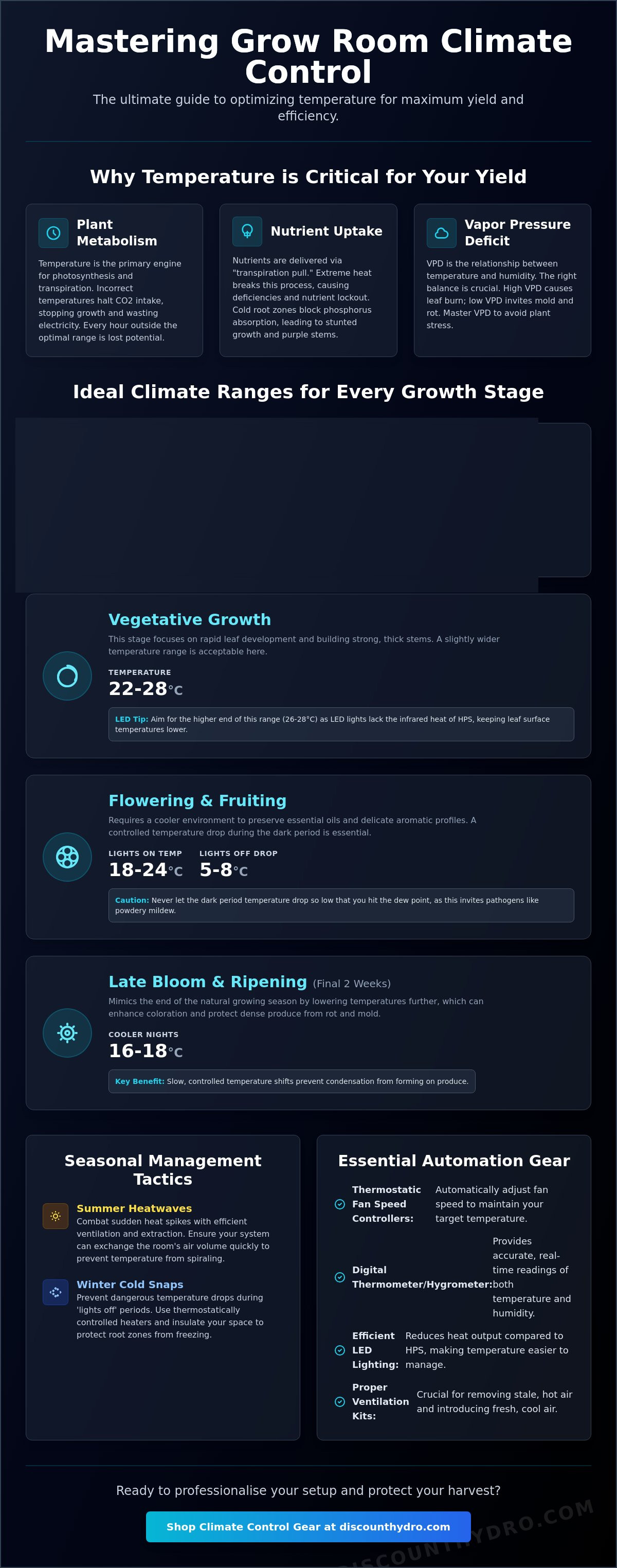
Temperature isn't just a comfort metric for your plants. It's the primary throttle for their entire metabolism. When you're managing grow room temperature, you're controlling the rate of photosynthesis and transpiration. If the air gets too hot, plants enter a survival mode where they close their stomata to prevent water loss. This action halts CO2 intake, which stops growth entirely. You aren't just losing time; you're losing final harvest weight. Every hour spent outside the optimal range is an hour of wasted electricity and lost potential.
Effective indoor cultivation relies on the same greenhouse principles used by commercial farmers to maintain a consistent internal climate. In contrast, cold environments present a different set of risks. If your root zone temperatures drop too low, you'll face phosphorus lockout. Even if your media is saturated with feed, the plant cannot physically absorb it, leading to purple stems and stunted development. High night-time temperatures are equally damaging. They cause plants to "stretch" as they seek cooler air, resulting in weak stems and airy, low-quality produce.
The Link Between Temperature and Nutrient Uptake
Nutrient delivery depends on transpiration pull. This process acts like a vacuum, drawing water and minerals from the roots up to the leaves. When heat is excessive, this vacuum breaks. You'll often see calcium deficiencies even if you're using high-quality Hydroponic Nutrients. This happens because calcium is immobile and relies entirely on steady water movement. Without precise temperature control, your expensive supplements simply sit in the pot and go to waste.
Understanding Vapor Pressure Deficit (VPD)
Temperature and humidity are inseparable. Vapor Pressure Deficit (VPD) measures the "drying power" of your air. For example, 25°C at 40% humidity feels very different to a plant than 25°C at 70% humidity. At low humidity, the plant transpires too fast, leading to salt buildup and leaf burn. At high humidity, it can't transpire at all, inviting mold and rot. Staying in the "VPD sweet spot" requires adjusting your extraction and heating to match the specific growth stage of your crop. It's about balance, not just hitting a single number on a dial.
Ideal Temperature Ranges for Every Growth Stage
Managing grow room temperature is a dynamic process. It changes from the day you pop seeds to the day you harvest. Following optimal temperature ranges ensures your plants never stall. If you miss these targets, you waste the potential of your nutrients and high-quality growing media. Success requires specific setpoints for every stage of the life cycle.
During propagation, your primary goal is root initiation. Cuttings and seedlings lack established root systems. They rely on high ambient warmth of 24-26°C to trigger cell division. Use heated mats or specialized propagation supplies to maintain this level consistently. If the environment drops below 20°C, root development slows to a crawl.
Vegetative growth allows for a broader range of 22-28°C. This supports rapid leaf development and thick stems. If you use LED systems, aim for the higher end of this bracket. LEDs don't emit the same infrared heat as HPS bulbs. This means leaf surface temperatures stay lower even if the air feels warm. Without that extra warmth, plant metabolism slows down significantly. It's a common mistake to run LED rooms at the same temperature as old HPS setups.
Flowering and fruiting require a cooler environment, typically 18-24°C. High heat during this stage destroys essential oils and delicate aromatic profiles. You must also manage the "Dark Period" carefully. Aim for a 5-8°C drop when lights go off. Never let the temperature fall so low that you hit the dew point. This causes water to settle on leaves and invites pathogens like powdery mildew.
Seedling and Clone Environment
Young plants are fragile. Cold shocks from fresh air intake can stunt them for weeks. Keep your environment at a steady 25°C with 70-80% humidity. This high humidity prevents the young plants from drying out while they grow new roots. Consistent root zone warmth is non-negotiable for rapid success. Use insulated trays to protect roots from cold floors in winter.
Late Bloom and Ripening
In the final two weeks, lower your temperatures further. This mimics the end of the natural growing season. Cooler nights, around 16-18°C, can enhance deep coloration in certain plant varieties. More importantly, these lower temperatures prevent bud rot and mold in dense canopies. Managing the transition from "lights on" to "lights off" is critical here. Slow temperature shifts prevent condensation from forming on your flowers. Upgrading to modern LED Grow Lights allows you to maintain these cooler targets more easily than with high-heat HID lighting.
Active vs. Passive Temperature Control Strategies
Managing grow room temperature effectively requires a mix of passive and active strategies. Passive control is your first line of defense. It involves using high-quality insulation and reflective sheeting to keep external heat out and internal heat in. The placement of your grow room matters too. A basement naturally stays cooler than an attic during summer months. These methods don't cost anything to run, making them the most efficient way to maintain stability. For more technical details on environmental management, refer to the Purdue University guide to greenhouse temperature control.
Active control involves equipment like extraction fans, intake systems, and environmental controllers. In small grow tents, heat builds up rapidly in confined spaces. You must calculate your "Air Exchange Rate" to move hot air out effectively. A professional rule of thumb is to replace the entire volume of air in your tent every 1 to 3 minutes. To find your required fan size in cubic meters per hour (m3/h), multiply your tent volume (Length x Width x Height) by 60. If you are running high-intensity lighting, you may need to double this figure to stay within your target range.
LED vs HPS: The Heat Output Reality
Switching to modern LED Grow Lights is the fastest way to lower your ambient heat load. LEDs convert more energy into light rather than heat. This allows for closer canopy proximity without the risk of leaf burn. However, HPS heat isn't always a disadvantage. If you're growing in a cold UK outbuilding during winter, the heat from an HPS bulb can help you reach the 24-26°C targets required for vegetative growth. Using LEDs in these cold environments often requires adding dedicated heaters, which can increase your total energy bill.
Ventilation and Airflow Dynamics
Correct fan placement is essential for managing grow room temperature. Position your intake fans at floor level and your extraction fans at the highest point. Because heat naturally rises, this configuration creates a consistent upward flow that pulls warm air away from your plants. Use oscillating fans to eliminate "hot spots" within the canopy. These stagnant pockets of air can cause heat stress even if your main thermometer shows a safe reading. Connecting your fans to a thermostatic controller ensures your extraction speeds adjust automatically as temperatures fluctuate throughout the day.
Managing Seasonal Temperature Fluctuations in the UK
Running your light cycle at night is the most effective way to handle summer. By keeping lights on from 8 PM to 8 AM, you ensure the heat from your equipment doesn't compete with the midday sun. This simple timing shift can drop your peak temperatures by 5°C or more. In winter, the "lights off" period is the danger zone. Temperatures in unheated sheds or lofts can crash below 10°C, which leads to nutrient lockout and halted growth. You must use tube heaters or oil-filled radiators to keep the dark period above 18°C.
Combating Summer Heat Spikes
During extreme heatwaves, even the best ventilation might struggle. Dimmable LED grow lights are a lifesaver here. Reducing your power to 75% can save a crop from heat stress when ambient temperatures are too high. If you still use HID lighting, "cool tubes" or air-cooled reflectors are mandatory. These allow you to pull heat directly away from the bulb before it enters the tent. Increasing your extraction fan speed to its maximum setting helps move air faster, preventing stagnant heat pockets from forming around the canopy.
Insulating for Winter Stability
Winter success depends on keeping the heat you've already paid for. Use polystyrene sheets to insulate your pots from cold concrete floors. This protects the root zone from chilling and prevents phosphorus lockout. Heating your intake air is often more efficient than heating the entire room. Small tube heaters placed near the intake vent warm the air before it reaches your plants. Automate your heating system with a controller so it kicks in the moment the lights turn off. This prevents the sharp temperature drops that cause condensation and mold in dense flowers.
For the best deals on seasonal climate control gear, browse our full range of Grow Tents and ventilation kits.
Essential Equipment for Professional Temperature Management
Professional climate control isn't about expensive gadgets. It's about precision. Managing grow room temperature effectively depends on having tools that react when you aren't there. Manual adjustments are too slow to stop heat stress during a summer spike or a winter freeze. You need a coordinated kit that maintains your target 22-28°C range automatically. This ensures your plants never stop photosynthesizing and your nutrients don't go to waste.
Digital thermometers and hygrometers are your primary diagnostic tools. Choose models with min/max memory functions. This feature records the highest and lowest readings over a 24-hour period. It's the only way to identify if your "lights off" period is crashing into the danger zone while you sleep. Without this data, you're just guessing. Thermostatic fan controllers provide the best return on investment for any indoor setup. These devices automatically ramp fan speeds up or down based on real-time heat levels. This prevents the staccato temperature changes that stress plants and reduces energy bills by ensuring fans only run at full power when necessary.
High-quality grow tent selection plays a major role in thermal efficiency. Tents with premium Mylar linings reflect light more effectively and offer better heat retention during cold UK winters. Combine this with low-wattage tube heaters to maintain a stable 18-20°C during the dark period without significant electricity costs. These heaters are safer and more economical than standard household radiators for small spaces.
Monitoring Tools You Can Trust
Sensor placement is everything. Never leave your sensor on the floor or hanging against a cold wall. Position sensors at canopy height to get an accurate reading of what your plants actually experience. In larger rooms, use multiple sensors to identify stagnant air pockets. Professional growers also use infrared thermometers to measure leaf surface temperature. This is vital for LED users, as air temperature often reads higher than the actual leaf temperature. Keeping the leaf surface warm enough is the key to maintaining a fast metabolism.
The Complete Extraction Kit
Your extraction fan is the heart of your climate system. You must size your fan to match your tent volume and lighting type. Remember that adding a carbon filter introduces air resistance. This can reduce your fan's effective airflow by 20% to 30%. Always choose high-pressure fans that can pull air through a filter without losing too much speed. This ensures you can move enough air to keep the room cool even during the height of summer. Shop our range of extraction fans and filters to find a kit that guarantees total climate control for your specific space.
Secure Your Harvest with Professional Climate Control
Mastering your environment is the most effective way to protect your investment in nutrients and lighting. Managing grow room temperature ensures your plants maintain a high metabolic rate and prevents the stunted growth caused by UK seasonal extremes. By implementing automated extraction and using efficient LED systems, you create a stable 24/7 climate that maximizes final harvest weight and improves produce quality. Consistency is the difference between a mediocre crop and a professional-tier result.
Don't let a sudden heatwave or a freezing winter night ruin your hard work. Our inventory includes the latest thermostatic controllers, high-pressure extraction fans, and insulated grow tents designed for thermal efficiency. We provide competitive pricing on top-tier LED and extraction brands to keep your overheads low. Benefit from our expert advice for hydroponic setups and reliable UK-wide fast delivery on all orders.
Browse our range of climate control tools and grow room accessories to get your environment dialed in today. You've got the knowledge; now get the gear to match your ambition.
Frequently Asked Questions
What is the absolute maximum temperature plants can handle?
How much can temperature affect my final harvest weight?
Temperature is a primary driver of yield. Deviating from the optimal range by just 5°C can slash your final harvest weight by up to 30%. Excessive heat during the final weeks results in low-density produce with poor aromatic quality. Cold environments during early growth lead to stunted plants that never reach the size required to support a heavy harvest.
Why does my grow room get so humid when the temperature drops?
This happens because cold air cannot hold as much water vapor as warm air. When your room cools down at night, the relative humidity percentage spikes because the moisture has nowhere to go. This often leads to dew forming on your plants. It's why managing grow room temperature is essential for preventing mold and rot during the dark period.
Can I use a standard household fan to control temperature?
No, a household fan cannot replace a dedicated extraction system. These fans only circulate air within a space to eliminate stagnant hot spots. They don't have the static pressure required to pull warm air through a carbon filter or out of a grow tent. You must use a centrifugal fan to physically remove heat from the environment.
Is it better to have a hot grow room or a cold one?
A cold room is typically easier and cheaper to manage than an overheated one. You can solve a cold issue with a low-wattage tube heater for minimal cost. High heat is more dangerous because it invites pests, encourages root rot, and destroys harvest quality. It also requires more complex and expensive ventilation upgrades to fix effectively.
What happens if the temperature difference between day and night is too large?
Large temperature swings cause significant plant stress and moisture problems. If the gap exceeds 10°C, you risk hitting the dew point as the lights turn off. This results in water droplets forming on the canopy, which creates a perfect environment for bud rot. Consistent temperatures lead to much sturdier, compact plant structures and better nutrient uptake.
How do I lower the temperature in my grow tent without an AC unit?
Increase your air exchange rate and switch to LED lighting. LEDs emit far less radiant heat than HPS bulbs. You can also run your lights during the cooler night hours to avoid midday heat spikes. Drawing in fresh air from a cooler part of the building using an intake fan is a highly effective way of managing grow room temperature without AC.
Does the type of growing media affect the temperature of the roots?
Different media types offer varying levels of root insulation. Soil and coco coir act as thermal buffers, protecting roots from rapid air temperature changes. Hydroponic systems like DWC are much more sensitive. In these setups, the water temperature tracks the air temperature closely, which makes it harder to maintain a stable root zone during extreme weather.