

Small Hydroponic System UK: The 2026 Space-Saving Guide
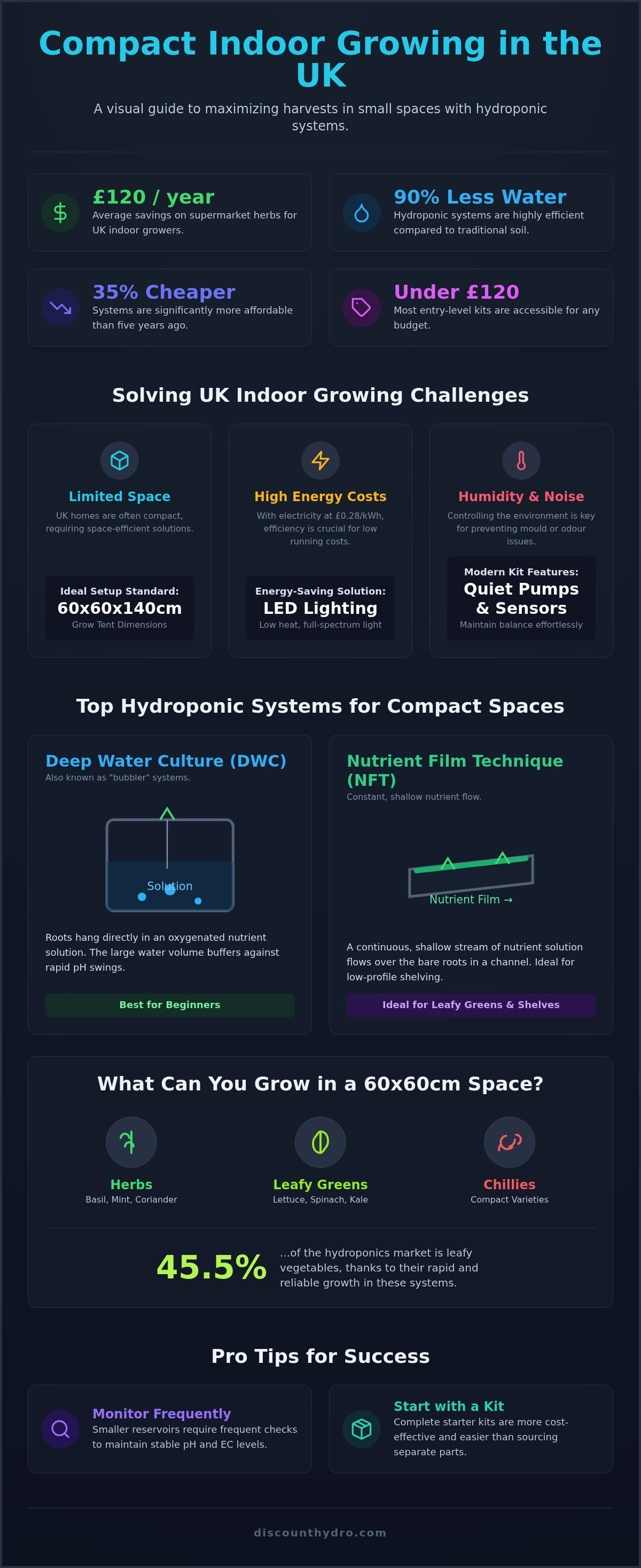
Recent data shows that UK indoor growers save an average of £120 per year on supermarket herbs. It's a proven way to cut costs. Finding a reliable small hydroponic system uk is now easier and 35% more affordable than five years ago. You don't need a massive spare room or a commercial budget to start. Most entry-level kits are now operational for under £120, making fresh produce accessible for any flat.
Space is tight in most UK homes. High electricity costs of £0.28 per kWh make efficiency a priority. You want a neat garden without the humidity or noise issues common in older setups. This guide shows you how to maximise indoor harvests with compact systems built for modern apartments. We'll cover energy-saving LED lights, low-cost nutrients, and space-saving grow tents. You'll get a productive indoor garden that lowers your grocery bills and stays easy to maintain. Expect a clear breakdown of the best value kits and technical tips to keep your setup running for pennies a day.
Key Takeaways
- Learn how DWC and NFT systems provide the highest efficiency for a small hydroponic system uk in restricted living spaces.
- Discover why the 60x60x140cm grow tent dimensions are the ideal standard for compact UK indoor gardening setups.
- Master the basics of LED light selection and airflow management to keep small-scale systems productive and energy-efficient.
- Understand why smaller nutrient reservoirs require more frequent monitoring to maintain stable pH and EC levels.
- See how complete starter kits and bundles offer a more cost-effective entry point than sourcing separate components.
Why Small Hydroponic Systems are Perfect for UK Indoor Gardening
Urban gardening is booming across the UK as more people move into apartments with limited outdoor space. The shift to soil-free growing isn't just a trend; it's a practical response to modern living. A small hydroponic system uk allows you to grow fresh produce in a kitchen corner or a spare cupboard without the mess of traditional soil. You get year-round harvests regardless of the British weather. Outside, it's raining and grey; inside, your plants thrive under controlled conditions.
For those new to the method, a comprehensive overview of hydroponics explains how these systems deliver nutrients directly to the roots. This direct delivery results in significantly faster growth rates than soil-based pots. Hydroponic systems also use up to 90% less water. This efficiency is vital for UK households looking to reduce waste and lower their environmental footprint while maintaining a productive indoor garden.
Overcoming the Challenges of UK Indoor Growing
Managing light levels during dark UK winters is the biggest hurdle for indoor growers. High-efficiency LED grow lights solve this by providing the full spectrum of light plants need without the massive heat output of older technology. With UK electricity tariffs at £0.28 per kWh in 2026, energy efficiency is paramount. Small systems are cheaper to run because they require lower wattage lights and smaller fans. Using a small hydroponic system uk ensures your utility bills stay manageable while your plants stay healthy.
Controlling humidity is another factor in well-insulated UK homes. Small-scale setups are easier to manage than large commercial tents. You can maintain the right balance to prevent mould or odour issues in your living space. Modern kits often include integrated sensors to monitor these levels in real-time, allowing for quick adjustments to your ventilation setup.
What Can You Grow in a Compact Setup?
You don't need a large footprint to get impressive yields. A 60cm x 60cm grow area is the standard for most UK apartments. This space is perfect for high-value crops that are expensive at the supermarket. Leafy vegetables accounted for 45.5% of the hydroponics market share in 2025 because they grow so quickly and reliably.
- Herbs: Basil, mint, and coriander grow rapidly in small reservoirs.
- Leafy greens: Lettuce, spinach, and kale provide consistent weekly harvests.
- Chillies: Compact varieties thrive in the warm, controlled environment of an indoor kit.
In a 60cm x 60cm area, you can expect enough salad greens to support a small household. As you gain experience, it's easy to scale your grow by adding more modules or upgrading your nutrients to boost specific plant traits. Starting small allows you to master the basics without a massive upfront investment.
Essential Small Hydroponic System Types for Limited Spaces
Selecting the right small hydroponic system uk requires balancing your harvest goals with the actual footprint of your home. Most UK apartments don't have room for sprawling setups, so compact designs focus on verticality or low-profile reservoirs. Four main system types dominate the market in 2026, each offering specific benefits for the urban grower.
- Deep Water Culture (DWC): Often called "bubbler" systems. Roots hang directly in a nutrient-rich solution oxygenated by an air pump. It's the most straightforward method for beginners.
- Nutrient Film Technique (NFT): A constant, shallow stream of nutrients flows over the roots. These systems are low-profile and perfect for leafy greens on narrow shelves.
- Ebb and Flow: Also known as flood and drain. This method periodically floods a growing tray with nutrients before draining it back into a reservoir. It's highly versatile for multiple small plants in pots.
- Drip Systems: These use a pump to deliver nutrients directly to the base of each plant. They work best with growing media like coco coir or clay pebbles.
For a technical breakdown of how these components interact, this Small-scale hydroponics guide provides a solid foundation for home growers. Understanding these mechanics helps you avoid costly mistakes when selecting your first kit.
DWC vs NFT: Which is Best for Your First Kit?
DWC systems generally require less daily monitoring than NFT setups. In a DWC bucket, the large volume of water buffers against rapid pH swings. Noise is a critical factor for bedroom or lounge grows. Air pumps used in DWC can produce a constant hum. NFT systems use water pumps that are often quieter but require more frequent cleaning to prevent root clogs in the narrow channels. For the highest oxygenation levels and root health in compact reservoirs, DWC remains the top choice for most entry-level growers.
Passive vs Active Systems for Micro-Grows
Passive systems like the Kratky method or wicking systems require no electricity. They're the ultimate "set and forget" choice for a kitchen windowsill. The Kratky method involves suspending plants over a stagnant nutrient solution that slowly drops as the plant grows. While simple, these lack the rapid growth rates of active, pump-driven systems. You should upgrade to an active small hydroponic system uk when you want to maximise yields in a 60cm area. Active systems circulate nutrients and oxygen, leading to 20% to 30% faster harvests compared to passive methods. Check our latest stock of Pots, Trays, and Systems to find the right configuration for your micro-grow.
Choosing Between Compact Grow Tents and Desktop Systems
Deciding where to house your small hydroponic system uk depends on whether you value discretion or display. Most UK renters and homeowners face a choice: a dedicated grow tent or a standalone desktop unit. While both options facilitate soil-free growth, they serve different goals. Desktop units are designed for aesthetic appeal on kitchen counters. Grow tents are built for maximum yield and total environment control.
The 60x60x140cm grow tent has become the "Secret Garden" standard for UK micro-growing. Its footprint is small enough to fit into a corner but tall enough to support mature plants. These tents use high-quality reflective sheeting, usually Mylar, to bounce light back onto the foliage. This ensures no photons are wasted, which is vital for keeping energy costs low. Tents also provide a complete seal against light leakage and odour, two major concerns in small apartments or shared housing.
Desktop hydroponic units offer a plug-and-play experience. They often feature integrated LEDs and automated timers. However, they lack the flexibility of a tent setup. Most desktop systems have a fixed light height, limiting you to short herbs or microgreens. If your plants grow too tall, they risk light burn. For serious hobbyists, the ability to adjust the height of separate LED Grow Lights in a tent is a significant advantage for long-term plant health.
The 60cm Grow Tent: The Ideal UK Entry Point
A 60cm tent is specifically sized to fit into standard UK wardrobes or alcoves. This allows you to maintain a productive garden without sacrificing visible floor space. To keep the environment healthy, you'll need an extraction fan and a carbon filter. This setup removes heat from the LED lights and scrubs the air of any plant odours before it leaves the tent. For a deeper look at specific dimensions and features, see our guide on Choosing a Grow Tent: A Complete Buyer's Guide.
Standalone Kits: Plug-and-Play Gardening
Standalone kits are attractive because they remove the technical guesswork. You get the reservoir, lights, and pump in one box. While convenient, these branded units are often more expensive than building a DIY bundle. A custom kit consisting of a small tent, a dedicated LED light, and a DWC bucket usually provides better performance when using a small hydroponic system uk in a restricted space. DIY setups also allow you to replace individual components if they fail, whereas all-in-one units often require a full replacement if the integrated light stops working.
Setting Up Your Small Hydro System: Lighting, Nutrients, and Airflow
Precision is the key to success when managing a small hydroponic system uk. In a compact environment, small errors are magnified. A reservoir holding only 10 or 20 litres of water can change its chemical balance in hours. To keep costs low and yields high, you must balance light output, nutrient concentration, and air circulation. Small-scale systems require a more hands-on approach to monitoring than larger setups where water volume acts as a buffer.
The "Big Two" of hydroponic success are pH and EC (electrical conductivity) levels. pH determines how well your plants can absorb nutrients. EC measures the strength of your nutrient solution. In a small tank, these levels fluctuate as plants drink. Checking these daily is the only way to prevent nutrient lockout or root burn. Stagnant air is another risk in tight growing spaces. Without proper movement, humidity builds up around the leaves, leading to mould. A small clip-on fan is an essential, low-cost addition to prevent these micro-climates from forming.
LED Lighting for Small Spaces
Heat is the enemy of small-space gardening. Traditional HPS lights are too hot for a 60cm tent and will cook your plants. High-efficiency LEDs are the only viable choice in 2026. Full-spectrum white LEDs have replaced older "blurple" lights because they provide a more natural light curve and better penetration through the canopy. For a 60cm x 60cm area, a 100W to 200W LED is sufficient. Running a 200W LED for 18 hours a day costs approximately £1.01 daily at the current UK tariff of £0.28 per kWh. Learn more about choosing the right fixture in our LED Grow Lights: The Ultimate 2026 Buyer's Guide.
Feeding Your Plants in a Mini Reservoir
Small reservoirs are prone to "nutrient swing." As plants drink water, the concentration of the remaining nutrients rises. This can quickly lead to toxic levels. Using high-quality UK brands like Intense Nutrients ensures your plants get a stable, balanced diet formulated for local water conditions. Most UK tap water is slightly alkaline, so you'll likely need a "pH Down" solution to keep your reservoir between 5.8 and 6.2. Detailed feeding strategies for different growth stages are available in our Hydroponic Nutrients: A Beginner's Guide.
Ongoing monthly expenses for electricity and nutrients for a standard small setup are estimated to be between £7 and £12. This makes it one of the most cost-effective ways to secure a fresh food supply. For the best value on essential hardware, browse our full range of LED Grow Lights today.
Get Growing with Discount Hydro’s Affordable Small Space Kits
Building a small hydroponic system uk from scratch can be time-consuming and often more expensive than necessary. Buying a complete starter kit removes the technical guesswork. You get every component designed to work together from day one. Discount Hydro specializes in these affordable entry-level bundles. We ensure that the LED lights, nutrients, and pots are perfectly matched for small-scale efficiency. This approach eliminates the risk of buying incompatible parts that don't fit in a 60cm tent.
Buying a bundle saves significant money compared to purchasing individual components. Our price structure is built for the budget-conscious grower who wants professional results. We stock quality brands like Intense Nutrients at competitive rates to keep your ongoing costs low. Every order is shipped with discreet packaging to protect your privacy. We offer fast nationwide delivery across the UK. This ensures your gear arrives ready for immediate setup without the delays common with international shipping.
Expert Advice and Local Support
Buying from a UK-based specialist shop provides a level of support you won't find on massive international marketplaces. We understand the local growing conditions and the specific requirements of UK indoor gardeners. If you're located near County Durham, our click-and-collect service allows for even faster access to your equipment. You can pick up bulky items like grow tents or heavy nutrient bottles at your convenience. Our team is focused on helping you troubleshoot your first grow to ensure you get the best return on your investment. We prioritize pragmatic, direct communication to get your system running at peak performance.
Start Your Indoor Garden Today
Starting your indoor garden requires a few essential items. Your shopping list should include a compact grow tent, a full-spectrum LED light, a hydroponic system like DWC or NFT, and a starter pack of nutrients. We provide all these in one transactional flow to get you growing faster. A small hydroponic system uk is the most efficient way to secure a fresh food supply in a limited space. For a foundational look at how these systems function without soil, read our article What is Hydroponics? A Beginner's Guide. Browse our full range of pots, trays, and systems to find the perfect fit for your home and start saving on your grocery bills today.
Secure Your Indoor Harvest with Compact Hydroponics
Maximising your indoor space with a small hydroponic system uk is the most efficient way to ensure a year-round supply of fresh produce. You've seen how a 60cm setup fits into almost any UK home while keeping electricity costs manageable. Success depends on selecting the right system type, like DWC for beginners, and maintaining precise control over your nutrients and airflow. By choosing a complete starter kit, you avoid the high costs and technical errors of sourcing parts individually.
Discount Hydro provides everything needed to launch your soil-free garden. We offer competitive prices on top brands and specialized LED lighting designed for compact spaces. You can benefit from our UK nationwide delivery or use our click-and-collect service in County Durham for even faster access to your equipment. Our focus is on providing reliable hardware that delivers results without unnecessary complexity.
Shop our range of compact hydroponic systems and starter kits today and take control of your indoor harvests. It's time to turn that spare corner into a productive, high-yield garden.
Frequently Asked Questions
What is the easiest small hydroponic system for a beginner in the UK?
Deep Water Culture (DWC) is the most straightforward method for new growers. It requires minimal equipment, usually just a bucket, an air pump, and a net pot. You don't have to manage complex plumbing or timing cycles. It's a reliable way to start a small hydroponic system uk without getting lost in technical jargon.
How much space do I really need for a hydroponic setup?
You only need a 60cm x 60cm floor area for a standard compact setup. This small footprint fits into most UK alcoves, cupboards, or wardrobes. A vertical height of 140cm is ideal to allow for light clearance and healthy plant growth. Smaller desktop units can even sit directly on a kitchen counter if you only want to grow herbs.
Are small hydroponic systems expensive to run in terms of electricity?
Running costs are very low when using modern LED grow lights. At the 2026 projected tariff of £0.28 per kWh, a 200W LED light costs roughly £1.01 per day for an 18-hour cycle. Total monthly expenses for a 1-metre setup usually range between £7 and £12. This estimate covers both electricity and the necessary nutrients.
Do I need a grow tent for a small hydroponic system?
A grow tent is highly recommended for total environmental control. It uses reflective lining to bounce light back onto your plants and contains humidity. While you can grow in an open room, a tent makes it much easier to manage odours and prevents bright light from leaking into your living area at night.
How often do I need to change the water in a small reservoir?
You should change the nutrient solution every one to two weeks. Small reservoirs under 20 litres are prone to rapid nutrient imbalances as plants drink. Regular full changes prevent the pH swings and salt buildup that can damage your crop's root systems in a restricted environment.
Can I grow vegetables in a small hydroponic system all year round?
Yes, you can harvest fresh produce 365 days a year regardless of the British weather. High-efficiency LED lights provide the full spectrum of light needed to replace sunlight during dark UK winters. This setup allows for consistent growth of herbs, chillies, and leafy greens in any season.
What are the best nutrients for a compact indoor system?
High-quality UK brands like Intense Nutrients are ideal because they're formulated for local water conditions. These nutrients are stable and concentrated, which is vital for maintaining balance in small tanks. Always use a pH testing kit to ensure your solution stays between 5.8 and 6.2 for maximum absorption.
Will a small hydroponic system make my room smell?
Any indoor garden creates some odour, but it's easily managed with the right hardware. Using a carbon filter paired with an extraction fan scrubs the air of all scents before it leaves your grow area. This is the most effective way to keep a small hydroponic system uk discreet in a flat or shared house.