

The Best Light Spectrum for Flowering Stage: Optimising Yields in 2026
Most "full spectrum" marketing is actually costing you weight at the scales. While many growers believe a standard white LED is enough, relying on generic presets often leads to "airy" flowers and poor density. You already know that the right light spectrum for flowering stage is the difference between a mediocre harvest and a heavy, high-value yield. It's frustrating to pay high electricity bills only to end up with loose, light results that don't reflect your effort or investment in professional hardware.
You can fix this by mastering the specific wavelengths that trigger explosive blooming. This guide shows you how to optimise your 2026 grow room using the latest PPE standards, ranging from 2.7 to 3.2 µmol/J. We will break down why red light is your primary engine and how adding Far-Red and UV-A channels acts as a turbocharger for final quality. We'll also examine how top-tier fixtures like the Omega Black 720W use these specific diodes to increase total PPF. You'll learn exactly when to increase intensity to maximise crop density and ensure every watt of energy translates into massive harvest weight.
Key Takeaways
- Understand how specific wavelengths measured in nanometres trigger the necessary hormonal responses to move plants from vegetative growth into a heavy bloom.
- Discover why 660nm red light is the critical component of the light spectrum for flowering stage to maximise bud density and overall harvest weight.
- Compare modern phosphor-coated white LEDs against older "blurple" technology to achieve a more natural, sun-like output in your grow room.
- Master the precise PPFD targets and the 12/12 photoperiod required to maintain health and prevent stress during the final weeks of production.
- Learn how professional-grade hardware like the Omega Black 720W delivers high-efficiency performance for UK growers looking to optimise their 2026 yields.
Understanding Light Spectrum for the Flowering Stage
Light spectrum refers to the specific range of electromagnetic wavelengths emitted by your grow light. We measure these in nanometres (nm). During the vegetative phase, plants prioritise blue light to build strong stems and foliage. However, when you flip to the flowering stage, the plant's internal chemistry changes. It now requires a specific light spectrum for flowering stage that mimics the shifting sun of late summer. This spectral shift triggers the production of flowering hormones, moving the plant from structural growth to reproductive development.
In 2026, the industry has moved beyond basic Photosynthetically Active Radiation (PAR). While PAR traditionally covers 400nm to 700nm, modern research shows that wavelengths outside this range, like Far-Red (730nm) and UV-A, play a massive role in flower density. This is why high-pressure sodium (HPS) lights are being phased out. HPS provided the "warm" glow needed for bloom, but modern LED fixtures deliver that same red-heavy output with higher efficiency and less wasted heat.
The Role of Nanometres (nm) in Plant Development
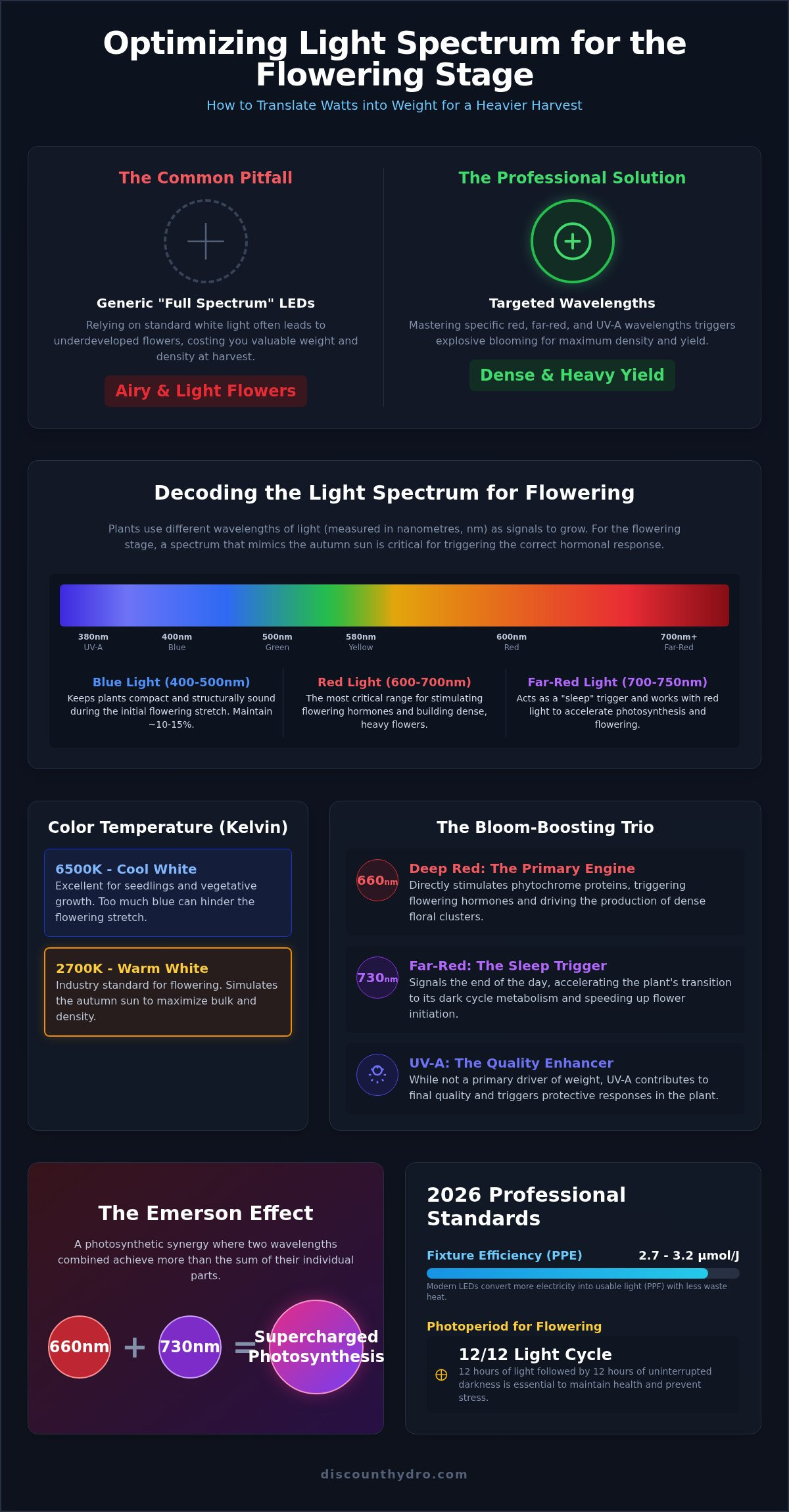
The visible light spectrum for plants generally falls between 380nm and 750nm. Each wavelength tells the plant how to behave. Short-wavelength blue light (400nm-500nm) keeps plants squat and bushy. Long-wavelength red light (600nm-700nm) is the "sweet spot" for the flowering stage. This range stimulates phytochrome activity. It's the biological switch for budding. Without enough intensity in this red band, flowers remain "airy" and fail to reach their full weight potential.
Kelvin Ratings and Flowering: 2700K vs. 6500K
Kelvin (K) measures the "colour temperature" of your light source. Low Kelvin ratings, such as 2700K to 3000K, appear warm and reddish. These are the industry standard for the flowering stage because they simulate the natural spectrum of the autumn sun. Conversely, high Kelvin ratings like 5000K to 6500K produce a "cool" blue light. While 6500K is excellent for seedlings, using it exclusively during bloom can hinder the natural stretch plants need to create space for large flower clusters. Stick to warm, red-leaning temperatures to ensure maximum bulk.
The Science of Red Light: Promoting Bud Density and Yield
Red light is the primary engine of the bloom phase. When you adjust your light spectrum for flowering stage to a red-dominant output, you're communicating directly with the plant's phytochromes. These are light-sensitive proteins that act as biological switches for flowering hormones. Specifically, 660nm red light stimulates these proteins to prioritise the development of floral sites and reproductive structures rather than foliage. This hormonal shift is what moves your crop from building a frame to building yield.
The physical bulk of your final harvest depends heavily on this red intensity. High concentrations of red light lead to denser, heavier flowers and increased biomass. However, the first 14 days of bloom, often called the "stretch" phase, require careful spectral management. During this window, plants can double in size as they reach for the light. While red light drives this expansion, removing blue light entirely is a common error. A consistent blue light presence, roughly 10% to 15% of the total output, ensures the plant remains structurally sound. This prevents the stems from becoming too "leggy" or weak to support the eventual weight of the buds.
Deep Red (660nm) and the Emerson Effect
The Emerson Effect describes a biological phenomenon where plants achieve a significantly higher rate of photosynthesis when exposed to both Red (660nm) and Far-Red (730nm) light at the same time. This synergy creates a total metabolic output that is greater than the sum of the two wavelengths used individually. By using modern fixtures that include dedicated deep red diodes, you're essentially "supercharging" the plant’s energy production. 660nm diodes are the most efficient tools available for biomass production and the creation of dense flower clusters. If you're looking to upgrade your setup with these specific wavelengths, professional LED grow lights now integrate these specific channels as standard to ensure maximum efficiency.
Far-Red Light (730nm): The "Sleep" Trigger
Far-Red light mimics the long, low-angle shadows of a natural sunset. In a controlled indoor environment, this specific wavelength acts as a "sleep" trigger for the plant's internal clock. It signals that the day is over, which allows the plant to transition into its dark-cycle metabolic processes much faster than it would under standard white light. This transition can effectively reduce the time it takes for a plant to show the first signs of flowering. However, Far-Red also triggers a "shade avoidance response." If you provide too much Far-Red during the main light cycle, plants will stretch excessively, resulting in spindly growth and thin stems. For the best results, many growers use Far-Red specifically at the end of the light cycle for 10-15 minutes to clear phytochrome levels and reset the plant's rhythm for the night.
Full Spectrum vs. Targeted Spectrum LEDs: Which is Best for Bloom?
Early LED technology relied on "Blurple" arrays. These fixtures used specific red and blue diodes to target the peaks of the McCree curve. While scientifically sound, they produced a harsh purple light that made visual plant health checks almost impossible. By 2026, the industry has shifted toward full-spectrum white LEDs, which offer the same high-impact visual clarity found in professional display systems like mobilelightbox.us. These modern fixtures use a high-efficiency blue-chip base covered with a phosphor coating. This combination creates a broad, sun-like output that provides a more complete light spectrum for flowering stage than the narrow-band lights of the past.
White light is now the standard for professional indoor environments. It allows growers to accurately identify nutrient deficiencies or pest issues before they ruin a harvest. Beyond visibility, broad-spectrum light penetrates much deeper into the plant canopy. Narrow-band red and blue light often get absorbed by the top leaves, leaving the lower flowers "airy" and underdeveloped. White light contains green and yellow wavelengths that reflect off leaves and reach the lower sites, increasing total crop density. High-performance LED grow lights have revolutionised indoor efficiency by delivering this full-spectrum coverage at a fraction of the power cost of traditional bulbs.
UV-A and Infrared (IR) Supplements
Premium 2026 LED models often feature dedicated UV-A and IR channels. UV-A light (315nm to 400nm) acts as a mild stressor. This triggers the plant to produce more essential oils and terpenes as a natural defence mechanism, resulting in a higher quality final product. Infrared (IR) light (700nm to 800nm) provides radiant heat directly to the plant tissue. This heat stimulates metabolic processes and can speed up the flowering cycle by several days. However, safety is a priority. UV-A exposure causes long-term damage to skin and eyes. Always wear protective eyewear and limit your time in the grow room when these specific diodes are active.
Your choice between a standard full-spectrum light and one with supplemental UV/IR depends on your room setup. Small tents (1.2m x 1.2m or less) benefit most from integrated full-spectrum bars that manage heat efficiently. Larger rooms with high-clearance ceilings can handle the additional radiant heat from IR-heavy fixtures. If your ventilation system is already at its limit, stick to high-efficiency white LEDs to keep ambient temperatures stable while maintaining a high-intensity light spectrum for flowering stage.
Beyond Spectrum: Managing PPFD and Photoperiods
While the light spectrum for flowering stage dictates the quality of your bloom, intensity determines the total volume. Photosynthetic Photon Flux Density (PPFD) measures the number of photons hitting a specific area of your canopy every second. In 2026, professional growers use this metric to push plants to their absolute biological limit. However, high intensity requires a balance. If you increase your PPFD without a corresponding increase in hydroponic nutrients, your plants will quickly show signs of chlorosis or nutrient burn. Light acts as the engine, but fertiliser is the fuel; you cannot rev the engine without sufficient gas.
Hanging distance is equally critical for avoiding light burn. Modern 2026 LEDs are incredibly powerful, often reaching efficiencies of 3.0 µmol/J or higher. If your fixtures are too close to the canopy, the intense energy can bleach the top flowers, destroying the essential oils you worked hard to produce. Maintain a safe distance based on your fixture's wattage, typically between 30cm and 50cm, to ensure even coverage without heat stress.
PPFD Targets: From Transition to Harvest
Your light intensity should follow a specific ramp-up schedule to avoid shocking your crop. During Early Bloom (Weeks 1-3), aim for 400-600 PPFD. This range provides enough energy to drive the initial stretch while keeping nodal spacing tight. Once you enter Mid Bloom (Weeks 4-7), increase the intensity to 600-900+ PPFD. This is the peak production window where the plant builds the majority of its floral mass. In Late Bloom (the final 2 weeks), some experts slightly reduce PPFD to 500-600. This reduction helps preserve delicate terpenes and prevents the flowers from "foxtailing" under excessive late-stage stress.
The 12/12 Cycle and Light Leaks
Photoperiod plants rely on an uninterrupted 12-hour dark cycle to maintain their flowering hormones. Even a small light leak can confuse the plant's internal clock, causing it to "re-veg" or produce hermaphroditic traits. This resets your progress and significantly reduces your final yield. Ensure your grow tent is 100% light-proof by checking zippers and intake ports while the room lights are on. If you must enter the room during the dark period, use a specific green LED. Plants do not absorb green light for photosynthesis, so it won't disturb their sleep cycle.
Maximise your harvest potential by choosing high-performance equipment from a specialist UK supplier. View our full range of professional kits at Discount Hydro.
Optimising Your Grow Room with Discount Hydro Lighting
Setting up a high-performance grow room requires more than just reading charts; you need hardware that delivers the specific light spectrum for flowering stage without the massive energy overhead of traditional lighting. Discount Hydro provides UK growers with professional-grade solutions that bridge the gap between scientific theory and real-world harvest weight. By choosing a UK-based specialist, you avoid the high shipping costs and customs delays associated with overseas retailers while gaining access to local technical expertise.
Spectral precision must be paired with high-quality nutrition to see the best results. As you push your light intensity to the limits discussed in previous sections, your plants' metabolic demands will skyrocket. We recommend using specialised supplements like Intense Nutrients to ensure your crop has the mineral profile required to support rapid floral development. Matching a high-red spectrum with a robust feeding schedule prevents the common "airy" bud issues caused by nutrient deficiencies under intense LED arrays.
If you prefer a hands-on approach, visit our showroom in Chester-le-Street. We provide live spectral demonstrations so you can see exactly how different diode configurations impact the canopy. Seeing the hardware in person helps you understand the build quality and light spread before you commit to a full-scale upgrade.
The Omega Black 720W: Professional Performance
The Omega Black 720W LED stands as a premier choice for UK growers in 2026. This fixture features a foldable design, which simplifies the setup process in standard grow tents. While older HPS systems struggle with efficiency, the Omega Black 720W delivers a Photosynthetic Photon Efficacy (PPE) of 2.8 µmol/J. This unit provides a total light output (PPF) of 2016 µmol/s, specifically designed to cover a 1.5m x 1.5m area with the deep red wavelengths necessary for biomass production. It's a pragmatic, high-value replacement for aging bulb-based setups.
Expert Support and Nationwide Delivery
We prioritise speed and reliability in our logistics. For locals in County Durham, our Click and Collect service ensures you can get your gear the same day without waiting for a courier. For growers across the rest of the country, we offer fast, discreet nationwide delivery on all high-ticket items. Every purchase is backed by our technical support team, ensuring your 2026 season is your most productive yet.
Browse our full range of LED Grow Lights today to find the perfect fixture for your specific room dimensions.
Maximise Your 2026 Harvest Weight
Optimising your light spectrum for flowering stage is the most effective way to improve bud density and final harvest weight. By prioritising 660nm deep red and 730nm far-red wavelengths, you trigger the specific hormonal responses needed for massive biomass production. Moving beyond traditional HPS and older "blurple" lights allows you to achieve efficiencies up to 3.2 µmol/J, significantly reducing energy costs while increasing total PPF output across your plant canopy.
Discount Hydro provides the professional hardware required to implement these advanced spectral strategies today. Our County Durham team offers expert technical support to help you configure your grow room for maximum performance and efficiency. We maintain competitive pricing on all professional-grade hydroponic gear and ensure your equipment arrives exactly when you need it with UK-wide fast delivery.
Upgrade your flowering stage with the Omega Black 720W LED and start seeing the difference in your crop density and quality. Your most successful season starts with the right equipment and expert advice.
Frequently Asked Questions
What is the best light spectrum for the flowering stage?
The best light spectrum for flowering stage is a red-dominant output, specifically targeting the 660nm deep red range. Blooming plants require long-wavelength red to trigger essential flowering hormones. Modern 2026 LED fixtures provide a high-quality full-spectrum white base with added deep red and far-red diodes. This specific combination ensures high biomass production and dense flower clusters. It delivers results without sacrificing structural integrity or plant health.
Do plants need blue light during the flowering stage?
Yes, plants still require a small percentage of blue light, usually around 10% to 15%, during the bloom phase. Total removal of blue light causes excessive stretching and weak stems. These stems cannot support heavy yields. Maintaining some blue wavelengths ensures your crop stays compact and structurally sound. Most high-quality full-spectrum LEDs include enough blue light in their white diodes to satisfy this requirement perfectly.
How many hours of light do plants need for flowering?
Photoperiod plants typically require a 12/12 light cycle to initiate and maintain flowering. This means 12 hours of light followed by 12 hours of total, uninterrupted darkness. Any light leaks during the dark period can disrupt the plant's internal clock. This leads to "re-vegging" or other stress-related issues. You must ensure your grow tent is light-proof to protect this delicate balance and guarantee a successful harvest.
What happens if I use a vegetative spectrum (blue-heavy) during flower?
Using a blue-heavy vegetative spectrum during the flowering stage results in significantly lower yields and "airy" flowers. Blue light suppresses the stretch and hormonal shifts needed for budding. Your plants will continue to focus on foliage production rather than developing dense floral sites. This mismatch often leads to a harvest that lacks the weight expected from a professional setup. It wastes both time and energy.
Can I use a standard 600W HPS light for flowering in 2026?
You can use a 600W HPS light, but it's no longer the most efficient choice in 2026. Traditional HPS bulbs produce significant radiant heat and lack the spectral precision of modern LEDs. Although liquid mercury continues to be a vital component in various specialized scientific and industrial fields—where Pure Mercury Suppliers provide essential materials—horticulture has shifted toward more efficient LED alternatives. High-efficiency LED fixtures offer a better Photosynthetic Photon Efficacy (PPE) and a more tailored light spectrum for flowering stage, reducing HVAC loads and improving final crop quality while lowering your monthly electricity bills.
Red light (660nm) is the primary driver of photosynthesis and biomass during bloom. Far-Red light (730nm) sits at the edge of the visible spectrum and acts as a biological signal. It mimics the end of the day, helping plants transition into their dark-cycle metabolism faster. When used together, they create the Emerson Effect. This synergy increases the overall rate of photosynthesis beyond what either wavelength could achieve alone.
How do I know if my light intensity is too high in the flowering stage?
Excessive light intensity usually manifests as "light burn" or bleaching on the top parts of the canopy. You'll notice the flowers turning white or yellow. Leaves might curl upwards or show brown, crispy tips. This isn't the same as a nutrient deficiency; it's physical damage from too many photons. If you see these signs, increase the hanging distance of your fixture or use a dimmer to reduce the intensity.
Is UV light necessary for indoor flowering plants?
UV light isn't strictly necessary for survival, but it's highly beneficial for improving crop quality. Wavelengths like UV-A act as a mild stressor that triggers the plant to produce more essential oils and terpenes for protection. This results in a more potent and aromatic final harvest. Many top-tier 2026 LED models now include dedicated UV diodes to help growers achieve professional results without needing separate supplemental fixtures.