

Calculating ROI on Grow Room Setup: A Practical Guide for UK Growers
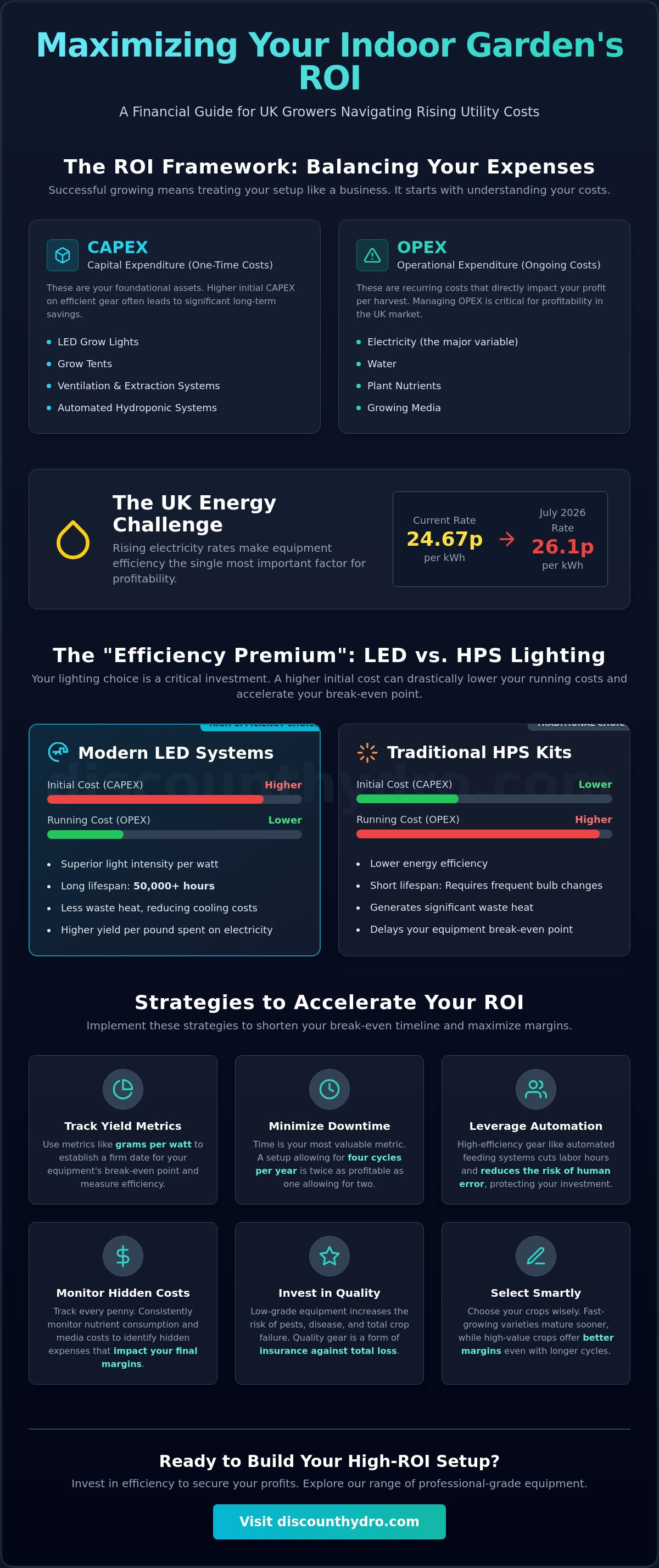
Is your indoor garden a profitable asset or an expensive drain on your resources? With UK electricity rates at 24.67p per kWh and rising to 26.1p in July 2026, the margin for error is gone. You know that high energy prices and rising water costs are cutting into your bottom line. Calculating roi on grow room setup isn't just a choice; it's a necessity for any serious grower. You need to know exactly when those LED grow lights pay for themselves and how much your plant nutrients are really costing per harvest.
We understand the frustration of uncertain yield projections and hidden media costs. This guide delivers a direct, repeatable formula to understand your break-even timeline and maximize your margins. We'll show you how to analyze equipment efficiency against current UK utility rates to ensure every pound spent drives a return. Get the facts on LED performance and start treating your setup like the business it is. We're stripping away the confusion to focus on the numbers that matter for your success.
Key Takeaways
- Break down your initial investment and monthly running costs to build a clear timeline for profit.
- Master the process of calculating roi on grow room setup by comparing energy-efficient LEDs against traditional lighting options.
- Track nutrient consumption and media costs to identify hidden expenses that impact your final margins.
- Use yield metrics like grams per watt to establish a firm date for your equipment's break-even point.
- Explore how automation and high-efficiency gear can cut labor hours and reduce your operational overhead.
Understanding the ROI Framework for Indoor Gardening
Return on Investment (ROI) is a cold calculation. It is the ratio between your total costs and the market value of your harvest. In the field of Controlled-environment agriculture (CEA), efficiency is the only metric that matters. Account for every penny. Calculating roi on grow room setup requires looking past the initial price tag. You are balancing what you pay now against what you save later. For personal growers, ROI is often savings-based. This means comparing the cost of your home-grown produce against retail prices. If you spend £500 to grow produce that would cost £1,000 in a shop, your ROI is 100%. High UK energy prices make these calculations vital for survival.
CAPEX vs. OPEX: Categorising Your Expenses
Successful budgeting splits costs into two piles. CAPEX refers to your initial capital expenditure. This includes Grow Tents, LED Grow Lights, and extraction systems. These are assets. They lose value over time but produce value every day. OPEX refers to ongoing operational expenses. Think electricity, water, Plant Nutrients, and Growing Media. UK energy prices are currently a major OPEX variable. High-efficiency gear often has a higher CAPEX but keeps OPEX low. Always amortise your equipment. Don't expect one harvest to pay for a professional-grade LED system. Spread that cost over the expected 50,000 hour lifespan of the diodes to see the true cost per gram.
Why Time is Your Most Valuable Metric
Don't just calculate ROI per cycle. Look at your annualised returns. A setup that allows for four cycles per year is twice as profitable as one that only allows for two. Crop selection dictates your timeline. Fast-growing varieties reach the harvest stage sooner. High-value crops offer better margins even if they take longer to mature. Downtime is a profit killer. Every week your grow room sits empty, your potential ROI drops. Efficiency isn't just about power; it's about keeping your system running. Minimise the gap between harvest and the next propagation phase to keep your margins high. Consistency leads to a faster break-even point.
Calculating Your Initial Investment (CAPEX)
Your initial capital outlay sets the foundation for your profit timeline. Choosing the right Grow Tents is the first critical decision. Large tents offer more yield potential but demand higher energy for heating during cold UK winters. Smaller setups are cheaper to buy and run but limit your total production capacity. Balancing tent size with your ability to maintain temperatures is a core part of calculating roi on grow room setup. You must also account for the "cost of failure." Low-grade equipment increases the risk of pests and disease. A single crop failure can wipe out your entire investment, making quality gear a form of insurance against total loss.
The "Efficiency Premium" in Lighting
Modern LED Grow Lights carry an "efficiency premium." While the CAPEX is higher than traditional HPS kits, the long-term savings are undeniable. HPS lights produce massive amounts of waste heat and require bulb replacements every few cycles. This drives up your OPEX and delays your break-even point. High-quality LEDs offer superior light intensity per watt of power consumed. This results in more produce for every pound spent on electricity. You can find specific efficiency metrics and performance comparisons in the LED Grow Lights: The Ultimate 2026 Buyer’s Guide.
Environmental Control and Extraction
Ventilation and extraction are essential for crop protection and compliance. High-quality carbon filters ensure odour control, which is vital for maintaining a discreet setup. Effective fans and controllers manage airflow to prevent humidity spikes. Damp environments lead to mould, which is a leading cause of total crop loss. A UK government report on CEA profitability confirms that precise environmental control is fundamental to financial success. Integrating sensors to automate these systems saves significant labour time and reduces the risk of human error.
Your choice of Pots, Trays, and Systems dictates your daily workload. Manual watering systems are affordable but labour-intensive. Automated hydroponic systems require more capital initially but provide consistent feeding and faster growth rates. This automation reduces the "human error" factor that often leads to nutrient burn or underwatering. Don't neglect Propagation Supplies either. Reliable scalpels, rooting gels, and specialised lighting for early stages ensure a high success rate. Every failed clone or seedling represents wasted electricity and space. You must also factor in the cost of high-quality Growing Media. Choosing the right substrate ensures better oxygenation and drainage, which directly impacts your final yield. Starting with professional gear from trusted grow stores ensures your investment is protected from day one.
Estimating Operational Costs in the UK Market (OPEX)
Operating costs are the recurring drain on your margins. While CAPEX is a one-time hit, OPEX follows you every month. In the UK, electricity is the primary variable in calculating roi on grow room setup. You cannot ignore the impact of the UK Energy Price Cap. As of June 2026, the average rate is 24.67p per kWh, but this is confirmed to rise to 26.1p in July 2026. This makes energy efficiency the difference between profit and loss. A UK government report on CEA financial viability highlights that managing these recurring inputs is the only way to remain sustainable in a high-cost market.
The Electricity Equation: Watts to Pounds
To find your monthly cost, use this formula: (Wattage x Hours x Days) / 1000 x Rate per kWh. For example, running a 600W LED for 12 hours a day over 30 days at 24.67p costs roughly £53.29. If you use a traditional HPS, you must also factor in the cost of running extra extraction fans to move waste heat. Switching from an 18/6 vegetative cycle to a 12/12 flowering cycle reduces your lighting energy consumption by exactly 33%, immediately boosting your ROI on power expenditure. Track your meter readings weekly to avoid surprises when the bill arrives.
Nutrient Precision and Waste Reduction
Nutrient costs are often underestimated. Calculate your "cost per litre" of finished feed rather than just the bottle price. High-quality Plant Nutrients & Supplements from brands like Intense Nutrients or Dutch Pro are formulated for maximum uptake. This improves Photosynthetic Photon Efficacy (PPE) by ensuring the plant can actually use the light you're paying for. Cheap nutrients often lead to nutrient lockout, which stalls growth and kills your ROI through reduced yields. Follow a strict schedule to avoid waste. You can find more details on maximizing feed efficiency in our Hydroponic Nutrients: A Beginner’s Guide.
Don't forget the recurring cost of Growing Media. Soil is often the cheapest entry point but is difficult to reuse. Coco and perlite mixes offer better aeration and can sometimes be buffered for a second run, though most professional growers treat media as a single-use OPEX to prevent disease. Finally, budget for maintenance. You'll need pH meters, calibration fluids, and cleaning supplies to keep the system sterile. A dirty grow room leads to crop failure, and a failed crop has an ROI of zero. Consistency in maintenance protects your investment.
Projecting Yield and Calculating the Break-Even Point
Your yield is the primary driver of your return. To measure success, use Grams per Watt (GPW) and Grams per Square Metre (GPSM). GPW tells you how efficiently your LED Grow Lights convert electricity into biomass. GPSM measures how well you utilise the footprint of your Grow Tents. A GPW of 0.5 is a standard starting point for beginners, but experienced growers using high-efficiency systems often target 1.0 or higher. Accurate data is essential when calculating roi on grow room setup. Without these metrics, you're just guessing at your profitability.
Valuing your harvest requires a realistic benchmark. Don't use arbitrary numbers. Instead, use the retail price of high-quality organic produce from local UK shops as your value metric. If your setup produces 500g of produce that retails for £10 per 100g, your harvest value is £50. This creates a tangible financial figure to weigh against your costs. The core break-even formula is simple: (Initial Investment + Cycle Running Costs) / Value of Harvest. This tells you exactly how many cycles you need to complete before the equipment has paid for itself.
Accept that your first cycle is a training run. The "learning curve" means your initial ROI will likely be lower than subsequent runs. You're dialling in Plant Nutrients and environmental controls. As your skills improve, your GPW will rise, shortening the time to total profitability. Consistency is the key to moving past the break-even point and into pure margin.
Yield Optimisation Strategies
Maximise every watt by using plant training techniques. Topping and Screen of Green (SCROG) methods create a flat canopy. This ensures all parts of the plant receive equal light intensity from your LEDs, preventing wasted energy on lower, shaded growth. Environmental stability is just as important as light. Fluctuations in temperature or CO2 levels stall growth and reduce final weights. Also, consider the "opportunity cost." Every gram you grow yourself is a gram you don't have to buy at retail prices, which effectively adds to your total savings.
Risk Management: Protecting Your Investment
ROI can vanish overnight due to pests or equipment failure. A £20 bottle of preventative spray is a small price to pay to protect a harvest worth thousands. Pests can devastate a crop in days if left unchecked. Read our Spider Mites Guide to understand how to identify and prevent these yield killers. Invest in backup systems like spare pumps or basic power surge protectors. A small investment in redundancy prevents a total loss of your CAPEX and OPEX. To secure the best gear for your next cycle, buy professional grow equipment here.
Strategies to Accelerate Your Grow Room ROI
Maximising your margins requires aggressive cost management. Once you have mastered calculating roi on grow room setup, the next step is slashing your recurring expenses. Upgrading to high-efficiency LED Grow Lights is the fastest way to slash your OPEX. These systems reduce energy bills by up to 40% compared to traditional HPS setups. Because LEDs produce less waste heat, you also save money on cooling and extraction. This double saving shortens your break-even timeline significantly.
Automation is another critical lever for profitability. Automating your grow room reduces labour hours and eliminates the human error that leads to stunted growth or nutrient burn. Consistent environments produce consistent yields. Use Vapor Pressure Deficit (VPD) charts to refine your environment. Keeping your plants in the "growth zone" ensure they transpire efficiently, leading to the highest possible Grams per Watt (GPW) return. Every percentage increase in yield directly improves your bottom line without increasing your fixed costs.
Smart sourcing is vital for long-term sustainability. Buy in bulk whenever possible. Purchasing larger volumes of Plant Nutrients & Supplements or Growing Media reduces the unit cost per litre or per bag. Unit cost is the only metric that matters when buying consumables. Track your usage rates to ensure you never pay a premium for emergency last-minute supplies. Planning your purchases around your crop cycle prevents unnecessary spending.
The ROI of High-End Ventilation
High-end ventilation pays for itself through energy savings and crop protection. EC fans (Electronically Commutated) draw significantly less power than standard AC motors. They are also more precise, allowing you to dial in the exact airflow needed. Better airflow prevents mould and Bud Rot, which is the leading cause of total ROI loss in the UK. One lost harvest can set your break-even point back by six months. Check the Grow Tent Buyers Guide to find efficient extraction setups that protect your investment.
Smart Sourcing and Discount Hydro Value
Leverage the Discount Hydro model to lower your initial CAPEX. We focus on high-volume, low-price inventory to ensure you get professional-grade gear at warehouse prices. Use our click-and-collect service for heavy items like clay pebbles, soil, or large Pots, Trays, and Systems to eliminate shipping fees. Reducing your entry cost is the simplest way to accelerate your return. Browse our high-efficiency LED Grow Lights to start optimising your ROI today.
Maximise Your Margins and Shorten Your Payback Period
Profitability in the UK market depends on operational efficiency. You've learned that calculating roi on grow room setup requires a strict focus on energy-efficient LEDs and precise nutrient management. By switching to modern gear and tracking your Grams per Watt, you move from guesswork to guaranteed results. High-efficiency equipment reduces your break-even timeline and protects your bottom line against rising utility costs. Every watt saved is a direct boost to your final margin.
Access the best value gear to keep your margins high. We stock top brands like Omega and Intense Nutrients at competitive prices. Our County Durham hub provides specialist advice to ensure you choose the right setup for your specific space. With UK-wide fast delivery, you won't face expensive downtime between cycles. Don't let high overheads stall your progress or eat into your potential profits.
Optimise your grow room ROI with Discount Hydro’s high-efficiency LED range. Your next harvest is the perfect opportunity to increase your margins and see your equipment pay for itself faster. Start growing smarter today.
Frequently Asked Questions
How long does it typically take to see a return on a grow room setup?
Most growers achieve a full return on their investment within two to four successful harvest cycles. This timeline depends on your initial equipment quality and your ability to hit consistent yield targets. Using high-efficiency gear reduces monthly bills, which accelerates the break-even point. If your setup produces produce valued higher than your total investment and running costs, you reach profitability faster. Consistency is the main factor in shortening this window.
Are LED grow lights really worth the extra cost for ROI?
LED grow lights are essential for long-term profitability due to their superior energy efficiency. While the initial purchase price is higher than HPS, the operational savings are significant. LEDs use less electricity for the same light output and produce minimal waste heat, reducing the load on your extraction fans. You also avoid the recurring cost of replacing HPS bulbs every few months, making LEDs the better choice when calculating roi on grow room setup.
How much does it cost to run a 600W light in the UK per month?
Running a 600W light for 12 hours a day costs approximately £53.29 per month at the current average UK rate of 24.67p per kWh. This cost is confirmed to rise to roughly £56.38 in July 2026 when the electricity price cap increases to 26.1p. These figures only cover the light itself. You must also factor in the wattage of your extraction fans and circulation equipment to get a complete picture of your monthly energy spend.
Can I improve my ROI by using soil instead of hydroponics?
Hydroponic systems often deliver a better ROI despite higher initial costs because they provide faster growth rates and larger yields. Soil has a lower entry price but requires more manual labour and produces slower results. If your goal is to maximise the number of harvests per year, the increased speed of hydroponics typically outweighs the lower setup cost of soil-based growing. Speed and yield are the primary drivers of profit.
What is the most expensive part of running a grow room?
Electricity is the single most expensive ongoing cost for any UK indoor gardener and accounts for the majority of your OPEX. Lighting consumes the most power, followed by environmental control systems like fans and heaters. Reducing energy consumption through high-efficiency LEDs and smart controllers is the most effective way to protect your margins. Small savings in wattage add up to hundreds of pounds over several cycles.
Does a bigger grow tent always mean a better ROI?
A bigger grow tent does not guarantee a better return and can sometimes decrease efficiency. While it offers more space for produce, it also increases your costs for lighting, heating, and extraction. If you cannot fill the space with a healthy canopy, you are paying to light and heat empty air. ROI is highest when you match your tent size perfectly to your lighting capacity and your ability to manage the environment.
How do I calculate the market value of my indoor harvest?
Calculate harvest value by comparing your yield to local retail prices for premium organic produce. Weigh your final dried harvest in grams and multiply this by the price per gram found in high-end UK grocery stores. This provides a realistic financial benchmark rather than a guess. Using this method ensures you are calculating roi on grow room setup based on actual market data and verifiable retail numbers.
What are the hidden costs that most new growers forget to calculate?
New growers often forget to budget for maintenance items and consumables like pH calibration fluids, replacement carbon filters, and cleaning supplies. Water rates are also rising, with the national average increase expected to be close to 9% for the 2026/27 period. Small items like scalpels for propagation or cable ties for cable management seem minor but contribute to your total CAPEX. Account for every small purchase to avoid budget creep.